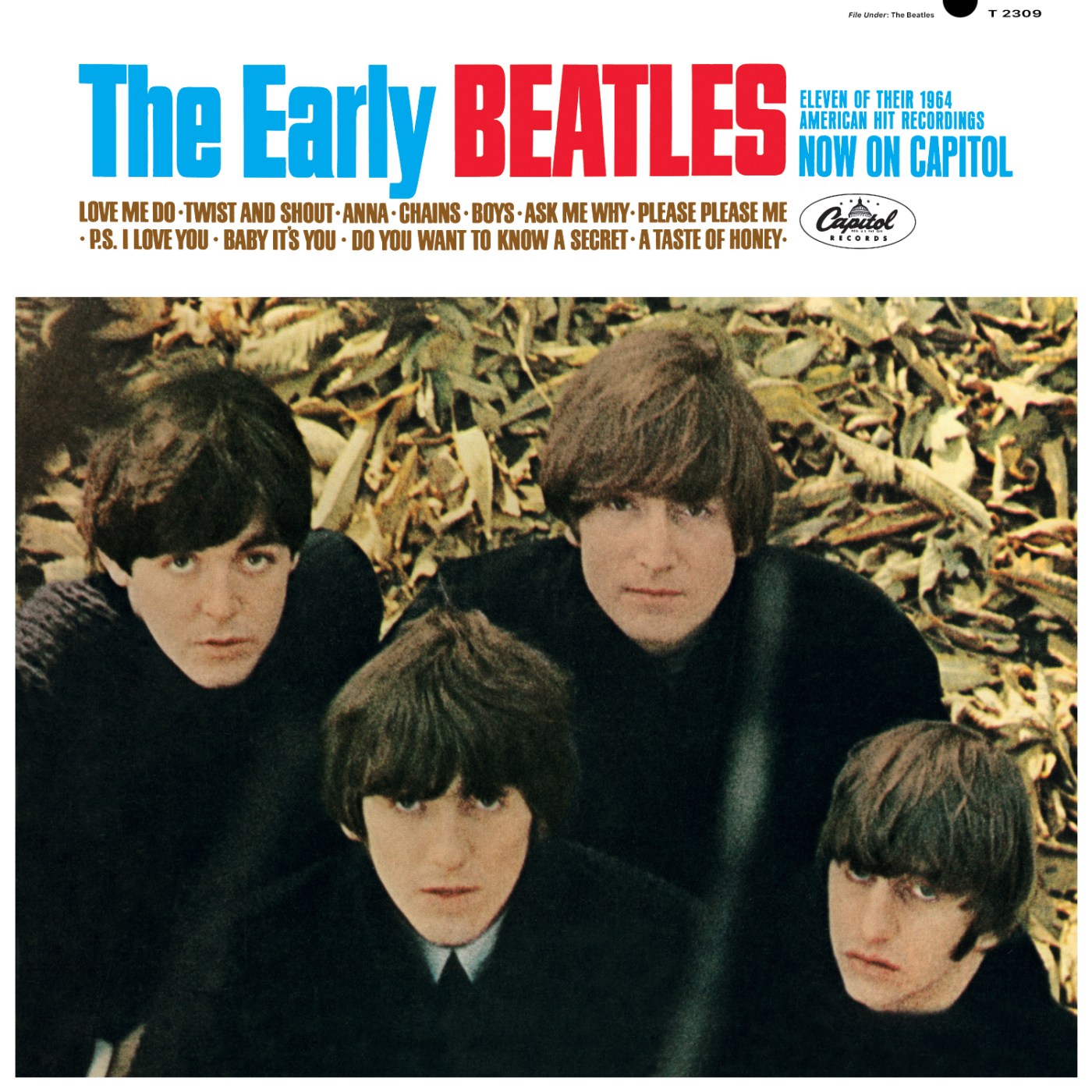
On March 22nd, 1963, the Beatles released their first British album: Please Please Me. Exactly two years later, Capitol released its own version, The Early Beatles. As mentioned earlier, the 14 songs that made up PPM were originally released on Vee-Jay, a small-time record label based in Chicago. However, due to various legal disasters, Vee-Jay lost the license to those 14 songs in October 1964, at which time, the rights went back to Capitol.
As the sleeve notes said:
“Early birds all over the United States – millions of them – got the bug for the Beatles in the first weeks of 1964. The eleven great songs in this album were among those that launched the Beatles. They appeared then on another record label. They appear now for the first time on Capitol – added, with pride and pleasure, to the fine Capitol treasury of Beatles recordings which, together, constitute an unprecedented phenomenon of entertainment history.”
The album, as noted, is basically Please Please Me with a re-ordered tracklist, minus three songs: “I Saw Her Standing There” had been on Meet The Beatles, while “There’s A Place” and “Misery” wouldn’t get released until 1980, on the Rarities collection.
As for those leftovers:
‘Love Me Do’: The very first Beatles song, and a logical place to begin. This version is probably the more well-known, since it’s a much stronger performance by everyone involved than the original single version… except, infamously, this is one of two songs without Ringo on drums! That’s Andy White pounding away in the background, poor Ringo was reduced to tambourine. Even so, it’s a solid first song, and the harmonica throughout gives it a nice blues-y vibe that contrasts with the sweetness of the words. Nice as the song is though, it’s a bit limp as an album opener compared to “Standing There.”
‘Twist And Shout’: Once a closing track, on this album it becomes track two, to its detriment. Even so, John Lennon gives the performance of his life, absolutely shredding his vocal part – recorded after sucking down cough drops and milk for an entire day. It is amazing, and he only needed one take to nail it. Also of note: the backing vocals from Paul and George, especially those rising “ahhs” that take us into the last third of the song. (And that scream! Yes!)
Anna (Go to Him): Following the original running order now, “Anna” has John on lead vocals, and on this track you can really hear how his cold affected his singing. It’s an interesting effect though, since it gives his voice a raw, haunting quality. I also quite like the reverb-heavy backing vocals from Paul and George.
Chains: The first of two lead vocal performances from George on this album, I’d say this one is easily the strongest. Interestingly, this is their earliest song to have originally been performed by a girl group – the Beatles loved American rock ’n’ roll, and not just the male heavy hitters!
Boys: Ringo’s sole song on the album, he nonetheless gives a vocal performance worthy of John and Paul. While he may not have a ton of range, he uses the range he does have to great effect, so it’s no surprise that this song became a staple of his solo concerts in later decades. And because we have boys singing about boys, it’s unintentionally queer. Works for me! (Brian must’ve loved this one, being gay and all.)
Ask Me Why: A more straightforward love song in which the narrator describes all the reasons he loves his partner, it’s got an interesting rhythm, and I really kind of like the way John’s voice cracks on the word “cry.” Wouldn’t have that in today’s recording world, that’s for sure!
Please Please Me: Their first British hit single, Please Please Me was John’s attempt to write a Roy Orbison song, with a little bit of Bing Crosby in the title. Early versions were slower and closer to a blues song than a rock number, but George Martin persuaded them to bring up the tempo and add harmonica, establishing it as an early Beatles trademark.
P.S. I Love You: One of Paul’s first epistolatory songs, (he seems to really like this format) P.S. I Love You is the other Andy White song on the album. A tender ballad song that shows off how well he can sing those, I still really like the brief flash of his rock ’n’ roll voice on the phrase “You KNOW I want you to remember,” just before George’s delightful “Yeeeaaah” a second later. As an aside, this is one of four Beatles songs for which no true stereo mix exists: the album version of “Love Me Do” and the singles “She Loves You” and “I’ll Get You” are the others. But if Giles Martin has his way, that won’t be the case for long…
Baby It’s You: I really love this song – the singer tells his girlfriend that she’s the only one for him, regardless of what other people say about her. That devotion is everything for a girl, and I speak from personal experience.
A Taste of Honey: Here’s an interesting technical detail: this song contains the first instance we have of a Beatle double-tracking a vocal part. In this case, it’s used in the choruses. It’s subtle, but if you know what to listen for, it stands out. This will go on to become a standard feature of Beatles recordings, long into the mid-60s.
Do You Want to Know A Secret: George’s second vocal spot, and probably my least favorite. Not because of his accent (his particular brand of Liverpudlian drawl is amazing) he just sounds slightly off-key in places. The “do-da-do” backing vocals are nice though. And on this specific album, it’s a complete disaster of an album closer. They really fucked up, moving Twist and Shout so far back.
You’d think that despite having most of the same songs and a near identical running order, The Early Beatles would be just as good as its transatlantic equivalent, but you would be wrong. There’s a specific flair to the way those early albums were structured, and Capitol deciding to move “Twist and Shout” to track two, leaving the album to close on a sheer dud like “Do You Want to Know A Secret,” was a mistake.
It’s easier to see now, I think, why the Beatles decided to renegotiate their contract in 1967 specifically to prevent Capitol from assembling these pick-and-mix compilations, interesting as they are. For one thing, it’s impossible to imagine songs like “Come Together” or “Lucy in the Sky With Diamonds” on any album other than Abbey Road and Sgt. Pepper. And for another, it just cheapens the music and makes it seem disposable and throwaway.
In the end, The Early Beatles is a pale imitation of an otherwise great album, and I know which of the two I’d prefer to spin. It’s the one that has “I Saw Her Standing There” on it.


Leave a Reply