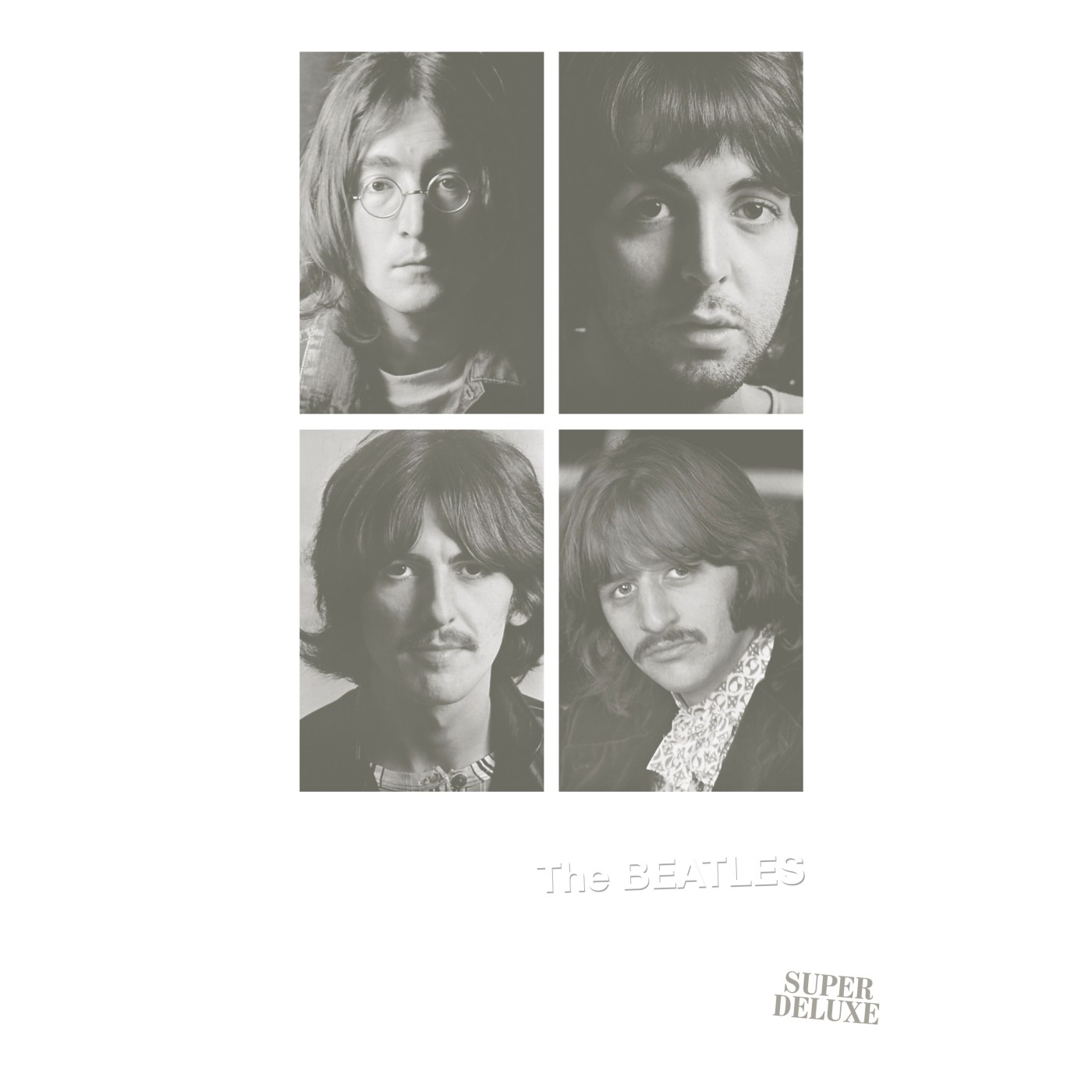
Since Magical Mystery Tour was skipped over, the next album mix from Giles Martin was 2018’s version of the Beatles’ eponymous double album, known among the fans (and the boys themselves) simply as the White Album due to its stark white cover, and the band’s name embossed on the record sleeve, an effect recreated for the 2018 re-release.
Visually and sonically, the White Album is an entirely different creature from Pepper. That album was an explosion of colour and sound, as the Beatles completely reinvented what pop music could be and grew beyond its boundaries, all while dressed in faux-military uniforms so bright, you could probably see them in the dark, all in service of perpetuating a child-like dream – an escape from the moptops they had once been. There’s a reason that album was the favourite of seven year olds everywhere, including me.
The White Album goes in the opposite direction entirely. It’s twice as long as Pepper, and the music isn’t remotely suitable for young ones in the least – not that that stopped me from buying my first copy of it when I was around ten or so, during a trip to Slacker’s Music and Video with my dad. But I didn’t really appreciate it, as an album, until I was much older.
What stuns me about the White Album, to this day, is how unflinching and raw it is. As Giles Martin notes in his introduction, “I have the feeling the group allowed the engineers less time to sort out sounds in the studio, leading to the recordings being not quite so precise as before.” This is the sound of the Beatles producing themselves, without George Martin there to keep things on track.
But now, for the very first time, we have the chance to not just listen to the finished product, but take a deep dive into its creation. Included here for the first time are the complete Esher Demo tapes, three discs of sessions recordings, and on the blu-ray, and a direct transfer of the original mono mix from 1968. And in listening to them, we’ll find what Giles Martin called “extraordinary inspiration – mixed with plenty of love and laughter.”
2018 Stereo Remix
Disc 1
Back in the USSR: The one where Paul decided to combine Chuck Berry and the Beach Boys… from the other side of the Iron Curtain. I fucking love this song, it’s one of the boys’ best rock numbers, and the 2018 anniversary mix does it the perfect amount of justice. This song appears on the Blue Album, where the ending airplane noises is faded out, as the next track didn’t originally appear there.
Dear Prudence: This song was added to the 2023 edition of the Blue Album, where it starts with a clean beginning rather than a slow crossfade from the airplane noise at the end of “USSR”. It’s one of my favourite late-period John songs, and despite not having Ringo on it, it still sounds perfectly Beatle-y.
Glass Onion: In which John writes a snarky response to all those people who “found” hidden messages in Beatles lyrics, complete with continuity nods to various songs from 1967. Giles Martin’s mix gives it a bit more punch, which I appreciate. Also note the lack of double tracking on John’s voice just before the “fool on the hill” verse.
Ob-La-Di, Ob-La-Da: It says something about the Beatles that they can take something as out of left field as ska and put their own spin on it.. and it still works really well! As discordant as the recording sessions were, the end result is still lovely – I particularly like the last two verses, where the roles of Desmond and Molly are swapped around. Could they be trans? I like to think so.
Wild Honey Pie: Yeah, this got remixed too. If it’s possible to do a good mix of a bad song, this is it. (Though “song” is pushing it.)
The Continuing Story of Bungalow Bill: The vocals come out really prominently on this song, which features Yoko and Maureen Starkey as well. You can hear everyone much more clearly now, especially when they sing the title phrase.
While My Guitar Gently Weeps: Despite having noted racist and general right-wing asshat Eric Clapton making an uncredited contribution on lead guitar, this George song from the Beatles’ self-titled double album is still one of my favourites of his, and one of the few songs of his from ’67 and ’68 with no Indian influences on it whatsoever.
Happiness is a Warm Gun: After his solo years, we’re used to Paul stitching together mini-medleys of his songs together into a cohesive whole, but this is a rare example of John experimenting with the form. My favourite section is the first one, describing a man and a woman who are probably him and Yoko. The 2018 mix is nice and crisp, particularly where the bass and drum parts are concerned.
Martha My Dear: While ostensibly a music hall pastiche, it’s still a rock song, as can be heard during the choruses. Paul plays all the instruments himself, save for the orchestral ones.
I’m So Tired: This song has always been great, what with jumping from John’s lethargic verses to the hard-rock explosion of the choruses. You can hear Paul more clearly doing backing vocals now, making full use of that deeper register he acquired around now and kept until Let It Be.
Blackbird: Paul’s tribute to the civil rights movement, it has aged like fine wine, and taken on new meaning in the age of Black Lives Matter. When I heard him play it live, it was only two years after the murder of Michael Brown in Ferguson, MO, an event that Sir Paul himself referred to when introducing it. Black lives have always mattered, and they always will.
Piggies: George gets political, with a new mix that makes everything sound like it’s happening in the room with you, even the string section! It’s surprisingly intimate for a political song.
Rocky Raccoon: Paul’s pastiche of Americana, complete with trying (again) to talk in an American accent. It doesn’t work (the accent, I mean) but the song is good, enlivened by Martin’s remix.
Don’t Pass Me By: Ringo’s spotlight song, and the first one he ever wrote! Both his vocal and his drums are highlighted nicely. Note the fiddle part over to the right channel.
Why Don’t We Do It In The Road?: One of the things I like about Giles Martin’s Beatles mixes is the way he lets Paul and Ringo’s respective instruments shine a bit more. Ringo’s drum part in particular really shines here.
I Will: While it is difficult to do much with a song that’s largely acoustic guitar, Martin does his best – Paul’s vocal is dead centre with the guitars spread across the stereo field, as are the chorus vocals.
Julia: The same applies with this song: John’s vocals are placed in the middle, with guitars and backing vocals surrounding him, making for quite a beautiful effect. And all the more touching, given who the song is about – his deceased mother.
Disc 2
Birthday: The Beatles do a birthday song to start off the second half of the album, and I really love this one. I listen to it every year on my own birthday, and it’s a fantastic way to start the day off! Like my favourite band in the world is singing “Happy birthday” just for me. Love ya, boys.
Yer Blues: Now that’s more like it! John’s blues number rocks as hard as anything else on this album, and I unabashedly love it. He wrote it as a parody of British blues music, and as parodies go, it’s a million times better than “Run For Your Life.” (And, IMO, better than anything the Stones have ever done.)
Mother Nature’s Son: Another really pretty acoustic ballad by Paul, though the horn section doesn’t really do it for me. A version of the song without those overdubs is available on Anthology 2, and I know which I prefer.
Everybody’s Got Something to Hide Except For Me and My Monkey: There’s a definite sense that the India trip completely re-energised John Lennon, the man is all over this album, and this is one of his best screaming rockers. Not done one of those for several albums now, and it’s really fucking great.
Sexy Sadie: In which John gets snide again, and it’s kind of amazing to behold. I admit I prefer the slower version of this song from Anthology 2, but this is pretty good too. As before, the way he sings here reminds me of some of his vocal stylings during the early part of his solo career, particularly Plastic Ono Band. (We’ll get to the solo stuff later on, I think.)
Helter Skelter: Staying with the hard rock theme of the past few songs, here is Paul casually inventing heavy metal, entirely so he could outdo the Who. Paul’s sheer determination is one of my favourite things about him, this song is probably one of the hardest (if not the hardest) rock songs they ever did.. and it’s about a carnival attraction. Bless. No “I’ve got blisters on my fingers!” though, if you’re listening to the mono version like I am. Stereo mixes only.
Long, Long, Long: In which George does a late-60s Dylan pastiche, except it’s about God. “I think all love is part of a universal love,” he explained to Rolling Stone years later. “When you love a woman, it’s the God in her that you see.” And you know what? He’s right. I might be an atheist, but I can sure see something of God in my girlfriend.
Revolution: This is the song that kickstarts the political angle to John’s songwriting that he’ll carry with him into his solo records, though by the mid-70s, he’ll end up softening his harder stances, likely out of fear of further persecution from the Nixon administration. There are two major versions of this song, and personally, I prefer the faster one. (Especially the live vocal one, where Paul and George do the shoop-be-do-wa vocals again.)
Honey Pie: Once again, Paul doing a pastiche of British music hall traditions, though to me it sounds like something I’d expect from a transatlantic version of Freddy Nagel, he of “Honkin’ the Horn for Honey” and “Sophisticated Swing” fame.
Savoy Truffle: George with another rock song, as he returns to guitar following spending a couple years learning the sitar. This time it’s about a box of chocolates, and Eric Clapton’s resulting cavities from eating too much of it.
Cry Baby Cry: John does a nursery rhyme song, including some lines from the actual nursery rhyme “Sing a Song of Sixpence.” My favourite thing about it is Ringo’s drum part, especially the snare hits between repetitions of the title phrase in the chorus. Paul’s little bit at the end remains creepy as fuck.
Revolution 9: Sophie says she likes this one, and for the life of me I don’t understand why. I’ve always found it kind of unnerving and creepy. Lennon said he was trying to paint a picture of a revolution using sound, and… well, he succeeded. I guess.
Good Night: And at long last, Ringo comes in to end the album with a sweet lullaby, wishing us all good night. Written by John for Julian, the album version is chock full of George Martin’s string arrangement, and there’s even a choir – the Mike Sammes Singers from “I Am the Walrus.” It’s all very Disney-esque, which makes good sense since that was John’s idea. And coming after the intensity of the rest of the album, it’s the perfect note to end on.
The Esher Demos
It is May 1968. The Beatles have returned home from a trip to India in the spring, and reconvene at George’s house in the London suburb of Esher, eager to share the new songs they’ve been working on with each other. With only acoustic guitars at hand and George’s new tape machine, the band spends the day singing and playing songs together, like the world’s coolest campfire sing-along session.
The resulting tapes become known as the Esher demos, and floated around in bootleg circles for decades. The quality wasn’t great, but for those who knew where to find them, what you had was basically the White Album unplugged. A few selections eventually made it on to Anthology 3, but the full tapes didn’t come out until now.
Arranged to mirror the main album tracklist, the demos are a fascinating listen, with a few surprises thrown in. So, let’s go through them:
Back in the U.S.S.R.: Written by Paul as a Soviet Russia-inspired parody of Chuck Berry and the Beach Boys, this early take finds him with an almost complete first and second verse, save for a few wording changes, and even working out what the guitar solo will sound like on the finished album.
Dear Prudence: In which John shows off the fingerpicking style of guitar playing, taught by Donovan, by writing a touching ballad to Prudence Farrow, sister of actress Mia, to cheer her up when things went south for her during the India trip… as John himself explains toward the end of the demo. With just him and his guitar, singing softly, this version of the song really brings home just how good John is at ballads.
Glass Onion: My personal favourite song on the White Album, the demo version here was first released in 1996 on Anthology 3. This version is slightly longer and in stereo, and illustrates that John has most of the first verse written, along with the chorus, but that’s about as far as he’s gotten. It’s still pretty great though.
Ob-La-Di, Ob-La-Da: Next we get to Paul’s take on ska, and on this demo you can hear that influence a little stronger, since Paul tries to do a ska type vocal. It doesn’t really work, though. It’s still a promising track though, and follows the progression of the album version perfectly, since the lyrics are complete.
The Continuing Story of Bungalow Bill: John’s story song about a stereotypical American Macho Man… except he’s also a mama’s boy. Some people find this song to be very tiresome, but I’ve always liked it. The demo version here includes the sound of barking dogs, and a complete set of lyrics.
While My Guitar Gently Weeps: While the best acoustic version of this song will always be on Anthology 3, this demo is pretty good as well, even if some of the lyrics are very different from the album version we all know and love. The structure is largely identical to the album, save for the lack of a solo.
Happiness Is A Warm Gun: One of the rare John songs to be composed from bits of three separate ones, this version of the song is lacking the “she’s not a girl who misses much” section, and consists largely of the “mother superior” section on a loop, since the lyrics aren’t done yet.
I’m So Tired: The other Lennon song to centre around sleeping, or rather, insomnia brought about by how completely in love he is with Yoko. The lyrics here are largely as on the album version, though the demo is in a higher key. New to the song is a spoken-word section that ultimately doesn’t make the cut.
Blackbird: Paul’s ballad in response to the civil rights movement, this demo sounds largely identical to the album version, and follows its structure pretty closely.
Piggies: George’s first attempt at political commentary, which just gets even funnier in light of the rumours about David Cameron fucking a pig. The lyrics are largely the same as the album version, save for a change in what the pigs eat: pork chops here, rather than bacon.
Rocky Raccoon: This story song of Paul’s begins with the first chorus and second verse, giving something of an in-medias-res vibe to proceedings. The rest of the song is here though, even if the key is different from the final.
Julia: John’s touching acoustic ballad to his late mother, presented here in a different key from the album version, but containing the same finger-picking style as on “Dear Prudence.” It’s just as beautiful and haunting as the album version, and one of my favourite demos.
Yer Blues: Being used to the punk rock song that is the album version, hearing it here as an acoustic number is kind of a trip. Lyrically, about everything is here, though the “my mother was of the earth” lyric will get changed for the better known version between now and then.
Mother Nature’s Son: One of my favourite late-period Paul ballads, the acoustic-only accompaniment honestly does way more for me than the brass overdubs on the album version. Probably would’ve fit in well on Wild Life, if he’d released it in the early ‘70s as a solo artist.
Everybody’s Got Something To Hide Except For Me and My Monkey: As before, being better acquainted with the faster rock version, hearing it done on acoustic is very strange. Decent song though.
Sexy Sadie: Originally written about the Maharishi in relation to John’s disillusionment regarding him, George made him change it. The Anthology 2 version, vocal-wise, actually reminds me of John’s solo work from the Plastic Ono Band and Imagine eras, and I can catch some of that here too.
Revolution: So there’s been how many different versions of this song over the years? A lot. This one might be one of my all time favourites – with the handclaps serving as percussion, the whole vibe of this song makes it feel more like a forerunner to “Give Peace A Chance” than either the album or single versions do. Like, you can definitely tell the two songs were written by the same guy.
Honey Pie: I’ve never really liked Honey Pie much. It sounds a bit too much like something the British equivalent of Freddy Nagel would sing. But it means something to Paul, and this acoustic version isn’t bad.
Cry Baby Cry: The last of the White Album songs on the Esher tapes, this lullaby of John’s is largely complete, lyric-wise. I’ve always liked it, though I do miss the rat-a-tat-tat of Ringo’s drums as on the album version.
Sour Milk Sea: George returns with the first Esher song that doesn’t appear on the White Album. It was given to Jackie Lomax as a single, and was released in August 1968. I really like it, I wish the boys had done this properly. I’d take this over “Revolution 9.”
Junk: A Paul McCartney ballad, describing the contents of a junk shop. He tried to include it on White and Abbey Road, only for it to eventually land on McCartney, his first solo album. This version isn’t too different from the final, save for the occasional squeaks of microphone feedback.
Child of Nature: A song by John about his experiences in India, it’s a really pretty song, suggesting he finally found inner peace after so many years of strife. In a way, it’s his version of “Mother Nature’s Son.” It won’t survive in this form though – John took the melody and wrote new lyrics for it in 1971, turning it into “Jealous Guy.”
Circles: A haunting George tune featuring organ and lots of minor chords, this track wouldn’t see a proper recording until 1982, when it appeared on his Gone Troppo album from that year. It’s a bit too gloomy for my taste, and I like “Blue Jay Way.”
Mean Mr. Mustard: We all know this song best as one of the pieces for the famous medley on side 2 of Abbey Road, but this demo was where it began, and I really like it. It was also the basis for an amazing fan-made remix.
Polythene Pam: Another Abbey Road song, and the only version of it that could be described as complete, since “Bathroom Window” hasn’t been written yet. It rocks right along, acoustic guitars aside.
Not Guilty: Another George song that he tried to get on the White Album, only it didn’t happen. Instead, it came out on his own eponymous album, 1979’s George Harrison. My favourite version though is from Anthology 3, where it becomes the rocker it was always meant to be. John and Paul really missed a trick, not letting George have this one.
What’s the New Mary Jane: Closing out the Esher demos is a song that feels more like one of John’s poems from In His Own Write or A Spaniard in the Works than any Beatles song he ever did. As it goes, at least it’s an actual song. Kinda wish they’d used this instead of “Revolution 9,” if I’m honest.
Sessions 1
Revolution 1 (Take 18): This should sound familiar – it’s the album version of this song shorn of overdubs, so no lead guitar or brass parts. You do, however, get to hear more piano. (Sadly, the shoop-be-do-wa backing vocals from George and Paul aren’t here either.) Note also that it’s ten minutes long, continuing well past the fadeout point to become more like an early draft of “Revolution #9.”
A Beginning (Take 4) / Don’t Pass Me By (Take 7): We start with this instrumental piece by George Martin, best known now as coming from the start of Anthology 3. This is followed by “Don’t Pass Me By,” the track for which “A Beginning” was recorded as an intro, in an early draft that contains more fiddle in the opening verses.
Blackbird (Take 28): Would you believe it took over 30 takes for Paul to get this right? This doesn’t yet contain the sound effects or the false ending – those came later.
Everybody’s Got Something to Hide Except Me and My Monkey (Unnumbered rehearsal): Not much to write home about here, just the boys jamming along to one of their harder rock songs. You gain a great appreciation for the specific quality of guitar distortion employed on this album, it really is incredible.
Good Night (Unnumbered rehearsal): Just Ringo doing a spoken word bit over the chords to his unprecedented second song on this album.
Good Night (Take 10): Featuring John playing fingerpicked acoustic guitar and a double-tracked Ringo, this gorgeous version of the closing song from the White Album also has John, Paul, and George singing in harmony with Ringo during the choruses. Honestly, this should’ve gone out instead of the orchestral version! It’s not often you get to hear the boys harmonise anymore, and it sounds just lovely.
Good Night (Take 22): This one is an Anthology re-release, but where that version of the song was crossfaded into the final album version, this is the entire rehearsal, with just Ringo on piano.
Ob-La-Di, Ob-La-Da (Take 3): While not quite the Anthology version of the song, it’s sonically similar to that. I believe they carried out a remake which contains the piano intro, which John came up with while high and pissed off at Paul for being such a perfectionist. (So, typical behaviour for both of them, really.)
Revolution (Unnumbered rehearsal): The faster version of the song now, with John managing to screw up the one-word title by turning it into “rainbowlution” instead, for which he’d still like to see the plan. (I assume that would be a useful description of the Stonewall riots, if those weren’t a year out in 1968.)
Revolution (Take 14 – Instrumental backing track): And for use at your next karaoke party, the instrumental backing track of the single version… only it isn’t quite the released one, because among other things it’s missing Ringo’s drum hit near the start. Even so, it rocks pretty hard.
Cry Baby Cry (Unnumbered rehearsal): A radically different take on this song compared to the album version. In the opinion of Giles Martin, it sounds a bit like early prog rock: “We have the acoustic version which John sings for the Esher demos, and then there’s a version on the outtakes which is almost like Pink Floyd. The final mix we did actually sounds more like the demo in some ways. They really valued each other as musicians and contributors to everything they did, and that’s what you hear in ‘The White Album’—the way the other members of the band added to the record to create the final version.”
Helter Skelter (First version – Take 2): A much slower version of the dirtiest rock song the Beatles ever came out with, previously released in abridged form on Anthology 3. This is the full 12-minute version of the song, with Paul’s vocal not entering the scene until 2:21 or so.
Sessions 2
Sexy Sadie (Take 3): Take 6 of this song is considerably slower than the album version, and I honestly prefer it. The sound of John’s voice here, both in terms of how close he was to the mic and the way it sounds, remind me a lot of his early solo work. His voice has noticeably shifted since the moptop days, it’s just a little harder to notice than with Paul.
While My Guitar Gently Weeps (Acoustic version – Take 2): This is not the famous acoustic-only version from Anthology 3, but it sounds very similar to that version of the track. This is the second take from the same session, with the same extra verse that didn’t make it into the album version. It’s a bit looser though, and the organ part is far more prominent.
Hey Jude (Take 1): Just when you thought the Beatles never recorded anything live in the room anymore, here’s an early run-through of the ultimate crowd song to prove you wrong. Live piano, live drums, live vocals and guitars, it’s got everything except a bass part! The Anthology 3 version was take 2, this is the one from just before.
St. Louis Blues (Studio jam): “The Saint Louis Blues” (or “St. Louis Blues”) is a popular American song composed by W. C. Handy in the jazz style and published in September 1914. It was one of the first blues songs to succeed as a pop song and remains a fundamental part of jazz musicians’ repertoire. It is also the namesake of the city’s hockey team, who have been around since 1967.
Not Guilty (Take 102): Not fully recorded until George’s eponymous solo album in 1979, the Beatles version performed here is straight late-sixties rock and roll, with a really crunchy guitar part and George singing in a higher register than usual. The remake keeps the structure but changes the vibe to something more laid-back and soft-rock inspired, which makes good sense – by 1979, George had long since moved on from the frustration he was dealing with in the 1968 recording.
Mother Nature’s Son (Take 15): If you think this sounds familiar, it does! This is take 15 of the White Album track, featuring just Paul and his acoustic guitar. It’s much nicer without all the extra stuff overdubbed on top. The Anthology version was the album master shorn of overdubs, this came later.
Yer Blues (Take 5 with guide vocal): John’s blues number rocks as hard as anything else on this album, and I unabashedly love it. He wrote it as a parody of British blues music, and as parodies go, it’s a million times better than “Run For Your Life.” (And, IMO, better than anything the Stones have ever done.) This version is almost instrumental, but listen for John’s guide vocal in the far background.
What’s the New Mary Jane (Take 1): John’s first idea for an avant garde piece, featuring just John, George, Yoko, and Mal Evans. According to the liner notes, it was almost on the White Album but was ultimately unissued until 1996, on this very album. And if I’m honest, I really wish they’d used this instead of “Revolution 9.”
Rocky Raccoon (Take 8): Take 8 of Paul’s American song, complete with Paul doing his best American accent during an opening spoken-word section. While it starts out as being largely identical to the final mix, this doesn’t last – by the time we get to “schminking of gin,” it’s all over, and everything collapses into silliness.
Back in the U.S.S.R. (Take 5 – Instrumental backing track): Just the backing track for the album opener, presented without vocals and considerably slower – I imagine they must’ve sped it up for the released version. It’s interesting hearing it like this, it gives the track a different vibe.
Dear Prudence (Vocal, guitar & drums): The album mix of the song with some overdubs removed. I’ve always really liked this song, and should I have a daughter, her first name will be Prudence. (Prue for short.)
Let It Be (Unnumbered rehearsal): A radically different version of one of Paul’s signature songs, though it’s mainly him screwing around with the others. Note the shift from Mother Mary to Brother Malcolm – now who could that be?
While My Guitar Gently Weeps (Third version – Take 27): Take 27 of no less than 45 takes of this song, now arranged in the familiar hard rock style we know from the White Album. It includes George trying to sing like Smokey Robinson, admitting near the end of the song that he can’t quite do it – ironic, given that Harrison would go on to pay tribute to Robinson on some of his solo albums in the 1970s.
‘(You’re So Square) Baby I Don’t Care’: A quick jam of this song, a hit for Elvis Presley. It was recorded during the sessions for “Helter Skelter,” hence the tape echo on Paul’s voice.
Helter Skelter (Second version – Take 17): A particularly raucous version of Paul’s classic screamer, a song that will always be the beginning of doom metal, and no one will ever be able convince me otherwise. I’m not sure Paul has remembered all the words, but it’s a little hard to tell due to the aforementioned tape echo.
Glass Onion (Take 10): A loose but nice-sounding version of John’s song from early on the album, though I admit I can hardly hear his vocal. Could this be him recording a guide vocal instead?
Sessions 3
I Will (Take 13): An early take of Paul’s acoustic ditty that starts in the middle of a verse, breaks down, and then starts over again.
Blue Moon (Studio jam): Recording during the same session as above
I Will (Take 29): Take 29, which is really more of a joke than a proper attempt at recording the song. Why? Because of the way the opening verse ends, with Paul inverting the title and singing “I won’t” instead, leading to John’s reply “Yes you will!” Goofs, the pair of them.
Step Inside Love/Los Paranoias (Studio jam): Nothing much to say here, just John, Paul, and Ringo screwing around and jamming. It’s silly and not meant to be taken remotely seriously. “Step Inside Love” was written as a theme for Cilla Black’s TV show, which first began airing in January 1968. It was later released as a single, with Paul writing two more verses and playing guitar.
Can You Take Me Back? (Take 1): If you’ve ever wanted to hear the entirety of the song fragment that closes “Cry Baby Cry,” the White Album box has it for you, and now so does Anthology 4. It’s not much of a song, but it does include John and Paul making references to the collage “Voices of Old People” by Simon and Garfunkel, from their album Bookends. The part of the song used on the White Album hits at 1:50.
Birthday/Piggies (Instrumental backing tracks): Two instrumentals that are similar to, but aren’t quite, the final versions.
Happiness is a Warm Gun (Take 19): Take 19 of one of my favourite late-period John songs, with much of the arrangement sounding largely similar to the final master. All three sections of the song are here, though the lyrics are sung more loosely than the final recording will be.
Honey Pie/Savoy Truffle (Instrumental backing tracks): Two more instrumental tracks. “Savoy Truffle” is the album version with George’s vocal taken out. (You can tell because the brass overdubs are here, among other things.)
Martha My Dear (Without brass and strings): Another reworked album version, with the brass and strings removed as indicated, as well as Paul’s second vocal track excised, so he’s single-tracked here.
Long, Long, Long (Take 44): In which George does a late-60s Dylan pastiche, except it’s about God. “I think all love is part of a universal love,” he explained to Rolling Stone years later. “When you love a woman, it’s the God in her that you see.” And you know what? He’s right. I see his point far more now as a Wiccan than I ever did as an atheist – there is definitely something of the gods in my wife and our partners. (And not just because we occasionally channel the Morrigan.)
I’m So Tired (Takes 7 & 14): Two takes of John’s other song regarding sleep, though as we know this one deals with the lack of it rather than an abundance as on “I’m Only Sleeping.” Note that the choruses in take 7 are not quite as loud as they’re going to be.
Take 14 is the basis for the final mix, with some extra backing vocals and other instrumentation that would later get mixed out. John is mostly single-tracked in the verses before going double-tracked during the choruses.
The Continuing Story of Bungalow Bill (Take 2): An early take of an India song, featuring more of Yoko than we’ve ever heard before – she sings the song’s opening chorus lines along with her soon-to-be husband.
Why don’t we do it in the road? (Take 5): Believe it or not, this was an acoustic number at first, with none of the harder edges that appear in the finished recording. The only constant is Paul alternating vocal styles, from soft and gentle to the louder, deeper voice he developed around this time.
Julia (Two rehearsals): Two rehearsals of John’s heartbreaking tribute to his mother, discovered by accident during preparations for the 50th anniversary White Album set. The first one has John strumming his guitar and singing the song in the same key as, of all things, “It’s Only Love” from Help!.
The second rehearsal has John returning to the fingerpicking style he uses from now until “Look at Me” on Plastic Ono Band. It’s a lovely performance, and I’m glad we get to hear it at last.
The next three songs aren’t album tracks, but singles recorded around the same time.
The Inner Light (Take 6 – Instrumental backing track): An instrumental version of George’s last Indian-themed Beatle track. This is take 6, over which vocals from George would be recorded. Another instrumental version of the song was later released on the 2014 remaster of the Wonderwall Music soundtrack in keeping with the Indian theme George adopted for the rest of the film score.
Lady Madonna (Takes 2 & 3): Take 2 is the release version of the song, with only drums and piano – the vocals and other instruments were added later during the overdub process. And since it is the released version, you can sing along! The second track is the backing vocals only, featuring the boys goofing around.
Across the Universe (Take 6): Because we haven’t had enough versions of this song released already, here’s take 6 of this song. It isn’t quite the version we know that’s been overdubbed and underdubbed a million times over the last 60 years, but it’s very close.
Out of all the super-deluxe mixes that have come out over the years, I think this one is probably my favourite. The bonus material alone is worth your time, and one gets the sense that Martin and Okell could’ve released even more if they wanted to. These releases are pure celebrations, and that’s something to be treasured as we drift further and further away from the 1960s.
The box set was a hit with critics as well. Jordan Orlando of The New Yorker writes that the 2018 remix “reveals what might be called the greatest record ever made, not only in terms of its innovation and its strange, impenetrable, endlessly suggestive beauty but also because of its place at the apex of the Beatles’ career and its role as an aesthetic keystone for nearly all the rock-and-roll recordings that have followed”.
He additionally comments that “Rebuilt digitally, the album’s enormous soundscape is finally complete: the progressive generational muddiness is gone, revealing the dry snap of Ringo’s snare and Harrison’s full-throated gentle weeping and the thunderous effervescence of McCartney’s bass runs and Lennon’s halting intakes of breath.”
Modern technology hasn’t detracted from the Beatle legend – it’s only been enhanced.


Leave a Reply