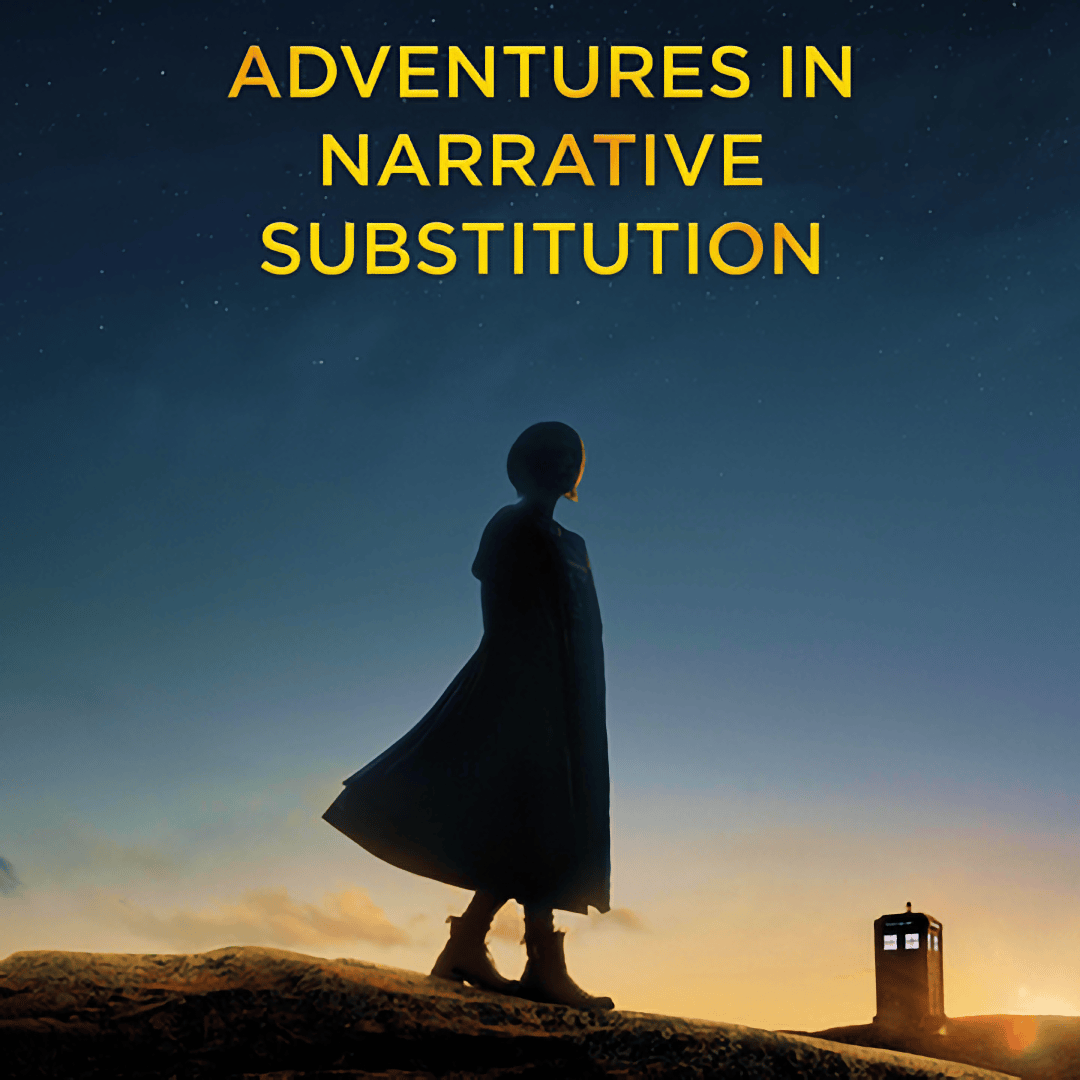
On the day The Woman Who Fell to Earth aired, I was lucky enough to be watching live. A few days earlier, I’d been in Chicago (AKA Enemy Territory for any St. Louisan worth her salt) attending a professional conference, and I had one last day of freedom before getting on the train and returning home the next afternoon. Knowing that day was when the new season of my favorite TV show was starting, I wanted to be able to watch Jodie’s debut live, rather than wait a day and buy the episode on iTunes.
Luckily, the hotel TV did in fact have BBC America, which meant I’d be able to catch the channel’s “simultaneous” airing of the episode without a problem. They’d done this for ‘The Day of the Doctor’ just five years ago, so I was looking forward to a similar event for an occasion just as momentous. It’s not every day your childhood hero turns into a woman, after all.
Jodie’s casting didn’t happen in a vacuum of course. The concept had been around since 1980 when Tom Baker, of all people, jokingly suggested it might be a woman who would be replacing him in the TARDIS. When Steven Moffat ended his hilarious and very prophetic parody ‘The Curse of Fatal Death’ in 1999 by regenerating the Twelfth Doctor from a big name actor into a blonde woman. 18 years later, it happened again, if not entirely by his hand, after spending just about the entirety of his showrunning tenure playing with the concept in various configurations.
Somewhere around the middle of his time on the show, I realized I was transgender. The first inklings I had came in the early months of 2013, when a friend started taking estrogen. Most people probably would not have immediately begun thinking “I wonder what that would do to me?” But I am not exactly most people.
A year of intense questioning followed, ending with me suspecting that I might be trans. I was terrified, I didn’t know what that would mean but I did know trans people usually had very hard lives. I needed some wise words of comfort, and on Christmas Day 2013, I got some:
“We all change, when you think about it. We’re all different people all through our lives. And that’s okay, that’s good, you’ve got to keep moving, so long as you remember all the people that you used to be.”
That calmed me down. It was okay for me to be trans, the show seemed to be saying. It was okay for me to be a girl, if that’s what I turned out to be. I still wasn’t sure though, so I kept questioning through 2014, just as the Twelfth Doctor was going through something of an identity crisis of his own. A month or so after his big public declaration to Missy that he was an idiot with a box and a screwdriver, I finally confronted that which had been staring at me in the face for the last two years, and accepted that I was, in fact, trans.
Fast forward another two years. It’s 2017, and Peter Capaldi has confirmed that the tenth series of the revival will be his last, and someone else will be taking his place. The hopes that his replacement won’t be another white man are louder than ever now, what with the news that Sonequa Martin-Green will be the first woman of color to helm a Star Trek show. When the second-longest running sci-fi franchise in the world beats you to another diversity punch for the third time in a row, something has to change.
And so in July 2017, history was made when Jodie Whittaker walked into a forest, lowered her hood, and revealed that she would be the next Doctor, causing girls of all ages to look on in awe and joy and euphoria. It was an amazing thing to see, and even now, it’s still one of my all time favorite moments from the show. The Doctor was now a woman, just like me.
So anyway: it’s October 2018, and around a year and a half after that enormous event, I’m about to watch Jodie Whittaker’s first episode of Doctor Who. I was thrilled, and I stared rapturously at the hotel TV as BBC America’s pre-game show gave way to the opening scenes of Woman.
For the first 20 minutes or so, everything went great. The companions were new and different, the score less loud, the cinematography beautiful, the writing… workmanlike. Less fluid than Steven Moffat’s scripts, but I was willing to accept that. The new guy deserves a fair shake. Then the show cut to commercial. COMMERCIAL. ON AN ALLEGED SIMULCAST WITH THE UK. WHAT THE FUCK WAS GOING ON.
As it turned out, commercials were the least of my problems (though they did result in me having the last 20 minutes spoiled by unaware Brits in a group chat and missing the closing titles because BBCA just had a generic credit sequence zip by on the screen as they cut back to their pre-game show). If BBC America’s false advertising was the only beef I had with Series 11, I wouldn’t be writing this.
Series 11 was not, to be charitable, a complete train wreck. The casting was, as always, spot on (thank the Goddess for Andy Pryor), the score was fresh and new and, to me, reminiscent of the early ‘80s incarnation of the BBC Radiophonic Workshop. The stories had interesting concepts and, in a few cases, provided long-needed and fascinating authorial voices. There was Jodie Whittaker.
But Jesus Tap-Dancing Christ, the writing. The writing, the writing, the writing, the writing. The last time I saw a season of Who with scripts that undercooked was Series 2, and even that managed to have interesting failures! You honestly can’t say you were ever bored watching Series 2, were you? (Except maybe Fear Her, which actually was boring.)
By week 2, I was beginning to have Doubts. By week 5, I was praying again and hoping to the God I don’t believe in anymore that the guest scripts would be above par. By week 10, I was actually glad the season was over, and at week 11, I was so done that I started drafting a list of alternate episodes to watch instead of the ones with J.W. in them. Which is kind of Bad News. I can’t even enjoy the first female Doctor without adding an asterisk. (All I can say is, thank goodness for spinoff media.)
I started sharing that list with people, and somewhere along the line, I decided it would be a good idea to dip a paw into this whole media criticism lark, and then I announced it on Twitter and began to write. The resulting series of blog posts went up on a site called DoWntime and then was republished on my own blog. The series was called, you guessed it, Adventures in Narrative Substitution.
Narrative substitution is a term coined by my friend Dr. Elizabeth Sandifer, who defined it thusly in her TARDIS Eruditorum piece on the episode ‘A Good Man Goes to War’:
“Where narrative collapse is based on threatening the basic functioning of a narrative structure so that further storytelling becomes impossible and then averting the collapse and reaffirming the structure, narrative substitution works by initially appearing to tell one type of story, and then rejecting that story, typically on ethical or ideological grounds, generally by revealing that the story was in fact an entirely different type of story all along.”
For a period of around eight months, I proceeded to apply that concept to the entirety of S11 by matching its episodes with their rough equivalents in the Davies and Moffat years with one story for each match-up, comparing and contrasting the episodes and (usually) rejecting the Chibnall-era ones. It was tremendously enjoyable, I learned a lot about myself in the process, made new friends, and even acquired a reader base, which I honestly never expected to happen. (Oh yeah, and Sandifer herself gave me a shout-out in her own post about ‘Oxygen’, which was FUCKING AWESOME.)
When it was done, I took a few weeks off to plan my next steps (this was at the end of 2019). My first idea was to switch gears and write about a period of the show I preferred, namely the Matt Smith era, which became the Back to the Eleventh Hour series of blogs and accompanying book series published through Arcbeatle Press.
However, I must admit that Eleventh Hour was not my first choice when it came to writing a book, though. I wanted to do a book version of this series at first, but those plans were derailed when another Arcbeatle writer, Sam Maleski, complained that having two books about the Chibnall era coming out from the same publisher created conflicts. And besides which, their book, Sheffield Steel, came out first. Eventually a compromise was reached: I could publish any other book through Arcbeatle that I liked, just not about post-2017 Doctor Who. I agreed, and the result was Back to the Eleventh Hour. Any attempts at publishing Narrative Substitution, I believed, would have to be done independently.
And then, just a week into 2021, Sam Maleski was accused of sexual and emotional harassment by myself and two other women, Christine Kelley and Michelle Coates. The three of us quickly realized there was a pattern: Sam had a tendency toward desiring to be the foremost expert on a given subject, which included Chibnall-era Doctor Who, and reacted poorly whenever someone (and in particular, a woman) dared to muscle in on what they considered their turf. On top of that, in group discussions, he had the unfortunate habit of strongly implying his opinion on something was “correct,” and anyone who didn’t agree was automatically wrong. Obviously, I tend to hold a far more negative view on Chibnall-era Who than them, and they would frequently shout me down and minimize me whenever I dared to be negative about it in their presence.
All of a sudden, their negative view on the suitability of Narrative Substitution being published as a book started to look less sympathetic and more like someone trying to hold all the glory for themself. On top of that, they were furiously angry when Eleventh Hour became the top-selling new book in its category on Amazon, which I now realize was an indication they viewed me as a threat.
Then the dam broke. Christine, Michelle, and I independently chose to speak out publicly about the harm Sam had done to us, and the reaction was instant. Arcbeatle canceled any further projects with them, and the creators of other fan projects, such as Clara Oswald: The Untold Adventures and The Twelfth Doctor Fan Audios, pledged no further involvement with them either.
I, perhaps, had the least to lose from all of this. I hadn’t contributed any material to Downtime since the original Narrative Substitution series went up, aside from an appearance in a round-table discussion series hosted there called Bit of Adrenaline, Dash of Outrage [Ed: Dash of Outrage lives on as She Was The Universe here on Spacetime Junction and is now happily Sam-free]. My writing projects were all being developed independently of Sam’s, and I had no real desire to work with them even before the allegations came out.
But there is still the matter of Narrative Substitution, the series that started it all and which has proven to be something of a problem child in the years since I originally wrote it. I’ve been intending to rework it for a long time now, originally for a published edition, but with that project essentially canceled, I’ve decided to return to first principles and revive it as a blog series instead.
This series of entries, covering Series 11, will be the expanded versions once intended for a book (replacing the Downtime versions) and will follow the original premise of one Chibnall era story, a Davies/Moffat story, and a classic series story, while the last entry will take a look at the Thirteenth Doctor-era spinoff media (and in particular, the various Thirteen stories published under Titan Comics) and how those function as a sort of alternative Chibnall era, existing in the liminal spaces between seasons and episodes. Future runs covering Series 12, 13, and whatever comes next will follow the same pattern.
So, with all that in mind, I present you with The List:
- The Woman Who Fell to Earth: The Eleventh Hour/Power of the Daleks
- The Ghost Monument: Ark in Space/The Beast Below
- Rosa: Thin Ice/Remembrance of the Daleks
- Arachnids in the UK: Flatline/Destiny of the Daleks
- The Tsuranga Conundrum: The Girl Who Waited/The Edge of Destruction
- Demons of the Punjab: Father’s Day/The Massacre
- Kerblam!: Oxygen/The Sun Makers
- The Witchfinders: The Eaters of Light/Survival
- It Takes You Away: The Doctor’s Wife/The Mind Robber
- The Battle of Ranskoor Av Kolos: Name of the Doctor/Logopolis
- Resolution: Dalek/Jubilee
- 13th Doctor novels/Titan Comics
So: without further ado, let’s get a shift on.
Doctor Who is unique among science fiction programs in that it can completely change itself from year to year while still recognizably being, well, Doctor Who. In other words, it’s the television equivalent of the ship of Theseus. True, Doctor Who as of 2021 is not “the same” show that once starred William Hartnell, Carole Ann Ford, Jacqueline Hill, and William Russell, but then again, it stopped being that show in 1964 and no one complained.
Anyway, the way the show changes its main lead is through the medium of regeneration. It was developed to facilitate the change in casting from Hartnell (who had become increasingly ill as his tenure wore on and would, in 1973, pass away) to Troughton. Though it wasn’t called regeneration back then, it has since been retconned as one over the intervening decades, and that’s the name we’ll be using throughout.
The Hartnell-Troughton regeneration occurred at the end of the fourth episode of ‘The Tenth Planet’ (broadcast October 29, 1966) as well as the closing minutes of the 2017 Christmas special ‘Twice Upon A Time,’ which, in turn, was set within the former story from the First Doctor’s perspective with the first full Troughton story beginning one week later on November 5, 1966.
Historically, there have generally been two types of post-regeneration stories: The first type uses the supporting cast established during the preceding era (at minimum, the current companions) to introduce the new actor, as seen in ‘The Power of the Daleks,’ ‘Robot,’ ‘Castrovalva,’ ‘The Twin Dilemma,’ ‘Time and the Rani,’ ‘The Christmas Invasion,’ and ‘Deep Breath.’
This particular type of story existed primarily in the classic series, since the show was a very long-running serial with somewhat hazily defined endpoints. You could, for example, jump straight from ‘The Twin Dilemma’ to ‘Attack of the Cybermen’ and barely even notice you’re watching stories from two separate seasons. Nowadays, things are different. Seasons are more clearly defined, each one has a story specifically marketed as a premiere and a finale, and they’re written as such, which leads me to type 2.
Type 2 completely wipes the slate clean; if you’ve never seen the show before, these are the episodes your friends are going to recommend you watch. These include ‘Spearhead from Space,’ ‘Rose,’ ‘The Eleventh Hour,’ and ‘The Woman Who Fell to Earth.’ Not coincidentally, the latter type only tends to happen when a new show runner turns up, at least in the modern era. Type 1, as I’ve said, was far more common in the old days.
Before we get to the old days, let us consider recent history. ‘The Woman Who Fell to Earth’ remains a fascinating watch; from the YouTube scene onwards, the sense that this is Doctor Who like it has never been done before is inescapable. Akinola’s score has more in common with Tristram Cary than Murray Gold; what moments of whimsy there are mainly consist of Salad Man and the Doctor asking Yaz if she can turn on the lights and sirens of her cop car. Plus, being a story set largely at night and even ending with a funeral, it feels a million miles away from ‘The Eleventh Hour.’
Chibnall’s conception of the Doctor here is not the Lonely God of Russell T Davies or the idiotic fairytale madman of Steven Moffat, but a simple traveler. This is a stripped down, back-to-basics version of the Doctor, a form of writing the character that has its roots in the show’s early days when she was just one part of a team of four. Still a hero, more or less, but not the focus.
This change in emphasis is most apparent in how Chibnall chooses to structure his episode. We don’t open with the Doctor falling through the night sky over Sheffield. Instead, we focus on the lives of four ordinary people: Ryan, Yaz, Graham, and Grace. The Doctor herself doesn’t show up until the nine-minute marker, and even then, she’s constantly framed through the eyes of the humans. We are kept at something of a remove from her as a result.
This choice to keep the Doctor at a distance is something David Whitaker also made in ‘The Power of the Daleks,’ the very first post-regeneration story. Since it and ‘Woman‘ were both the first stories filmed in their respective seasons, by grounding the story in the companions and giving the new Doctor a dangerous enemy to fight, this allowed Patrick Troughton and Jodie Whittaker room to develop their characters and settle on a portrayal that fit them best.
Whittaker’s Doctor as seen in ‘Woman’ is an empathic soul; whenever she apologizes, it’s clear in her facial expressions and tone of voice that she really is sorry. What’s more, she is kinder and warmer toward the three humans she meets than her immediate predecessor had been in his debut story.
By contrast, the Second Doctor is a more alien and reactive figure than the First had been, constantly playing his recorder to avoid answering questions and reacting in fear when a Dalek confronts him at the end of the second episode rather than making a big speech denouncing them like Hartnell always did.
‘The Eleventh Hour’ goes in a completely different direction. Part of this comes from a production standpoint: ‘Hour’ was filmed fourth, with ‘Time of Angels’/’Flesh and Stone’ being filmed first, ‘The Beast Below’ second, and ‘Victory of the Daleks’ in third. So the work that Whittaker and Troughton undertook to sort out their performances in their debuts was instead done over the course of filming the stories that came after the debut in Smith’s case. (This is exactly what happened with the previous youngest Doctor in the show’s history, Peter Davison.)
What this results in is that Smith’s performance is impeccable in The Eleventh Hour, and patchy in the 3 stories that follow it, but between the Daleks, River Song, Weeping Angels, and understated Cartmellian political allegories, it’s an easy thing to forgive, because you know from the premiere that Smith works extremely well in the role.
Unfortunately, it’s difficult to make a similar assessment of Patrick Troughton’s overall performance in ‘Power.’ Not because he wasn’t any good, it’s simply due to the fact that ‘Power’ is completely missing from the BBC archives, as the tapes were wiped following transmission. All we do have to go on is the audio of his performance. (The 2016 animated reconstruction I watched was very good, but the stiff animation work of the thing means that the physical aspect of his performance is largely lost.)
What we can say about his Doctor is that he is, as expressed above, set up as a deliberate contrast to Hartnell’s. Troughton’s Doctor flits around the edges of the stories he’s in, using comedy and bravado to mask the darker, spikier side lurking within. He’s a bit like a heroic Meddling Monk, causing chaos in service of a greater good.
Whittaker’s Doctor, judging by how she’s written in other stories of Series 11, is more vulnerable than most of her predecessors have been. In her second story, she reacts with distress when the TARDIS doesn’t land after she’s called it, and, in her fourth, reacts to her companions’ apparent departure by trying to pull off the same “Back to the TARDIS, same old life” stuff Tennant did, but her desperately sad puppy dog expression gives it all away: she’s lonely and doesn’t want to lose the first faces this face saw quite so soon.
Of course, that’s not to say she doesn’t have any of the fire that her previous incarnations did. She absolutely does; look at how ruthless she acts with Krasko the Space Racist in ‘Rosa’ or the Dalek in ‘Resolution,’ practically daring her enemy to try and attack her. She doesn’t act that way around the Fam, (at first) perhaps because she’s afraid of being rejected if she did show her true self to them. (Which is, sadly, something I can relate to.)
Another thing this type of story has to do is establish the relationship between the Doctor and the companion. In the case of ‘Power,’ the goal is to re-define that relationship, because Ben and Polly aren’t new companions but old ones whose relationship with the Doctor has just undergone a dramatic shift, and some of the story is about how they react to the transformation.
As a result, the first episode of ‘Power’ features Ben and Polly having an argument over whether or not the short guy with the Beatles haircut is the Doctor. Polly believes he is, Ben thinks he’s a completely different person. However, the fact of the matter is… they’re both right. The Doctor is still the Doctor, regardless of whether or not they look like William Hartnell, Patrick Troughton, or Jo Martin. By story’s end, Ben has come to accept the new Doctor for who he is, and that is that.
In the case of ‘The Eleventh Hour’ and ‘The Woman Who Fell to Earth,’ their task is more difficult, since they have to sell the viewing audience on a new Doctor and a new companion without very many points of familiarity there to reassure them aside from the costuming choice of having Smith and Whittaker spend the bulk of their episodes in the ragged remains of their predecessors’ clothes.
So, quite correctly, both of them do what Russell T Davies did with Rose Tyler in 2005: start with the companions rather than the Doctor. So the first scene of ‘The Eleventh Hour’ following the pre-titles and the title sequence is of young Amelia Pond doing what everyone does whenever a spooky crack in your wall shows up: pray to a higher power, in this case Santa Claus. Correspondingly, ‘Woman’ opens with Ryan Sinclair attempting to ride a bicycle with the help of his grandparents.
From there, we quickly learn just who these people are and why they’re so important to the Doctor: Amy, as an adult, suffers from never-specified mental health problems due to every major adult figure in her life abandoning her, including the Doctor. Meanwhile, the Sheffield bunch are a little more like Rose than Amy in that they are four entirely ordinary people who just happen to have their lives interrupted by alien incursions, and the Doctor turns up to help them out. Yaz is a cop, Ryan works in a warehouse, Grace is a nurse, and Graham is a retired bus driver.
One of the points of difference between Moffat and Chibnall is how their companions’ choice of jobs influence the plot. For Moffat, Amy’s initial occupation as a kissogram pretending to be a cop largely exists so she and the Doctor can meet again with the whole cop routine being dropped after she and the Doctor run out of the house to the TARDIS.
By contrast, the jobs Chris Chibnall assigns to his companions aren’t just what they do to make a living; they are defined by them, at least in this story. Yaz, Graham, and Grace each have their jobs incorporated into the plot in some way: Yaz is the one investigating the scene on the train as if she’s still on duty, and Grace and Graham checks in with some work friends of theirs. Chibnall, it seems, defines one’s job as part of who they are, like me being trans, rather than something that’s just done to earn a living in a capitalist economy. It seems that humans live to work rather than work to live.
The sad thing is that none of these jobs ever come up much after ‘Woman’ unless the plot requires them to. Ryan’s warehouse job pops up in ‘Kerblam!’ but not anywhere else, and Yaz’s job is almost entirely ignored even in situations where it would be needed, as in ‘Resolution’ with the Dalek squid possession plot. Despite allegedly working in the same city as that cop Lin kills, Yaz apparently doesn’t know him.
Contrast Chibnall’s non-handling of his own companions’ jobs with how often Rory was called upon to provide medical assistance, including in episodes Chibnall wrote! Why is it he can come up with a scene where Rory gives first aid to his dad with some space nursing gear but he can’t be bothered to have a scene where Yaz uses her police training against that week’s villain? For crying out loud, almost all the TV he’s written has involved cops in some way, so why did he suddenly forget how to write one for Doctor Who? It’s galling!
Another of the weak points of ‘Woman’ is its villain. Let’s be honest, Tzim-Sha sucks. ‘Power of the Daleks,’ obviously, has the Daleks. They’re the Doctor’s most well-known enemy and the one they’ve fought against the longest, making their debut in December 1963. They’re genocidal saltshakers with harsh, electronic voices whose only goal in life is to EX-TERM-IN-ATE everything in sight. You don’t need to do a whole lot of work to make Daleks fit into a story. They’re very easy villains to fight against.
If you must do a new villain, you have to make them relate to something else, i.e. the companion. In ‘The Eleventh Hour,’ we learn Prisoner Zero not only snuck into Amy’s house when the Doctor let them in, they watched her grow up from a secret room she never noticed was there. They have that personal connection with Amy, and that’s one of the reasons Prisoner Zero works as a villain. They’re preying on her fear of being abandoned again, and as someone who has been abandoned by people she trusted before, that shit cuts deep.
But Tim Shaw? He has no real connection to anybody or anything; he’s just a guy with blue skin with a thing for collecting teeth like some sort of demented tooth fairy from Hell. You could make the argument that he is a representation of the toxic masculinity periodically exemplified by the Doctor’s previous incarnations (Three, Six, and Ten spring to mind) but the script doesn’t even try. Instead, he is presented as a cheater; the Donald Trump of his kind (or rather, Don Jr., with about as much importance as Eric).
There is an attempt, at the end of the season, to make him into a Universe-Destroying Villain (à la Davros in the Series 4 finale), but again, it goes nowhere. Davros had narrative heft, being the creator of the Daleks and all. But Tim Shaw remains Tim Shaw; a useless hack of a villain who’s a lot closer to Count Zarth Arn than Darth Vader. The closest thing he gets to having a personal connection with any of the companions is when Grace gets electrocuted thanks to him leaving his gathering coils lying around, but even then, Graham doesn’t seem to harbor any feelings toward him until ‘The Battle of Ranskoor av Kolos,’ when he randomly decides to kill Tzim-Sha out of revenge despite never previously expressing any such desire at any point in the preceding nine episodes.
And then there’s why the Doctor defeats him. (Not so much the how; turning Tim Shaw DNA bombs against him is really not too far away from overloading the colony’s power supply at the end of ‘Power.’) The Daleks were obvious, they’re a race of angry saltshakers who exist to kill anything that isn’t just like them; and Prisoner Zero, again, had that connection to Amy as well as the fact that the Atraxi were ready to blow up the Earth if they didn’t come out with their metaphorical hands up. But the Doctor defeats Tim Shaw primarily because he cheated, and the Doctor’s role (as she puts it) is to “sort out fair play throughout the universe.” Which is an… uncomfortable choice of words.
Remember, we’re talking about a character who was once a mop-topped anarchist causing an exceptional amount of damage to a planetary colony just to defeat his deadliest and oldest enemy; and later, a master of improv who defeats a shapeshifting space snake by luring them to a hospital, writing a virus that resets all the clocks on Earth to zero, and then asks his companion-to-be to dream about their true form so the waiting space cops will arrest them.
And now we have “fair play.” The Doctor, a character all about breaking the rules, has now become a Space Centrist devoted to the upholding of those rules. Eleven might’ve used the Atraxi to do the work of taking care of Tim Shaw for him, but he also at least called them back for trying to blow up the Earth. If Tim Shaw had followed the rules of his people rather than using the Gathering Coils, would she have stopped him in the first place or just written him a ticket and sent him on his way? Small wonder this is also the Doctor who will proclaim, without a hint of irony, “the system is not the problem.”
Like I said earlier, ‘The Woman Who Fell to Earth’ is a fascinating story. Quality-wise, it’s not terrible. It does what it set out to do with a good amount of competence, and there are glimmers of beauty (like the entire sequence where the Doctor builds her own sonic out of spoons). Switch out the villain and the Doctor’s motivations, and it could even be a great one.
Too bad it isn’t.


Leave a Reply