In early December 1965, the Daleks were busily executing their masterplan, with the fourth episode, ‘The Traitor,’ airing on the 4th. One day earlier, The Beatles released their sixth British LP, Rubber Soul. It’s my personal favorite of theirs as, among other reasons, it contains a song that gave me my middle name (“Michelle”, track 7). It also contains the song “Nowhere Man,” (track 4), the opening lines of which go like this:
He’s a real nowhere man
Sitting in his nowhere land
Making all his nowhere plans for nobody
The Nowhere Man, much like the political allegory at the heart of ‘The Beast Below,’ can be anything you want it to be. In the 1968 acid trip/children’s film Yellow Submarine, it describes a character who speaks only in rhyme. When I was 9, I thought it described George Bush. But it can also describe ‘The Ghost Monument’: the second episode of Series 11 and our main topic of discussion for this week.
Let us begin with the titular Nowhere Man: he is Ilin, a hologram projection, who’s been operating a death race that appears to be some sort of hybrid of The Amazing Race and Suzanne Collins’ Hunger Games books. The planet they’re all on is called Desolation, a literal Nowhere Land. According to the story, the goal is to get from one part of the planet to the other, and the winner will receive… A 20-VOLUME SET OF THE ENCYCLOPEDIA INTERNATIONAL! A CASE OF TURTLE WAX! A YEAR’S SUPPLY OF RICE-A-RONI, THE SAN FRANCISCO TREAT!
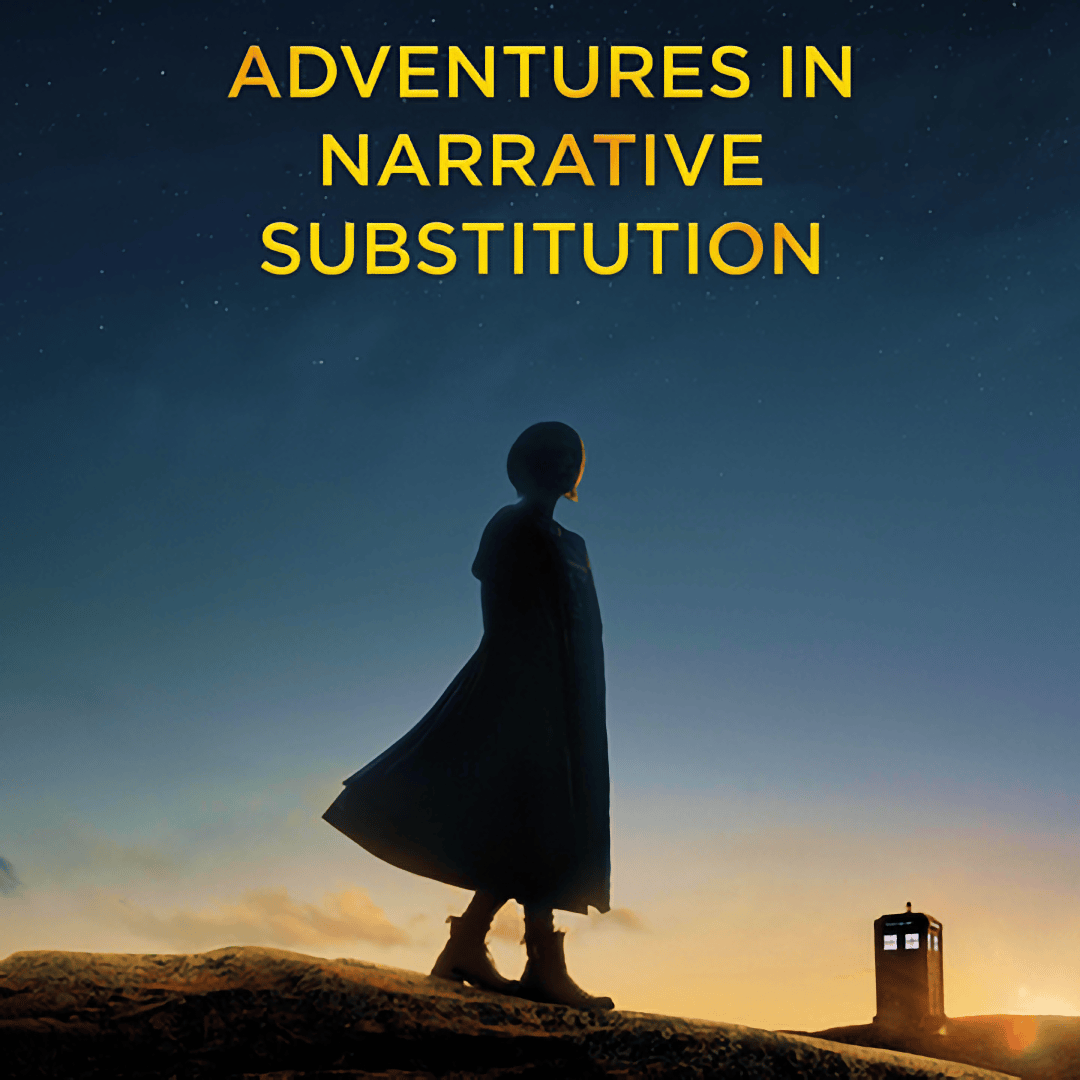
Well, no. Actually, they’ll get money and be transported off-planet, and the loser will get to starve to death in the middle of an alien landscape that contains allegedly murderous water, evil drapery, and killer robots that make the Stormtroopers look like Katniss Everdeen. But at least the sunrises are nice. (Incidentally, that instantly iconic image of Jodie’s Doctor in silhouette on a hilltop was captured by one of the actors in this story with their iPhone.)
One would imagine that a story of this type would be a good opportunity for some character development, and there issome. Except it happens to our guest characters who will never appear again after this story rather than to the three other people listed in the lovely new credit sequence designed by the guy who did the black hole effects in the Series 10 finale. All we really learn about the Fam is that Yaz’s family apparently drives her bananas, which is more than a little generic. Relatable, sure. But generic.
For our guest characters, we learn that Epzo’s mother is exceptionally abusive, and Angstrom has a dead wife (yay, offscreen gay-burying!) and her home planet is presently undergoing racial cleansing. She wants to win the race to help her family out, Epzo wants to win it because he’s a pompous ass.
If I were a betting woman, I’d bet on Angstrom winning, but I won’t because despite this allegedly being a contest, there isn’t any actual racing being done. Instead, it’s a group romp that ends with Angstrom and Epzo being declared dual winners, and then the aliens all get the hell out of Dodge so the Doctor and friends can discover what the mysterious Ghost Monument is. (It’s the TARDIS, and we find this out in around 10 minutes, completely sapping any momentum the story might have had.) Announcing you’re going to tell one story (an evil version of The Amazing Race, like an uninteresting version of the killer game shows from ‘Bad Wolf’/’Parting of the Ways’) and then not even trying to follow through is not narrative substitution, just bad writing.
***
Where ‘The Ghost Monument’ is a black hole of utter emptiness out of which neither light nor the experience of being entertained can escape, ‘The Beast Below’ and ‘The Ark in Space’ are stories filled with interesting things. Indeed, both stories even share a couple of common links: they are both about human societies attempting to survive in space following the roasting of the planet by solar flares in the 29th century, and empires.
In the case of ‘The Ark in Space,’ Noah (the one-time leader of the humans who has been changed into a Wirrn, a creature that is essentially a giant ant) explains in episode four that:
“Long ago, long ago, humans came to the old lands. For a thousand years, the Wirrn fought them, but you humans destroyed the breeding colonies. The Wirrn were driven from Andromeda. […] Since then we have drifted through space, searching for a new habitat.”
The way Noah tells it, the whole affair sounds like a bunch of humans screwing over the native population of a place, a concept that describes every empire that has ever existed going all the way back to fucking Ancient Rome.
Not that the Wirrn have their appendages clean either, that is. They’ve decided to get back at the descendants of their colonizers by colonizing them right back, by which I mean take over the Ark and transform every last cryogenically frozen human in the place into a Wirrn too so they can then use Earth as their new breeding grounds. After all, as the old saying goes: “If you can’t beat them, change them!”
The Doctor stops them, of course, because they are evil monsters made out of green bubble wrap, and the story ends with Vira (who has been promoted to leader of the humans thanks to Noah getting himself turned into an ant) going off to wake up the rest of her kind so they can return to Earth and presumably resume that species’ history of screwing over everyone who is different from them. Yay, humans.
Though this brings us back, I suppose, to the Stenza. In The Ghost Monument, the Doctor reads out a message left behind by the natives of Desolation, and what she reads sounds more than a little fascist:
“We are scientists. Abducted, tortured and made to work, while our families are held hostage. We are forced to find new ways of destruction. Poisons, weapons, creatures. We gave them our minds and they made us the creators of death. This planet has been left scorched and barren from our work. The atmosphere and water are toxic. Killing machines and creatures inhabit every corner. We had no choice but to obey… The Stenza.”
In the space of one paragraph of exposition, the Stenza now have a point. They are not merely alien bounty hunters, but fascist alien bounty hunters, like the alt-right, only blue [Ed: So, the Tories]. Given the state of global politics at the time this episode aired, with hard-right governments springing into life in alleged democracies like Brazil, Hungary, Poland, and the United States, one could almost read the Stenza as being an allegory for global politics. We could even say they were trying to build an empire, like the future humans of ‘The Ark in Space,’ or keeping the one they had afloat, as in ‘The Beast Below.’
But that wouldn’t be right, because, after that paragraph of exposition, the Stenza only appear one more time, and even then it’s just Tim Shaw back for revenge. After ‘The Battle of Ranskoor av Kolos,’ they completely disappear from the series like they were never there in the first place. If you thought they’d be that season’s arc villain, no such luck. (Of course, it’s not as though the actual attempt at an arc was any better.)
Where empires go, fascism follows. Well, eugenics in the case of ‘Ark,’ but considering how the Nazis work, the two concepts go hand-in-hand. Noah himself claimed in episode two that “our genetic pool has been balanced, cross-matched, compat-evaluated,” so it’s not a stretch to say there’s something fascist afoot when ‘The Ark in Space’ itself says the Ark program itself is built upon eugenics.
Oh sure, the Doctor talks about “all of humanity” being present on the Ark and specifically refers to “all colors, all creeds,” as if he were on the bridge of the starship Enterprise (the original, you might say), but that doesn’t change the fact that of the four Ark people shown on screen, 100% are white Brits. This was not Holmes’ intention (he wanted Vira to be black), but Rodney Bennett overrode him.
On the other side of the coin, you have Starship UK, now down to England and Northern Ireland. Scotland is said to have wanted its own ship in a neat prediction of the Scottish independence referendum, and while Wales’ fate is never remarked upon, we can pretend it went to join Spaceship European Union out of revenge for the whole Brexit thing. [Ed: I suppose the North just didn’t want it enough.]
Unlike the Bright and Shiny Ark of Aryans, Starship UK is a grimy floating junkyard built out of cannibalized remains of its own iconography, from the design of the Vator signs resembling that of the London Underground to the ship logo looking exactly like the BBC TV logo of 1963. It at least has more non-white people than the Ark does (INCLUDING THE BLOODY QUEEN!), but one has to wonder that if the two ships are contemporaneous (and they might be, given the solar flares and the fact that SS UK and the Ark were built in the 29th century), how did they decide who went where? Did the Ark leave first, and SS UK was built by everyone who didn’t pass the examinations? The world may never know.
Starship UK is also, being the remains of an empire, a police state. The Doctor even says as much: “Secrets and shadows, lives led in fear. Society bent out of shape, on the brink of collapse.” And why are things so awful? Because the British government is engaged in a cover up that goes right to the very top, and absolutely everyone (or at least the over 16s) is an accomplice. This makes Watergate look like small potatoes by comparison. You don’t get much worse than “We enslaved an alien creature so we could escape our burning planet, and then we made the entire voting population of Britain forget all about it for three hundred freaking years.”
All of this is exceptionally deep and interesting stuff, especially for a family show. Sure, the Doctor is a character built out of colonialist tropes and who is, by virtue of being written by British writers and played by various British actors, a British character, but part of what makes them so interesting is how often they rebel against the oppressive system they benefit from. (See: the barn stuff at the start of ‘Hell Bent,’ and the Doctor’s stare down with Rassilon.)
But ‘The Ghost Monument’ doesn’t do any of that. There is no further exploration of the Stenza and their imperialist tendencies, and while this is the episode where the Timeless Child thing is brought up, the less said about that godawful clusterfuck of an “arc” the better. (Besides, that’s another post.) Instead, the Doctor is revealed as a passive figure, completely refusing to do anything about Art Malik’s character. There is no actual day to save, just 50 minutes of our regulars and the two guest characters wandering around the (admittedly spectacular) South African landscape.
There are no stakes. There is never a sense of panic as a bunch of characters try to stop giant ants from taking over, nor is there a sense of bristling anger as the Doctor uncovers what atrocities his favorite species has come up with now. All we have is some water that we are told is toxic but no one actually dies from it, evil whispering drapery, and robots who can’t shoot.
You might have noticed I haven’t talked about the companions very much so far. This seems a strange omission given that, ever since ‘The End of the World,’ the function of a second episode in most seasons of the show has been to showcase the companion just as the premiere episode showcases the Doctor. ‘The Beast Below’ is Amy’s showcase moment, and ‘The Ark in Space’ is Harry’s, sort of. ‘The Ghost Monument’ should be this for the Sheffield Trio, but as ever, there is a problem, succinctly defined as ‘Chris Chibnall doesn’t seem to care very much about them except Graham.’ Yaz and Ryan may as well be named Exposition and Comic Relief for all the stuff they get to do.
Well, okay, that’s unfair. There is that scene where Ryan tries to shoot at the killer robots like he’s playing Call of Duty, which is brilliant partially because it comes out of fucking nowhere and also because Tosin Cole is good at physical comedy, but poor Mandip Gill is given precious little to do except ask questions and spout off descriptive dialogue as though she was in a Big Finish audio instead of actual fucking television.
Indeed, Chibnall’s absolute failure to give Gill any usable material isn’t isolated to this single episode; it’s spread throughout the entire season. It gets a little better in Series 12, but that season is also the one where the Doctor and her companions are separated from each other more often than they’re together for most episodes, which is an odd way to juggle having four lead characters.
Indeed, the best possible amount of lead characters you can have is about three. Any more than that, and at least one person has to be sidelined to make more room for everyone else, either on a temporary basis, such as whenever someone would go on vacation for an episode during the Hartnell era, or a permanent one, as when the initial group of Troughton companions – Ben, Polly, and Jamie – were whittled down to just Jamie and Victoria at the end of season 4. Quite why Chibnall attempted to have three companions for two seasons in a row is beyond comprehension.
There’s no question that ‘The Ark in Space’ gives Harry and Sarah Jane more to do, with Harry mainly being paired off with the Doctor while the more experienced Sarah gets to have an adventure of her own as an accidental space colonist. And of course, in ‘The Beast Below,’ Amy shares her role as main companion with Mandy (the little girl she meets and talks to while unlocking a padlock) and Liz Ten.
Now, it’s just possible that I’m being unfair to Chris Chibnall here. Prior to this story, he’d written only a small handful of scripts for the series: ’42’ in 2007, ‘The Hungry Earth’/’Cold Blood’ in 2010, plus ‘Dinosaurs on a Spaceship’ and ‘The Power of Three,’ both in 2013. Say what you will about those stories (and maybe the guiding hands of Russell T Davies and Steven Moffat had something to do with it), but I’d hazard a guess that all of them do a much better job at juggling large casts than ‘Ghost Monument.’
The best solution would have been to take out the three guest characters and do something like a modern remake of ‘The Keys of Marinus,’ focusing entirely on the four leads and allowing we the viewers to get to know them better, especially considering that in this case, Graham, Yaz, and Ryan are only with the Doctor in the first place because they got caught up in her jury-rigged teleporter. If we’re really going to do a contemporary version of the early Hartnell era, have more obvious distrust between Doctor and companions than a few token lines at the beginning that are then entirely ignored.
Then again, if ‘The Ghost Monument’ were a better story, I wouldn’t be writing this.


Leave a Reply