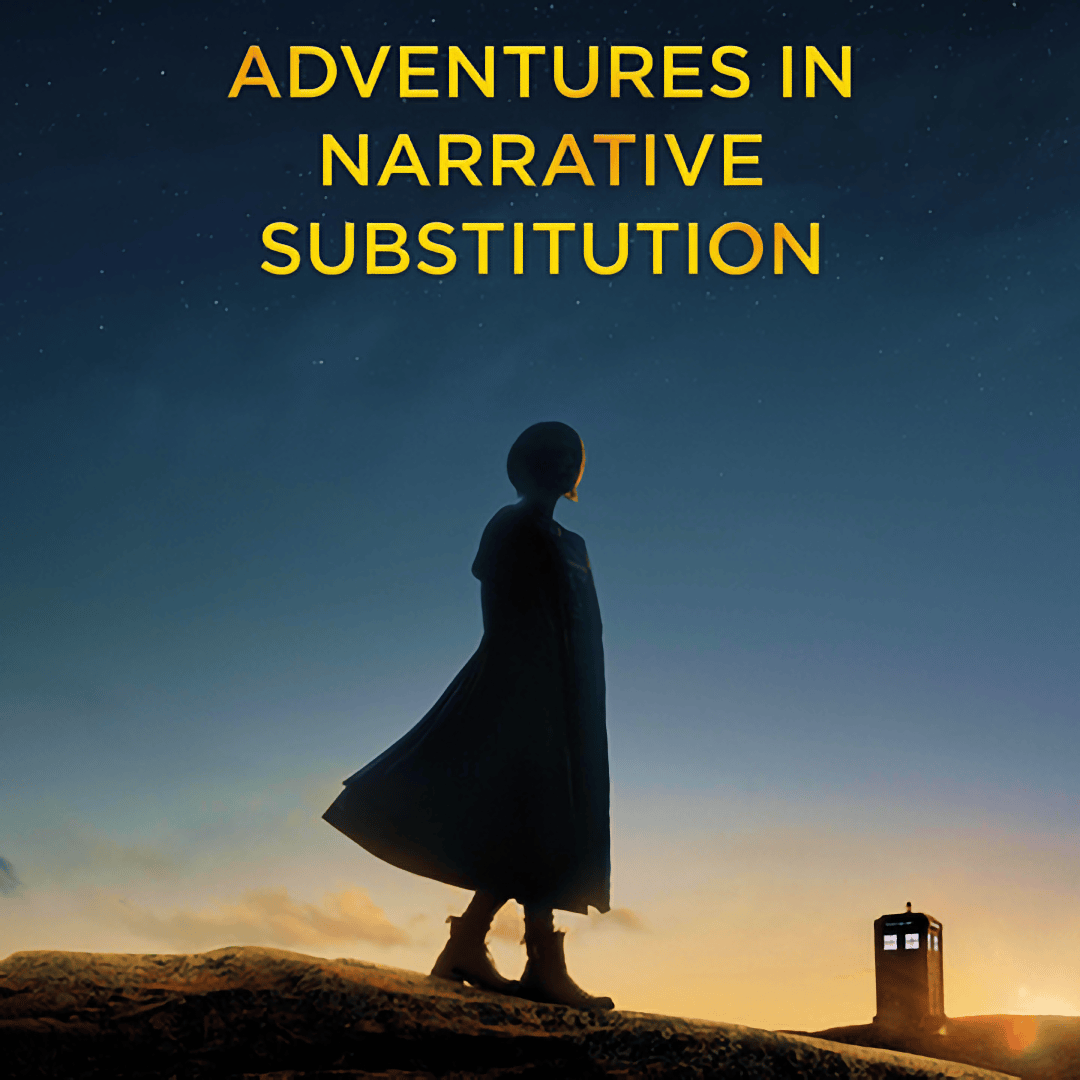
Welcome back to Adventures in Narrative Substitution, the blog series that believes the Chibnall era isn’t all that it’s cracked up to be and helpfully recommends alternative stories to watch instead. Since we took our break in September 2021, quite a lot has happened within and without the world of Doctor Who: First off, Russell T Davies was announced as the “new” show runner from 2023 on, making him the Who equivalent of Grover Cleveland, the only US president to serve two nonconsecutive terms. (Let’s hope RTD’s second administration ends with higher approval ratings than Cleveland managed.)
I have mixed feelings on the return of Davies. On the one paw, Davies’ return guarantees I won’t need to write a blog series similar to this in the future, and speaking as a member of Canis lupus, I am extremely pleased that the show I love will be safe in the talented paws of Jane Tranter, Julie Gardner, and the rest of the team at Bad Wolf Productions. Furthermore, Davies has grown a lot as a writer since 2005, and I have every expectation his second era will be very different from his first.
On the other paw, the fact that Davies is returning does not speak well with regard to the show’s current health, and that’s what this series will try to focus on as we move closer to the end of the Chibnall era: the rapid cratering of the show’s fortunes, and the BBC’s last minute Hail Mary pass. (Or should that be Hail Verity?)
In other news, Series 13 happened, I publicly broke up with the show as the last remaining shreds of patience I had snapped once and for all, I finished writing the second Back to the Eleventh Hour book, (available April 2022 from Arcbeatle Press) I started HRT, and I became a girlfriend to an amazing woman who has never seen Who before. Yes, really. (I’ll soon fix that.)
So anyway, let’s talk spies. I’m going to be nice to Chibnall here and say that doing a Bond pastiche at a point when Bondmania is in the air again thanks to No Time to Die was, on the face of it, a smart move. Sure, the movie got delayed a bunch due to a terrifying respiratory disease that hit worldwide pandemic levels about ten days after the finale aired, but that’s not Chibnall’s fault. Dude has his finger on the pulse of pop culture, and there is no shame in doing the Doctor Who version of whatever the big popular thing is.
In the case of Bond, there’s even precedent for this: the Pertwee era was steeped in Bond homages, up to and including the fact that Jon Pertwee himself worked with Ian Fleming during the second world war making gadgets and things. Add in the car chases, the vaguely Blofeldian character of the Master to the Third Doctor’s Bond, more gadgets, and the Doctor’s status as a British government employee, and you have a rich history Chibnall is tapping into for Spyfall. (And, well, who am I to begrudge someone for recreating the era they loved as a kid?)
For the first half, Spyfall even works well as a Bond pastiche; the cold open featuring various other spies get killed while on the job is lifted straight out of the 2008 Get Smart movie, a film that owed as much to Bond as it did to its source TV show. The Doctor gets to wear a tux, introduce herself in Bondian style, (though Jodie’s reading of the line botches the effect a bit) have a vehicle chase, match wits with a villain, and even get a mission briefing from an MI5 agent with a single letter codename: Stephen Fry’s C. We have all the makings of a genuinely good opening to the series, surely he can stick the landing, right? RIGHT?!
Unfortunately, as Lemony Snicket used to say, that’s not how the story goes.
One of Chibnall’s many flaws as a writer is a belief that if you can pack a script with lots of ideas and concepts, that means you’ve got a better story than someone with just a few ideas and concepts. The problem is that if you have too many balls in the air at one time, and you’re not really good at juggling, one or five of those balls will hit you in the face. Sure, Steven Moffat was known for packing his own scripts with ideas that on their own could power an episode or three, but one thing people sometimes miss about that is that he always had one central concept that animated everything else. Strip away the hijinks involving electrified chess, carnivorous skulls, and Winston Churchill riding a Woolly Mammoth, and The Wedding of River Song becomes a story about a woman trying to save the man she loves from certain death.
Just in Spyfall we have a Bond pastiche that also wants to be a commentary on Silicon Valley tech companies doing their best to rule the world via end user license agreements no one reads, and in part two, even more also a time-twisting adventure in history as the Doctor pursues the Master (male again and played by Sacha Dhawan, but at least he still rocks purple) from the 1800s to 1940s Paris. That’s a lot of stuff to throw at the viewer, and virtually none of it lands. Chibnall’s other maxim of always having something to cut to at least keeps things from getting too boring, at the expense of his ideas ever getting a moment to breathe. (Although, looking back at Lenny Henry’s Evil Steve Jobs keynote address, it’s probably just as well, as if the third season of Broadchurch is any indication, Chibnall’s understanding of technology hasn’t really budged since the Bondi Blue iMac came out. Real boomer of a Gen X’er, that guy.)
For an idea of what Spyfall could’ve been like, let’s look at The Impossible Astronaut/Day of the Moon. Like Spyfall, it’s a two-part series premiere that aims to be ambitious and daring after a season of playing it safe, and even contains many a homage to spy fiction, though Canton III working on a mission for President Nixon owes more to The X-Files than it does to 007.
Unlike Spyfall, what makes Astronaut/Moon sing is the emotional connection to its characters. In this case, the story opens with the Doctor being shot by the titular astronaut while River, Amy, and Rory are there to witness it. Amy is devastated at the sudden loss of her childhood friend, the younger Doctor is suspicious when his companions refuse to open up to him about who sent the envelopes, River is furious when the Doctor comes back apparently alive, and in part two, Rory is justifiably put out with the Doctor when Amy gets kidnapped by the Silents.
It should go without saying, but foregrounding your fiction work in the emotions of the characters you’re writing about is an important part of crafting a good story. Chibnall didn’t have a problem with this when doing Broadchurch: half of the drama in that series comes from the town’s reactions to the death of Danny Latimer, and their interactions with each other as Officers David Tennant and Olivia Colman search for the murderer. For crying out loud, the entire second half of Chibnall’s own Silurian two-parter in Series 5 is partly about what happens when Ambrose murders Restac’s sister! We know Chibnall understands how emotions work in other contexts, so why does he completely drop the ball in his own era?
Consider the very end of Spyfall‘s second episode: the Doctor returns to Gallifrey after the Master tells her he razed the place, and sure enough, all she finds is a bombed out ruin. Later, her companions confront her on it:
YASMIN: You okay? You’re really quiet.
RYAN: Yeah. You have been for days now.
GRAHAM: They’re right. Five planets, you’ve barely said a word.
DOCTOR: I’m fine.
GRAHAM: Why don’t you ever share anything with us?
DOCTOR: I share stuff.
GRAHAM: Not about yourself, though.
RYAN: Yeah, you know everything about us.
YASMIN: And we know nothing about you.
GRAHAM: Mmm.
DOCTOR: Fine. What do you want to know?
GRAHAM: Who are you, Doc? I mean, really.
So much telling, not enough showing. At the time, I took this as Chibnall’s attempt at resetting the board to where it had been at the beginning of the Davies years: Gallifrey destroyed, and the Doctor as one of the last of her kind, except that when the Time War is introduced, the Ninth Doctor doesn’t just tell Rose what happened, the pain he went through is written all over Christopher Eccleston’s face, and the mouth-foaming fury when he yells at the Dalek makes it even more clear.
Jodie Whittaker does her best to make it all work, but to be perfectly honest, she shouldn’t have had to. If we’re going to go back to What Worked In 2005, the first thing Chibnall should’ve done was focus in more on the companions realizing the Doctor isn’t in a good mood, and spread that out throughout the episode rather than shoving it in for the last five minutes.
But of course to do that, Chibnall would also have needed to not split the companions away from the Doctor for a large chunk of the episode. The Fam end up spending most of episode two away from the Doctor on modern day Earth still doing Bond stuff with Lenny Henry, in direct contrast to Astronaut/Moon, where the Doctor is pretty much always with at least one of his companions for the entire story. I don’t really believe Chibnall gives a shit about the companions, but this isn’t the time for that line of criticism.)
So instead, let’s talk villains: there are, for some reason, three of them in this episode. There’s Daniel Barton, a Silicon Valley tech CEO that is probably supposed to be the equivalent of Facebook or Google, the Kasavin, a bunch of extra-dimensional aliens who came to Earth to do… something vaguely threatening, and the Master.
Since we haven’t dealt with the character yet in this series, a quick review: the Master, like the Doctor, is a Time Lord and travels around the universe in a stolen TARDIS, but he usually seeks to take it over rather than just be a tourist. He was introduced in Terror of the Autons, the first story in Jon Pertwee’s second season as the Doctor and originally played by Roger Delgado.
The character as Delgado played him was supposed to be the Doctor’s best friend turned to darkness, and it pops up quite frequently during the stories Delgado is in. He and Jon Pertwee were quite close, which provided their characters’ friendship with more realism. The Doctor admits to Jo at the end of part 4 that he’s looking forward to their next meeting, and who can blame him? These two are like the 1970s equivalent of Catra and Adora!
The friendship angle came and went as the years went by. Different Doctors came and went, while the Master was quietly retired for a while following Delgado’s death in 1974, the character returned properly in 1981’s The Keeper of Traken, where he became a melodramatic ham, with some admittedly gay subtext in Anthony Ainley’s stories against Peter Davison’s Fifth Doctor.
It wasn’t until 2014 when the character returned to something like the Delgado mode, but with a twist: the Master was now a woman, referred to as Missy (short for Mistress) and played magnificently by Michelle Gomez. When asked why she turned the dead humans of Earth into Cybermen to give the Doctor an army, she replies, “I need you to know we’re not so different. I need my friend back.” And, two seasons later, she almost gets her wish, though not in the way she’d imagined.
When this story aired two years ago, I wasn’t sure what to make of Sasha Dhawan’s Master. I’d adored Missy, and wasn’t sure how Chibnall would follow up the end of her arc on the show, if he did at all. And for the first half of Spyfall, it seemed like Chibnall was doing the character right: having him pretend to be human and a friend of the Doctor’s? Straight out of the Pertwee playbook. What I didn’t expect was for him to, after the big reveal, elect to crank the character back to the hyperactive man child that John Simm’s Master had been back in the Davies years, albeit with a South Asian guy in the role rather than a white person.
Then we get to episode two and everything goes completely off the rails. Ordering the Doctor to kneel to him in what felt like an attempt at recapturing the dynamic of Tennant/Simm without the homoerotic undertones made me viscerally uncomfortable (Dhawan is two years younger than Whittaker for fuck’s sake) but frankly, that’s nothing compared to what Chibnall has him do after they ditch the 1800s. The Doctor follows him to Paris during the time of Nazi occupation, and they chat on the Eiffel Tower while he’s dressed up in Nazi cosplay. Bear in mind that the Master, at the present moment, is not white in the goddamn least, as far as the viewer is concerned.
Here’s the thing: There’s tastelessness, and then there’s being willfully blind to the implications of your own writing. It should have been screamingly obvious to anyone, once the decision to cast Sacha Dhawan was made, that putting him in a Nazi uniform was an objectively bad visual. But what really takes it over the edge for me is having the Doctor allow the Nazis to capture him, and presumably cart him off to a concentration camp like Dachau, where Noor Inayat Khan was executed. (The production team even went so far as to film that execution, but ultimately it never appeared in the finished episode… FOR TIMING REASONS.)
At a basic level, I can understand what Chibnall was going for: something akin to what the Doctor does in Day of the Moon, when he hacks the moon broadcast to place a post-hypnotic suggestion on the viewing audience to get them to kill the Silents… except that the Silents are fictional aliens as opposed to very real mass murderers, and weaponizing racism even in the name of “the greater good” still means you’re letting racism slide.
The audio commentary provides some idea of what went through Chibnall’s mind when he wrote the first scene with the Master in Nazi cosplay:
JODIE: “I think this is- we were chatting about this, for [the Master] putting that costume on, it’s a really – it sends such a shudder down yourself as the actor and also to see it on somebody as well… it’s just – y’know with hindsight it’s such a symbol of such a horrific moment-
SYLVIA BRIGGS [Ada]: there’s so much weight to it just by him wearing that costume- JODIE: yeah and for him to put it on, y’know, it’s so dark-
CHIBS: I definitely weighed up sort of whether you could do that or whether that was tasteless or whether that was –
JODIE: it wasn’t.
CHIBS: I think it’s that thing of the symbolism of it being – and actually gives the Master that absolute sense of evil that he will treat it as a dress up –
JODIE: Yeah! Yeah, he does –
CHIBS: and actually that’s what makes it worse-
JODIE: Sort of a reflection of him.
CHIBS: Exactly, yeah, yeah.
Your eyes are not deceiving you. If you don’t believe that happened, pull out the DVD and watch episode 2 with the commentary track turned on, as my friend TomeDeaf did so I could have exact quotes to work with for this post. (Thanks Tome!) He really is more concerned with the “symbolism” of Nazi cosplay on the Master. I don’t particularly care about the in-universe justification, putting the Nazi outfit on doesn’t tell us anything we didn’t already know about the character, or at least, Chibnall’s conception of him.
What I do care about is how the Nazis are used. They were real people, responsible for the deaths of 29 million innocents, and they should not be used as “symbolism” for your cheesy British sci-fi show. That’s what the Daleks are for. But what you absolutely under any circumstances should not do is HAVE THE DOCTOR CALL THEM IN TO ARREST THE MASTER. ABSOLUTELY FUCKING NOT.
The moment I saw that, I wanted the show cancelled. I’m sorry, but if that’s how you have the Doctor stop the Master, by calling the fucking Nazis on him, you have comprehensively failed to grasp how this character works and should not be allowed anywhere near it again.
I have a lot more to say on the subject of Chibnall and race, but suffice it to say that there is a deeply ugly rot at the heart of his era, and this is one of the worst symptoms. Spyfall part 2 is ethically bankrupt television, and it poisons everything around it. So much like Kerblam!, I can’t in good conscience praise it for everything it does well when something like this is there, waiting to attack.


Leave a Reply