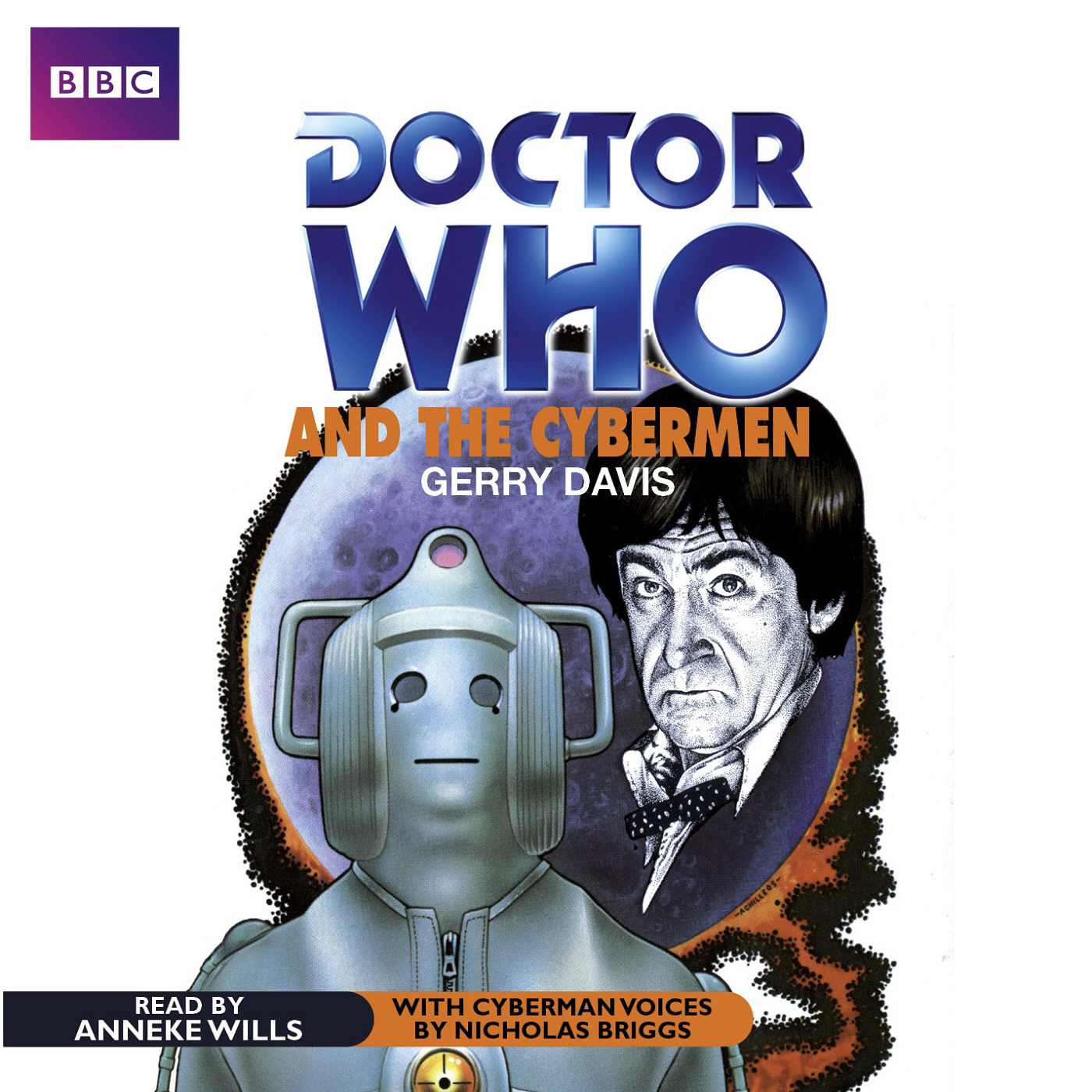
It took me ten years to finish reading this book. This was not on purpose; when I first discovered it in the long-ago age of 2007, I was approximately 13 years old and in middle school. I had an inkling of what Doctor Who was, but before this moment I had not interacted with any particular story. I was going in more-or-less blind, with no idea of how things would turn out.
I found the book in my middle school library. Exactly how in the world such a place managed to get three old Target paperbacks is beyond me, but I very specifically remember the covers: Cybermen had a picture of two Cybermen and a star field with the 1980s neon logo at the top, Curse of Peladon had a brown diamond logo with a drawing of Jon Pertwee’s face on it, and Green Death had a drawing of a fly with the green maggots on the bottom.
What I also remember is managing to misplace Cybermen when I was about halfway through the book, rendering it missing, much like the TV story it adapted: The Moonbase, from 1967. I never found it again, though I searched every classroom I could. I’ve long suspected it ended up in the room belonging to my seventh grade math teacher, but that’s just a theory. In any event, I had to replace the book with something, so I went with a children’s book about Lewis and Clark’s dog. (Not exactly an equivalent exchange, but what else could I do?)
With nothing else to do, I proceeded to read the other two books I’d found (which I did not lose) and eventually became a fan of the show. I finished middle school, went on to high school, and then college, whereupon I regenerated into a woman about two years before the Doctor did. (Long story.) It was not until 2017 that I finally managed to get my paws on a copy of Cybermen again, this time in the Kindle edition of the book’s 2011 reprint. Finally, I could finish the story.
The book starts off with a prologue explaining the creation of the Cybermen, which makes for a clunky read, to say nothing of the fact that it gets their planet of origin entirely wrong, though honestly that’s not so bad in light of The Doctor Falls. But do I really need to read that the Cybermen “have the strength of ten men” when similar phrasing pops up in a later chapter? No, I sure don’t.
On a related note, I have to talk about Davis’ inclination toward tangents regarding his characters. that have no bearing on the story whatsoever. He writes, for example, in chapter 4 about a new respect Benoit apparently feels for Hobson… which then entirely fails to show up in the rest of the story. I’m not opposed to tangents and asides if they have some purpose to them, but they have actually matter to the story for me to enjoy them. Paul Cornell, for example, spins up a background for one of those two guys in New Zealand at the start of his Scream of the Shalka novelization: Drawing upon his own time in New Zealand when the animation was being made, Cornell has his character consider moving there only to get killed when the meteor containing a Shalka arrives.
Davis doesn’t do anything like that, or at least not as effectively. The alleged new respect I mentioned might have come across better if, for example, Hobson got hit by the contaminated sugar in chapter 7 instead of Bob, a character named and introduced solely for that one scene. If Hobson had been in Bob’s place, Benoit would’ve been forced to become the base commander, as was hinted at in chapter 3, but no such luck.
On the bright side, I like how Davis elected to update the story from the mid-1960s to the mid-1970s, entirely so Ben and Polly can mention the Apollo 11 landings in 1969, which happened around a month after The War Games ended. Davis’ description of Ben, Polly, and Jamie bouncing around on the moon is fun to read, not least because of Jamie’s sheer incredulity about where they are. (Such a shame he spends most of the story in bed.)
Then there’s the character of the Second Doctor. Being a die-hard Eleventh Doctor fangirl, I can very easily see the bits of his character that Matt Smith latched on to when preparing for the role. The scenes in Chapter 6 where he wanders around the base’s main area being a complete nuisance as he collects his evidence is delightful, reminding me of how Eleven goes about exploring Starship UK by doing things like putting someone’s glass of water on the floor and talking about escaped fish.
But what really sticks out to me is seeing the Doctor act like the Victorian scientist archetype he was inspired by, helping himself to the late Dr. Evans’ supplies in the medical storage room, putting slides under microscopes and looking at them, and determining that it’s not a disease we’re dealing with here, it’s conversion. It’s not often we get to see the Doctor be a scientist anymore, and I wish we did, because it’s a great thing.
Of the companions, it’s a mixed bag. Poor Polly gets saddled with having to do things like make coffee for the rest of the base, (not helping matters is that she’s the only woman in the fucking book) and compared to the TV version of the story, her character comes off as vapid and stupid, while the narration plays up the fact that she paints her nails and wears a mini-skirt. Not exactly “She breasted boobily” territory here (remember, this is a children’s book) but still, Jesus Christ.
Jamie gets short shrift as well, unfortunately. He was shoved into the story that the last second, so he spends the bulk of the story being laid up in the hospital. Ben probably comes off the best, but if I’m honest, I find him to be exceptionally annoying, so I can’t say I enjoyed his scenes very much.
Another thing that stuck out to me was the truly incredible amount of testosterone soaked in this book. The base staff are all men, and manly men at that. They’re manly men doing manly things like putting screwdrivers into things, turning them, and adjusting them! Men men men men men men! Yeeeesh! Most damningly of all, Polly doesn’t get to load up a fire extinguisher with her random mix of chemicals at first, despite it being her idea in the first place. Instead, Ben blows her off with a patronizing “Not you, duchess. This is men’s work.” (Luckily, she makes another batch and joins the boys anyway.)
I mean, okay, it’s early Doctor Who, there’s always going to be a higher percentage of men in a given story than women, and when women do show up, they’re usually going to either be twisting their ankles and screaming a bunch, or they’re straw feminists like how Sarah Jane Smith was often written as in the 1970s, saved only from the junk heap of history by people like Elisabeth Sladen, Katy Manning, Jacqueline Hill, and Anneke Wills refusing to let that bullshit stand.
While the reprint’s dedication to presenting the text largely as written in the 1970s is admirable, I kind of feel like at least a little bit of editing might have been helpful, mostly in regards to the book’s use of the R-word in chapter 8:
“The first Cyberman was obviously bored with the conversation. No wonder humans were so retarded when they talked in this ridiculous way. ‘It is unnecessary,’ he said flatly. He turned to the second Cyberman. ‘Keep a close watch on them.”
Fucking hell. I mean, I know, it’s the 1970s, but you know what? That’s not a fucking excuse. The R-word is a slur. It was a slur in 1975 and it’s a slur today, and people stilluse it. It’s fucking wrong, and it shouldn’t have been in a Doctor Who book in the first place.
Even so, this does bring up an important question: Would editing the word out have done a disservice to Gerry Davis? Personally, I don’t think so. It’s one thing when Mark Twain uses the N-word 219 times in The Adventures of Huckleberry Finn; Twain was anti-racist and had his white characters use the word repeatedly in order for people to understand why it’s so wrong and hurtful.
Gerry Davis isn’t doing anything like that, he’s just using it as a way to express a Cyberman’s attitude toward humans. There are plenty of other words Davis could have used, and he chose the wrong one. As Twain once said, “The difference between the almost right word and the right word is really a large matter – it’s the difference between the lightning bug and the lightning.” Editing the text, and maybe placing an explanation in the “Between the Lines” chapter, would have been the better move.
I wasn’t just content with just reading the book, of course. I also listened to the audiobook, which came out in 2009 with Anneke Wills (Polly in the original TV story; The Moonbase) on narration duties, with go-to monster voice man Nicholas Briggs reading the Cyberman dialogue, complete with ring modulator.
Listening to an audiobook is an entirely different experience from simply reading the words on the page, and when paired with the right narrator, it can make some of the roughest prose sound interesting and engaging. Case in point: Wills’ take on the opening prologue. Reading the text myself was a bit of a chore, but hearing her performance of it, with all the pauses and inflections and things an experienced actor can do instinctually, made it zip by.
What I also like about the audio version: the inclusion of music and sound effects. A tense musical score mixed with the TARDIS engine noises makes the tumultuous opening of the second chapter take on new life, while sections where Wills narrates the Cybermen threatening the occupants of the base alongside Briggs in chapter 7 makes the book almost seem more like a play, rather than simply a straight reading of a story. (Note: the Cyberman voices heard are the same style as the Cybus models from Series 2, rather than the more generic robot-like delivery in the original TV episodes.)
To sum up, while I would say the story it’s adapting is a very good early Troughton one, Doctor Who and the Cybermen is not exactly a favorite book. I will give it credit for introducing me to the series, of course, but I have to deduct points for the sexism, Ben’s sheer existence, and the obsession with men doing manly male things. His prose is readable, but I find it works better when read by Anneke Wills than just read on its own.
One last thing: if the BBC ever decided to remake this story, it’d be a great Series 6-era Matt Smith episode, especially if made in black and white. I’d definitely watch it!


Leave a Reply