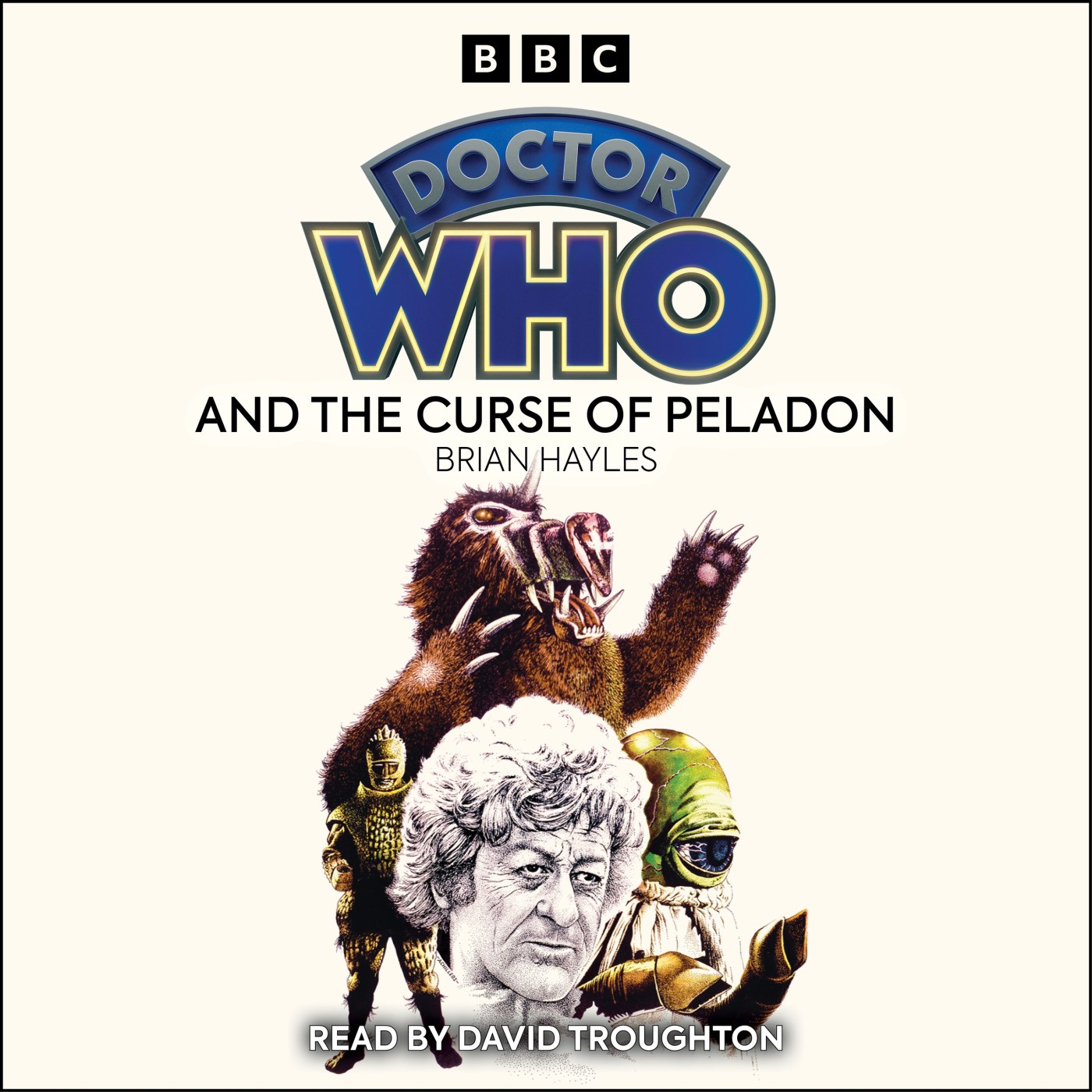
The very first Third Doctor story I ever found was, in fact, this very book. Released in 1975, it novelizes the TV story The Curse of Peladon from 1972. And unlike the book we looked at last time, I actually got to finish it when I got my hands on the paperback in seventh grade. Unfortunately, the book hasn’t been reprinted since 1992, so this review will instead be based on the audio edition, released in 2013.
The first word I would use to describe Brian Hayles’ prose style is flavorful. If Terrance Dicks is the master of beige prose, Brian Hayles is more florid and descriptive. Here, for example, is his description of the TV story’s opening shot of a castle in the middle of a thunderstorm:
“The electric storm clawed and tore its way across the night sky like a wild animal, flaring suddenly into ripples of lightning more eerie and majestic than the three moons of Peladon. The harsh wind, drowned only by fitful claps of ragged thunder, howled and keened through the crags and passes of Mount Megeshra while, far below, deep-shadowed valleys and canyons echoed and re-echoed to the almost continuous shudder of sound. Yet another blaze of light flowed across the torn sky, silhouetting the mountain peak. A mighty granite-stoned castle became starkly visible before slipping back into the darkness, its pointed turrets challenging the night. It was the Citadel of Peladon.”
If Gerry Davis’ writing felt like something more out of a 1950s pulp novel, Hayles feels more like Tolkien describing a similar thunderstorm in the fourth chapter of The Hobbit:
“All was well, until one day they met a thunderstorm—more than a thunderstorm, a thunder-battle. You know how terrific a really big thunderstorm can be down in the land and in a river-valley; especially at times when two great thunderstorms meet and clash. More terrible still are thunder and lightning in the mountains at night, when storms come up from East and West and make war. The lightning splinters on the peaks, and rocks shiver, and great crashes split the air and go rolling and tumbling into every cave and hollow; and the darkness is filled with overwhelming noise and sudden light.”
Add in, for example, the wind and thunder sound effects present in the audio edition of the book, and you have an engaging opening that immediately grabs your attention and forces you to keep listening. Say what you will about him as a television writer, (he is responsible for The Celestial Toymaker, AKA the Talons of the 1960s on the race front) but when it comes to prose, he’s very enjoyable.
Plot-wise, the story (both in novel and television form) resembles something straight out of the original Star Trek television series, specifically the second season episode “Journey to Babel”: there’s a Galactic Federation composed of a variety of species, and the plot of the story centers around the government of the planet Peladon trying to join this Federation even as opposing forces (namely, Hepesh, the royal priest) conspire to ruin everything. There’s even a couple of murders (one successful, one attempted) and a fight scene, just like the ones Captain Kirk was always getting into.
Of course, it’s not exactly like Star Trek. The Galactic Federation we see here isn’t anywhere close to being as well put together as the one Roddenberry came up with, given all the double-crossings and suspicion and commentary about how “primitive” the Peladon natives are. (Alpha Centauri has no room to talk, they’re a giant green penis with a cape!) And anyway, Star Trekhasn’t really got a figure like the Doctor, a one-person whirling mass of chaos and heroism, quite far away from a buttoned up officer like Kirk or Jean-Luc Picard.
Ironically, in this story the Doctor spends more time investigating the Ice Warriors and then trying to turn Aggedor onto his side to do much chaos, and anyway, the Third Doctor was never going to be that kind of guy.
On narration duties for the audiobook is David Troughton, son of Patrick, and the actor who played King Peladon in the TV version. For these audiobook readings, he typically gets the ones for stories that starred his father, which makes good sense as he can do a scarily accurate impression of him. This is his only Third Doctor audiobook, and while he does a good job differentiating most of the characters, (I particularly like his voices for the alien delegates, and of course he does a superb recreation of his own role as the king) his version of Three left me cold. It seems less Pertwee, more Generic Doctor with some Patrick Troughton flourishes.
I mean, don’t get me wrong: it’s still a good performance, and as with Anneke Wills, Troughton instills the text with more drama and nuance than just reading the words on the page would do, but it’s hard for me to picture Pertwee when I listen to the Doctor’s dialogue. If anything, it’s more like a glimpse into an alternate universe where Patrick Troughton had a tenure as long as Tom Baker’s. (If you recall his interactions with Jo in episode two of The Three Doctors, you’ll see what I mean.)
Looking back at The Curse of Peladon now, I’d say it’s at once a good example of what Doctor Who can be at its best in general, but it’s very much not the typical Pertwee story. But that’s okay! To the young 13 year old me who went into this not knowing what to expect, it’s as perfect an introduction to this wonderful show as could be hoped for.
Next time: environmentalism, maggots, brainwashing, the Brigadier, and Bessie?! It can only be The Green Death!


Leave a Reply