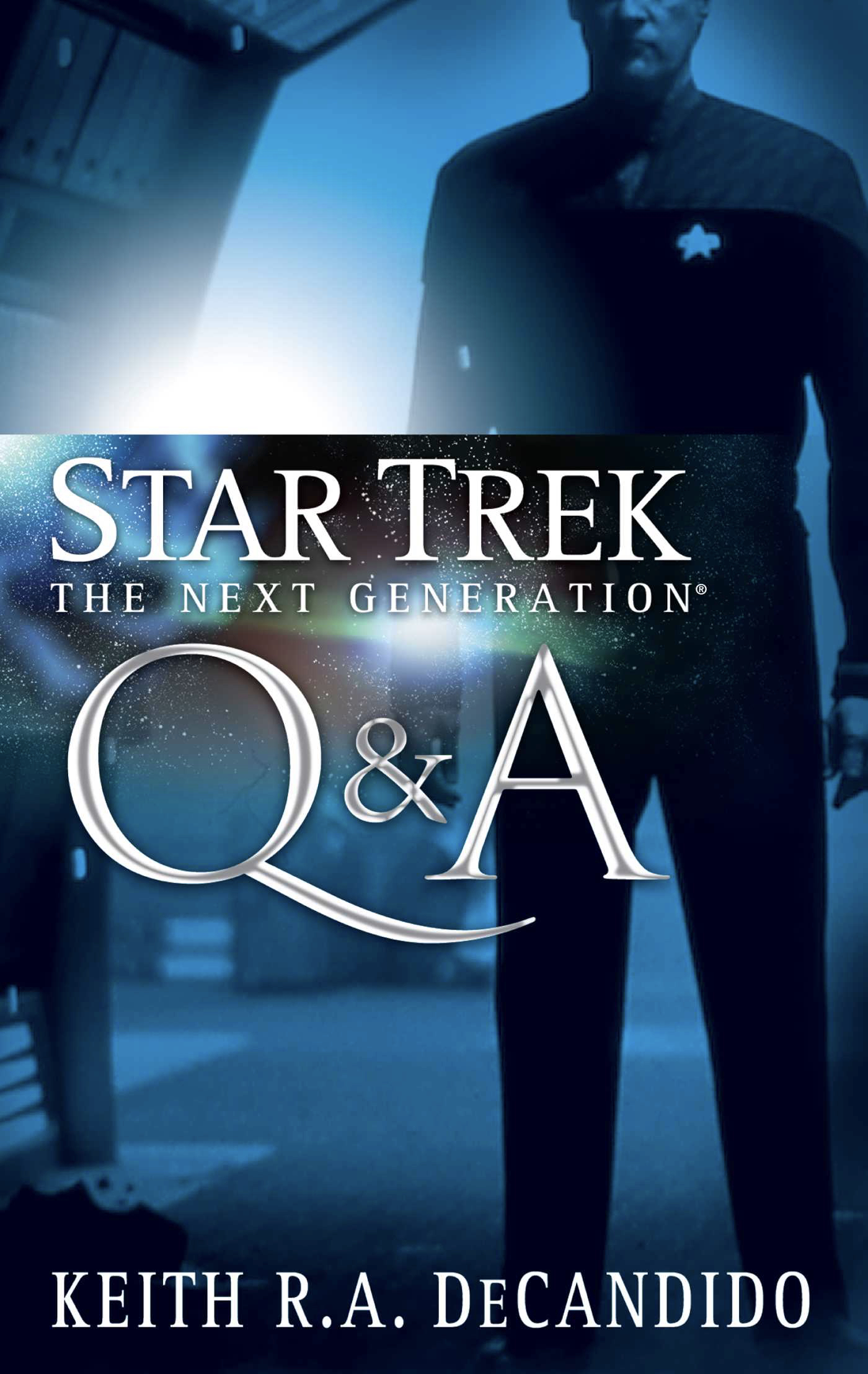
Q&A is a Star Trek: The Next Generation novel published in 2007, for the TV show’s 20th anniversary. It’s set in 2380, shortly after the events of the Nemesis movie, so about half of the TNG regulars (Troi, Riker, and Data) are on the Titan or dead, respectively. Worf has gone on to become Picard’s new Number One in Data’s absence, while the rest of the new crew are filled out with Miranda Kadohata at ops, the Vulcan T’Lana as counselor, and Zelik Leybenzon as security chief – book-only characters that do a lot to freshen up the dynamic aboard the Enterprise.
I liked all the new folks – crew rotation on this scale isn’t something you see a lot of on the Trek TV shows, for obvious reasons, but prose frees you up a lot, especially if you’re working in what was, in 2007, uncharted territory. (We’ll get to squaring this with canon later.)
The official synopsis:
Nearly two decades ago, Jean-Luc Picard took command of the USS Enterprise NCC-1701-D. The captain knew it was an honor without equal. His new command bore the name of Enterprise. The people who had commanded other like-named starships had gone down in Starfleet’s annals. Some officers would be intimidated, but they would not have been given command of Enterprise.
On her first mission, the Enterprise was sent to Farpoint Station. A simple, straightforward investigation. Perfect for a crew that had never served together. Then there was Q. An omnipotent lifeform that seemed bent on placing obstacle after obstacle in the ship’s – and in particular in Picard’s – way. And it hadn’t ended with that first mission. When he was least expected, Q would appear. Pushing, prodding, testing. At times needling captain and crew with seemingly silly, pointless, and maddening trifles. Then it would turn all too serious, and the survival of Picard’s crew was in Q’s hands.
Why was it today that Picard was remembering the day he took command of the Enterprise-D? Now he commanded a new ship, the USS Enterprise-E. His crew was different. There was nothing about Gorsach that in the least resembled Farpoint. But Picard couldn’t shake the feeling that something all too familiar was going on. All too awful. All too Q.
As the title indicates, this is a Q book, and if you’ve seen all of his appearances on TNG, then you know you’re in for a good time. DeCandido’s Q is absolutely spot-on, I could hear John de Lancie’s voice in my head the entire time. (Sadly, there is no audiobook version.)
Structurally, the book divides its time between scenes set on the Enterprise-E as Picard and crew set about their mission on Gorsach IX, interspersed with brief interludes set within the Q Continuum that directly reference all of those old TV episodes. And while all that is going on, there are chapters that focus on the book’s B-plot: random sectors of space are simply disappearing, replaced with anomalies that shipboard sensors can’t detect.
At first, you begin to wonder what all these B-plot scenes have to do with the Gorsach IX material, but by the time you get to an observation lounge scene roughly halfway through the book, (featuring a cameo from Kathryn Janeway) all becomes clear. The universe is coming to an end, and Gorsach IX is at the center of things… and only Jean-Luc Picard and the rest of the Enterprise crew can do something about it.
This is the point at which having a bunch of new crew in the Enterprise’s senior staff pays dividends – if the original seven were here, this would be scarcely different from any other TNG Q episode. But because the legacy crew are limited to Picard, Worf, Geordi, and Beverly, this means our new friends get their time to shine instead, as in this scene in sickbay:
“His hand going to his phaser, Leybenzon said, “Captain, Commander—I cannot simply stand here and—”
“And do what?” Q asked in a low, dangerous voice.
“Get frozen, most like.” That was Kadohata, who had gotten up from her biobed. “That’s what happened when he first came on board. Froze the conn officer, a nice young chap name of Ricardo Torres. He was a friend of mine.”
Turning to Kadohata, Q said, “Ah, the Tinker-toy’s replacement. And newly procreated too.” Q moved to put his arm around Kadohata. “I must say, Randy—do you mind if I call you Randy?”
Kadohata looked at Q’s arm like it was a diseased snake but wasn’t foolish enough to provoke him. Instead she simply said, “Yes, I do, rather.”
“I must say, Randy, I used to think very ill of the entire reproductive process, but since I’ve fathered a son of my own, I’ve done a complete one-eighty on the subject. Parenthood is simply wonderful, isn’t it?”
“Yes, it is,” Kadohata said gamely. “I can’t imagine it’s the same thing for you, though.”
“No. For one thing, I’m actually raising my son instead of leaving him at home with the spouse.”
Another innovation is Worf’s idea that everyone simply ignores Q rather than rise to his attempts at getting attention. He still gets some snark in, but the cold shoulder visibly throws him off his game, making for an interesting shift in the dynamic. It’s not often Q is seen on the back foot (“Deja Q” from TNG’s third season is a greatshowcase there) so the change in interaction is refreshing. Seeing him spar with Janeway during the aforementioned observation lounge scene was just icing on the cake!
Moving on to the main plot, I have to admit I wasn’t a huge fan of Gorsach IX being an uninhabited wasteland of a planet, cosmological importance aside, right up until the last third of the book. Picard, Kadohata, and Leybenzon have beamed down planetside to figure out what’s going on with a mysterious impenetrable barrier that they weren’t able to deal with earlier… and then they end up transported into alternate timelines where their lives went incredibly differently… and only Picard, being who he is, is able to see through the illusion.
The final chapters serve as a remake of the episode “Parallels” from season 7, the one where Worf ended up jumping around between various alternate timelines. In this book, we get to see glimpses of other Enterprises, including a Borg-adjacent version flown by Picard alone, one where Thomas Halloway is the captain, an ISS Enterprise-D from the mirror universe, and most intriguingly of all, one where she became a Klingon ship and poor Picard winds up chained to his command chair. It’s a great little scene, reminiscent of the aforementioned episode, with just a dash of “All Good Things” for color.
Once the crisis is squared away and we learn why the whole Robin Hood roleplay bit from “Qpid” happened, (Q wanted to see JL in tights, it turns out) our favorite pan dimensional trickster departs the scene with this: “DON’T COUNT ON IT, JEAN-LUC. YOU HAVEN’T SEEN THE LAST OF ME YET.”
Which is funny, because Q never returns to the TNG book line after this, making it a finale for all of his TNG appearances…
…except then season 2 of Picard happens.
Here’s the thing to know about the state of Trek in the 2000s. The TV shows had collapsed following the cancelation of Enterprise in 2005, and the movie series was all but dead following the failure of Nemesis. The Pocket Books line of Trek novels, like the Virgin Publishing’s line of Seventh Doctor novels before it, seemed to be the only ongoing storytelling you had for a good long time.
And then, in 2017, Trek came back to TV, now under the control of Alex Kurtzman. Given the TOS love that resulted as the franchise turned 50, one would think that the 24th century would be shunted to the side, but you would be wrong!
Because, in 2018, Patrick Stewart got up on stage in Las Vegas and said five wonderful words: “Jean-Luc Picard… is back.”
All of a sudden, the post-Nemesis era of the 24th century was no longer a blank canvas. Details were being filled in. Abrams gave us the Romulan supernova in his 2009 movie, and the final fate of Ambassador Spock. Picard season 1 established that JL became an admiral in 2381, and had resigned from Starfleet four years later, when the Romulan relocation effort fell apart.
In resigning from the organization that made him who he is, Picard loses himself. Saving Data’s daughter brought back some of his old spark, as evidenced by the start of season 2 where he’s back in Starfleet doing admiral things again, but he’s not quite all the way there yet.
Which is where Q comes in! I won’t say exactly what he gets into in season 2, but retroactively, I would say that the way this book ends leads into PIC S2 very nicely. This may be his final story with the Enterprise, but he’s not quite done with Jean-Luc yet.
And neither, incidentally, are we. 😉


Leave a Reply