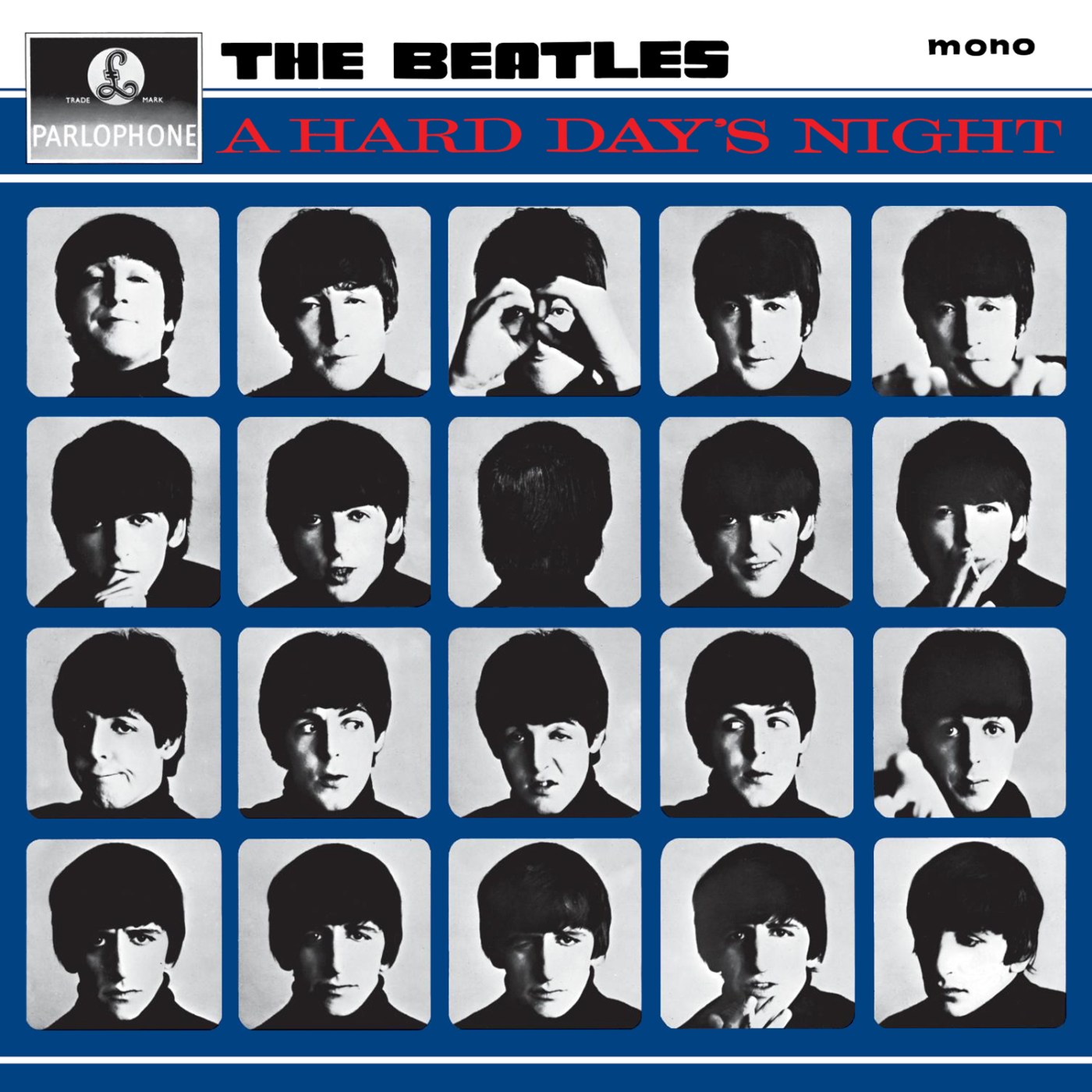
BANG! A Hard Day’s Night ushered in a huge sea change for the Beatles when it was released in July 1964, since it served not only as the soundtrack for the accompanying movie of the same name, but as a statement of intent from John and Paul, since this is the first ever Beatles album to feature entirely original songs, rather than a mix of originals and covers. And as well, this was the first album to be recorded on four track tape, rather than two track as the last two albums were, so the stereo mix of this record holds up fairly well!
As George Martin explained in Anthology:
The very first records we made were mono, though I did have stereo facilities. To make mixing easier I would keep the voices separate from the backing, so I used a stereo machine as a twin-track. Not with the idea of stereo – merely to give myself a little bit more flexibility in remixing into a mono. So the first year’s recordings were made on just two tracks and were live; like doing broadcasts.
With the great advance of four-track we were able to overdub and put on secondary voices and guitar solos afterwards. By the time we did A Hard Day’s Night we would certainly put the basic track down and do the vocals afterwards. Invariably, I was putting all the rhythm instruments onto either one or two tracks (generally one track) so you would have bass lumped with guitar.
It wasn’t until later still that we began putting bass on afterwards as well, giving Paul the opportunity of using his voice more.
I should also point out that this album was the first one they made since conquering the US back in February 1964, a full sixty years ago as of this writing. The version of A Hard Day’s Night released here, in contrast to what the Brits got, was a genuine soundtrack, excising all the songs that weren’t in the film except for “I’ll Cry Instead.” That song was meant to accompany the police chase scene in the last third of the movie, when John, George, and Paul go to track down the missing Ringo before the concert starts.
Also included on the album? The instrumental cover versions of some of the film songs, as conducted by George Martin himself. We’ll be talking about this version of the album later, so for now, our focus is entirely on the canonical British release. Let’s go track by track:
A Hard Day’s Night: By far this song’s most distinguishing feature is its opening chord, the best attention-grabbing sound on a Beatles album ever. If you want to learn more about it, check out this nifty article. Written to order so as to provide a good accompaniment for the movie’s opening credits, the title comes from one of Ringo’s many malapropisms, and features John and Paul trading verses, and for the first time, the sound of George’s new 12-string Rickenbacker in the guitar solo. (Which was, incidentally, recorded at half-speed then sped up when played back.)
I Should Have Known Better: What’s that? Another Beatles song with harmonica on it! Pretty sure this is the last of those. Also listen for, again, George’s solo here, he gets a lot of mileage out of that 12-string. One of my favorites of his solos. ❤
If I Fell: One of my favorite John ballads, this song gets played early in the movie to cheer up Ringo, but nowadays I associate it with all the times I’ve listened to it with my girlfriend, since it’s part of one of our couples mixes. Sonically, it’s a wonderful display of John and Paul’s talent for harmonizing. That’s a sound you’ll never forget, even sixty years later.
I’m Happy Just to Dance With You: George’s vocal spot on the album, I occasionally forget that he didn’t actually write this. I like it anyway, and I like the way he sings it.
And I Love Her: One of the prettiest love songs the Beatles ever wrote, this. The opening riff was apparently George’s creation, right on the spot – an earlier version on Anthology 1 lets us hear it on electric instruments, minus the riff, and I have to say, something really is lost without it. This song belongs on acoustic guitars.
Tell Me Why: The happiest song ever recorded about confronting your partner for some kind of failure, right here. As an aside, those falsetto vocals are, “Is there anything I can do?” (It took me an embarrassingly long time to realize this.)
Can’t Buy Me Love: An energetic Paul song for the ages, it’s most well known for accompanying the scene in the movie where the Beatles screw around in a field for two minutes, and it’s amazing. And check out the double-tracked guitar solo! I love it when Paul gets to rock out.
Any Time At All: With this song we move away from the movie songs, to what might derisively be called album filler. I don’t think so though, this is a nice collab between John and Paul, as the narrator promises their partner that they’ll always be with them. We can all use little reminders like that, I think.
I’ll Cry Instead: The aforementioned almost-film song, in which John sings about his inability to be emotionally honest with himself in the aftermath of a nasty break-up, coupled with a promise for revenge. Sheesh.
Things We Said Today: Another Paul love ballad, featuring him harmonizing with himself. (It’s especially noticeable in stereo, you can hear him pushed off to the right.) They’d sometimes play this song during their concerts, including on the Hollywood Bowl album. God knows why, but it makes for an interesting effect, at least.
When I Get Home: This song is our first entry in what will become a distinct genre of Beatle song: The one where the narrator (read: John) writes about, and then sings, about having an affair. Given his marriage troubles throughout the ‘60s, it really says something that he tends to focus on the messier side of love until he begins dating Yoko around 1968.
You Can’t Do That: If you read my review of the expanded Red album from last year, you already know what I think of this song: two minutes of sexist trash that, sadly, are of a piece with ‘60s expectations between men and women in relationships, and given John’s history of domestic violence… good fucking grief, Lennon.
I’ll Be Back: A more subdued album closer this time, as John and Paul share lead vocal duties on this acoustic-guitar driven track. It’s a surprisingly downbeat ending to what has otherwise been their most energetic record yet, something that speaks to their rapidly increasing maturity as musicians.
Surprisingly, A Hard Day’s Night is a difficult record to sum up: in terms of raw musicianship, this is their best work yet – the move to four-track tape, and a reliance on overdubs, allows for songs with more complex arrangements that, naturally, would become increasingly difficult to perform on stage.
That this is their first album composed entirely of original material shows that they don’t need to do covers in order to release a good record. When they do return to covers again, as they will on their next two albums, it’s mainly due to a lack of time and a need to get things done quickly.
In terms of album sides, I’d have to say the first seven tracks (all the movie ones) are much stronger. The six remaining songs are a bit more mixed: I like “Things We Said Today” a lot, but John’s songs on this half (and this is a very Lennon-heavy album) are more mixed. “Any Time” and “I’ll Be Back” are good, but his other three contributions… they really drag the album down for me.
Good thing, then, that the John situation improves dramatically over the next few albums.


Leave a Reply