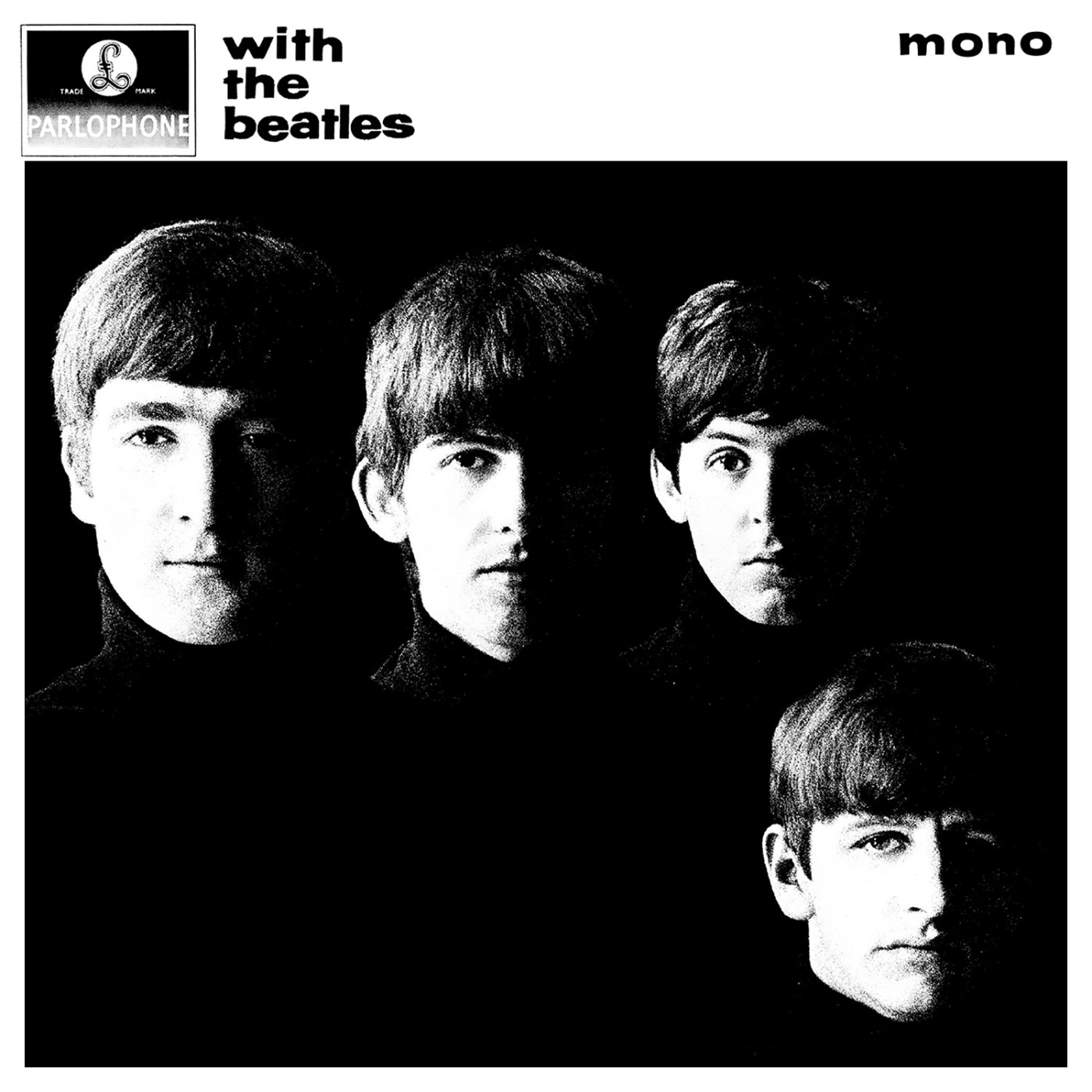
By sheer coincidence, this album was released on November 22nd, 1963, the exact day John F. Kennedy was killed. You might think that from their somber expressions and the stark simplicity of the photograph (four faces looming out of the darkness) that our lads from Liverpool were already mourning the dead American president, but you would be wrong.
No. The cover of this album was taken by Robert Freeman, and was inspired by the work of Astrid Kirchherr, a friend of the band’s from their Hamburg days. Astrid’s photos of the band were moody, black and white portrait shots, the linked image here, of John and George, may have been the image that inspired the With The Beatles cover a few years later.
Immediately distinctive, the cover of With The Beatles, for me, illustrates the way in which the Beatles were already breaking boundaries. While the cover of Please Please Me might’ve looked like the cover of any other ‘60s album from that time, With is very much not that. It’s thoroughly unique and arty, an album that’s trying to prove that the boys are far more than the latest fad among teenagers.
And the innovation doesn’t stop there, either. Musically, With is a definite step up from Please Please Me. There’s more piano here, for one thing, and more prominent acoustic guitar work, providing these songs with sonic depth that Please Please Me didn’t have. John and Paul, of course, are on fire here lyrically, and George gets his songwriting career started on this record too.
As is standard for Beatles albums up until 1965 or so, the album is split between originals and covers, with eight of one and six of the other. Let’s go through them, shall we?
It Won’t Be Long: Though the Beatles were on record as being big fans of Elvis Presley, Buddy Holly, Chuck Berry, and lots of other heavyweights of ‘50s rock and roll, they really liked girl groups too. This track is an original and it sounds a lot like a girl group number from the same period, but where anyone else would do it from the woman’s perspective about the guy, the Beatles flip the script, and what results is a song from the guy’s perspective about the woman he’s with. This is radical stuff for the early sixties, and one of our earliest indications as to how awesome women are in Beatles songs.
All I’ve Got to Do: John’s take on a Smokey Robinson pastiche, it’s a great early ballad number from him, and I love the way he sings on it. While his vocal stylings could be described as tart, (probably from all the cigarettes he smoked) he really makes it work for him – that tartness gives his vocal some raw passion, and it really shines in this song. And then he does it again, six years later, on Don’t Let Me Down.
All My Loving: Paul really seemed to like epistle songs, given the sheer number of them that he writes during the Beatles years, from P.S. I Love You to Paperback Writer. This is a fantastic one, though whenever I listen to it I can’t help but think like the narrator is practically begging to end up cheating on his girlfriend later on. While researching this song, I found someone in The Independent had hypothesized that it was inspired by “Kathy’s Waltz” by Dave Brubeck, and I wouldn’t be surprised if it was, given all the jazz that played in the McCartney house when Paul was growing up.
Don’t Bother Me: For a band whose catalog could be described as, largely, being about the power of love in all its many varieties, they could also write some really good break-up songs. This one, by George, was his very first song ever, and while he didn’t really like it, I think it’s fantastic. It really reflects the sheer devastation and downtrodden-ness that accompanies a break-up, be it romance or friendship, and I love that about it.
Little Child: One of the last Beatles songs to prominently feature harmonica, it’s a song that definitely exists. In fact, according to Paul it was almost Ringo’s vocal spot on the album, until saner heads prevailed and we got “I Wanna Be Your Man” instead. As a song, it comes off as uncomfortable – I really hate the early sixties’ penchant for infantilizing women, and this one is particularly bad.
Till There Was You: A beautiful acoustic guitar-driven cover of a song from the musical The Music Man, this features Paul attempting to sing in an American accent, for whatever reason. He does an okay job, though the way he sings “at all” and “saw” kind of break the illusion. For a real trip, go track down the version of the song they played at Decca Records in January 1962 – everyone sounds super nervous, though I do like Paul’s vocal, even if he is a bit shaky. (Pete Best… well… thank god they hired Ringo.)
Please Mr. Postman: In which the Beatles do a credible Motown cover, complete with the requisite gender-swap in the lyrics that, in their hands, turns the song into something a bit more feminist than would’ve flown in the early ‘60s. You can really hear the desperation in John’s voice, especially when he starts screaming his vocal toward the end. (He always was great at rock and roll screams.)
Roll Over Beethoven: As a native St. Louisan, I’m contractually obligated to like George’s version of this classic Chuck Berry number, but even if I wasn’t, I’d still enjoy it because George does such a fabulous job with it. He can do straight rock songs just as well as John and Paul, and this one proves it. It really shines on the expanded Red album from 2023, where we get to hear it in proper stereo.
Hold Me Tight: The one song from this album that John and Paul don’t think much of, and I kind of get why they don’t like it. There’s no bass to speak of, Paul sounds like he has a cold, it’s just kind of… there. What I didn’t know was that they sped this one up from E to F, to give it a bit more energy. Having slowed it back down to get an idea for what it might’ve sounded like otherwise, I think they made the right choice. In E, it sounds a bit plodding. (And despite the title, this has nothing to do with the song from Red Rose Speedway.)
You’ve Really Got A Hold On Me: Another Smokey Robinson song, this one is another great showcase for John’s ability to do ballad songs, along with some gorgeous harmonies between him and George in places.
I Wanna Be Your Man: Now this is more like it! I don’t care what anyone says, Ringo is really good at rock and roll as long as it’s in his range, like this one is. It’s more remembered these days for being the song that gave the Rolling Stones their first hit single, which kind of says everything you need to know about the Stones. As John put it, “We weren’t going to give them anything great, right?” (Ringo’s version is way better.)
Devil In Her Heart: Once again, here comes George! This time around he’s singing about the naiveté that results when you start dating a girl who is legitimate bad news, and holy shit, they could’ve been singing about either of my ex-girlfriends. This one’s for you, Alex.
Not A Second Time: One of my favorite Beatles songs, this, and a great early break-up song. George Martin’s piano gives the song some wonderful depth, I especially like the solo. I also highly recommend Robert Palmer’s cover, decked out in 1980s synths and an entirely original second verse that I wish John had sung.
Money (That’s What I Want): Another Motown cover from the boys, the idea was for it to be an energetic album closer in the tradition of Twist and Shout, though I’m not entirely sure it works as one. Then again, it’s a little hard to top the exuberant performance of the latter. That said, having heard the version from the Decca demo tapes, I gotta say, the album version has way more energy. Probably comes from not being so audibly nervous.
For all that Taylor Swift gave us the term “era” to describe the phenomenon of album releases and the surrounding marketing, as ever, a large percentage of modern music can be traced, however distantly, back to the Beatles. With The Beatles isn’t just Please Please Me 2.0, but a record with a sonic character all its own – if Please Please Me was about harmonica, With’s big thing is the piano.
I think what also sets With apart from Please is the fact that, as busy as their schedule was in 1963, they had time to actually record these songs and give them a bit more polish: 3 months, in fact. As a result, it’s less raw-sounding than Please, and there’s greater use of overdubs and double-tracked vocals, things that will go on to become essential pieces of the band’s sound. While second albums are usually difficult, this one (much like Rio will do for Duran Duran 20 years later) proves that the band has staying power – they’re not just a fad.
And if this is what they can do with a mix of originals and covers, what might they be like with all originals? Next time, we’re going to find out.


Leave a Reply