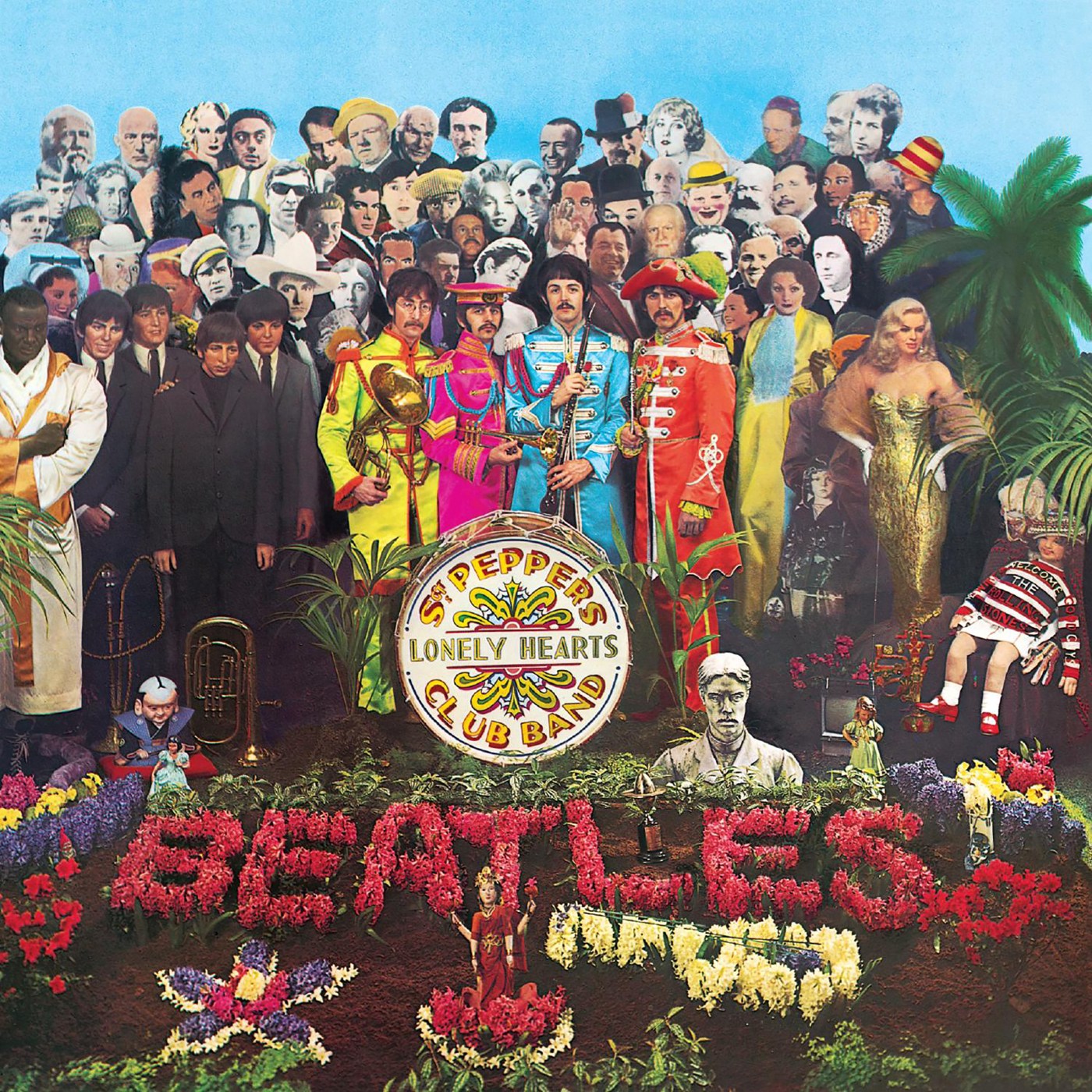
So, here we are: the Big One. The Beatles album widely hailed as their magnum opus, the soundtrack of the Summer of Love. The album that showed a band completely untethered from touring, free to use the studio as often as they needed. Every album before Pepper feels quaint by comparison, music made by boys with toys, rather than men.
I can only imagine what it was like to hear this album in the summer of 1967. The days of Help! and Beatles For Sale, nevermind Please Please Me, must have felt like ancient history. The moptops were out, mustaches were in. The double A-side single that launched the year, “Strawberry Fields Forever/“Penny Lane,” was completely different from anything the Beatles had ever recorded to that point.
Just watch the old interview footage of John from November of 1966. He’s wearing glasses! He has a mustache! He looks older, more like 46 than 26! He was living in an entirely different musical universe to the one he’d been living in during that final US tour over the summer, and those two songs, along with this album, were proof of it.
This is where all the experimentation was headed. Everything from John writing Dylan shoutouts on Beatles For Sale to the sitar on Rubber Soul and simply everything about Revolver, especially the technical side, was leading to this album. It’s a completely new direction that upends everything we know about the Beatles, despite their half-baked attempt at pretending they weren’t the Beatles. (Guys. Your name is spelled out in red flowers. Get real.)
Does it hold up? Let’s find out.
Sgt. Pepper’s Lonely Hearts Club Band: The title song announces the “concept” of the album, by introducing the band named in the title… and that’s pretty much it, lyrically speaking. Musically there’s a lot going on, from crowd noises here and there to an absolutely blistering guitar part from George, to show they haven’t entirely forgotten their rock roots, a horn section, some nice harmonies in the choruses… it’s a pretty great song! And then it leads directly into…
With A Little Help From My Friends: A lovely ode on friendship, written by John and Paul for Ringo to sing. It’s one of his best, and he sings wonderfully on it. (There is also an amazing drum part, because of course there is – it’s freaking Ringo, people!) Small wonder that it’s become a mainstay of his live shows over the decades, right?
Lucy In The Sky With Diamonds: The somewhat controversial Lewis Carroll riff that John wrote based off a drawing by his son Julian, it’s one of my favorites of his songs from this period. The mono version (which I’m listening to while I write this) is at a slightly different speed than the stereo mix more people are familiar with, which is always a little jarring, but you adapt quickly.
Getting Better: Another of John’s confessional songs, but sung by Paul, which must’ve thrown people off. It’s still a great song though, the interplay of “it’s getting better all the time” and “it can’t get no worse” is very typical of John and Paul – ever the cynic and the optimist, those two.
Fixing A Hole: Easily my favorite song on this album, entirely became of the lead guitar line that runs through it. It’s absolutely delightful, and probably my all time favorite bit from any song. (Also on the list: the solo in “Nowhere Man,” and the harmonies in “Baby’s In Black.” Apparently, it came about as a result of a little blue dot Paul saw when he first took LSD, and isn’t actually an ode to home improvement.
She’s Leaving Home: Another song where the differences between mono and stereo stick out: this song is actually higher in mono than in stereo! Aside from that, this is another one of Paul’s classical music songs, and like “Eleanor Rigby”before it, tells the sad story of a woman… except the woman is real. Melanie Coe ran away from home in February 1967, and being well-to-do, her story attracted Paul’s attention. (John’s lines in the choruses, meanwhile, were things his aunt Mimi used to say – this is the same woman who thought John would never make a living from guitar.) I had this song in my head when I moved to Ithaca last fall – it’s intensely relatable.
Being For The Benefit of Mr. Kite!: Another of my favorite John songs from the psychedelic era, Mr. Kite came from an old Victorian circus poster that John bought in an antique shop, and almost all the song’s lyrics were transcribed entirely from the poster. It certainly sounds very circus-y, with all the organ and calliope music, albeit slightly unreal, almost eerie… and then the Love mix of the song takes it into nightmare territory by mixing it with “Helter Skelter” and “I Want You (She’s So Heavy)” after the last line. Mr. Kite’s circus of nightmares, everyone!
Within You Without You: Given the function of this project, I can’t possibly describe well enough the extent to which George’s exploration of Indian music and culture affected him. It became one of the biggest things in his life, and remained a part of him until he died in 2001. After the last Beatles tour in 1966, he almost left the group entirely, but ended up sticking it out for a few more years. This song came about after he spent a few weeks in India being immersed in sitar lessons and Hindu spiritualism, and its lyrics may as well be foreshadowing for some of his best-known work as a solo artist in the ‘70s. We are a long, long way from “Roll Over Beethoven.”
When I’m Sixty-Four: And now for something completely different. One of Paul’s earliest songs, it expresses a hope that the object of his affections will still care about him when he’s a senior citizen. Not too much to write about it honestly – I do like the clarinets, and the way they sped his voice up so he sounds younger. (Naturally, everyone made exactly the same joke when he did turn sixty four.)
Lovely Rita: When I was a little pup, I used to listen to this album on a Fisher-Price cassette player while taking a bath, and right around now was when I would decide I was ready to dry off. This has nothing to do with the song itself, but it’s a cute anecdote that illustrates just how long this music has been a part of my life. The song itself is something of a trip, but then, given all the LSD that was taken during recording, who’s surprised?
Good Morning Good Morning: Of all things, this song was inspired by a commercial for Kellogs corn flakes. I am not making this up. The lamest cereal in the world led to this! Who’d’ve thunk it? There’s not a lot to write about here either – John thought it was a throw-away, but I kind of like the lyrics, especially the parts about wandering around town when there’s no one else outside.
Sgt. Pepper’s (Reprise): Again, not much to write about – the penultimate song on the album, suggesting that the surreal concert we’ve been listening to is about to end after the last song, about which there is far more to write. Nice drum part though, and more blistering Harrison guitar.
A Day in the Life: Another song based on newspaper articles, it’s often hailed as one of the Beatles’ best songs, and honestly, I can’t argue with it. The echo on John’s voice gives it a somewhat dream-like quality, which then becomes nightmarish when the build-up starts, preceding Paul’s verse, and the other extremely well-known chord in Beatles music. (Fun fact: that chord was held for so long, with the gain turned up so high, that if you turn it up as it fades out, you can hear EMI’s air conditioning humming away.)
Technically speaking, I’m not going to go against the grain here: Sgt. Pepper really is their most complex album, and it is genuinely impressive that they were able to make it, given the recording limitations of 1967. But then, those very limitations are part of what makes the album work so well: if you tried to make it today, it would sound soulless and empty. It’s a spectacular musical achievement, and that’s that. This is pure psychedelia pomp and circumstance, and it’s notable that with the exception of Magical Mystery Tour, they never go this hard in that direction again.
As a Beatles album though… (HOT TAKE INCOMING) I have to say, it kind of leaves me cold. As someone with a background in audio engineering, I can appreciate it on that level, and I do. Only Abbey Road gets close to this album on a technical level, and that was the Beatles pulling out all the stops to make one last really great album before breaking up for good. It was a group effort, and it sounded like one.
Sgt. Pepper does not sound like a group effort, and I’m not just saying that because it was primarily Paul’s idea. Ringo, I think in Anthology, said that he learned to play chess on this album, because of how long it would take to do overdubs. Everything sounds overdubbed here, none of the songs feel like genuine artistic collaborations in the way that Revolver did. Everyone comes in, does their song, and moves on to the next thing.
The same criticisms are leveled at the White Album, but after hearing what Giles Martin said about it for the remix in 2018, I don’t agree. For my money, Pepper is when the break-up starts. You don’t see it in the technicolor LSD haze, but it’s there. Paul became the dominant creative force in the band starting with this album, supplanting John, and when you’re dealing with personalities, and egos, as big as John Lennon’s and Paul McCartney’s, something is going to give eventually.
That something turned out to be Brian Epstein’s death in August 1967. Once he was wrenched out of the picture, the Beatles were bound to fall apart, especially with Paul continuing to dominate the group and become its de-facto manager.
True, Sgt. Pepper was made while Brian was still alive – it was the last Beatles project he oversaw. And maybe it isn’t fair to put the blame on the breakup on this record. But I’m doing it anyway. Pepper is an amazing technical achievement, and it deserves all the praise it’s gotten for the last fifty seven years, but when I listen to it sometimes, I can’t help but be taken out of the celebratory summer mood, because I’m haunted by what comes next in the story.
So maybe the way to look at it is to appreciate it as the psychedelic snapshot that it is – a picture of a more innocent time, before 1968 came around and the entire world seemed to fall apart. The dream has to end sometime, and with this album, we’re getting ever closer to it.


Leave a Reply