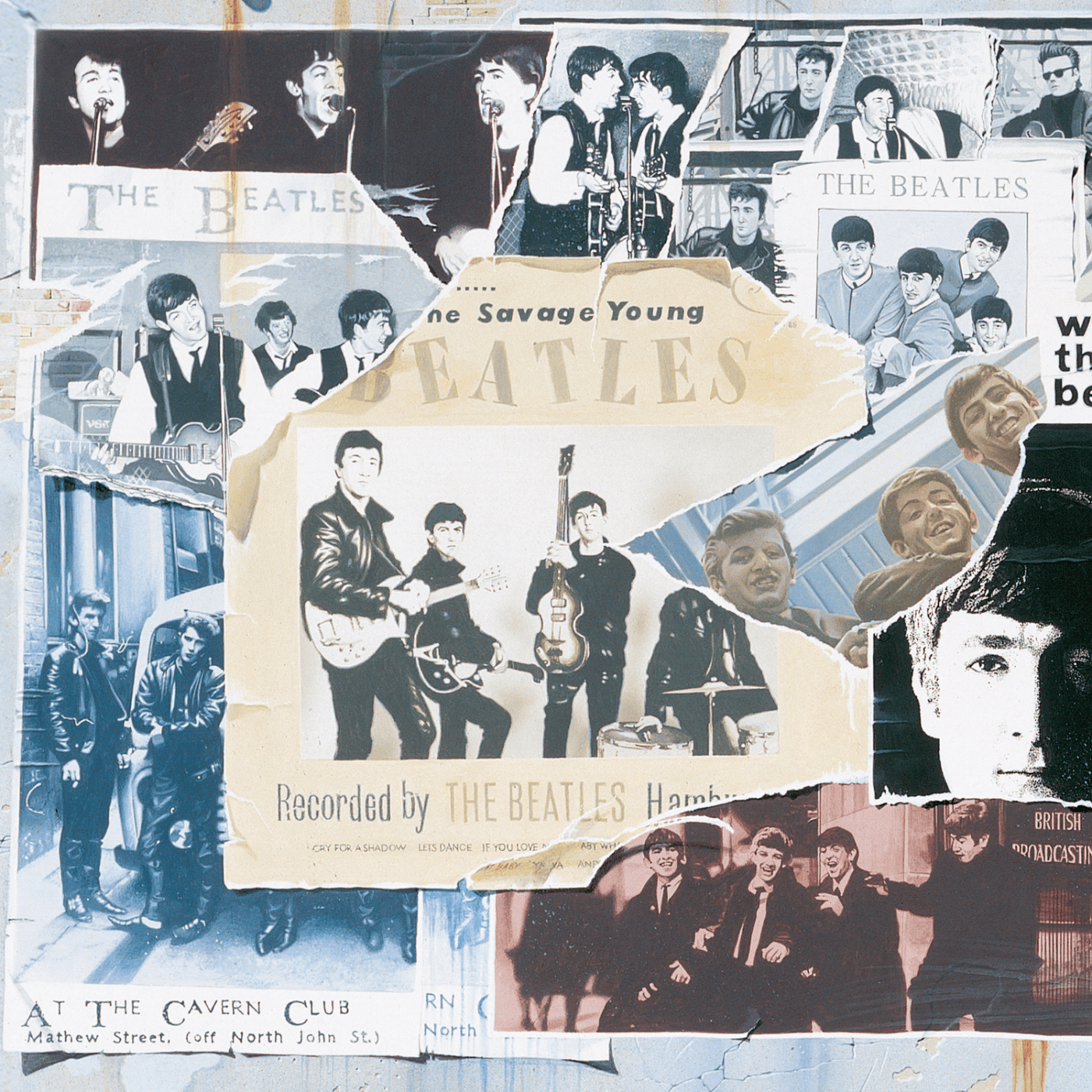
In 1995, the impossible happened: The Beatles reunited.
Now, true, it was only the three of them, since John had been murdered in 1980, and was still dead in 1995, but still! Here they were, three quarters of the most beloved band in the history of music, back together!
It came about partly as a revival of a Neil Aspinall project called The Long and Winding Road, a documentary he made in 1970, before being shelved. This new version was developed by the early 1990s, with the intent of finally allowing the three of them to tell their own story, with John appearing in archival interview clips.
The project then expanded to include not just the 8-part documentary, but a book (also called The Beatles Anthology) and three double albums consisting of previously-unreleased archival material, going all the way back to the Quarrymen days… and two BRAND NEW SONGS, “Free As A Bird” and “Real Love” – piano demos recorded by John Lennon in the late 1970s, then refurbished and transformed, as if by magic, into Beatles songs. (We’ll be discussing those later.)
I was born in 1994, just before the project publicly launched, so I don’t really remember much (or any) of Anthology as it was coming out, but I do remember checking out Anthology 3 from the library and gasping in surprise when I heard John, on an early demo take of “Happiness is A Warm Gun,” say the word “shit.” Ah, the innocence of childhood!
My most enduring memory of the Anthology project, though, was watching it with my dad around the time it came out on DVD – 2003 or so. It was his Father’s Day present that year, and while I have my own copy now, I’ll always fondly remember sitting next to him in front of our basement TV, watching it together.
As for Anthology 1 itself, this collection covers the band’s earliest years, from their Quarrymen days to the height of Beatlemania in 1964, with both of the original Beatles (Pete Best and Stuart Sutcliffe) making appearances. Strap in, because this is gonna be a long one! (I’m ignoring the speech tracks, incidentally.)
Disc 1
Track 1
‘Free As A Bird’: Advertised as the first new Beatles track in 25 years, “Bird” is one of three Beatles songs that began as demo recordings by John Lennon from the late 1970s, during his hiatus from the music industry. Some of the lyrics were unfinished, which meant Paul got to do a little bit of collaborating with his old partner once again. It’s a beautiful number, and while some people think it sounds a bit too much like ELO and less like the Beatles of the ‘60s, I personally feel like “Bird” is more like an evolution in their sound… the kind of thing they did in the 60s with every freaking album.
Tracks 3 & 4
Performed by the Quarrymen, (as they were called at that time) these next two tracks were recorded at Phillips’ Sound Recording Services in Liverpool, a very small-time home studio owned by a man called Percy Phillips. They were cut directly to vinyl, and the resulting acetate disc was thought lost until it reappeared in 1981. It was then remastered (more or less) and appears here for the first time.
‘That’ll Be The Day’: In which John Lennon pays tribute to Buddy Holly, even going so far as to imitate Holly’s unique singing style. It’s a pretty good performance actually, putting aside the poor fidelity of the recording itself. (Maybe Giles Martin could do a remix…)
‘In Spite Of All The Danger’: One of Paul’s first ever songs, though that’s John on lead vocals with Paul and George doing the backing ones. George also contributes the guitar solo, making this the one (and only) Beatles related song credited to McCartney-Harrison. Paul has since performed this song live at his concerts – I heard him do it in 2016 when I saw him at Busch Stadium in St. Louis.
Tracks 6-8
These three songs were recorded at 20 Forthlin Road in Liverpool, otherwise known as Paul McCartney’s house. They were still the Quarrymen at this point, though the lineup had shifted to include Stu Sutcliffe, the original bass player for the band.
‘Hallelujah, I Love Her So’: The Beatles do a Ray Charles cover, and as Paul says on the dialogue track that precedes this, the quality sucks. Still, what we can hear of it is a very lively performance.
‘You’ll Be Mine’: In which John and Paul screw around with a parody of the Ink Spots. It’s funny enough, but next to impossible to understand the words.
‘Cayenne’: An instrumental piece, mostly John and Paul, with Stu thudding away in the background on bass guitar. It’s not bad, actually.
Tracks 10-12
These songs were recorded in 1961 in Germany, during the Beatles’ Hamburg residency. Tony Sheridan was the lead vocalist, with the Beatles (John, Paul, George, and Pete Best) as his backing group. As we know, this was the single that so obsessed Liverpudlian record buyers and eventually led to Brian Epstein going to the Cavern Club on his lunch one day to see this popular beat combo… and the rest was history.
‘My Bonnie’: While I don’t rate Sheridan terribly highly as a vocalist, the energy in this track is undeniable, and I completely understand why British music buyers of the time were so obsessed with this band “from” Germany – they really are that good.
‘Ain’t She Sweet’: John on lead vocals this time, turning in a great performance of this song the 1920s. Pete is actually on good form with the drums here, compared to the mess he makes of “Love Me Do” later on this album.
‘Cry For A Shadow’: An instrumental inspired by the Shadows, an instrumental rock group that were huge in the pre-Beatles era. Come for the guitar solo action, stay for Paul letting off some truly amazing rock and roll screams in the background!
Tracks 15-19
In January 1962, the Beatles had been rejected by seemingly every label in the UK without even an audition – only Decca Records, based in north London, let the boys come down to play something. The end result was 15 songs (an entire album’s worth of material) of which five are presented here. (The other 10 have been bootlegged to hell and back, and can be easily tracked down on YouTube.)
Unfortunately, the Decca audition never panned out – according to Brian Epstein, Dick Rowe felt that “guitar groups are on the way out” and “the Beatles have no future in show business”. And yet, within a year the boys would have several hit singles to their name, and in February 1963, they’d record their first album, so… he was mistaken.
And as for the guitar groups comment? Decca would go on to sign The Rolling Stones, the grungy alternative to our favorite Liverpudlian quartet. Go figure.
‘Searchin”: In case there was any doubt that a lot of the Beatles’ favorite American artists were Black, this cover of a song by the Coasters proves it pretty conclusively, down to even replicating the original vocal stylings.
‘Three Cool Cats’: George on lead vocals this time, and while I don’t rate the song very highly, I do like his vocal here.
‘The Sheik Of Araby’: This is a song that was written in 1921 by Harry B. Smith and Francis Wheeler, with music by Ted Snyder. It was composed in response to the popularity of the Rudolph Valentino feature film The Sheik. While the band’s performance is pretty good, to my ears (listening from the perspective of 103 years later) it’s kind of incredibly racist. NEXT!
‘Like Dreamers Do’: One of Paul’s earliest songs, written in 1959 – in fact, it’s one of the first credited to the Lennon-McCartney partnership. I kind of love it, so much so that I used the title for my in-progress Beatles book.
‘Hello Little Girl’: John and Paul sing this song together, very heavily inspired by the work of Buddy Holly. In fact, this song was one of John’s earliest, written in 1957. It’s honestly a strong little tune, and I really wish they did it with Ringo on one of their early albums.
Tracks 21 & 22
By June 1962, the Beatles were very close to securing themselves a record contract. Now at EMI for the first time, they recorded four songs, of which these two are the only ones that survive. The test was something of a disaster, but everyone who was there that day thought the boys had a spark – and it was that spark that got them signed.
These two songs are also notable for being the only two EMI recordings to feature Pete Best rather than Ringo – Best was fired from the band not long after this. At the time, the band believed he wasn’t a very good drummer, or at least, not for the Beatles. And given the available evidence, they were probably right. All the same, Best was for a long time somewhat bitter about the entire experience – understandably so.
In a 2007 interview, he admitted to liking the band’s albums, and when the Anthology albums came out, received around 1-4 million pounds in royalty payments. On top of that, he was kind enough to donate some video footage for Peter Jackson to use in the music video for “Now and Then,” so it’s not all bad blood.
‘Besame Mucho’: A spirited rendition of this beloved single by Mexican artist Consuelo Velázquez, with Paul on lead vocals. It’s pretty good, and Pete Best’s drumming doesn’t suck.
‘Love Me Do’: The earliest recording of the band’s first single, and oh boy, does it show. It’s honestly kind of thin compared to either of the two versions we’re more familiar with, though it’s clear that John’s harmonica part was already in place. Worst of all, though, is Pete Best, with the way he completely changes what he’s doing during the bridge and solo sections so he can show off. Good fucking grief. This is why he got fired, and why I’m glad they switched to Ringo.
Tracks 23 & 24
These two songs date from September 1962, during the Beatles’ earliest recording sessions as official EMI artists, and as such, are the first tracks on the album to have Ringo on drums. As such, there’s an immediately noticeable step up in the performance quality with these songs. Ringo, who’d sat in with the band sometimes on nights when Pete couldn’t make it, proved to be the magic that made the Beatles what they are today.
‘How Do You Do It’: George Martin’s idea for a first Beatles single, and it’s thoroughly and entirely generic. The boys insisted on “Love Me Do,” and it’s a good thing they did! Without it, they’d’ve never gotten past Please Please Me.
‘Please Please Me’: An early take of the title song from their first album, without the harmonica that brings so much to the finished version. A thoroughly clean electric guitar instead really doesn’t work, though the rest of it is broadly similar to the one from the album, minus the backing vocals.
Tracks 25 & 26
These two tracks are the earliest attempts we have of the Beatles trying to play “One After 909,” a very early Lennon-McCartney song. They do their best, but the energy isn’t quite there – it’s not until 1969, when they play it on the roof of Apple HQ, that they nail it.
“One After 909 (sequence)”: In which Paul stops playing bass because he doesn’t have a guitar pick on him. Once he gets one, the rest of the song is okay, but there’s not much energy here, and it stops shortly after the solo when John screws up his timing.
‘One After 909’ (complete): A much stronger performance of this train song from the boys, though again, it’s still a bit limp compared to the rooftop version from Let It Be.
Track 27
‘Lend Me Your Comb’: A live-in-studio performance for BBC Radio, dating to July 1963. The Beatles often did things like this, recording “live” versions of their songs (along with covers) just for the BBC. They did this so often that Apple later came out with two volumes of their BBC recordings: Live at the BBC, released in 1994 and 2013 respectively.
Track 28
‘I’ll Get You’: A spirited live performance of their recent B-side, coming from the Sunday Night at the London Palladium show from October 13th, 1963. This is the exact performance that launched British Beatlemania – the very next day, the British national press started paying attention to the band, and never really stopped.
Tracks 30-34
Finishing out this disc are five songs from a seven-song set the band recorded for Swedish radio, ahead of their first tour there in late October 1963. With any live performance, get ready for the sound of screaming teenage girls! (Not that I can blame them: I’d scream too!)
‘I Saw Her Standing There’: It’s missing the count-in, but this version of the song rocks just as hard as the album version – if possible, even harder! The solo here is a million times better than the original, and I fucking adore it.
‘From Me To You’: Then a recent single for the boys, their performance is pretty great, though George’s lead guitar during the solo seems a bit muted to my ears.
‘Money (That’s What I Want)’: While the lack of piano means the track loses a little bit of oomph, the band do their best, with Ringo in particular turning in a great performance. I also really like how loud George is compared to Paul when they do their backing vocals.
‘You Really Got A Hold On Me’: A credible live performance of this song from late on With The Beatles, and again, George really shines on this take – you can hear him well doing the low harmonies!
‘Roll Over Beethoven’: Closing out this side of the album is George getting the spotlight for this energetic performance of a Chuck Berry song, with Paul helping out on backing vocals – he does the last few lines of the song, presumably because George was too busy with the lead guitar to do both at the same time.
Disc 2
Tracks 1-3
Three of the four songs performed by the band during the Royal Variety Performance of November 1963. They’re audibly extremely nervous on the recording (or at least Paul is) but John, snarky as ever, makes the show with his famous “rattle your jewelry” joke before launching into “Twist and Shout.” As you do!
‘She Loves You’: It’s a little surreal, listening to one of the very few Beatles live recordings that do not include screaming girls. Even so, the performance itself is very good – I particularly like Paul’s little bass thing toward the end.
‘Till There Was You’: Paul is audibly nervous as he introduces the song, and his vocal is a little bit edgy too, but he seems to calm down some after the first chorus.
‘Twist And Shout’: Playing us out is John doing his throat-tearing screamer from Please Please Me, and while it’s not quite as audibly rough as the studio version, it’s still a big shift from the previous number. The guitar solo sounds fantastic!
Tracks 4-7
Recorded during the band’s performance on Two of a Kind, starring British comedians Eric Morecambe and Ernie Wise. A dialogue-only track leading into “Moonlight Bay” has the band exchanging joking insults with the two hosts, proving they can dish it out as well as taking it on the chin.
‘This Boy’: One of my favorite songs of theirs, and this live version is beautiful, even if I can easily hear the plosives that show up in places, particularly in the first few lines. I especially like the very end, where they’re entirely a cappella.
‘I Want To Hold Your Hand’: The bass part comes through really clearly on this version, thoroughly drowning out George’s lead guitar fills that decorate the studio version.
‘Moonlight Bay’: I first heard this song in an episode of Hey Arnold!, and while I can’t say I’m terribly fond of it, I’m always on board for more of the Beatles harmonizing.
Track 8
‘Can’t Buy Me Love’: Two early takes of the hit from A Hard Day’s Night, recorded in France in January 1964. Note there are some backing vocals in here that don’t appear in the finished track. Also listen for Paul getting some of the words wrong… or just forgetting them entirely!
Track 9
‘All My Loving’: This is the Big One, at least for us Americans. On February 9th, 1964, 60 years and two months ago as I write this, the Beatles appeared on the Ed Sullivan Show for the first time, launching the British Invasion of the American music industry. You can hear the exhilaration in Paul’s voice when he sings this one, and it’s absolutely spell-binding.
Tracks 10-12
These three tracks are early takes of songs that will go on to appear on the A Hard Day’s Night album, including such fascinating bits as “And I Love Her” without the famous opening riff, and George completely screwing up his lead guitar arpeggios on “Night.”
‘You Can’t Do That’: …Sigh. This again?! I fucking give up. Not even gonna bother with a breakdown, it’s just as bad in this early take as the regular version.
‘And I Love Her’: As I’ve mentioned, this is an early take of the song performed with electric instruments, and a notable lack of guitar riff. Instead, we have Ringo doing some drum fills. Good, but not what this song needs. It ends fairly abruptly, too.
‘A Hard Day’s Night’: After an exceptionally raggedy rendition of the opening chord, what follows is an amusing first take of the title song from the first movie, including some extra lyrics in Paul’s verses that get cut by the time of the final master.
Tracks 13-16
Four songs recorded for the Around the Beatles TV special, which also included the boys doing a bit from the Shakespeare play A Midsummer Night’s Dream.
‘I Wanna Be Your Man’: Ringo rocks out as hard as he can, but live this time, with John and Paul helping out on backing vocals.
‘Long Tall Sally’: Paul gets to show off his rock and roll voice again, with a performance that’s just as energetic as the studio recording.
‘Boys’: As before, Ringo gets a chance to rock, his second go in as many songs! Along with George trying to do a better solo, but not entirely succeeding.
‘Shout’: The only recording of this song that we have, featuring all four Beatles each getting a line or two sing, for the first (and only) time. Or at least, until “Carry That Weight,” where they sing in unison.
Tracks 17 & 18
“I’ll Be Back”: More from the AHDN sessions, as the band rehearse what will become that album’s closing number. John runs into difficulty singing his lead vocal part, leading to the second take breaking down and leading into the third.
Track 19
‘You Know What To Do’: A lost George Harrison song, it was recorded in June 1964, when Ringo was struck down by tonsillitis. As such, this is the only Beatles song on this disc to just consist of John, Paul, and George.
Tracks 20-26
These seven tracks come from the Beatles For Sale sessions. Notable highlights include the demo of “No Reply” where seemingly the end of every verse is “Your face!” because John forgot the words. It also includes the only performance of “Leave My Kitten Alone,” which they should’ve used on Sale and didn’t.
‘No Reply’ (Demo): The infamous “Your face” take of the song, so named because seemingly that’s how every verse ends. I kind of love it!
‘Mr Moonlight’: Still a terrible song, though only because the words are cheesy as all hell.
‘Leave My Kitten Alone’: I find it interesting that this song is presented in mono, or at least very narrow stereo, when the recording of it in an Anthology episode is in wider stereo. Still, I like this song – kind of reminiscent of “You’re Going to Lose That Girl,” and we get to hear John go into his higher register briefly.
‘No Reply’ (Take 2): A slightly less goofy take on the song this time, featuring some piano flourishes and John and Paul making themselves laugh as they forget the words.
“Eight Days a Week (Takes 1, 2 4, 5): Before we got the fade-in that opens the master, we got some pretty oohs instead! Nice enough, but they don’t really work too well.
‘Kansas City/Hey-Hey-Hey-Hey!’: An earlier take of the other Missouri-related Beatles song in their catalogue, just before the master. I’d almost confuse them for each other, they sound so much alike.
The “Free As A Bird” Single
Though originally released on the Anthology 1 album in 1995, “Bird” also saw release as a single a couple weeks later. The CD version includes 4 songs: “Bird,” of course, along with three others:
“I Saw Her Standing There” (Take 9): The take of the song from which the famous count-in was taken: the album master was the first take. It’s a solid effort, but there’s a raw energy in the first take that is somewhat lacking in this one.
“This Boy” (Takes 12 & 13): A solid attempt at this song, though John and Paul seem a little quiet to me. I am highly amused by take 12 breaking down because George manages to screw up the second verse. Take 13 is stronger, right up until they screw up after John’s solo verse.
“Christmastime Is Here Again”: The one and only official Beatles Christmas song, edited together from their 1967 fan club Christmas record. It’s slightly anachronistic (since this single and the album it accompanies only go as far as 1964) but it’s hard to care, because I like it anyway. Ringo even covered it for his own Christmas album in the late 90s, and did a superb job with it.
Join us next time for Anthology 2!


Leave a Reply