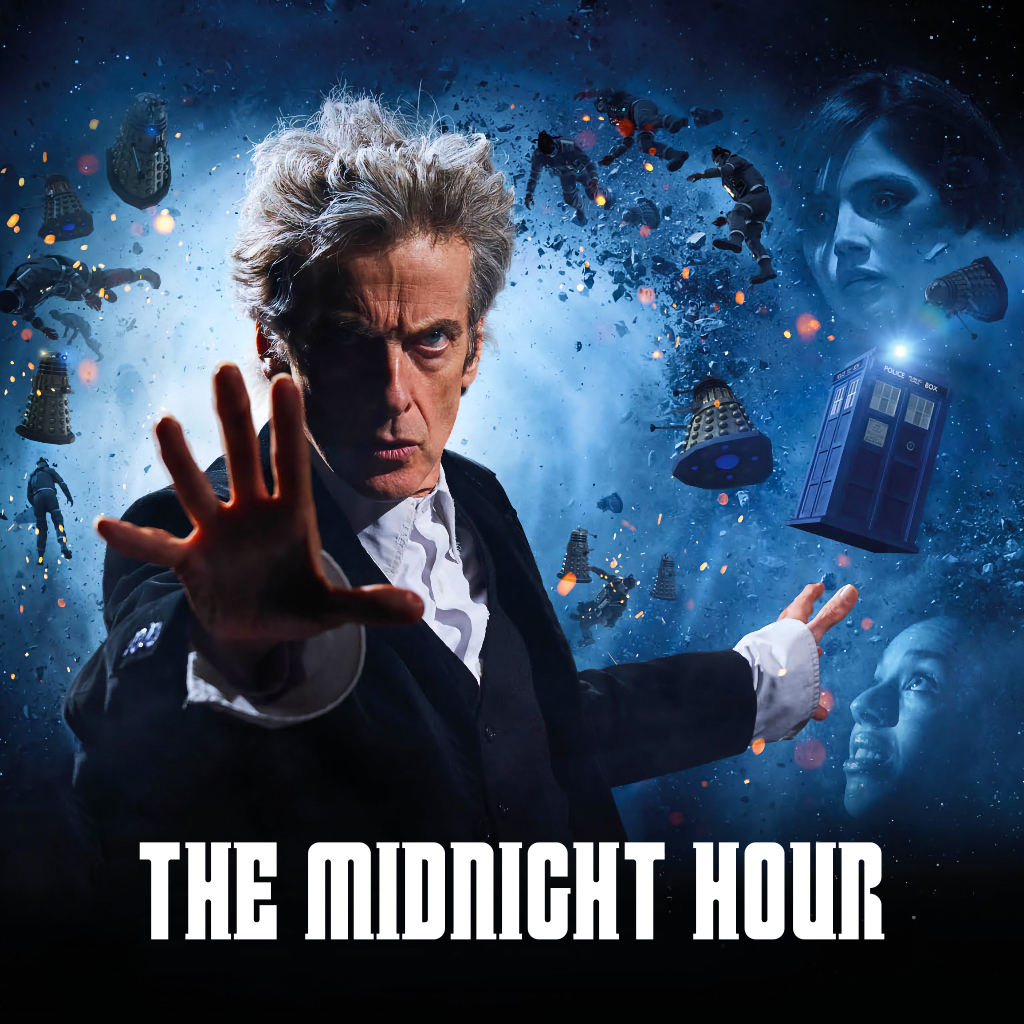
The story of Clara Oswald is the story of a woman who, over the course of two and a half seasons, graduates from being the Doctor’s companion to being, in essence, a female incarnation of the Doctor themself, years before Jodie Whittaker showed up. This transformation begins with Kill the Moon, continues here, and then finishes up in Flatline, where she formally grabs the sonic screwdriver and the title for herself, at least on a temporary basis.
For my money, Clara’s arc on Doctor Who is probably the best one ever given to a companion – I might prefer Amy Pond’s arc more in terms of personal resonance, but I’m enough of an adult to recognize quality writing when I see it, and Clara’s storyline really is that good.
Certainly, none of the companions that have followed have had anything like this in terms of complexity. Bill Potts was only ever a 1-season wonder in the tradition of the RTD era, Yaz/Dan/Graham/Ryan were just cardboard cutouts, and while there are echoes of Impossible Girl-era Clara in the case of Ruby Sunday, the fact that series 14 had 4 fewer episodes than series 8 meant that we didn’t get much of anything for her either.
What I like about Clara’s arc as a companion is how much it does to de-couple the narrative role the Doctor plays from the man who holds the title. Moffat has explored this idea before, of course, with the War Doctor. But the War Doctor was about the Time Lord we know and love intentionally refusing to use his name, because he didn’t think he was worthy of it.
Whereas with Clara, her story is about democratizing the Doctor. Proving that other people can act like him and carry on his ideals without necessarily being Gallifreyan themselves. But there is an inherent danger in that – get too emotionally involved, and you put a lot more people at risk. (Hence the discussion about the Doctor’s perceived heartlessness toward the end of the story.)
Which brings me, at last, to the “last hurrah” that wasn’t, best summed up by the song title at the top of this post. Released in 1999 on the Magnetic Fields’ 3-disc magnum opus 69 Love Songs, “I Don’t Want to Get Over You” is in fact more of a break-up song, in which our protagonist, struggling to get through a nasty split, confesses that he doesn’t want to get over his ex.
But for my money, it may as well be a song about Clara and the Doctor. Because, while she is insistent that this trip to the Space Orient Express is her “last hurrah” as a companion following the events of Kill the Moon, it turns out to be a lie.
She changes her mind, but rather than own up to that and accept it for what it is, she instead lies to both of the men in her life so she can try, desperately, to regain some control over a narrative that has been spinning wildly out of control since… well, approximately, the day the floppy-haired young man she first met turned into the grumpy old Scotsman.
But she can’t do it. Or at least, she can’t do it as Clara Oswald. She has to become the Doctor, something she’ll learn how to do over the back half of series 8. At this stage in her character arc, she’s more of a Doctor-in-training. This is what makes the conversation on the beach at the end so compelling:
CLARA: So, when you lied to Maisie, when you made me lie to Maisie
DOCTOR: I couldn’t risk Gus finding out my plan and stopping me.
CLARA: So you were pretending to be heartless.
DOCTOR: Would you like to think that about me? Would that make it easier? I didn’t know if I could save her. I couldn’t save Quell, I couldn’t save Moorhouse. There was a good chance that she’d die too. At which point, I would have just moved onto the next, and the next, until I beat it. Sometimes the only choices you have are bad ones. But you still have to choose.
And in the very next scene, we get this:
CLARA: I know it’s scary and difficult, but do you love being the man making the impossible choice?
DOCTOR: Why would I?
CLARA: Because it’s what you do, all day, every day.
DOCTOR: It’s my life.
CLARA: Doesn’t have to be. Is it like
DOCTOR: Like what?
CLARA: An addiction?
DOCTOR: You can’t really tell if something’s an addiction till you try and give it up.
CLARA: And you never have.
DOCTOR: Let me know how it goes.
It doesn’t, of course. Clara “successfully” lies her way into continuing her travels with the Doctor because, whether she admits it or not, she’s as addicted to this gig as he is. In this way, Clara is in much the same position John Watson was in “His Last Vow,” in which Sherlock says of him: “John, you are addicted to a certain lifestyle. You’re abnormally attracted to dangerous situations and people. So is it truly such a surprise that the woman you’ve fallen in love with conforms to that pattern?”
Whether you’re traveling with the Doctor or solving mysteries with Sherlock Holmes, what you get addicted to is the adrenaline rush that comes out of these situations. And who among us hasn’t wished that a blue police box might appear in the front yard and whisk us away on an adventure or two? I’d be lying if I said I hadn’t. Sure, the stress is tough, but the benefits outweigh the drawbacks, right?
Well that’s what Clara thinks initially. But she’s about to get (several) lessons in cold, hard reality about this, culminating in the events of series 9’s Face the Raven. You can play at being the Doctor all you want, but there’s always a price to be paid when you do.


Leave a Reply