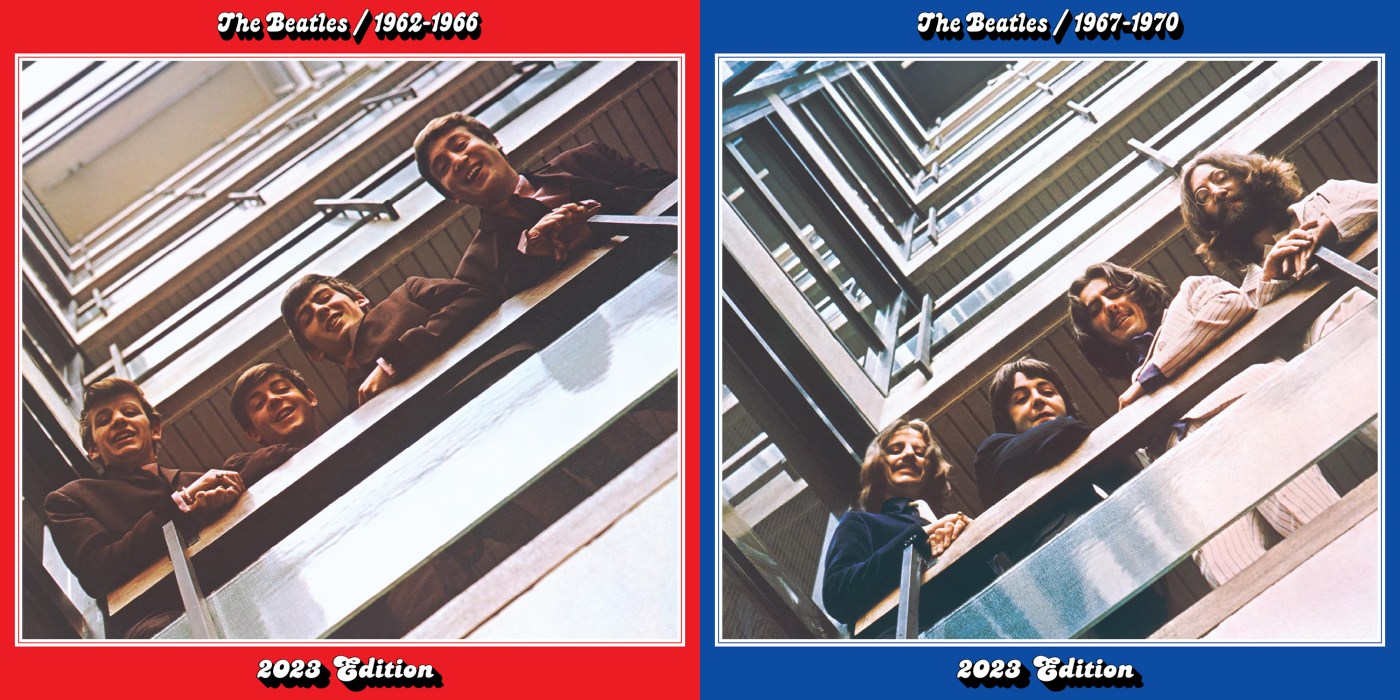
The story of the Red and Blue albums (to use the popular name for each of them) begins, as most things do, with a lawsuit.
In 1972, a record company in New Jersey released Alpha Omega, an unauthorized compilation album of Beatles songs, along with a few contemporary solo numbers. It was spectacularly illegal and of course, Apple Corps sued and won the case. The next year, Allen Klein, in one of his last acts as head of Apple, put together two new compilation albums – 1962-1966 and its twin, 1967-1970, collecting the highlights of the Beatles’ recording career, during the years indicated in their titles. The two albums were an amazing introduction into the world of Beatles music, and became incredibly popular. I know this because, as a kid, I would go around town with my Dad in his Nissan Altima, listening to Red and singing along at the tops of our voices.
The Red album functions as an excellent summary of the Beatles’ earliest years, from humble beginnings as Liverpool’s top pop band to the non-stop thrill ride of British and American Beatlemania, and on to their maturity into true artists. But as great as it is, there are still essential pieces missing – the original version of Red, for instance, had no George Harrison at all, just John and Paul with one Ringo song, “Yellow Submarine.” (I imagine Allen Klein probably had something to do with that.)
Cut to 2023. These albums turned 50 this year, and to celebrate, Apple has released expanded versions of Red and Blue. Red features not only George songs, but covers too. Almost all of the songs have also been newly remixed with Peter Jackson’s MAL process, the same one that made the Get Back documentary and last year’s Revolver mix possible.
But how does it stack up against the originals? Let’s find out. First up:
Love Me Do: The original version of this album (or at least, the 2010 remaster) opened with the Please Please Meversion of this song, where the drums were played by Andy White and poor Ringo was reduced to hitting the tambourine. The new version, as noted above, opens with the single version from October 1962, with Ringo on drums. And as noted, this is the first ever stereo mix of the song, made with the MAL process, and it sounds pretty great! Like the mono mix, only in 3D. It’s clear as can be, and every element has more room to breathe.
Please Please Me: The title song from their first album, the previous stereo mix of this song (as with all of their songs from 1963) was done with the vocals panned hard right, and instruments panned hard left. This new one has the vocals dead center, with instruments panned all around the stereo field. John’s harmonica is panned to the right, for example, while George’s lead guitar is on the left, making it easier to hear the countermelodies he plays alongside the harmonica line. Also more audible: Paul screwing up the last verse.
I Saw Her Standing There: Just when I thought the opening track from PPM couldn’t get any better, Giles Martin does this. Compared to either the original mono or the stereo, this new mix is an absolute revelation! Everything sounds crystal clear, in particular Paul’s vocal and George’s lead guitar, which sparkles and shimmers in a way it never has before. (Probably because it’s been compressed fairly heavily.) And I can hear the handclaps! And god, J&P’s harmonizing remains as sexy as ever.
Twist and Shout: The legendary closer to PPM, this song is well-remembered in Beatles lore for being done in one take, at the end of the long 12 hour session that the majority of the album was recorded in. John had a cold on that February day, so his voice was absolutely raw. He absolutely shreds his vocal part, and it sounds better than ever with the rest of the band surrounding him.
From Me To You: A non-album single from 1963, this song is well known for being the band’s first brush with minor chords in their original compositions. And as with all their other songs from this year, the new MAL process does it a lot of favors. Pay particular attention to the sound of Paul’s bass at around 1:03 – you can actually hear it!
She Loves You: Another non-album single, “She Loves You” is one of only four Beatles songs for which no true stereo mix has ever existed – the tapes for this song, as well as “Love Me Do,” “PS I Love You,” and “I’ll Get You” were wiped after mixdown, meaning that for 60 years, we’ve been listening to the mono version of the song. Even various faux-stereo mixes, like the one made by Dave Dexter Jr. for the American market, were still based on the original mono master. But now, in 2023, a true stereo mix exists, and it sounds amazing. The vocals are a little muffled, but that’s how they were on the mono as well. Ringo’s opening drum part sounds like a shotgun, and George’s lead guitar fills continue to remind me of James Bond.
I Want to Hold Your Hand: The song that electrified the American public in late 1963, this song has been mixed by Giles Martin once before, for the 1+ collection in 2015. That mix already sounded great, but this one, with Ringo being much higher in the mix than usual, sounds even better!
This Boy: “This Boy” has always been a favorite of mine, showcasing the gorgeous three-part harmonies of John, Paul, and George. This new mix allows them to shine like they never have before, and the effect is spell-binding.
All My Loving: The second track from With The Beatles, I’m just going to say it again: the MAL process is fantastic. It’s much easier now to hear the triplets John plays on guitar, and it’s nice to have Paul’s vocal in the center where it belongs.
Roll Over Beethoven: George makes his long-awaited Red Album debut, now that Allen Klein is dead and can’t say no, with a cover of a song by St. Louis’s own Chuck Berry, one of his favorite artists. Absolutely superb, mix-wise. Highlights include, again, handclaps!
You Really Got A Hold On Me: George Martin, one of the many Fifth Beatles out there, plays piano on this one, and now that piano playing can truly be appreciated. I bet Giles must’ve loved working on this track, given how close he was to his father.
Can’t Buy Me Love: I can’t listen to this song without thinking of the scene in A Hard Day’s Night where the boys goof around in an empty field. Previously remixed for the 1 re-release in 2015, I’d say that while sonically the 2023 mix makes for a more comfortable listening experience, there’s something to be said for all the low end in the 2015 version, since that was remixed from the original 1964 masters. Nice to hear Ringo a bit better though, he was muffled on the old mix.
You Can’t Do That: I hate this track. It’s an early example of a particular genre of Lennon songs: “The Violent Warning to the Girlfriend.” (Given John’s history of domestic violence… yeah.) The best thing I can say about it is the stereo mix is better than the one from the 2009 remaster, but honestly, even that isn’t much of a compliment. I don’t know who chose these new songs, but if I was them, I’d’ve swapped this with something else. Anything else.
A Hard Day’s Night: Do I need to explain this one? Title song from their first movie and the accompanying album, previously remixed in 2015. The new mix, particularly that legendary opening chord, hits you like a freight train and doesn’t let go. While the 2015 one was a dramatic reinvention, this one hews closer to the original mono, just in 3D. I like it a lot, especially the punch of that opening chord, but when it comes to which one I’d play just for hell of it, I’d go for the 2015, mainly because John’s vocal is so much more prominent on it.
And I Love Her: One of Paul’s best ballads, it’s nice to have a version of this song that has a bit more oomph to it without sacrificing the beauty of the piece. It is definitely going into one of my girlfriend playlists.
Eight Days A Week: Beatles for Sale, as an album, is criminally underrated. This song comes from that album, and I’ve always enjoyed it, especially since dating my girlfriend. This new stereo mix brings Ringo up much higher in the mix, so you can hear him banging away, having the time of his life. John might’ve said it was lousy, but I don’t think so!
I Feel Fine: I’ve always enjoyed this song, though on most stereo mixes of it, the opening bass note, and the corresponding feedback from John’s guitar that follows it, are placed in different channels. This version, thankfully, puts it dead in the middle, and I like that about it.
Ticket to Ride: Described by John as the first heavy metal song, this song is known for being one of those early occasions where the band overdubbed everything, rather than playing it live and adding smaller pieces onto the master. The new mix gives it some much needed depth, particularly (again) where Ringo is concerned.
Yesterday: The Beatles song. You’ve heard it a million times over the years, performed by about as many people. And this one, second only to “Hey Jude,” sticks in people’s minds more than any other song in their catalog. Most stereo mixes of it tend to place the guitar on one channel and the strings on the other, but the 2023 one does the simplest and best thing you can do: Paul and guitar in the middle, with the strings surrounding him. A plaintive ballad for lost love and deep regret has never sounded better.
Help!: The title song from their second movie, I have heard a lot of different mixes of this song over the years. The Love version is probably the punchiest, while the 2015 version places George’s guitar bits in the center. The 2023 mix, meanwhile, places the descending notes on either side of the stereo field, with what I suspect is ADT, while the arpeggios are mixed closer to the right. Interesting choice! I kinda like it!
You’ve Got to Hide Your Love Away: An acoustic ballad from John about forbidden love, it’s hard to figure out what to write about it – not because I don’t like the song (I do) but because it’s so simple. It’s a very well-rounded mix, I think, and I love how the flute part at the end fills your ears.
We Can Work It Out: When the 1 remix came out in 2015, I was thrilled to have a version of this song where the vocals weren’t panned hard right. This version is even better, not to mention punchier – Ringo, as always, is given more prominence. The boys circa late 1965 is one of my favorite periods of Beatle music, and this song is a good encapsulation of why.
Day Tripper: But for my money, nothing sells the Beatles circa Rubber Soul quite like “Day Tripper.” The new stereo mix absolutely drives along, with Ringo’s drums pulsing in time to that guitar riff. It’s the sexiest this song has ever sounded, in my humble opinion. Hell fucking yeah, boys!
Drive My Car: Rubber Soul is probably my favorite Beatles album, and the expanded version of Red gives us plenty of highlights. “Drive My Car,” in particular, was always one of my favorite tracks, but the stereo mix was terrible – the best version of the song I’ve ever heard was the Love version, where it was mixed with a bunch of other Beatles songs in the same key. This take, for my money, is the best pure version of the song out there.
Norwegian Wood (This Bird Has Flown): One of the reasons I like late 1965 Beatles so much is that it captures them at the halfway mark between the early pop-rock sensibilities that defined their early stardom, and the serious artists that they became from 1966 onward. “Norwegian Wood” is the very beginning of that process, exemplified in the sitar George plays. This new stereo mix unearths some details I never knew were there – specifically, what sounds to me like the finger cymbals, tambourine, and maracas that Ringo plays. Listen closely to the last third of the song, at the “She told me she worked in the morning” verse, and you’ll hear them.
Nowhere Man: When I was a pup, I believed this song was about George W. Bush, despite the fact that in 1965, Bush was at Yale. Now, I just recognize it as one of my favorite mid-period John songs, and this new mix really makes it shine.
Michelle: For a while, before I changed it to Fenrira, Michelle was my middle name, entirely because of this song. I still really like the song, even if the personal connection no longer exists. The French lyrics are really pretty, infamous mondegreens aside.
In My Life: While I like the song itself, previous stereo mixes I’ve heard of it have always left me slightly cold on it, at least before now. This one is great, especially now that John’s vocal is dead center instead of being shunted off to the side. The piano solo, the one that sounds like a harpsichord but isn’t, remains my favorite part. The wonders of varispeed, ladies and gentlethems.
If I Needed Someone: Our second George song on the collection, I really love this mix, especially compared to the original stereo. The guitars sound great, but what I love best is the center channel, just George, Paul, and Ringo keeping it real.
Girl: Believe it or not, this is actually the second time Giles Martin has mixed this song – the previous mix was a bonus track on the iTunes version of Love, released in 2011, where it was combined with some Indian sitar drones and some of the riff from “And I Love Her,” this song’s tonal opposite. This new pure mix is just as good, and to my great relief, the hissing noises that occur between repetitions of the title phrase are much further down in the mix than they were originally. (Which I’m fine with, because that hissing freaked me out as a kid. SNAKES!) This is also the last of the 2023 mixes on this album – the remaining selections, all from Revolver, were done in 2022, for that album’s special edition.
Paperback Writer: If I have my Beatles history knowledge right, this and “Nowhere Man” are two of the earliest Beatles songs to not be about love. I admit to being somewhat underwhelmed by this version of it when I heard it on the Revolver set last year. While it’s always been one of my favorite genuine rock songs of theirs, I thought the way it was mixed on the 2015 version of 1 was better – you can hear the tape echo on Paul’s voice whenever he sings the title in the acapella sections, something that previously was only on the mono mix. Later stereo versions, including this one, don’t have it. Shame, really, it’s one of my favorite parts!
Eleanor Rigby: The OG stereo mix of this song was always so weird, with how the verses were panned hard right but the choruses weren’t. This new version is much better, and you can hear more clearly how ADT, artificial double tracking, was used on Paul’s vocal during those choruses. (If you want to know the difference between real double tracking and ADT, listen closely to “Where do they all come from,” and then the “All the lonely people” lines in the last third of the song, just before the final verse about Eleanor’s funeral.)
Yellow Submarine: At last, Ringo! Some people think this song is silly, but I don’t understand them, it’s fucking great. It’s every 9 year old’s favorite Beatles song, and as an adult, I still enjoy it! The 2022 mix is good, I just wish the sound effects during the opening verses weren’t so buried.
Taxman: The lyrics themselves may not be the greatest, considering how rich George was in 1966, but I don’t care because the rest of the song sounds fucking great, especially the rhythm section. Nice and crisp, as it ought to be.
Got to Get You Into My Life: Would you believe this song is actually about pot? Because it is! But you wouldn’t know it, given Paul is disguising it as a love song. Revolver was very much “the pot album,” as John put it, and I love it. It and Rubber Soul, for me, are inseparable halves of a wonderful whole, and I’m glad this new version of Red allows them both to shine.
I’m Only Sleeping: John Lennon had to be, at least as far as mid-Sixties Britain is concerned, the laziest person in England in 1966. Lethargic in tempo this song may be, but it’s far from boring – I particularly like the reversed guitar solo. Listen close, and you can even hear John asking Paul to pretend to snore.
Here, There, and Everywhere: One of my favorite Paul love songs, the vocals in this one are spread all over the stereo field, particularly those Beach Boys-esque harmonies from John and George. Brian Wilson, eat your heart out!
Tomorrow Never Knows: Our final song on this album is John’s ode to Timothy Leary and the Tibetan Book of the Dead. It’s the most psychedelic track on Revolver, and one of my all time favorites, much improved here with the increased prominence of Paul’s bass and the gloriousness that is Ringo’s drumming. The Beatles were a studio band now, having left the moptop era entirely behind. And best of all, “Tomorrow” serves as a perfect lead-in to the first song on the next album…
In summary, I would say that the 2023 version of Red, sonically, is an entire galaxy apart from the remaster released in 2010. As problematic as generative AI is, the machine learning that made this album possible is proof that there can be good parts to it as well – up to, and including, making the earliest Beatles recordings sound better than they ever have before.
The addition of George songs to the collection, as well as more songs from Rubber Soul and Revolver, make it clearer than ever just how good all the Beatles were, not just John and Paul, as songwriters and as vocalists. This period of Beatles history has been unfairly overlooked in the streaming era, and now that the technology exists for Giles Martin to improve upon the early stuff, as he did for the later stuff, I think the odds are good that within a few years, we’ll have improved versions of all their music.
And I’m more than ready for it.
Moving on to the Blue album, we find that it now has 9 additional songs on it, almost all of them on the second disc. Among them is “Now and Then,” a John Lennon demo given a refurbishment by Paul, George, and Ringo, and dubbed “the last Beatles song” in official marketing.
The rest of the tracks have been newly remixed, either with Peter Jackson’s MAL process, or pulled from previous remix albums that have been issued, like clockwork, since 2015. In fact, if Red was entirely MAL songs, Blue is the inverse – it now functions as a greatest hits collection for the last eight years of Beatles re-releases, ever since Giles Martin took over for his father as curator of their legacy.
But how does it stack up against the original? Let’s find out.
Strawberry Fields Forever: The first Beatles single of 1967, Giles Martin’s 2015 remix of this song first appeared as a bonus track on the 1 collection, where it accompanied a remastered version of the music video. It reappeared again as a bonus track on his Pepper remix, and now appears here as the lead-off track, where it can finally be appreciated as the psychedelic wonderland it is, given new life through a return to the original 1967 master tapes. Favorite mix of my favorite song, paws down. (After the Love one, anyway.)
Penny Lane: Continuing the nostalgia theme, Paul’s song takes us through a famous Liverpudlian street he used to walk down a lot in his childhood. While slightly less poverty psychedelic than its sister song, there’s still some surrealism buried in the lyrics. The 2017 mix featured here, as noted, is sharp and clear.
Sgt. Pepper’s Lonely Hearts Club Band: The title song from what is regarded their masterpiece, the 2017 anniversary mix by Giles Martin infuses it with new energy – George’s lead guitar, by itself, becomes the star of the show. You can hear so much more of it now! I am also fond of Paul’s little howl just before the chorus.
With A Little Help From My Friends: Appropriately for a song that showcases Ringo with his three brothers, there is a lot of drum sound in here. The tom fill at around 40 seconds, in particular, sounds absolutely fucking huge.
Lucy in the Sky With Diamonds: For those of us used to the 1967 stereo mix, hearing “Lucy’ at its original speed is a little weird. But that’s how it was released back then in mono, and Martin’s goal in this new mix was to follow that version. I’d say he succeeded. (Also, again, Ringo’s drum hits between the verses sound very huge.)
Within You, Without You: The sole new song on disc 1, “Within” is a snapshot of where George’s interests lay in 1967. He’d gotten really into Indian music by now, and his compositions for most of ’67 and ’68 reflect that interest.
A Day in the Life: John’s other psychedelic masterpiece, (after “Strawberry”) this new mix puts his vocal square in the middle where it belongs, rather than moving around between verses as on the original stereo version. Aside from the lack of crowd noise at the beginning, this mix is the one from 2017, and perhaps the best sounding of them all – though the Love version is close.
All You Need is Love: The anthem that defined the Summer of Love, “All You Need” is a quintessential Beatles song, summing up everything the band represented in five simple words. This 2015 mix is nice and crisp, providing just a bit of extra low end to an already immaculate recording. The brief quotation of “She Loves You” by John toward the end is a startling reminder of how far they’ve come since then, fame-wise and as musicians, and how fast it all happened – only four years separate the two songs. Trippy, isn’t it?
I Am the Walrus: The first contemporary mix on the Blue album, Giles Martin opts to put a flange effect on John’s vocal, and to my surprise, doesn’t do much with Ringo’s drums here – he sounds almost flat compared to what you’d expect from Martin’s other Beatles work. The second half just sounds weird: it’s like he’s tried to recreate the faux stereo portion of the original 1967 mix for some reason, when on the Love album, the second half of this song is actually allowed to breathe! A rare misstep on what has otherwise been a sterling effort, mix-wise.
Hello, Goodbye: Difficult to know what to write about this one, from a mixing standpoint. It’s… fine. Not bad, but not exactly a sonic revelation either. Maybe it works better in concert with the video.
The Fool on the Hill: Thankfully, the second song from Magical Mystery Tour goes down a lot easier now that the weird panning decisions of ’67 have been excised. It’s much better now!
Magical Mystery Tour: The title song from the only American album in the official Beatles canon, Giles Martin shows us what we’ve all been missing, closing out the boys’ psychedelic era in fine style. Whatever your thoughts on the movie, you have to admit the soundtrack absolutely slaps.
Lady Madonna: With this song, we go from a drug-fueled dreamscape to good ol’ rock and roll, Beatles style. Martin’s mix here is from 2015, meaning he was working with the original tapes, somewhat limiting his mixing decisions here. Even so, nice to hear John and George’s harmonies in stereo at last, and I always have time for a good brass solo.
Hey Jude: The crowd song. I’ve heard Paul play this live, and believe me, once you do that, you never quite look at the studio version in the same way. It’s still a wonderful song though, and Martin’s mix makes you feel like you’re right there with the band. It’s fantastic.
Revolution: The final song on disc 1, I’ve never heard a stereo version of this song that I liked until Love came out, and that one got crossed with “Back in the USSR” toward the end. This blistering rock number finally gets a decent stereo mix, and it rocks just as harder as ever. Listen close and you can just make out Ringo going “Ahhhh…” before the second verse!
Back in the USSR: The one where Paul decided to combine Chuck Berry and the Beach Boys… from the other side of the Iron Curtain. I fucking love this song, it’s one of the boys’ best rock numbers, and the 2018 anniversary mix does it the perfect amount of justice. The OG Blue album faded this song out with the closing airplane noise, and it does here too.
Dear Prudence: A newcomer to Blue, this version of the song is still the 2018 mix, but with a clean beginning rather than a slow crossfade from the airplane noise at the end of “USSR”. It’s one of my favorite late-period John songs, and despite not having Ringo on it, it still sounds perfectly Beatle-y.
While My Guitar Gently Weeps: Despite having noted racist and general right-wing asshat Eric Clapton making an uncredited contribution on lead guitar, this George song from the Beatles’ self-titled double album is still one of my favorites of his, and one of the few songs of his from ’67 and ’68 with no Indian influences on it whatsoever.
Ob-La-Di, Ob-La-Da: It says something about the Beatles that they can take something as out of left field as ska and put their own spin on it.. and it still works really well! As discordant as the recording sessions were, the end result is still lovely – I particularly like the last two verses, where the roles of Desmond and Molly are swapped around. Could they be trans? I like to think so.
Glass Onion: In which John writes a snarky response to all those people who “found” hidden messages in Beatles lyrics, complete with continuity nods to various songs from 1967. Giles Martin’s mix gives it a bit more punch, which I appreciate.
Blackbird: Paul’s tribute to the civil rights movement, it has aged like fine wine, and taken on new meaning in the age of Black Lives Matter. When I heard him play it live, it was only two years after the murder of Michael Brown in Ferguson, MO, an event that Sir Paul himself referred to when introducing it. Black lives have always mattered, and they always will.
Hey Bulldog: One of the Beatles’ best rock songs, “Hey Bulldog” is a deep cut even by their standards, buried in relative obscurity on the Yellow Submarine soundtrack album. But now it has pride of place on the Blue album, with a brand new stereo mix from Giles Martin that finally decouples the piano from the bass guitar, while bringing up the vocal further in the mix and cleaning it up a bit. It sounds fantastic, and has easily become my favorite version of this track. (Also, holy god those snare hits are out of this world.)
Get Back: With this song we reach the last two albums the band’s recording career, featuring Billy Preston on keyboard duties. Giles Martin gives him plenty of time to shine on this mix from 2015, made to accompany the 1 remix. (Also, I’m pretty sure “Sweet” Loretta Martin is nonbinary with any/all pronouns. Yes, I have thought about this.)
Don’t Let Me Down: Coming from the Let It Be remix from a couple years ago, Giles Martin improves upon one of John’s best ballads, giving Ringo’s drum part a nice crisp feeling, while John and Paul’s vocals have never sounded better. It’s always nice to hear them sing together, especially as they didn’t do it much by 1969.
The Ballad of John and Yoko: In which John recounts the story of his marriage to Yoko in song form. It only has John and Paul on it, in one of their last collaborations before the band’s split just a year later. The remix (from the 2019 version of Abbey Road) lends an additional sense of immediacy to the proceedings.
Old Brown Shoe: It’s a very odd George song, this. I’ve never been quite sure what to make of it, but the new mix is nice at least! It definitely indicates just how far from the other three George was by now.
Here Comes the Sun: Who doesn’t like this song? At a time when the boys were finally falling apart, it’s one last burst of Beatle optimism, right when we need it most. Small wonder it’s gotten the most streams of any of their songs. Giles Martin’s mix from 2019 puts George’s vocal right in the middle, while giving Ringo a bit of added punch in some places.
Come Together: It’s hard to improve on perfection, but the touches Giles Martin adds to Abbey Road’s opening track make this version from 2019 the best it’s ever been. Of particular note: the organ notes just before the keyboard solo, and the newly double-tracked vocal from John during the end fade out. He was single tracked for most of it on the original, and now he’s not! Nice to have some consistency.
Something: The love song, penned by George Harrison no less – exemplifying just how he’s grown as a songwriter and a guitarist since the early days. I’ve always loved this song, but even more so since meeting my girlfriend. Giles Martin’s remix from 2019, as always, gives it a nice crisp feeling without detracting from the essential beauty. And god, those strings… nothing says late-period Beatles quite like a good string section.
Octopus’s Garden: Is it any wonder why Ringo will always be the favorite Beatle of kids? He acquits himself so well with children’s songs, as we saw on Red with “Yellow Submarine.” “Octopus” is one of his own compositions, arising during the Get Back sessions, and it’s brilliant. A little whimsy goes a long way.
Oh! Darling: Reportedly, this was supposed to be Paul doing his Little Richard voice again, but his voice had changed so much by 1969 that he ended up doing something entirely different instead. I really like Paul’s deeper voice in 1969 – such a shame it doesn’t stick around for long. By the time he forms Wings, he sounds broadly like he did in 1966.
I Want You (She’s So Heavy): If you could condense the experience of sex into a song, this is pretty much what you’d get, especially when John basically screams his vocal in places. Between the 7 minute runtime and that long hypnotic chorus, it sounds like John’s attempt at aping “Hey Jude” in structural terms, if not in content, which is very on brand for him.
Let It Be: Based on a dream he had about his mother, “Let It Be” is one of Paul’s defining works. For my part, the single version (which this is a remix of) is the best one, since it contains zero Spectorian bullshit. Every time I listen to it, I remember watching a sea of phone flashlights swaying in time at Busch Stadium in 2016.
Across the Universe: A surreal acoustic John song begun in 1968, the version on Let It Be is sadly ruined by Phil Spector and his incredibly overwrought “wall of sound” approach to mixing. Giles Martin at least makes it workable, but… yeah. There’s only so much he can do. For my money, the version on Let It Be… Naked is a million times better, since it’s basically the single version from Past Masters with the backing vocals removed.
I, Me, Mine: Not content with ruining John and his love of surrealism, Spector now turns his attention to destroying George’s final song on this collection, a short and sweet rock number that, funnily enough, was the first song to be recorded by himself, Paul, and Ringo. Further such collaborations include the Beatles versions of “Free As a Bird” and “Real Love,” available on the Anthology series. I will give Spector points for one thing though: extending this song by another minute. But if you want to hear that without his bullshit, check out Let It Be… Naked. Again: Martin makes this listenable, but that’s about it.
The Long and Winding Road: Written by Paul in 1968 and recorded during the Get Back album sessions, this became the Beatles’ final single, issued in May 1970 alongside Let It Be. It’s a yearning piano ballad by Paul, though you’d never know it from the Spectorian gloss that covers up everything but his vocal and piano. At least Giles Martin’s 2021 remix makes it listenable. As finales go, it’s a pretty disappointing one… so it’s a good thing this is now the penultimate track.
Now and Then: Where the original album closed with “The Long and Winding Road,” the new version closes with the first, and last, Beatles recording of the 21st century. And now that it’s on an album, with their picture and their name and everything, it feels like a Beatles song visually, as well as sonically. This plaintive piano ballad by John becomes him and Paul harmonizing one last time, calling out to each other across the chasm of life and death. In a way, especially in light of Paul’s tweaks to the song’s structure, it’s almost like John’s long delayed answer to “Winding Road.” A miraculous recording made with love and determination, it’s a beautiful, fitting finale to a sixty year old story, and exactly the goodbye that these four men from Liverpool deserve.
The Blue album was already great, but the addition of the new songs, paired with Giles Martin’s remixes, make it even better. Placing “Now and Then” as the last song only emphasizes this – it goes to show that even in 2023, decades away from the other thirty six tracks on this record, that old Beatle magic still exists. These two albums, when played back to back, are a beautiful summation of their legacy, and “Now and Then” is a perfect capstone.
They ride off into the sunset with their final ever song at the top of the official UK charts, and if that doesn’t speak to their longevity, I don’t know what does.
No matter what decade you’re listening in, one thing is certain…
The Beatles are forever.


Leave a Reply