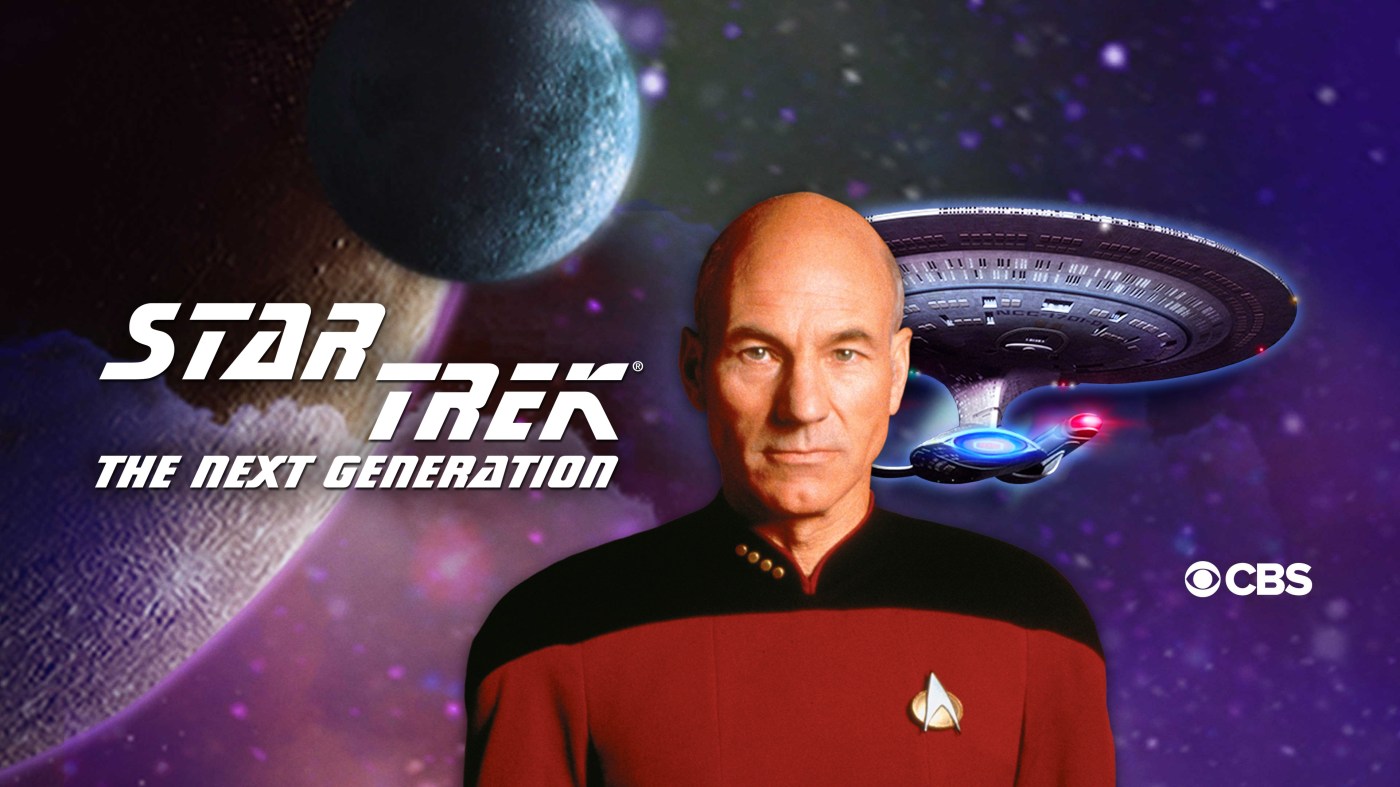
Captain’s log, stardate 80215.2: Q returns once more to the Enterprise and propels the crew thousands of light years to prove to Picard that some threats are too much for humanity, and the Borg is certainly one of these threats.
Here we are, the big one. One of the most important TNG episodes out there, and I would argue, one of the most important Star Trek episodes ever. Because while Q does appear in this episode, his role here is purely advisory, as the crew encounter the Borg for the very first time. (He’s also responsible for that meeting in the first place, but I have a few ideas about that.)
Like, I realize that these days it’s fashionable to hate on the Borg. As the TVTropes page for “Villain Decay” elaborates:
‘The Borg are probably the most infamous example, gradually going from a once-a-season menace to a routine annoyance. In their original appearance in the Star Trek: The Next Generation episode “Q Who?”, they were a faceless, inscrutable Hive Mind who could never be truly defeated because they always acted in perfect synchronicity, and could never be reasoned or bargained with.
This gradually changed with “I, Borg” and Star Trek: First Contact, which introduced the idea that the Borg could be taught to act as individuals, and gave them an actual leader in the Borg Queen—meaning that the heroes just needed to outsmart the Borg Queen to defeat them.
Then came Star Trek: Voyager, which took place entirely in the Delta Quadrant (the site of the Borg’s home territory), thus making the Borg regular antagonists for the first time in the franchise’s history. Since tangles with the Borg suddenly became frequent occurrences, the writers of Voyager had to regularly depict them being defeated by the crew of the titular lone starship (in contrast to appearances in previous shows, where the Borg mopped the floor with entire fleets) in order to keep the story moving, thus robbing them of a good deal of their original scare value.
Some in-universe justifications I’ve seen usually go like this: Wolf 359 was such a monumental disaster that Starfleet tried to change up how they designed ships to fight them off, and it works – a much smaller fleet is sent to Sector 001 and actually managed to destroy the cube, and that’s with only six years of lead time to get them there. That’s a lot of advancement, very quickly, and the Borg were likely caught off-guard – no wonder Voyager, a much smaller ship compared to the Enterprise, was capable of doing stuff the flagship couldn’t.
So, when we get to the era of Star Trek: Picard, the writers there decided to follow up on what Janeway does at the end of Voyager. Repeated encounters with an increasingly strong Starfleet led to Janeway getting in a killshot, largely ending the Borg threat for 23 years.
The key comes from a point that Seven of Nine, fittingly, makes in “The Star Gazer,” the first episode of PIC season 2: “Victory through whatever means necessary. And in the absence of strength, deception.” They’re not the all-powerful empire that they were during the early TNG period, so that’s why they do things like ally themselves with the changelings and take over Starfleet in secret, because they don’t have the resources for anything else.
But to hear people on the Star Trek subreddit tell it, they think it’s still 1998 and the Borg are still being overused and they’re terrible and “I can’t believe they brought back the Borg again” and bla-de-bla-de-blah. But here’s the thing – the current generation of Star Trek writers understand this, because chances are, they’ve been making the exact same complaint, only now they’re in a position to do something about it. The subreddit people are just doing Monday morning QBing.
So anyway, the episode.
It’s funny how the really serious episodes of TNG all begin with something silly – here it’s Sonya Gomez accidentally spilling some hot chocolate on Picard’s uniform, later in “Descent” it’ll be Data playing poker with Newton, Einstein, and Stephen Hawking. Even this season, we’ve had Riker failing to make a decent omelette prior to an episode about time travel!
But “Q Who” takes things up to another level, simply by adding Q in the mix and having him return to his Farpoint-esque “I am here to teach you lunkheads a lesson” mode, as opposed to the more comedic mode we see him in starting around “Hide and Q,” but with even more menace than what “Farpoint” gave us.
Key to this is the observation lounge scene just after that first encounter with the Borg, when 18 crewmembers are killed. Q is sitting in a dark corner of the room with only half his face lit, and this exchange happens:
Q: The Borg is the ultimate user. They’re unlike any threat your Federation has ever faced. They’re not interested in political conquest, wealth or power as you know it. They’re simply interested in your ship, its technology. They’ve identified it as something they can consume.
RIKER: You brought us here, you exposed us to them, and you cost us the lives of our shipmates.
Q: Oh, please.
That was not in the script. Per TVTropes: Q’s iconically chilling “Oh please” when blamed for the deaths of the eighteen crewmembers was an ad-lib by John de Lancie. The original dialogue was much hammier (“Stop, or you will surely die.”) but DeLancie and the director wanted to get away from playing Q that way. It’s not hard to see why – the more serious take is definitely my favorite mode for Q, particularly in “Penance,” (PIC S2) which is just this moment expanded for a solid ten minutes. It’s very compelling television.
“Q Who” is also a good turn for Whoopi Goldberg as Guinan – by now we’re used to her as the warm, friendly hostess of Ten Forward, but we don’t get any of that this time around. She’s scared, and given everything that happens, I can’t really blame her.
One more note: It’s often said that this episode’s title is a reference to Doctor Who, specifically the Cybermen, that series’ equivalent to the Borg. Which begs the question: which of the two is better? Let’s break this down.
The Cybermen, as envisaged by Kit Pedler in 1966, used to be human until they went incredibly overboard on the whole cybernetic augmentation thing and started upgrading people against their will, which is a cool idea for a monster… except what then happens is the Cybermen get written as GIANT STOMPY ROBOTS. Talk about a waste of a good premise.
My friend Frezno has a handy rule of thumb when it comes to evaluating Cyberman stories: “If you could replace the Cybermen in this story with generic evil robots and not have to alter anything else, you have made a bad Cyberman story.” As I pointed out, this describes about 90% of the Cybermen stories on TV.
It says something that the one time anyone’s written a decent one since 1966 was 40 years later, and that was by re-imagining them in a story that can be best described as Genesis of the Daleks but with more capitalism. Or by pairing them with Missy. Yes, Earthshock is a good military sci-fi story, but it’s a wretched Cyberman story because again, THEY’RE SWARMS OF FUCKING ROBOTS.
There are, in my estimation, way more good Borg episodes than there are Cyberman ones, and I would include their Next Generation appearances in that list, along with “Scorpion” from Voyager and the last two episodes of Picard’s second and third seasons, albeit for very different reasons.
One thing I’ve always said is that if we want more good Cyberman stories, we should try writing them like Borg instead. For example: Monsters in Metropolis a Ninth Doctor Big Finish story, is basically TNG’s “I, Borg” for the Cybermen. (That’s the one where a Borg drone slowly comes to grips with his own humanity.) But it figures that the only time anyone tries to do that is Nightmare In Silver, a story that was terrible when it aired in 2013, and has become unwatchable ever since we learned about how much of an inhuman monster the writer was.
So, given all of that, the Borg win. The Cybermen can fuck off.


Much as I love Trek, Who will always be my long-running multigenerational sci-fi series…and even then, when I learned that the Cybermen trounce the Borg in that one crossover comic miniseries, I found the suggestion could ever beat them in a fair fight utterly absurd. Did Eric Saward ghost-write that one?
LikeLike
No, Tony Lee just sucks.
LikeLike