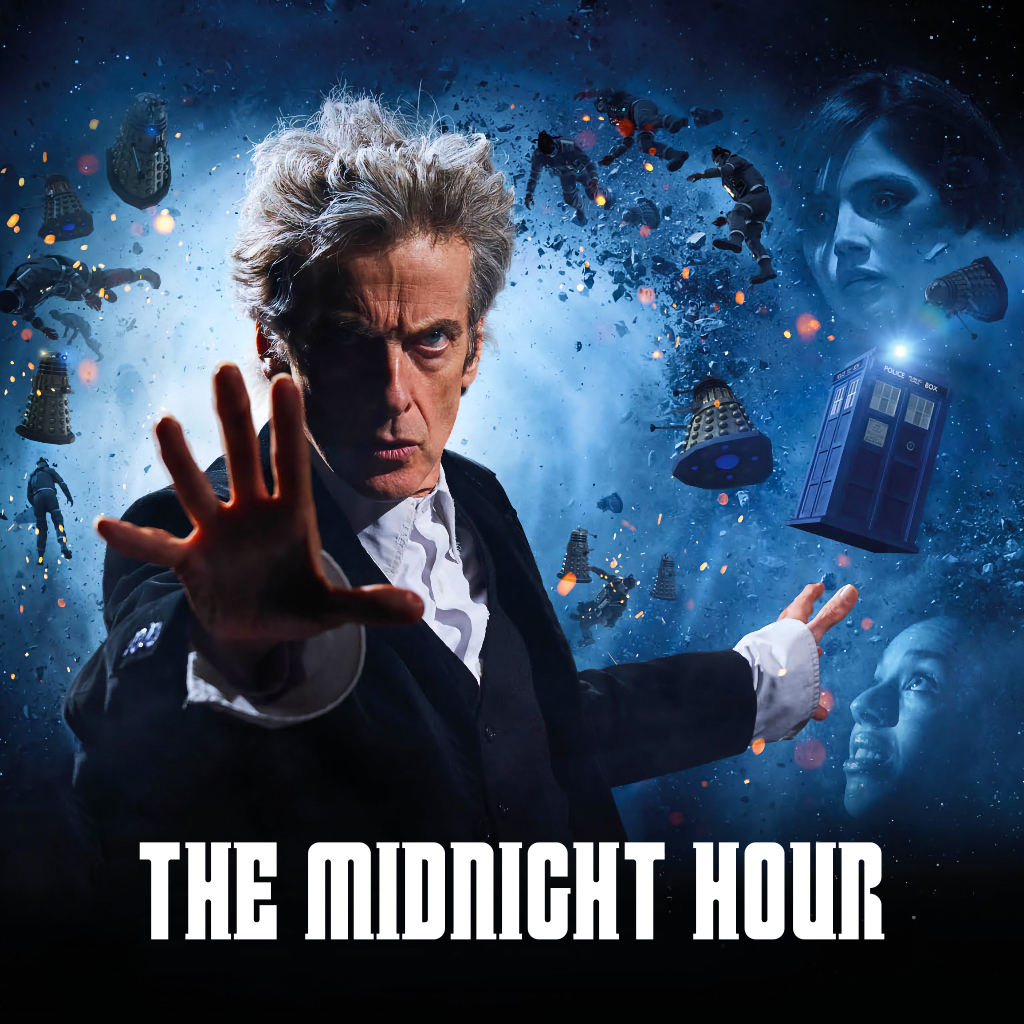
The title, incidentally, comes from my second-favorite song on The Tragic Treasury, a Gothic Archies album that collects the 13 bespoke songs for the audiobook versions of A Series of Unfortunate Events. “This Abyss” represents the sixth book in the series, The Ersatz Elevator. It’s a spooky, eerie song, drenched in synthesizer and Stephin Merritt’s echoing vocals. All in all, it provides the perfect atmosphere for a story about endings.
For me, this two-parter is the inverse of The Day of the Doctor. Once again we bear witness to a character from the Davies era returning to see out the tenure of the incumbent Moffat character, along with a third older character along for the ride, and the making of a difficult choice. Except this time it’s John Simm’s Master in the role held by the Tenth Doctor, Missy in the role of Eleven, and Twelve in the role of War.
And the choice? Missy’s decision to stand with the Doctor, rather than against him. She becomes the only incarnation of the Master to at least take a step down the road to redemption, only to be cruelly cut short by Harold Saxon at the last second. (On the plus side, I got to finish off Missy’s redemption arc in a Werewolf game a couple years ago, which was fun. Blenderfield Mall is canon, and you can’t convince me otherwise.)
And having now seen all of the stories in which John Simm played the Master, I have to say: I like him better under Moffat’s pen than under Davies’. True, you lose the homoerotic undertones that you had in The Sound of Drums and The End of Time, but Moffat makes up for that by giving him a goatee, having his outfit mirror Twelve’s, and pitching him as the amalgamated “classic” Master, in the same way the War Doctor was an amalgamation of the classic series Doctors.
And besides, what works when Simm is 37, versus what works when he is 47, are two entirely different things. Having a recurring character come back and act like it’s still the mid-2000s doesn’t fit. He’s not John Barrowman, for goodness sake. And for that matter, why can’t Simm’s Master mature a bit? He had to do something after murdering Rassilon in The End of Time. Simm acquits himself well, though I will admit the casual sexism in how he interacts with Missy gets very old, very fast. I was glad when she finally killed him.
On to the rest of the story.
The returning characters aren’t the only reason this is a dark inversion of Day – Day was also a story about a failure turning into a victory. The Doctor’s greatest triumph, the redemption and acceptance of War by his future selves, and the start of a new beginning. It is very easy to imagine a whole raft of adventures for Eleven and Clara that follow on from Day, there’s nothing in the text of either it or The Time of the Doctor that says Eleven’s last adventure happens directly after his penultimate one.
None of that is true of this story. Nothing else except Twice Upon A Time can follow on from this. By the end of The Doctor Falls, Bill has been reincarnated into a lesbian water goddess, Missy is dead, Nardole is off defending the colony ship, and the Doctor is on the verge of regeneration… except, just as with the last time Harold showed up in a story like this, the Doctor doesn’t want to go.
It’s worth noting, though, that the context in which Twelve says “I don’t want to go” is very different from what Ten meant when he said it. (And I don’t mean the Trenzalore in-joke.) When it was used in The End of Time, it was both an intentional inversion of Ten’s catchphrase “allons-y” (“let’s go” in French) and as a final rage against the dying of the light by a Doctor who was egotistical as Six.
But the Doctor is much older now. And by this point, he’s exhausted. Even allowing for the fact that he has a new regeneration cycle now, he doesn’t want to use it. He’s suicidal, or at least as close to it as you can get in a show like this. Pretty bleak stuff as far as it goes, and surprisingly cynical for a Moffat story.
Good thing, then, that he spends the next one figuring out how to live again.
Because, as grim as World/Falls is, as consumed with methodically ending the Capaldi era it is, as close to serving as the finale for the entirety of Doctor Who it is, this is still not the end of the story. There is another theme brewing under the surface here: the possibility of new beginnings.
Look at what begins here. The beginning of Missy’s life, and the start of her redemption arc. The hatching of the plan that we see in Dark Water/Death in Heaven, to which this story is both a sequel and prequel. The start of Bill’s new life as a water goddess. And, yes, the hinting toward the Doctor’s impending gender change.
But what caps it all for me is the Doctor’s speech in part 2. The one where he explains, for the first time, why he does what he does:
“Winning? Is that what you think it’s about? I’m not trying to win. I’m not doing this because I want to beat someone, or because I hate someone, or because, because I want to blame someone. It’s not because it’s fun and God knows it’s not because it’s easy. It’s not even because it works, because it hardly ever does.”
“I do what I do, because it’s right! Because it’s decent! And above all, it’s kind. It’s just that. Just kind. If I run away today, good people will die. If I stand and fight, some of them might live. Maybe not many, maybe not for long. Hey, you know, maybe there’s no point in any of this at all, but it’s the best I can do, so I’m going to do it. And I will stand here doing it till it kills me.”
“You’re going to die too, some day. How will that be? Have you thought about it? What would you die for? Who I am is where I stand. Where I stand, is where I fall.“
When we say that Steven Moffat was the best writer ever to do this show, speeches like this are what we mean. There is no one else out there who gets the Doctor to the degree that he does. Even in things like “Terror of the Umpty Ums” or Boom!, he shows that not only has he not lost a step, his conception of the Doctor endures. For a moment, I stopped seeing Ncuti Gatwa and saw a time traveling alien who used to look like Peter Capaldi and Matt Smith. That is how good Steven Moffat is.
And along with that, I’m going to make an admission: Peter Capaldi was the best actor ever to play the Doctor.
Now, that is not a knock on any of his predecessors or his successors. Remember, I came in with Matt Smith, and I will defend the Eleventh Doctor until the day I die. But when it comes to embodying the Doctor, with all his age, wisdom, and experience, Peter Capaldi tops them all. When you see him doing that big speech in the Zygon two parter, you feel like you’re watching the Doctor. It’s the same with the speech I just quoted. The actor disappears, leaving only the character.
The Capaldi era was brilliant. Faced with the tough task of following the 50th, not only did it do a marvelous job at keeping the show alive, it made sure the show got to a 60th. It was brilliant, it was magical, and it made me fall in love with the show all over again. And as I prepare to bid my writing about the show goodbye, it’s as good a place as any to end.
But first, there’s one more thing…


Leave a Reply