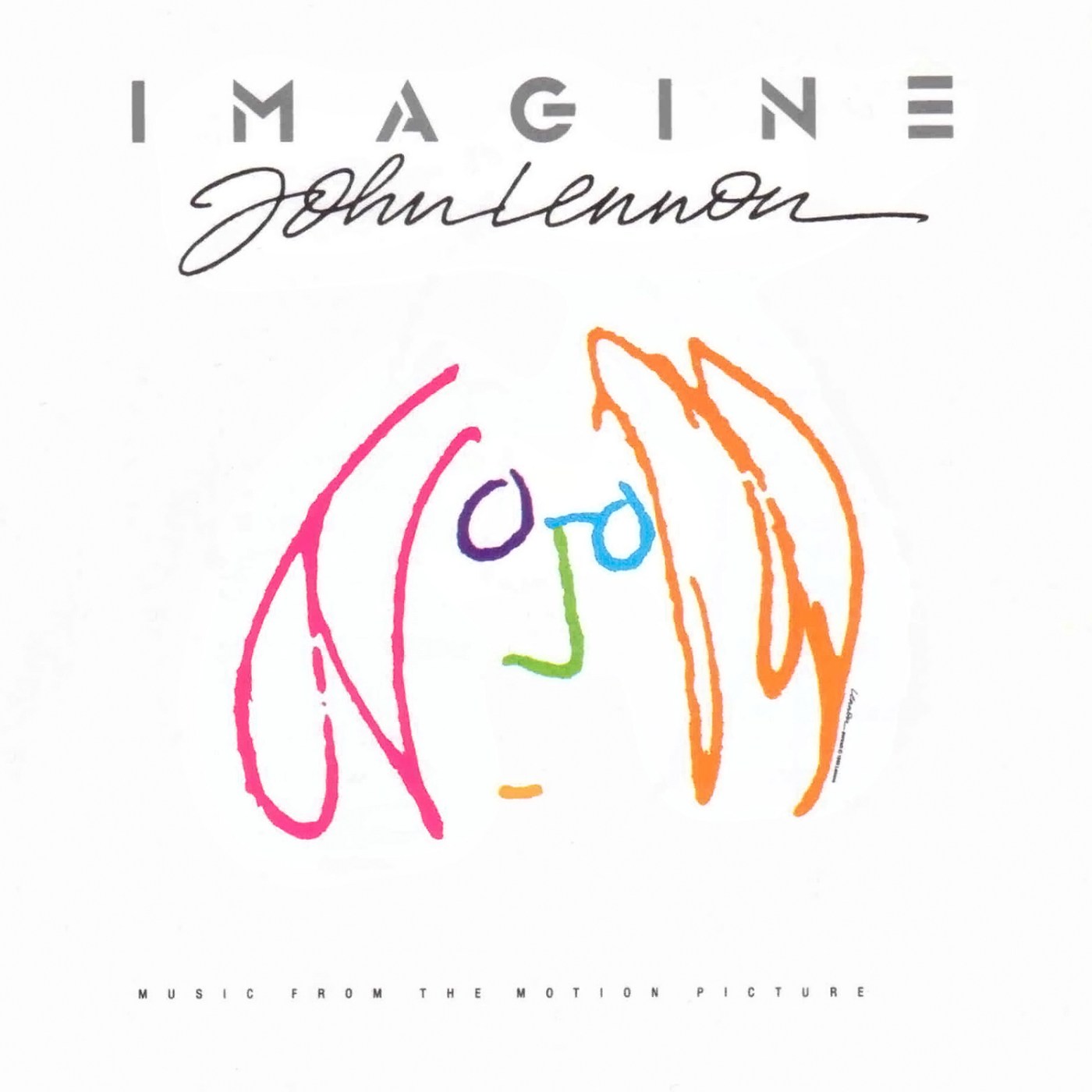
In 1988, a new documentary was released about John’s life and music, narrated by the man himself. And it was called, of course, Imagine: John Lennon, because that’s not confusing at all. Making it even more confusing is that a soundtrack album was later released for this film, which means there are now TWO entirely different John Lennon albums with the word “Imagine” in the title.
Anyway. I first caught this documentary sometime in the very early 2000s, when I was Way Too Young to be watching something like that. (It was rated R, and I must’ve been nine or ten years old.) Mom caught on to what I was watching made me turn it off, so I didn’t get to see it until years later when we moved out of the apartment we’d been living in the early 2000s to the house where I lived out the rest of the 2000s, all the 2010s, and the early 2020s.
Anyway, the soundtrack. This is the only album, across the considerable number of posthumous compilation albums that have come out in the 44 years since he was murdered, to include Beatles songs. And I mean the original recordings from the 1960s. (And if you watch the movie, there are even more Beatles songs than appear on the album.) I love this, the way it bridges both halves of his career together. As it should be.
Let’s dive in:
“Real Love”: I love this version of “Real Love” so much. ❤ This is a different version of the song from the one that first appeared in 2004 on the Acoustic album, but it’s pretty similar to that one, both in key and in how John plays the song. This is the first version of the song I ever heard that wasn’t the Beatles version, and I fucking loved it. And so far as I know, this album was the only one in which that specific recording appears, so of course I tracked it down and bought it from eBay.
‘Twist And Shout’: Once a closing track, on this album it becomes track two, and it works better here than it did on The Early Beatles. John Lennon gives the performance of his life, absolutely shredding his vocal part – recorded after sucking down cough drops and milk for an entire day. It is amazing, and he only needed one take to nail it. This is the mono mix of the song, as released on the CD version of Please Please Me from 1987.
‘Help!’: The title song of their second movie, written by John Lennon. He described it as essentially being him calling out for help amidst the hurricane that was Beatlemania in the early sixties, and that really does lend the track a more anxious vibe than “A Hard Day’s Night” had. Audio nerd note: the lead vocal heard on the stereo version is completely different to the lead vocal on the mono – listen to the verses and choruses, not the intro.
In My Life: One of John’s prettiest ballads, my personal favorite aspect of this song is the piano solo – it sounds like a harpsichord, but it isn’t! It’s a regular piano played at half speed, then sped up, a technique called varispeed. I used the exact technique once in an AUDI 2000 assignment in college, and my professor was really impressed! Thanks, George Martin!
Strawberry Fields Forever: My all-time favorite Beatles song ever, this. John wrote this in Spain after the band finished touring in 1966, and the actual recording of the song launched the band’s psychedelic period. It’s probably the most technically complicated song they ever did, not just with all the instrumentation going on, but the way it sounds – the first minute or so is in the key of B flat, while the rest of it (originally recorded in a higher key) had to be slowed down to match the first part.
The resulting edit is one of the most famous pieces of Beatles lore ever, and the song just wouldn’t feel the same without it. What starts as a nostalgic look back at a favorite hiding place of John’s as a kid becomes an LSD-infused wonderland, and it’s absolutely brilliant. I wish I could’ve heard this in 1967 – it probably blew everyone’s minds.
A Day in the Life: Based on newspaper articles, it’s often hailed as one of the Beatles’ best songs, and honestly, I can’t argue with it. The echo on John’s voice gives it a somewhat dream-like quality, which then becomes nightmarish when the build-up starts, preceding Paul’s verse, and the other extremely well-known chord in Beatles music.
The version included here was the first one to include the clean, crowd-free introduction – the original vinyl version of the Blue Album from 1973 just faded in the crowd noise. When the albums were released on CD in 1993, the new clean edit was the one they used.
‘Revolution’: Like “Paperback Writer” before it, “Revolution” defines the word distortion, as the guitar sound came from the guitars being plugged into the mixing desk directly and played so loudly as to overload the meters. It was one of Lennon’s earliest political songs, responding to the revolutionary fervor gripping the UK and the US by asking “What’s the plan for afterwards?” It was recorded twice: a slower version appeared on the White Album in 1968, and the single version is presented here.
‘The Ballad Of John And Yoko’: This song was a hybrid of two approaches. Specifically, Paul’s preference for story-songs was wedded to John’s fondness for autobiographies to create this track, a written record of John’s marriage to Yoko Ono, and the honeymoon that followed. It was John and Paul’s first true collaboration in some time, and they played all the instruments. “Ballad” was also the first Beatles song to be mixed only for stereo, no dedicated mono mix was ever prepared, as mono had fallen out fashion by 1969. The last mono Beatles single was “Get Back,” backed with “Don’t Let Me Down.”
Julia: One of two tribute songs John wrote about his mother, this one is easily my favorite, with just a touch of Yoko in the lyrics. After all this time, John found someone he could be himself with, and begin to heal. I know from experience how important that is. If only he’d lived longer…
‘Don’t Let Me Down’: One of John’s finest love songs, “Don’t Let Me Down” was inspired by his relationship with the artist Yoko Ono, whom he’d met in 1966. Released as the b-side of “Get Back,” both tracks feature the keyboard playing of Billy Preston, a friend of theirs from the Hamburg period, and who sat in as the “fifth Beatle” during the Get Back/Let It Be sessions.
Give Peace A Chance: John’s very first solo single, written and recorded in 1969 during a break in the recording sessions for the Abbey Road album. The happiest anti-war song ever recorded, it’s just John on acoustic guitar, encouraging the group around him to join in his demand for peace instead of endless war. Originally meant to protest against the Nixon administration’s involvement in the Vietnam war, the song has remained relevant even in today’s world.
‘How?’: Staying with the theme of John being confessional on a piano, this song finds him trying to figure out whether, or if, he’s capable of love given all the difficulties he’s experienced over the course of his life. The chorus (“You know life can be long”) inject a bit of optimism into the lyrics, suggesting he might have come up with a solution.
“Imagine”: A very simple rehearsal of this song that demonstrates for those listening what it sounds like. Just the first verse and the chorus, but that’s all it needs for a demo anyway.
God: In which John comprehensively rejects everything from magic to tarot, the Bible, Jesus, Buddha, Bob Dylan, divinity in general, and of course, the Beatles. The way he spits out his former band’s name as if it were an insult remains attention-grabbing, and when paired with his gentle, though blunt, statement that he’s only himself now, it’s very effective.
“Mother”: Coming from the MSG concert recordings, this version of POB’s first song sounds really different being played on electric pianos. It also sounds like John is straining his voice a bit here – I’m not sure if it’s because he’s just worn out from singing or he can’t reach the notes in a live environment. Still, it’s a good performance of a haunting song.
Stand By Me: Released on Rock ’n’ Roll, John’s album of covers of the songs he loved as a kid, this was his last hit song before he retired from music in 1975 to raise Sean Lennon. The original album version has slapback echo on his vocal – the Ultimate Mix from 2020 presents it unadorned. Whichever you way you slice it, the sheer emotion in his singing is always exhilarating.
Jealous Guy: As mentioned in the Esher Demos post, this song began life as “Child of Nature,” when John was high on learning transcendental meditation in India. He set new lyrics to the tune from 1968, resulting in this piano-based confessional from 1971’s Imagine. I must’ve been about 12 or so when I first heard it, and the sheer vulnerability of it hit me like a freight train. (And it still does!) The last decade of John’s life was one where he tried to make amends from all the pain and awfulness of his youth, and this song is part of that process.
Woman: Described by the writer as a grown-up version of “Girl” from Rubber Soul, down to the title, “Woman” is nothing less than a joyful exclamation of love and appreciation for, as he calls us, “the other half of the sky.” It’s a song that exemplifies how refreshed and happy he was feeling in 1980, entering his 40s, ready to take on the world.
Beautiful Boy (Darling Boy): John’s touching ballad to his son Sean, dating from 1980. It’s an absolutely gorgeous song, and the imagery and instrumentation carries echoes of John’s restorative visit to Bermuda in 1980, a trip which re-awakened his musical muse. (It’s also Paul’s favorite solo Lennon song, per a 1982 appearance on Desert Island Discs.)
(Just Like) Starting Over: The lead-off song from Double Fantasy opens with chiming bells – a deliberate reference to the funeral bells at the start of “Mother,” the opening song from Plastic Ono Band. This is a song that exemplifies John’s development as a musician and a human being throughout the 1970s, and as we all know, he was really looking forward to the 1980s. I truly wish he’d been able to see them.
‘Imagine’: The Big One. Ask anyone to picture John’s solo years, and this, understandably, is the first one they’ll name. Some have called it an atheist anthem, and others see it as what it is – a plea for world peace at a time where it seemed like the entire world was burning down.
While its message has been derided over the years as being hypocritical, I feel like people who say things like that are missing the point. He can make these statements because he had been a Beatle. There’s no bigger platform than that, and no better legacy than this.
It’s funny that a movie soundtrack album should be the thing that provides as perfect a summary of who John Lennon was as you could want, but here it is anyway. By including nine Beatles tracks in the list, we get to see all sides of John – the activist, the father, the loving husband, the fan of 1950s rock and roll, the psychedelic dreamer. You see him vulnerable, and you see him gentle. You see him call for revolution and ask that we all come together in peace.
We need his music now more than ever, as we look at the incoming authoritarian regime masquerading as an American presidential administration. If you want a preview of what we could all be facing in this new future (or are already living in, for those of you reading this on WordPress) I highly recommend another documentary about John’s life: The U.S. vs John Lennon, about John and his attempts to deal with/fend off the FBI under J. Edgar Hoover and Richard Nixon’s administration more generally.
We won’t be as lucky as John was. But his music can still provide us hope. Just as it was in the 1970s, his work is the soundtrack to resistance. The world he imagined is still possible, we just have to put in the work to make it so.
Let’s get started.


Leave a Reply