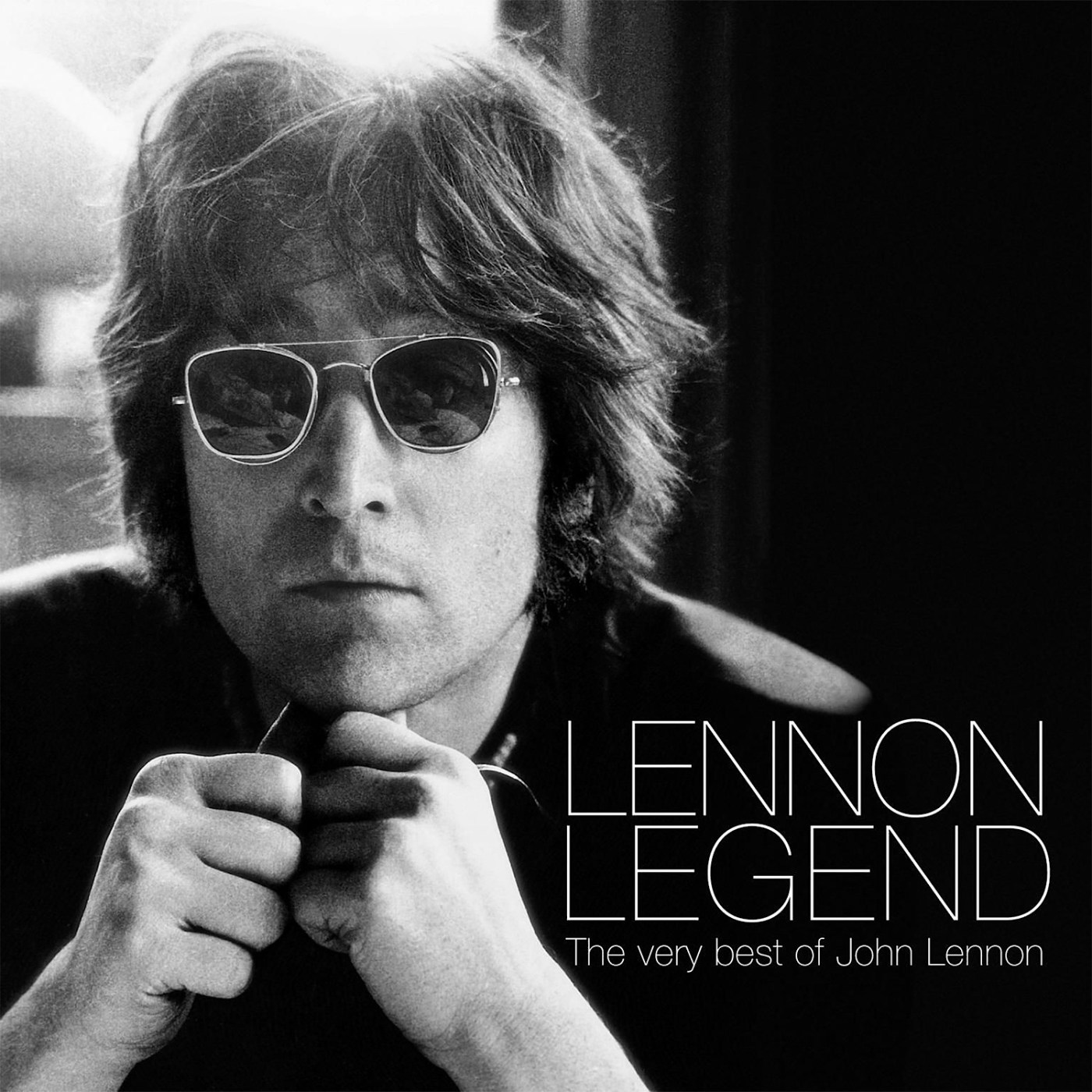
For me anyway, no discussion of John’s solo career would be complete without looking at 1997’s Lennon Legend, one of several best-of albums of his music released in the years following his death. This one came out when I was about 3, and I remember my dad owned a copy… except his would skip toward the end of “Just Like Starting Over,” which always kind of freaked me out whenever we’d listen to it in the car. (The black Nissan Altima, I think it was.)
Point being, this was where my love of John’s solo work began. To my young mind, the cover art and even the look of the disc itself seemed more “grown up” than the Beatles releases I was used to. The Beatles were a band that you could play with your kids in the car, like my dad did with me. John’s solo stuff? Not so much. But it was new music (well, new to me) by one of the four men I loved, so I treasured it.
Lennon Legend, for me, is kind of like the equivalent of the Beatles’ 1 album. All the big hits from his solo career are here, you’ve got at least one song from all of his studio albums… if you’re just getting into his music, this is the one to get. I wouldn’t say it’s my favorite compilation, (for me that’s Working Class Hero) but it’s the essential one.
So with all that said, let’s jump in:
Imagine: The Big One. Ask anyone to picture John’s solo years, and this, understandably, is the first one they’ll name. Some have called it an atheist anthem, and others see it as what it is – a plea for world peace at a time where it seemed like the entire world was burning down.
While its message has been derided over the years as being hypocritical, I feel like people who say things like that are missing the point. He can make these statements because he had been a Beatle. There’s no bigger platform than that, and no better legacy than this.
Instant Karma!: This one has always been one of my favorite solo-Lennon songs, it was even my ringtone for years when I was in high school. Per Wikipedia, “focus on a concept in which the consequences of one’s actions are immediate rather than borne out over a lifetime,” and I have to say, I understand this concept way better now as a practicing Wiccan. (Look up the Threefold Law for more information.) This track has also been covered by Duran Duran, and they did a fabulous job with it.
Mother: The inverse of (Just Like) Starting Over, as noted below. If you’re coming to this song after his Beatles work, it’s nothing less than an angry, much-deserved howl of frustration, as he finally lets loose with all the accumulated 30 years of rage at how both of his parents abandoned him.
Thank goodness Ringo is there to provide support, both at the drum kit and emotionally. The remixed version of Plastic Ono Band includes a version of the song that is just John’s raw vocal, and it is simply the most haunting thing I’ve ever heard.
Jealous Guy: As mentioned in the Esher Demos post, this song began life as “Child of Nature,” when John was high on learning transcendental meditation in India. He set new lyrics to the tune from 1968, resulting in this piano-based confessional from 1971’s Imagine. I must’ve been about 12 or so when I first heard it, and the sheer vulnerability of it hit me like a freight train. (And it still does!) The last decade of John’s life was one where he tried to make amends from all the pain and awfulness of his youth, and this song is part of that process.
Power to the People: A non-album single of John’s from 1971, when he was at his most intensely political – in this case, he shows off his development as a feminist during verse three, and a commitment to the working class heroes of the world in verse two. But what I like is the opening two lines, where he repeats the first line of his song “Revolution,” and then follows it up with a desire to get things moving, rather than the more cautious approach he took in 1968.
Cold Turkey: A song about John and Yoko each deciding to quit heroin… well, cold turkey. It has nothing to do with a cold Thanksgiving turkey, though that didn’t stop UMG from releasing a digital EP in November 2020 based around Lennon songs to play during the Thanksgiving holiday. (Pandemic days are weird, aren’t they?)
Anyway, John’s first idea was to release this song as a Beatles single, which was vehemently refused. So John decided to release it himself instead. The resulting track, much like Plastic Ono Band itself, is as raw as any other song on the album, and I’m glad the 2021 remix put it on at the end. It seems to be a natural place for it.
Love: One of the rare upbeat songs on Plastic Ono Band, this is one of John’s loveliest ballads, the close-miked vocals, acoustic guitar, and Phil Spector’s gentle piano give it an almost lullaby-like quality – which might explain why Kenny Loggins did a version of it on his album Return to Pooh Corner, which I listened to obsessively as a kid.
Mind Games: The title song from his under-appreciated release, Mind Games came out at the beginning of John’s 18 month separation from Yoko. The title track, though, is just the latest in an entire sequence of “Power of love” songs of his that go all the way back to “The Word” from Rubber Soul, filtered through the mysticism that runs through the early 1970s.
John specifically mentions druidry and magic here, nodding toward neo-paganism and other non-Abrahamic religious traditions. If you read Drawing Down the Moon, you will never look at Lennon’s lyrics in quite the same way again. The whole song gives me big pagan vibes, as I wrote about when I discussed the parent album.
Whatever Gets You Thru the Night: John’s first number one single as a solo artist. Joining John on co-lead vocals is another John: Sir Elton, of Honky Chateau fame.
Lennon was the only ex-Beatle not to have a hit single by 1974, and his career had taken a downturn after Imagine. Elton, though, made a bet: if this song hit the top of the charts, Lennon would sing it live with him at Elton’s Madison Square Garden show on Thanksgiving. And sure enough, that’s exactly what happened!
At MSG, the two Johns not only sang “Whatever Gets You Thru the Night” together, but also “I Saw Her Standing There” with Lennon on lead vocals for the first time, and Elton’s cover of “Lucy in the Sky with Diamonds.” The performance led to Yoko rekindling her relationship with John, and Sean Lennon was conceived not long afterwards.
#9 Dream: This song is Sophie’s favorite, so I thought it appropriate to ask her why. She replied that she appreciates how ethereal the song sounds – John’s voice, she says, sounds like it’s coming from everywhere.
One of her favorite bands, R.EM. did a cover of it in 2007 for Amnesty International’s Instant Karma album, and she likes that version too. (I love that each of us has a cover from that collection that we both love. Duran Duran and “Instant Karma” for me, and REM and “#9 Dream” for her.)
Listening to the original for myself, I’d have to agree with Sophie’s view. The echo-drenched vocal, the whispering between lines just before the bridge section, the line in the chorus that literally came to John in a dream… this is a song that lives up to its title.
Stand By Me: Released on Rock ’n’ Roll, John’s album of covers of the songs he loved as a kid, this was his last hit song before he retired from music in 1975 to raise Sean Lennon. The original album version has slapback echo on his vocal – the Ultimate Mix from 2020 presents it unadorned. Whichever you way you slice it, the sheer emotion in his singing is always exhilarating.
(Just Like) Starting Over: The lead-off song from Double Fantasy opens with chiming bells – a deliberate reference to the funeral bells at the start of “Mother,” the opening song from Plastic Ono Band. This is a song that exemplifies John’s development as a musician and a human being throughout the 1970s, and as we all know, he was really looking forward to the 1980s. I truly wish he’d been able to see them.
Woman: Described by the writer as a grown-up version of “Girl” from Rubber Soul, down to the title, “Woman” is nothing less than a joyful exclamation of love and appreciation for, as he calls us, “the other half of the sky.” It’s a song that exemplifies how refreshed and happy he was feeling in 1980, entering his 40s, ready to take on the world.
Beautiful Boy (Darling Boy): John’s touching ballad to his son Sean, dating from 1980. It’s an absolutely gorgeous song, and the imagery and instrumentation carries echoes of John’s restorative visit to Bermuda in 1980, a trip which re-awakened his musical muse. (It’s also Paul’s favorite solo Lennon song, per a 1982 appearance on Desert Island Discs.)
Watching the Wheels: Here’s one of my favorite late-period John songs, describing his contentment with just letting life go by rather than chasing the next big fad or capitalizing on his existing fame. For me, this is the grown-up version of “I’m Only Sleeping” from Revolver, only from a healthier perspective than the drug-induced stupor he was in during 1966.
‘Nobody Told Me’: Another almost-Ringo song, but to be honest I can’t really see it working as one. It’s too John-ish. The UFO incident, by the way, dates back to 1974 when Walls and Bridges was being made. In the album’s lyric sheet, he wrote, “On the 23rd Aug. 1974 at 9 o’clock I saw a UFO,” referring to an incident that happened shortly after he and May Pang returned to New York. They really did see one, and so had quite a few others!
‘Borrowed Time’: This song came about after John heard a Bob Marley song while in Bermuda, though its direct inspiration was the maritime adventure he had sailing during a thunderstorm. As he explained in an interview, “I was there driving the boat for six hours, keeping it on course. I was buried under water. I was smashed in the face by waves for six solid hours. It won’t go away. You can’t change your mind. It’s like being on stage; once you’re on there’s no gettin’ off.”
Working Class Hero: For such a simple song, it took John about a hundred tries to get this one right, and even on the final master take he still had to do some splicing. The resulting edit is far from clean, but who cares? What matters is the message.
In this song, John tears down the worlds of family and school that forced the young into conformity, attacks the way the ruling classes keep the underclasses busy with bread and circuses while they get to mooch off the after-effects, and even finds time to go after the meritocracy, which he believes is preceded by a trail of blood.
Like all of John’s best work during his solo years, it pulls no punches, and I feel the struggle related in the lyrics more and more strongly with every passing decade. For all that the line “If you want to be a hero well just follow me” was meant ironically, I feel pretty safe in saying that a lot of listeners, both in the 1970s and ever since, took him literally. Because in John’s music, particularly his political songs, we can find the tools that we need to take back control from the fat cats that have been ruling our lives.
Happy Xmas (War Is Over): John’s one and only Christmas song, and the first one to be recorded by a Beatle since “Christmastime Is Here Again” in 1967. Like “Give Peace a Chance” before it, the goal of the song is to promote an end to war and strife, and optimism for the coming new year. It has since become a holiday standard, right up there with Paul McCartney’s own Yuletide track, “Wonderful Christmastime.”
Give Peace a Chance: John’s very first solo single, written and recorded in 1969 during a break in the recording sessions for the Abbey Road album. The happiest anti-war song ever recorded, it’s just John on acoustic guitar, encouraging the group around him to join in his demand for peace instead of endless war. Originally meant to protest against the Nixon administration’s involvement in the Vietnam war, the song has remained relevant even in today’s world.
It’s interesting, how the music world responds to an artist dying. Particularly when that person is as nearly universally beloved as John was, the cynical might say that periodic re-releases of songs we’ve all heard a million times already is just one more way of getting money from a gullible public. As the man himself wrote, “Everybody loves you when you’re six foot in the ground.”
Thing is though, I don’t see it that way. The Beatles were all born during the Second World War, their generation has gotten old enough to become grandparents. (And in some cases, great-grandparents.) We’re not always going to have these musical legends forever. What periodic compilations and re-releases allow is for new generations, like my dad in the 1970s, or me in the 1990s and early 2000s, to become introduced to such important music.
Lennon Legend is the album that helped make me a Lennon fan, just as the 1, Red, and Blue albums helped make me a Beatles fan. And I would be willing to bet that for a lot of people my age, they’d say the same. The recent Ultimate Mixes might be doing the same for the kids who’ve grown up on Spotify and Apple Music.
And that, I think, is part of why this music has lasted as long as it has, and will continue to. Tony Barrow may have been wrong about kids smoking and picnicking on Saturn in the year 2000, but who knows? He may well be right about the sheer longevity of it all. As long as people like Taylor Swift or Billie Eilish are out there, carrying the flame, John and the rest of the Beatles will live on in their music, forever.
So mote it be.


Leave a Reply