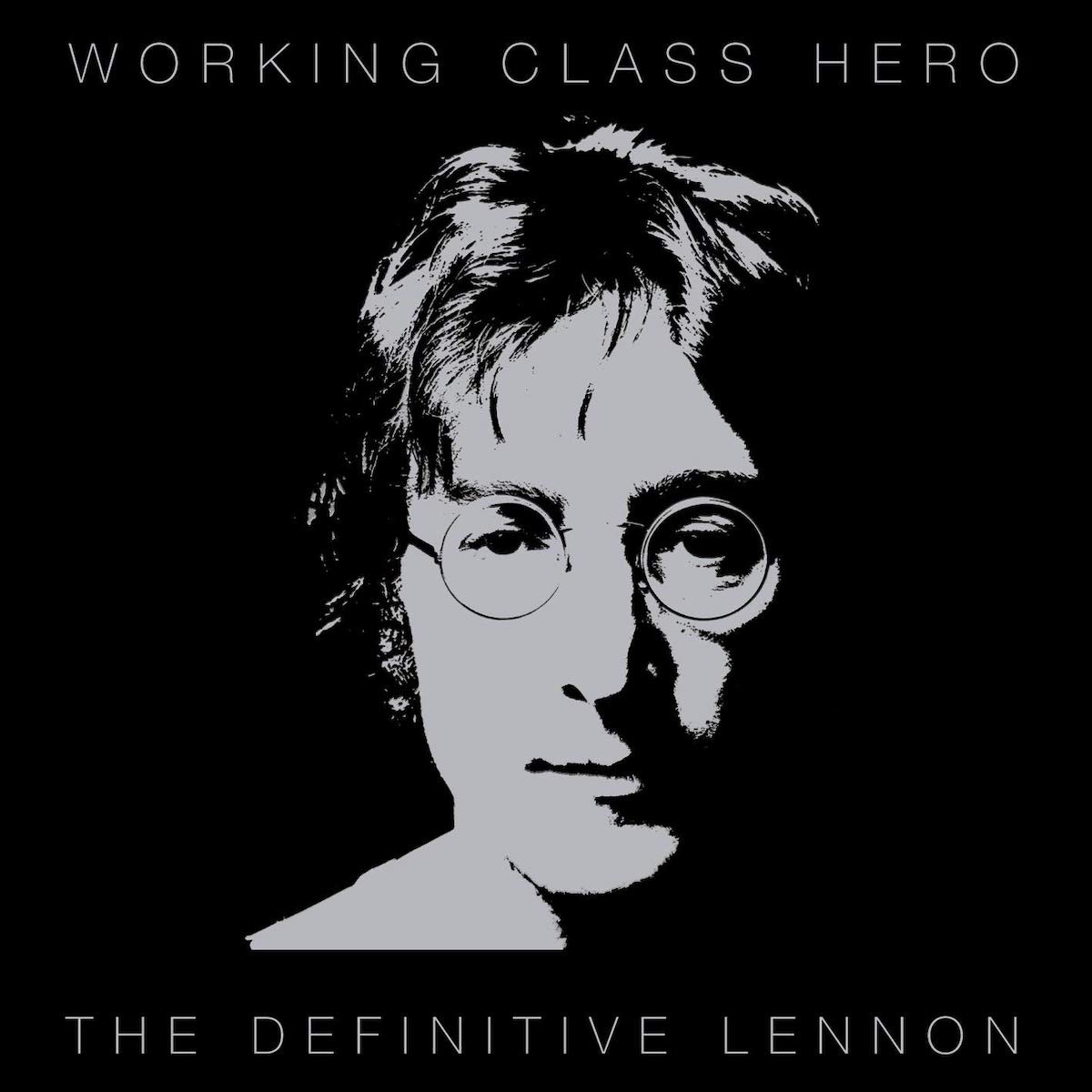
We end our look at the solo career of John Lennon with this, my personal favorite of the many, many compilations of his work that have come out since his death. It came out in October 2005 to celebrate his 65th birthday, and on the surface, it looks like a repeat of Lennon Legend – the same black cover art, with text set in the lighter weights of Helvetica Neue. But look deeper, there’s more to it than that.
The subtitle is The Definitive Lennon, and if you are a dedicated Lennon fan like me, you’ll agree that this album more than lives up to that subtitle. Sure, there are box sets that probe even deeper into his solo work, (2010’s Gimme Some Truth dedicates FOUR discs to different themes, for example) but this is the collection that feels more accessible, striking a good balance between having All The Hits, and some deeper cuts that Lennon Legend didn’t touch.
I first heard this album probably not long after it came out, so the latter half the 2000s, after checking it out from the library. It’s a wonderfully varied collection, as much like the Beatles’ Red and Blue albums, there are two discs here, giving more room for music. But where Red and Blue are arranged chronologically, the selection here is a bit more random – you get songs from 1980 up against stuff from 1970 and ’71. There are album tracks that make their “Greatest Hits” debut here, and even some songs from the Anthology collection.
Let’s dive right in:
Disc 1
(Just Like) Starting Over: The lead-off song from Double Fantasy opens with chiming bells – a deliberate reference to the funeral bells at the start of “Mother,” the opening song from Plastic Ono Band. This is a song that exemplifies John’s development as a musician and a human being throughout the 1970s, and as we all know, he was really looking forward to the 1980s. I truly wish he’d been able to see them.
Imagine: The Big One. Ask anyone to picture John’s solo years, and this, understandably, is the first one they’ll name. Some have called it an atheist anthem, and others see it as what it is – a plea for world peace at a time where it seemed like the entire world was burning down.
While its message has been derided over the years as being hypocritical, I feel like people who say things like that are missing the point. He can make these statements because he had been a Beatle. There’s no bigger platform than that, and no better legacy than this.
Watching the Wheels: Here’s one of my favorite late-period John songs, describing his contentment with just letting life go by rather than chasing the next big fad or capitalizing on his existing fame. For me, this is the grown-up version of “I’m Only Sleeping” from Revolver, only from a healthier perspective than the drug-induced stupor he was in during 1966.
Jealous Guy: As mentioned in the Esher Demos post, this song began life as “Child of Nature,” when John was high on learning transcendental meditation in India. He set new lyrics to the tune from 1968, resulting in this piano-based confessional from 1971’s Imagine. I must’ve been about 12 or so when I first heard it, and the sheer vulnerability of it hit me like a freight train. (And it still does!) The last decade of John’s life was one where he tried to make amends from all the pain and awfulness of his youth, and this song is part of that process.
Instant Karma!: This one has always been one of my favorite solo-Lennon songs, it was even my ringtone for years when I was in high school. Per Wikipedia, “focus on a concept in which the consequences of one’s actions are immediate rather than borne out over a lifetime,” and I have to say, I understand this concept way better now as a practicing Wiccan. (Look up the Threefold Law for more information.) This track has also been covered by Duran Duran, and they did a fabulous job with it.
Stand By Me: Released on Rock ’n’ Roll, John’s album of covers of the songs he loved as a kid, this was his last hit song before he retired from music in 1975 to raise Sean Lennon. The original album version has slapback echo on his vocal – the Ultimate Mix from 2020 presents it unadorned. Whichever you way you slice it, the sheer emotion in his singing is always exhilarating.
Working Class Hero: For such a simple song, it took John about a hundred tries to get this one right, and even on the final master take he still had to do some splicing. The resulting edit is far from clean, but who cares? What matters is the message.
In this song, John tears down the worlds of family and school that forced the young into conformity, attacks the way the ruling classes keep the underclasses busy with bread and circuses while they get to mooch off the after-effects, and even finds time to go after the meritocracy, which he believes is preceded by a trail of blood.
Like all of John’s best work during his solo years, it pulls no punches, and I feel the struggle related in the lyrics more and more strongly with every passing decade. For all that the line “If you want to be a hero well just follow me” was meant ironically, I feel pretty safe in saying that a lot of listeners, both in the 1970s and ever since, took him literally. Because in John’s music, particularly his political songs, we can find the tools that we need to take back control from the fat cats that have been ruling our lives.
Power to the People: A non-album single of John’s from 1971, when he was at his most intensely political – in this case, he shows off his development as a feminist during verse three, and a commitment to the working class heroes of the world in verse two. But what I like is the opening two lines, where he repeats the first line of his song “Revolution,” and then follows it up with a desire to get things moving, rather than the more cautious approach he took in 1968.
‘Oh My Love’: The tenderest song on the album, this is a love song to Yoko, with its origins from the same 1968 sessions that produced the Beatles’ White Album. Quoting the Beatles Bible: “The lyrics, which reveal feelings of clarity and rebirth at having fallen in love, are among the album’s most elegant and direct, and the references to the wind and clouds are reminiscent of Ono’s instructional works.”
‘Oh Yoko!’: Proving beyond a doubt that John can do joyful exclamations of love for his wife just as well as Paul can, he comes up with this, the closing track from Imagine. It’s absolutely delightful, with little nods toward his Beatles days – “My love will turn you on” evokes “A Day in the Life,” while the harmonica toward the end echoes his songs from 1962 and ’63, when they were first starting out.
‘Nobody Loves You (When You’re Down And Out)’: By 1974, John Lennon’s life had largely fallen apart. He’d lost Yoko, and his music wasn’t selling. After the highs he’d enjoyed on the release of Imagine, it seemed his solo career had flamed out, big time. This song, then, is a reflection of all the troubles he’d been through, with only the strings and brass to comfort him. “I’ll scratch your back and you knife mine” indeed.
‘Nobody Told Me’: Another almost-Ringo song, but to be honest I can’t really see it working as one. It’s too John-ish. The UFO incident, by the way, dates back to 1974 when Walls and Bridges was being made. In the album’s lyric sheet, he wrote, “On the 23rd Aug. 1974 at 9 o’clock I saw a UFO,” referring to an incident that happened shortly after he and May Pang returned to New York. They really did see one, and so had quite a few others!
‘Bless You’: On this song, John seems to reach the acceptance phase of the five stages of grief. Though it is a ballad, it’s more of a tribute to a relationship that appears to have ended. That said, he wishes Yoko’s new partner (guitarist David Spinozza) well, so it’s not all as sad as it seems. John himself described it as the best song on the album: “As a song, I think it’s the best piece of work on the album, although I worked harder on some of the other tracks. In retrospect, that seems to be the best track, to me.”
“Come Together (Live)”: This song comes from John’s second (and last) live album: 1986’s Live in New York City, which presented recordings from two performances at Madison Square Garden in 1972. What we have is a rollicking performance of “Come Together” in which John, as is traditional, gets some of the words wrong. (Interestingly, it’s also played in a higher key relative to the studio version from Abbey Road.) This is the evening version, the after performance of the song later came out on the 2020 remix album Gimme Some Truth.
‘New York City’: Not much to note here, just John doing one of his best solo-era rock songs, singing from the sheer joy of being in his new home. It’s a diary song in the tradition of “The Ballad of John and Yoko,” but with enough energy to power Manhattan. I absolutely had this song in mind when I moved to Ithaca in 2023 – the energy surge is real.
‘I’m Stepping Out’: In which John, newly enthused after a visit to a nightclub in Bermuda. It was one of the first songs recorded for Double Fantasy, and the take included here has John doing a guide vocal, which presumably would’ve been replaced with an overdub later. Personally, I like it as is – the opening spoken word section is really funny!
‘You Are Here’: A touching ballad from John reflecting on his relationship with Yoko, with its title taken from an art exhibition he held in 1968, as a tribute to her. It’s a song about two separate individuals coming together, whether as cities or as countries, to form a whole. It’s quite beautiful, I think.
‘Borrowed Time’: This song came about after John heard a Bob Marley song while in Bermuda, though its direct inspiration was the maritime adventure he had sailing during a thunderstorm. As he explained in an interview, “I was there driving the boat for six hours, keeping it on course. I was buried under water. I was smashed in the face by waves for six solid hours. It won’t go away. You can’t change your mind. It’s like being on stage; once you’re on there’s no gettin’ off.”
‘Happy Xmas (War Is Over)’: John’s one and only Christmas song, and the first one to be recorded by a Beatle since “Christmastime Is Here Again” in 1967. Like “Give Peace a Chance” before it, the goal of the song is to promote an end to war and strife, and optimism for the coming new year. It has since become a holiday standard, right up there with Paul McCartney’s own Yuletide track, “Wonderful Christmastime.”
Disc 2
‘Woman’: Described by the writer as a grown-up version of “Girl” from Rubber Soul, down to the title, “Woman” is nothing less than a joyful exclamation of love and appreciation for, as he calls us, “the other half of the sky.” It’s a song that exemplifies how refreshed and happy he was feeling in 1980, entering his 40s, ready to take on the world.
‘Mind Games’: The title track is just the latest in an entire sequence of “Power of love” songs of his that go all the way back to “The Word” from Rubber Soul, filtered through the mysticism that runs through the early 1970s. John specifically mentions druidry and magic here, nodding toward neo-paganism and other non-Abrahamic religious traditions.
For all that John said in 1970 that he didn’t believe in magic or tarot, I kinda think that by now, he must have done. Among other things, Yoko was known to keep astrologers and tarot card readers on her payroll, and made her business decisions based on what the cards told her. All of that is real-world magic. (And for crying out loud, she released an album called Yes, I’m A Witch.) So in that kind of environment, of course John would end up slipping some pagan references into his work. He was surrounded by it!
‘Out The Blue’: Here we have another song written specifically for, and about, Yoko. It’s the most powerful love song John Lennon ever wrote, but as Rob Sheffield said in Rolling Stone, “it’s a song he couldn’t write until she finally left him.” It feels like his version of Paul’s “Maybe I’m Amazed,” down to the sense of sheer astonishment that he gets to share his life with such a magnificent individual.
‘Whatever Gets You Thru The Night’: Brightening the mood considerably is this song, John’s first number one single as a solo artist. Joining John on co-lead vocals is another John: Sir Elton, of Honky Chateau fame.
Lennon was the only ex-Beatle not to have a hit single by 1974, and his career had taken a downturn after Imagine. Elton, though, made a bet: if this song hit the top of the charts, Lennon would sing it live with him at Elton’s Madison Square Garden show on Thanksgiving. And sure enough, that’s exactly what happened!
Love: This is one of John’s loveliest ballads. The close-miked, ADT-treated vocals, acoustic guitar, and Phil Spector’s gentle piano give it an almost lullaby-like quality – which might explain why Kenny Loggins did a version of it on his album Return to Pooh Corner, which I listened to obsessively as a kid. It has since become a staple of mine and Sophie’s various couples mixes.
Mother: The inverse of (Just Like) Starting Over, as noted before. If you’re coming to this song after his Beatles work, it’s nothing less than an angry, much-deserved howl of frustration, as he finally lets loose with all the accumulated 30 years of rage at how both of his parents abandoned him.
Thank goodness Ringo is there to provide support, both at the drum kit and emotionally. The remixed version of Plastic Ono Band includes a version of the song that is just John’s raw vocal, and it is simply the most haunting thing I’ve ever heard.
‘Beautiful Boy (Darling Boy)’: John’s touching ballad to his son Sean, dating from 1980. It’s an absolutely gorgeous song, and the imagery and instrumentation carries echoes of John’s restorative visit to Bermuda in 1980, a trip which re-awakened his musical muse. (It’s also Paul’s favorite solo Lennon song, per a 1982 appearance on Desert Island Discs.)
“Woman Is the N****r of the World (Live)”: John’s first attempt at a feminist anthem, inspired by something coined by Yoko in a 1969 interview with Nova magazine. Given that the first wave of feminism was taking off at literally the same time, it’s not hard to see why John, a domestic abuser turned supporter of women’s rights and our liberation, would want to lend his voice to the cause.
As a song, it’s got a lot in common with Imagine’s louder numbers like “It’s So Hard.” Lyrically, it’s genuinely a firm “fuck you” to the patriarchy and the various abuses it perpetuates. It’s a song that looks to the men of the world and forces them to acknowledge that they collectively treat us like shit.
But… uh… yeah, John, I know you tried to make sure you weren’t going to be accused of racism, and I know it wasn’t something you said originally, but… SIR. YOU ARE WHITE. THE N WORD IS NOT YOURS TO USE, REGARDLESS OF YOUR INTENTIONS. THERE WERE OTHER WAYS TO WRITE THIS SONG THAT WOULD NOT HAVE GOTTEN IT BANNED ON EVERY RADIO STATION IN THE COUNTRY.
God: In which John comprehensively rejects everything from magic to tarot, the Bible, Jesus, Buddha, Bob Dylan, divinity in general, and of course, the Beatles. The way he spits out his former band’s name as if it were an insult remains attention-grabbing, and when paired with his gentle, though blunt, statement that he’s only himself now, it’s very effective.
‘Scared’: The track begins with the howl of a lone wolf… and no, it isn’t me guest-starring on a John Lennon song. (It’s 1974, I won’t be born for another 20 years.) That howl, however, does launch us into a song that’s just as raw and soul-baring as anything on Plastic Ono Band. This is John’s heartbreak at being on the outs with Yoko, in music form. Even the guitar seems to evoke a wolf in places!
#9 Dream: This song is Sophie’s favorite, so I thought it appropriate to ask her why. She replied that she appreciates how ethereal the song sounds – John’s voice, she says, sounds like it’s coming from everywhere.
One of her favorite bands, R.EM. did a cover of it in 2007 for Amnesty International’s Instant Karma album, and she likes that version too. (I love that each of us has a cover from that collection that we both love. Duran Duran and “Instant Karma” for me, and REM and “#9 Dream” for her.)
Listening to the original for myself, I’d have to agree with Sophie’s view. The echo-drenched vocal, the whispering between lines just before the bridge section, the line in the chorus that literally came to John in a dream… this is a song that lives up to its title.
‘I’m Losing You’: A proper version of “I’m Losing You” now, performed with the members of Cheap Trick acting as John’s vocal backing. I have to say I much prefer this version to the final one on Double Fantasy – it sounds a little like a 1980 version of “Yer Blues” from the White Album.
Isolation: A song in which John tears down the various illusions that have been written about him and Yoko, stripping the two of them down to their bare essentials. They’re just trying to make the best of things in a society that seems set against them. Even just living life is hard to do in this harum-scarum world, whether you’re an ex-Beatle or a trans Wiccan like me.
Cold Turkey: A song about John and Yoko each deciding to quit heroin… well, cold turkey. It has nothing to do with a cold Thanksgiving turkey, though that didn’t stop UMG from releasing a digital EP in November 2020 based around Lennon songs to play during the Thanksgiving holiday. (Pandemic days are weird, aren’t they?)
Anyway, John’s first idea was to release this song as a Beatles single, which was vehemently refused. So John decided to release it himself instead. The resulting track, much like Plastic Ono Band itself, is as raw as any other song on the album, and I’m glad the 2021 remix put it on at the end. It seems to be a natural place for it.
‘Intuition’: A rare note of McCartney-esque optimism in John’s work, both as Beatle and as a solo artist. While the maintainers of Beatles Bible seem quite down on Mind Games as a whole, and this song in particular, I couldn’t disagree more if I tried. It’s a happy song that rambles along, and given everything that was happening to John at this point in his life, it’s wonderful that he was able to conjure up something like this.
My favorite line? “The magic of the music seems to light the way.” I’ve loved music since I was a kid, and in particular the Beatles. It was because I spent my childhood listening to them that I majored in audio production, and I have always believed in the power of music to enhance, and even change, our emotional states.
‘Gimme Some Truth’: Easily my favorite of John’s protest songs, in which he speaks out about deceptive politicians, hypocrisy, and chauvinism. Given that this was the 1970s he includes some digs at Richard Nixon, but I have zero doubt that if he had been alive to see the Trump administrations, he would’ve released a new version with 47’s name in place of Nixon’s. (And maybe Dhani Harrison subbing in for George on the solo, as he did for a 2007 cover by Jakob Dylan, son of Bob.)
Give Peace A Chance: John’s very first solo single, written and recorded in 1969 during a break in the recording sessions for the Abbey Road album. The happiest anti-war song ever recorded, it’s just John on acoustic guitar, encouraging the group around him to join in his demand for peace instead of endless war. Originally meant to protest against the Nixon administration’s involvement in the Vietnam war, the song has remained relevant even in today’s world.
‘Real Love’: This is one you’ll recognize: a recording of “Real Love” that dates from 1979, during John’s househusband era. Note, though, that this isn’t the take that Paul, George, and Ringo used in 1995. It’s in a different key and quite a bit slower from the final Beatles version, but just as beautiful.
‘Grow Old With Me’: One of John’s final recordings, the song is a beautiful, touching love song to Yoko, recorded in November 1980 at The Dakota. John and Yoko hoped this song would be played at weddings – I think it’s a pretty safe bet I’m playing it at mine. This version features strings overdubbed by George Martin, with his son Giles on bass guitar, in lieu of instruments and vocals by the other three Beatles.
Listening to John’s work is always a good time, but I especially appreciated it on this go around, because it provided me some much needed comfort in the face of… well, if you’re reading this in May, I’m sure you don’t have to guess too hard. I realize I’m probably putting myself on a list by speaking out against the government in a music post, but you know what? Fuck it. Trump and his goons can just deal.
That’s the thing I love about John Lennon: he was unafraid to put his career on the line if it meant speaking to a cause he believed in, whether that’s world peace or getting his fellow English out of Ireland. The Nixon FBI tapped his phone, but he just kept right on doing his political bit, serving the greater good the only way he knew how: “And being what I am I react in four-to-the-bar with a guitar break in the middle,” as he put it in 1972.
So I sit here, looking at the encroaching fascist nightmare ahead of me, and I find I’m not afraid. Defiant, sure. Listening to John’s music all my life has already instilled within me a healthy skepticism of the government. I’ve seen these craven cowards and fundie fascists making the world a more hellish place. But I’m not scared, because I have the tools I need to resist: the magic of a witch, and the music of my favorite Beatle. And as history has shown, both those things tend to make waves. Come and get me, motherfuckers.
And thanks for everything, John. I hope I make you proud.


Leave a Reply