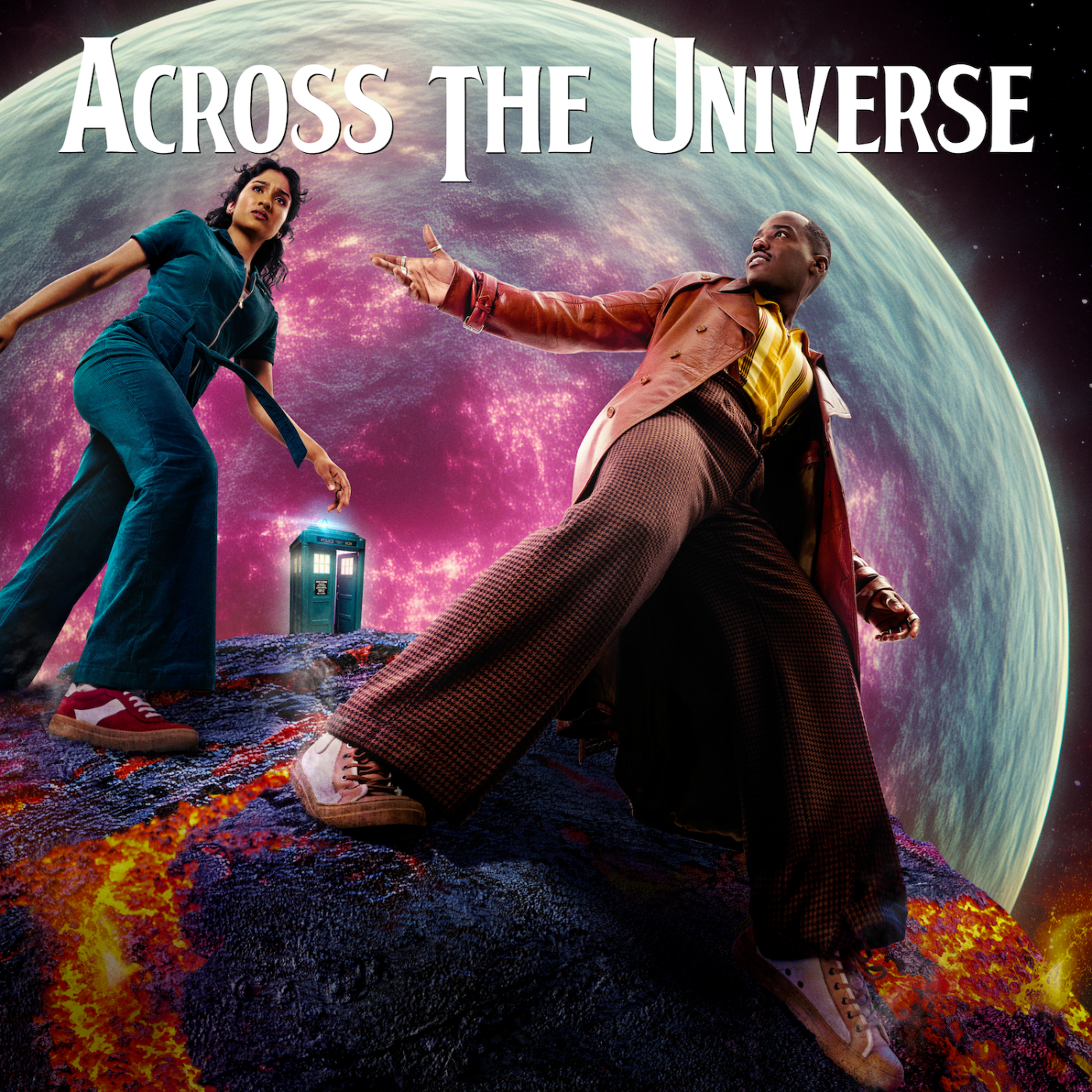
This week, we go back in time to series 14 with what appears at first blush to be a remake of 2006’s Love and Monsters – weird loner kid accidentally meets the Doctor and spends his whole life trying to find him again, but unlike Elton Pope in the latter episode, our guy does pull it off earlier than the last ten minutes. And he bags an interview with Ruby Sunday, regarding an unseen adventure that takes place straight after The Devil’s Chord, going by some early dialogue.
So far so good, right? Well, yeah… but unfortunately, I think our luck has just run out. Because this week’s episode isn’t just the first solo guest story we’ve had in a year, but it’s written by a returning writer who isn’t named Steven Moffat.
It’s Pete McTighe.
Yes, Pete McTighe – a stalwart of the Whittaker years of Doctor Who, AKA the Chibnall era, back again for his first outing since 2020’s Praxeus. You know, the one about a fatal contagion that spreads across the planet Earth and features an Asian woman as the villain, which aired approximately a month before the WHO declared a worldwide COVID-19 pandemic?
And the story before that was, of course, Kerblam! – the sci-fi Amazon satire that certainly felt like a lost Sylvester McCoy episode, except it ends with the Doctor on the side of the evil monstrous retail conglomerate and the quasi-millennial/Gen-Z kid is the villain instead. The episode that gave us the infamous “The systems are not the problem” line, which pretty much spells out the problem with the Chibnall era in a nutshell.
Yeah. This is the guy they got from the Chibnall era, as opposed to any of the good writers like Malorie Blackman, Vinay Patel, Joy Wilkinson, Ed Hime, Nina Métivier, Charlene James, and Maxine Alderton. Instead it’s the guy that struck out twice they gave a second at-bat to. (Why do I use baseball metaphors when talking about the Chibnall era? No idea.)
Here goes nothing, I guess.
Okay, well, admittedly the first act is by far and away the best material he’s ever done, if you’re into heterosexual romance. (I’m really not but considering how badly he blew the gay couple in Praxeus, this is a million times better.) Ruby herself is always great – it wasn’t until she came back that I realized how much I missed her and her family. She and Conrad Birdie (I know his actual last name is Clark, but I couldn’t resist the Bye Bye Birdie joke) are cute together, though I admit she has more chemistry than he does.
And then it turns out that our boy Conrad isn’t a nice guy at all, but a traitor, working for some sort of group calling itself “Think Tank,” which exists to expose the lies perpetrated by UNIT… and it’s the same sort of conspiratorial right-wing horseshit that we get in our world, evidently run by the British equivalent of the Gen-Zers who voted for Trump in the last election. Or, to dust off a reference to mid-70s Doctor Who, it’s the evil villains from Robot back again.
And now the story becomes clear: this is about our world, right now, and the way that right-wing conspiracy theories change and contort observable reality to fit a pre-established narrative. It’s a story about how the right-wing have taken over our media and our politics, all in service of making the world a worse place to live. So it is a remake of Love and Monsters, but this time Elton is the British version of Ben Shapiro instead of a well-meaning Doctor Who fan who ends up caught in the web of Sam Maleski/David McCormack/Ian Levine.
And you know what? It’s really not that bad. Which I didn’t think I’d ever say about a Pete McTighe script, but maybe today was his lucky day.
There’s a real bristling anger to this season that I haven’t seen from Doctor Who in a long time, and even longer ago from the collective pen of RTD and his writer’s room. What McTighe turns in here is easily his best work, culminating in a final monologue from the Doctor where we get to see Gatwa play angry for the first time. The smile is ever-present, but there’s some bite to it, now, a sharpness. And then there’s the speech itself:
“You see, I am fighting a battle on behalf of everyday people… who just want to get through their day, and feel safe, and warm, and fed. And then along comes this… noise. All day long, this relentless noise. Cowards like you, weaponizing lies, taking people’s insecurity and fear and making it currency. You are exhausting. You stamp on the truth, choke our bandwidth and shred our patience. Because the only strategy you have is to wear us down. But the thing is, Conrad, I have energy to burn and all the time in the universe.”
You know what that is? That’s Doctor Who confronting the fascist right-wing hellscape we’re living in and saying no. That’s Doctor Who confronting all the 18 year old men for whom Trump is the only Republican president they remember, and telling the blunt, honest truth for once in their lives. And he says that on a streaming service owned by a company that, since the 20th of January, has been bending over backwards trying to keep in the current president’s good graces.
Is it enough? Well, no, of course it’s not. But we can’t expect Doctor Who to stop fascism any more than we could’ve expected Jean-Luc Picard to do it in the second season of Star Trek: Picard. Fictional characters can’t affect our real world, but they can inspire us to act in their names, to borrow a line from my birthday twin, Mark Gatiss.
That’s what Doctor Who has always been about: Standing up to bullies. Whether the bully is Jessica, the bitchy would-be cheerleader I knew in elementary school who didn’t like my taste in music, Cody the gaslighter, or Donald the fascist, we can be empowered to stop the baddies. We don’t have to take their shit lying down.
And the best part is? We may not have a police box, but we do have our voices. Our words. We can speak truth to power, and refuse to be brought down by men who’d rather we be silent. Because if we weren’t so powerful, they wouldn’t be trying so hard to shut us up.
Let’s get talking… and watch the world change around us.


Leave a Reply