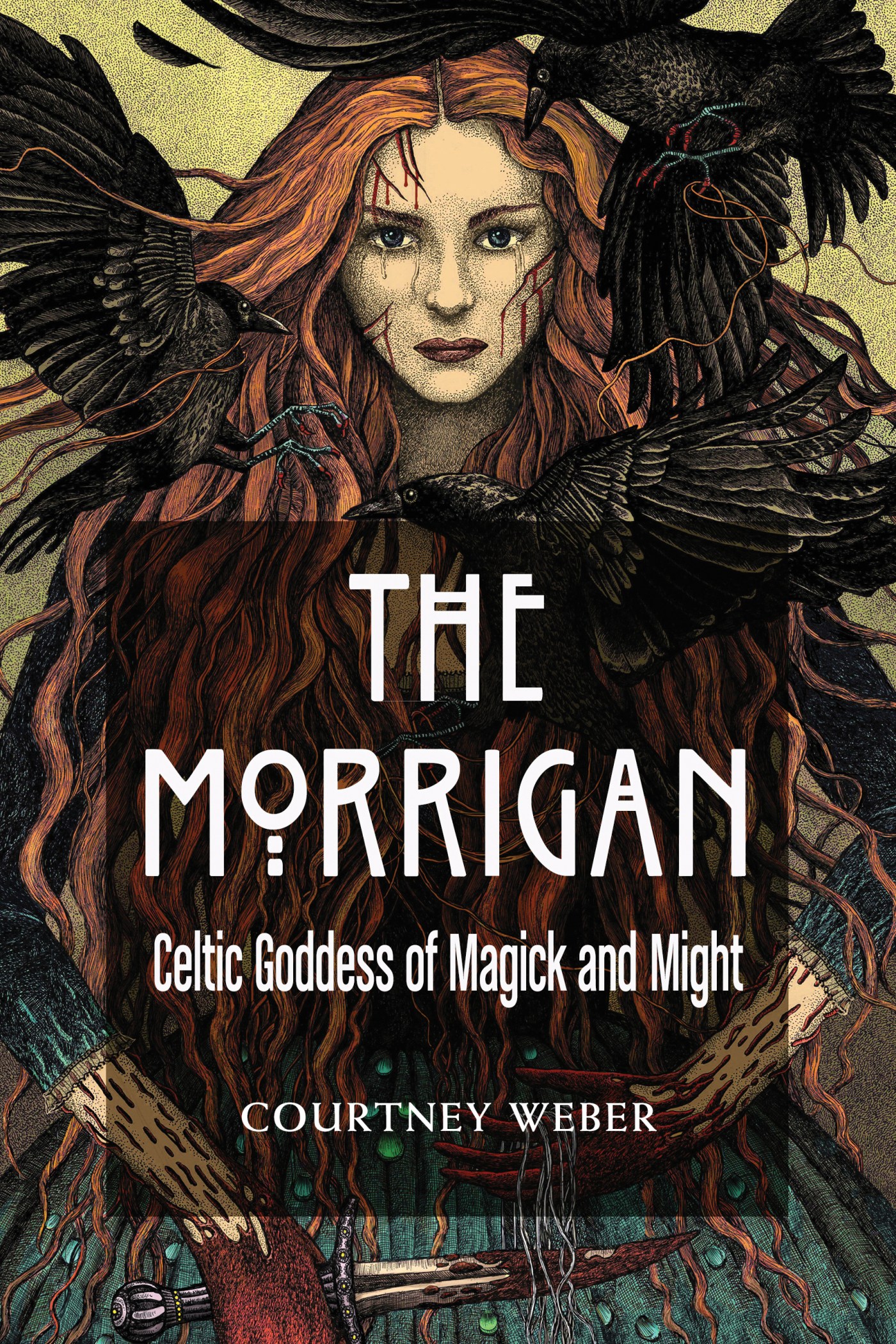
Despite an introduction by Lora O’Brien, Courtney Weber’s book on the Great Queen is actually really good. For a goddess as complicated and multi-faceted as the Morrígan is, Weber does an exemplary job at introducing readers to her, and emphasizing the Great Queen’s many different forms and faces.
Through the book, Weber blends recounting the ancient history of the Morrigan with rituals and spells that can be used in modern devotional practices. She places herself in a neutral role, emphasizing over and over that her only job is to present multiple perspectives to us, not draw conclusions in our stead.
What really makes this book shine, however, is the personal touch. In the first chapter, she explains the harrowing circumstances under which she met the Great Queen:
“I did not come to the Morrigan like a young tornado. My life was stable, my relationship solid, my health good. Yet, my soul was ragged. In a single year, I stepped down as high priestess of my coven, so bitterly burned out that I was on the verge of quitting magick and Pagan spirituality completely. My husband and I moved three thousand miles west from New York City to a small town in rural Oregon. I’d hoped to spend the first few months settling into our new home and writing.”
“Instead, I spent most evenings in one of many therapists’ offices. An eating disorder I’ve battled since age twelve flared up, coupled with chronic depression I’d ignored for too long. Most painfully, a two-year journey to heal an infertility issue hit a dead end. I found myself in a place so dark and deep that no one could reach me. That is where I found the Morrigan.”
Through the rest of the book, we learn other people’s Morrigan stories, and a common thread emerges. As a dark goddess, she is not someone we approach when everything in our lives is going well – she’s someone we turn to when we’re lost in the dark, unable to find our way out.
Certainly that’s as true for me as it is for Courtney Weber. When the Morrígan came to me, I was struggling to put my life back together after the collapse of multiple friendships, including one in particular that had me suicidal for days after the break-up. Though my studies of witchcraft gave me a reason to keep going, it was finding the Morrigan in the midst of all that darkness that really helped me become the witch I am today.
The thing you have to understand about the Morrigan is that, like Cerridwen, she’s a goddess of transformation. She melts her devotees down and reforges them into their best selves, because she knows we can excel. She can be blunt and sharp, but never cruel – her goal is our own self-improvement, giving us the tools we need to fight our battles.
Another thing Weber emphasizes is something that I don’t often see people talk about in terms of working with the Great Queen: Joy. As she notes in chapter 4, “Contemporary Morrigan devotion tends to be heavy and dramatic, which makes sense to an extent. The sisters are heavy and dramatic goddesses! But my experience at the ritual taught me that the Morrigan does not want only serious faces and stern words. The faery nature of the Morrigan may want to have fun, too. The Morrigan typically responds in kind. Approach the sisters with joy and they are likely to return it.”
Reader, I can’t tell you how thrilled I was to finally see someone mention this aspect of the Great Queen in print. In all the books I’ve read, this is the first time someone’s mentioned joy and the Great Queen in the same sentence – if you just took Daimler and Ravenna’s word as gospel, you’d think the Morrigan was humorless and no-nonsense, but she isn’t! She has a playful, humorous side to her, and she knows how to smile.
In all but one of the rituals I’ve done in her honor, there’s always been a softer side to her. I’ve felt her awe, her amusement, and of course, her joy. When she formally asked me if I wanted to be her raven last Samhain, and I said yes, the euphoric feelings I felt in the circle were positively overwhelming, and I swear my psychic abilities improved just from that night.
That feeling of joy allowed me to relax around her to a certain degree. In my July ritual, I was a nervous wreck, approaching a goddess that, from all the reading I had done, seemed tempestuous and moody. I was intimidated by her, and it showed in how I conducted myself. But despite my nervousness, she didn’t lash out – she was serious, yes, but in a way that set me at ease, paradoxically.
That’s another under discussed aspect of the Morrigan: She’s a goddess of healing as well as of war. Woodfield’s book touches on this aspect, but Weber gives it an entire section in chapter 7. When you read both books together, it begins to make sense: all battles eventually end, and win or lose, we still have to patch ourselves up. The Morrigan doesn’t want ravens who fall into a constant state of battle because we think that will please her – she wants us to know when to put our swords down and rest.
As Treasa Kerrigan observes in a sidebar, “Most women I know who work with the Morrigan are divorced or single or have had a lot of trouble finding a partner. I don’t know if that’s because the Morrigan picks strong women or because she picks women who have been through a lot of emotional and physical troubles. She chooses people who don’t necessarily believe in themselves, but who have a great deal of inner strength. She will push you to bring out the best in yourself. She will definitely test you. She picks people She knows won’t crack.”
I can co-sign this. Growing up with an emotionally abusive mother did not grant me with a lot of self-esteem – even now, I struggle to let myself be proud of my own accomplishments, or commend myself for a job well done. But with the Morrigan there beside me, I’m getting better. Just in the six months I’ve been one of her ravens, I have felt myself change. I don’t know what the final shape is yet, but the Morrigan has been around a long time. She knows how long it’ll take, and she’ll be there every step of the way, guiding my paws.
All I have to do is trust in her, and in myself. And as Weber reminds us, do it with joy. And the rest will follow.


Leave a Reply