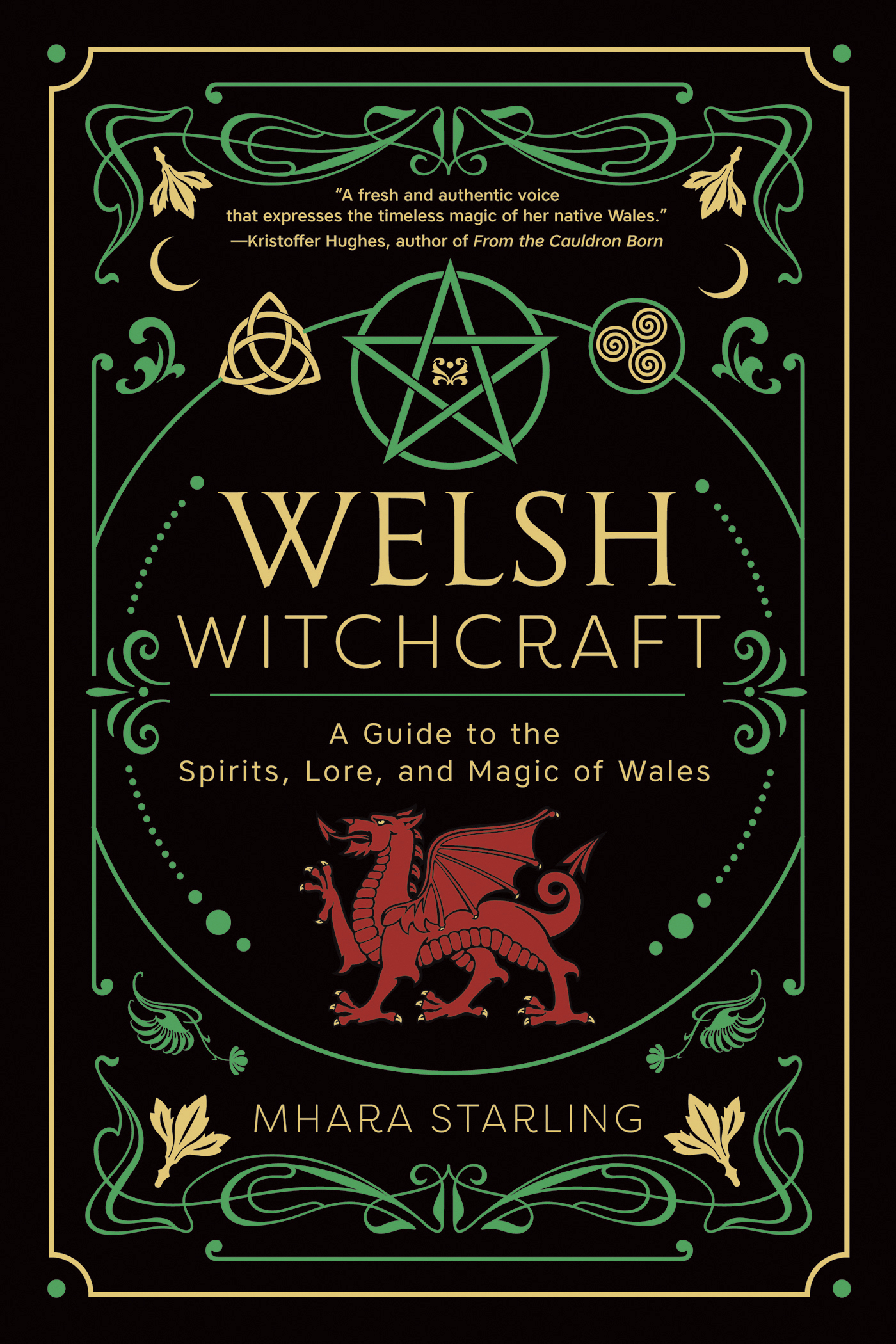
This week, we conclude our exploration of Celtic Witchcraft with a trip to Wales, and the particular practices of our author, Mhara Starling. She is a born-and-bred Welshwoman, and an absolute joy to read as she guides us through the culture of her home country, and the magic inherent within.
As she writes in the introduction: “The culture of Wales is packed to the brim with pure, unadulterated magic. Many modern-day inhabitants of Wales would rarely describe their culture as magical, and yet within the language of the land, the regional folklore and myth, and the beauty of the landscape, magic is ever present. Who could ever deny Wales’ magic, when the emblem of the Cymry, the people of Wales, is the mighty red dragon. Wales, or Cymru as it is known by its native Welsh speakers, is a land rich with a legacy of myth, legend, superstition, and intrigue.”
This is a book that is soaked in pride for her home country, and why not? As she discusses, the English have spent several centuries trying to put the Welsh down and assimilate them, and every time, the people of Wales have stood up and said “No. We will never surrender. We will be ourselves, and no one else.” And that spirit runs through every word in this book, from the first chapter to the last.
Part of what attracted me to this book, aside from the fact that I worship Cerridwen (who gets her very own chapter in this book) is just Starling’s particular authorial voice. She’s a warm, gentle presence, and welcoming as can be. Though she admits at a couple points that the book mainly got started to fill a needed gap in her own life, she doesn’t let that take away from the main thrust of the project – to present her own form of witchcraft, and allow us to take what we feel called to, wherever we are.
All this is made plain in the introduction: “Whether you have a genetic connection to the various lands where a Celtic culture was found, or whether you are simply drawn to the lore, legend, languages, and practises of all that encompasses “Celtic,” this book is for you. It is to further your investigations and explorations into the very heart of Celtic magic.”
This is the kind of attitude that I so dearly wish Lora O’Brien had held. While I have no particular ties to Wales aside from dating someone of Welsh descent, and the fact that one of my goddesses is Welsh too, I felt more welcome and comfortable reading Starling’s book than I ever did reading O’Brien’s. (There’s an irony in that, I think.)
Part of the reasoning for that, I think, is that Starling is herself transgender, just like me. While the word itself only comes up twice in the whole book, her transness still informs how she conceives of witchcraft, both for herself and for her readership. She knows full well that most of her readership will likely not be Welsh at all, and rather than treating that fact with scorn, Starling embraces and accepts it.
In one part of the introduction, she deals directly with the question of whether or not Welsh witchcraft, or indeed Celtic witchcraft of any form, is an open practice or not, and whether it’s necessary to be Welsh in order to practice magic like this: “To put it simply and bluntly, no, it is not inherently important at all. Of course, it is beneficial, but not a necessity. […] Being Celtic in my view has very little to do with ancestry, blood, race, or location. Being Celtic is a state of mind, a way of living, a way of believing.”
That, my friends, is how you write a book on witchcraft. Where O’Brien’s book came from a place of haughty superiority, Starling is the exact opposite – she is proud of the land she calls home, but also humble, and she seems visibly thrilled that her audience is so wide and varied.
While she does suggest, late in chapter 4, that we visit Wales if we can, (and I know I’d like to visit Llyn Tegid someday, just to see the place Cerridwen calls home) she does not pass judgement on us if we can’t. Nor, for that matter, does she insist that we speak to the various Welsh deities only in their native language – for crying out loud, she includes English incantations for the sake of accessibility, with not a single word of complaint. This is what you call Knowing Your Audience.
If I had to think of a writer that Starling most reminds me of, it’s actually Scott Cunningham. When we looked at his book back in January, the overriding impetus for everything he did was to make Wicca open to absolutely everyone who wanted to give it a try. Starling’s book is operating in a similar register: this is a book on her specific practice, made available for all who think they might find something useful in it.
By far my favorite part of the book has to do with the other big theme: the importance of one’s own personal power. In the first chapter, she writes, “Those who turn to Witchcraft are often asked what exactly drew them to practise such a thing. For me, and for many others who are like-minded, Witchcraft is a form of empowerment and wisdom that we stand firmly and proudly within. Being a Witch to me means living a life of integrity, power, wisdom, and of course living with a constant thirst for knowledge.”
This is the fucking vibe, as the kids say these days. Certainly that form of empowerment was why I came to the Craft: I spent my whole life feeling powerless. But now? I have power, and no one, not even an abusive fascist dictatorship, can take it from me. “Stand in your power and be the Witch that you know you are,” she says at the end of the book, and I couldn’t agree more.
One more thing: in the final chapter, (regarding the Welsh equivalent of what we Wiccans would call the Wheel of the Year) she writes about a holiday tradition called the Mari Lwyd: “The Mari Lwyd is a Welsh Christmas tradition, mostly found in the south of Wales. The general idea is that a party including an individual carrying a decorated horse’s skull on a pole, concealed by a white sheet, and would sing outside a house, petitioning a plea to allow them entry for some food and drink. The home owners would sing back listing reasons why they cannot enter. Think of it as a mixture between the modern trick-or-treat and an epic Welsh rap battle.”
Yes, my friends, you read that right: the people of Wales invented the rap battle. And they did it in the middle of winter, no less! If that’s not fucking brilliant, I don’t know what is!
Seriously, go read this book! You’ll be gad you did!


Leave a Reply