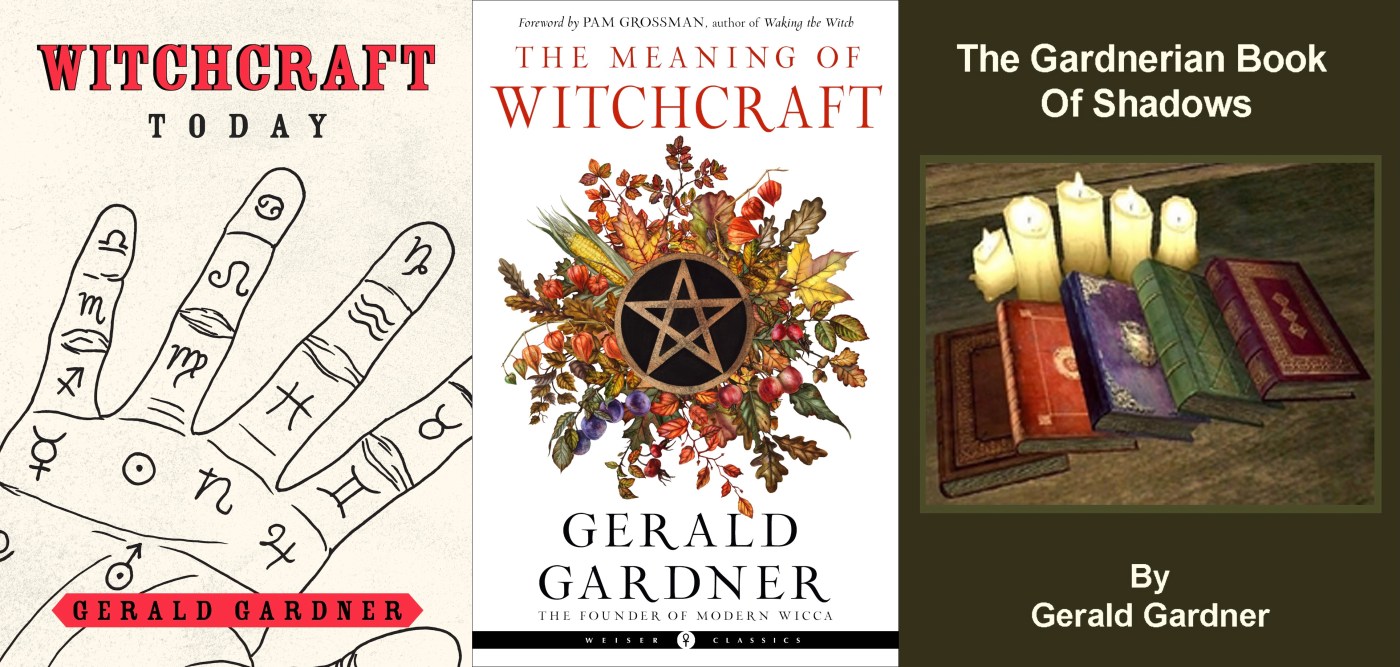
This is it, witches! This week, having looked at the history of American witchcraft in Margot Adler’s seminal Drawing Down the Moon, and its personal effect on me, I decided the time was right to continue in that vein by going right back to the source, the man who invented Wicca back in the 1950s.
And so… it’s finally time to talk about Gerald Gardner.
I really don’t know why it’s taken me this long to get around to him, given that the witchcraft renaissance we’ve all been enjoying would not have gotten started without him. As Adler herself notes on the back cover of The Meaning of Witchcraft, “If it weren’t for Gerald Gardner, contemporary Wicca would not exist. There would surely be Pagans and modern worshippers of goddesses and gods, but Wicca itself, if it existed at all, would have a far different form.”
And frankly, I don’t want to imagine what a world without Wicca might be like. You may as well ask me to imagine a world without the Beatles – why would you want to take away something that has brought so much joy to so many people? To me? I wouldn’t be who I am without either one, and I will cling to them until the day I pass into the Summerlands.
(Also they both come from Liverpool and made it big Stateside in 1964… but that’s another story.)
Now, true, Wicca has evolved by leaps and bounds since Gardner first began writing about it in 1954. In his day, covens were the only way to become a witch – solitary witchcraft wouldn’t become a thing until a decade after he died, and until Scott Cunningham came along, there was no easy way for a solitary witch to find all the information she needed.
But even Scott Cunningham’s book wouldn’t exist without Gardner’s. And before that, Margaret Murray’s The Witch Cult of Western Europe. Take Murray out of the equation, and Gardner himself would probably have died in obscurity. Good thing that didn’t happen then, isn’t it?
Enough counterfactuals already, let’s get to the good stuff!
The first thing to note is that we’re covering all three of Gardner’s books this week: Witchcraft Today, The Meaning of Witchcraft, and the Gardnerian Book of Shadows – that is, the BOS Gardner himself wrote and compiled, with various alterations by Doreen Valiente. The complete story of Wicca can’t be told without these books, so now seems as good a time to get to them as any.
Witchcraft Today is a very odd book.
Gardner, who had been born in the late 1800s and died just a decade out from publishing this book, was in his seventies when he wrote it, and it shows: much of the book is taken up with extended digressions and asides on everything from Christianity to the Knights Templar, and the respective mythologies of Ancient Greece, Rome, and Egypt. It is not a book that you would ever imagine would become the foundational text of an entire religion.
And yet… somehow, it did.
For me, the book shines brightest when Gardner discusses the basic tenets of what we now call Wicca: circle casting, the basics of how covens work, duotheism, the belief in and use of magic in order to create change in the world, all of that is present and familiar. He discusses in great detail the anti-witchcraft furor of the Middle Ages, and repeatedly breaks down common misconceptions regarding what witches are, what we do, and what we want, so he can explain the truth as he’s experienced it.
Is it a perfect book? Not at all. Much of the historical context was drawn from Margaret Murray’s witch-cult theory, and while there may still have been adherents and believers in 1954, we all know better now… but that doesn’t detract from the book, I think. The witch cult theory may not be real history, but as a creation myth, it still has value, particularly in the current age of ascendant American Christian theocracy.
Despite affecting the voice of anthropologist who is firmly convinced that the Craft is doomed to die, Gardner planted the seeds for its survival – and that, alone, makes this book worth reading.
The bonus essays included in the 50th anniversary edition do a lot to provide context about who Gardner was, and what drove him. Ronald Hutton’s essay “A Starting Point” paints Gardner as a man who deeply loved history and mythology, and when he retired in 1936, he now had free reign to pursue those passions, and in the process, created an entire religious faith, as well as serving as a hype man for the same.
Onwards we go to The Meaning of Witchcraft, Gardner’s second nonfiction book on Wicca. This is a much longer book than Witchcraft Today, but that’s alright – he now has time to cover his subject in even more detail than before, as honestly as possible.
Meaning is very much a companion book to Witchcraft Today, centering primarily around Gardner continuing to break down the negative stereotypes forced upon witches during the Middle Ages, along with even more Murrayite “history,” stretching from the Stone Age to Britain’s Roman and Saxon periods. It is a lot, particularly nowadays when much of the historical material he cites has been roundly debunked. But as I said earlier, it’s still worth your time. You’ve got to know your roots, after all.
That said, there are times where Gardner’s conservatism (he was a registered Tory after all) shine through. Chapter 9, for example, begins with his “explanation” of what kind of women best represent the Goddess:
“It is only those who are recognised as being young and lovely, loving and generous, motherly and kind. In fact, those who possess all those qualities which can be summed up in the one word “sweetness.” […] “Among the virtues she must have is the realisation that youth is among the requisites necessary for the representative of the Goddess, and that she must be ready to retire gracefully in favour of a younger woman in time.”
This is, to make a very obvious point, really fucking sexist.
Sorry Gerald, but I don’t think the Goddess much cares about how old we are if we try to do the Drawing Down the Moon ritual. As long as we approach Her with respect, that’s all that matters. She is just as likely to inhabit my body as She is an older woman, and frankly, to assume that She’s as shallow as you claim Her to be is a failure of imagination.
And speaking of imagination, now seems like a good opportunity to take a close reading on the foundational Wiccan text – the Book of Shadows. Witchcraft Today and The Meaning of Witchcraft have each given us important background information, but if you want to know how Wicca actually works, this is where you start.
Gardner began compiling the BOS sometime in the mid-1940s, combining what he’d learned from the New Forest coven with some rituals derived from Crowley’s writing on ceremonial magic, among a wide variety of other sources. After she became High Priestess of Gardner’s coven in 1953, Doreen Valiente took it upon herself to rework much of the BOS, stripping out the Crowley and adding some of her own poetry.
Their combined efforts formed the basis for Gardnerian Wicca, among many other traditions, and as the Craft spread, so too did the Book of Shadows: witches of every stripe began to compile their own Books, and today, the BOS has become a standard feature of Wicca, always growing and evolving with the times – some witches (like me) even have digital Books!
But no matter what form they take, every witch who compiles one is following in the footsteps of Gardner and Valiente. So, let’s see what they came up with, shall we?
First thing to note, this isn’t the whole enchilada. My pal Anna has informed me that the “Gardnerian BOS” is well known to be incomplete and modified,” this isn’t the unadulterated version used by actual covens in that tradition.
Still! It’s a place to start, at least. It begins, fittingly enough, with instructions on how to cast a circle – that is, creating a sacred space in which we can do our magical workings, including communion with the gods. There’s an early formulation of the Drawing Down the Moon ritual, when a witch brings the spirit of the Goddess into herself.
As a solitary witch, much of my knowledge of how covens work comes from research. Gardner’s BOS is an absolute treasure trove of material! Sure, I’ve read example rituals in DJ Conway’s Wicca: The Complete Craft, or in Raymond Buckland’s Complete Book of Witchcraft, but those books were otherwise geared toward solitary practice. This is the real deal, as practiced by Gardnerian covens then and now. If you’re a solitary and you want a glimpse of what coven practice is like, now you have your answer!
That said, I still disagree with some of what is written in it: working skyclad (read: nude) has never been something I’ve felt called to do. If other people do it and it works for them, that’s fine, but this witch is quite happy to do magic in any old t-shirt and Snoopy PJs. I don’t think the gods much care, they don’t even have physical bodies!
Easily the most frustrating part of the BOS is near the end: The Wiccan Laws. They’re written in the same Elizabethan style as the main ritual texts, in keeping with Gardner’s belief that he was merely reviving something ancient, but read through them more closely and you’ll find they’re decidedly… ah… very early 1960s in attitude. (And no, that is not a compliment.)
But I digress. Gardner’s books are definitely products of their time – certainly I wouldn’t recommend them as an easy beach read. That said, if you haven’t read them yet, you should: they are a part of our history, and that means reckoning both with the good, and the bad.
In the 70 years that have passed since Witchcraft Today came out, the religion has evolved. The way Wicca is practiced now, as Wren Walker notes in her essay from Witchcraft Today, is very different from what Gardner was doing back in the 1950s:
“What Gerald Gardner might think of solitary Wicca, we cannot know. Nor can we guess his reactions to the many labels and myriad guises that Wicca wears today. He might be thrilled. He might be surprised. He might not be entirely pleased with all of these new variations, but I daresay he would be fascinated – and impressed.”
I’m inclined to agree. Gardner was right about one thing: he loved the religion he believed to have reconstructed, and didn’t want it to die out. He wanted it to survive, and that meant publicizing it – spreading the good news, to borrow a Christian expression. And it worked! I know in my heart that every single Wiccan practicing today would not be here without him. Whatever else we might say about Gerald Gardner, we can at least respect him for why he wrote these books.
What I’ve found, in reading about his life and his work, is that he got from the Craft the same thing I have – a spiritual home. Catholicism and atheism didn’t do it for me, Wicca has. I found my gods, and now I’m finding my calling. Gardner and I may have very different approaches to the religion he developed and popularized, but we at least have one thing in common.
At the end of the day, we do what we do for nothing more than love, and a desire to serve the gods as best we can. And for all he’s given us, I’m eternally grateful.


Leave a Reply