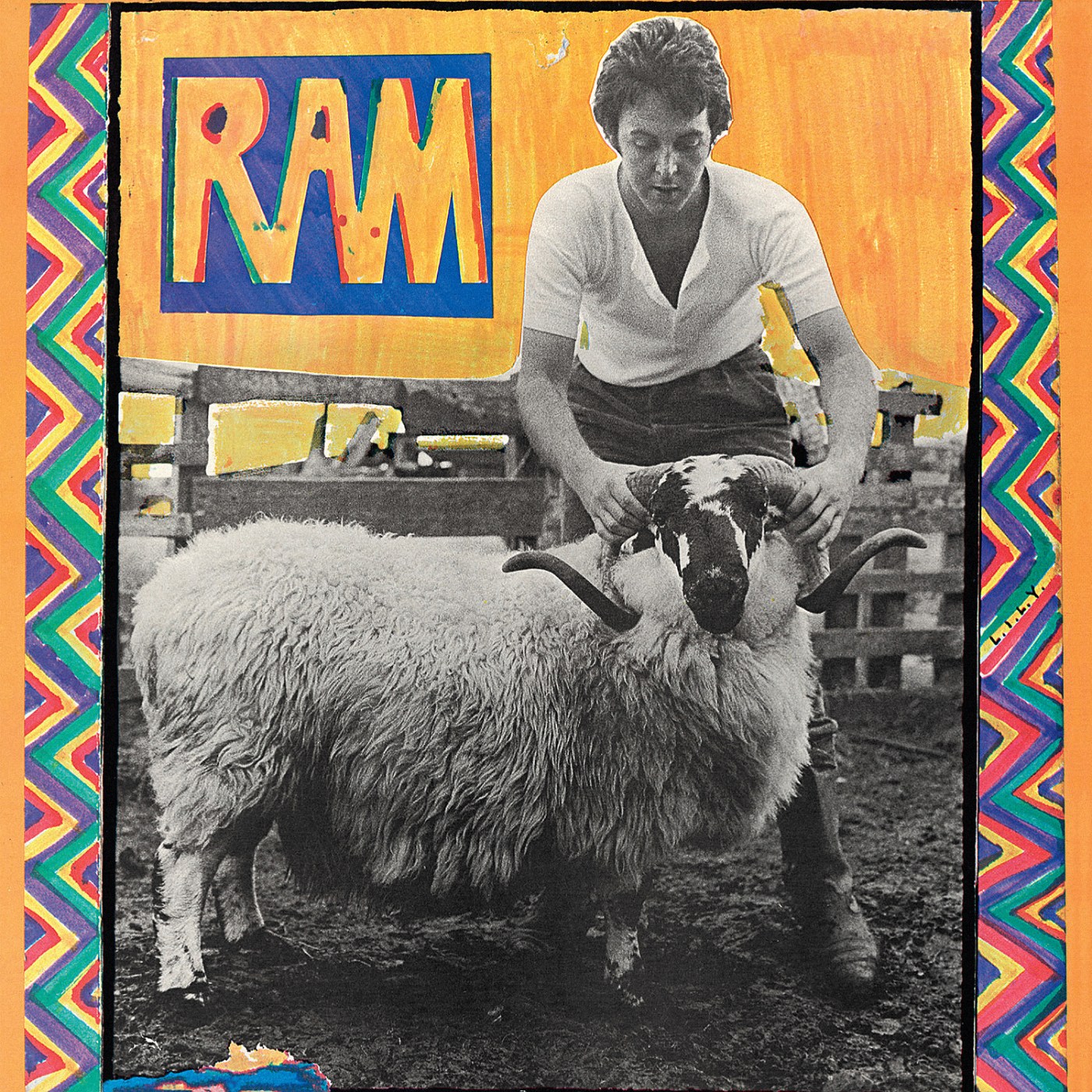
This week, we continue our dive into Paul’s solo career with Ram from 1971. Ram is something of a return to form for Paul, after critics savaged McCartney for being a giant letdown in the aftermath of Abbey Road. These songs, as noted by Beatles Bible, are “carefully crafted” in that way of his, and were Ram recorded both in New York and Los Angeles, in the first of many foreign recording sessions for Paul and Linda.
Ram later spawned a sister album – Thrillington, from 1977. That album is an easy listening version of Ram, featuring Vic Flick (best known for playing the riff from the James Bond theme) in his latest of several Beatles related recordings. He also played lead guitar on “Ringo’s Theme” from the American version of A Hard Day’s Night, (also heard in the movie) and he played on “A World Without Love,” a Lennon-McCartney track recorded by the duo Peter & Gordon.
Quite why Thrillington exists, I’m not entirely sure. But it was recorded around the same time as Ram itself, and was released alongside it in 2018 for Paul’s Archive Collection series, so we may as well mention it, at least.
Let’s get going, shall we?
‘Too Many People’: Ohhh boy. There is no song that has ever engendered as much controversy as this one has, except maybe “Give Ireland Back to the Irish.” “Too Many People” is four minutes of Paul McCartney inventing the diss track, all with the goal of pissing off John Lennon… but because this is Paul, the comments are quite veiled.
Needless to say, it had the desired effect. As John said in an interview, “There were all the bits at the beginning of Ram like ‘Too many people going underground’. Well that was us, Yoko and me. And ‘You took your lucky break’, that was considering we had a lucky break to be with him.”
John’s reply was “How Do You Sleep?” off Imagine, which pulls no punches and doesn’t even bother to hide behind veils of fictionality. It’s spectacularly bitchy, and I love both of these songs because of how wonderfully vicious they are. As I know all too well, the best betrayals come from best friends.
‘3 Legs’: Another song widely believed to be Paul celebrating his newfound freedom outside of the Beatles, with more than a few digs toward his ex-bandmates, particularly in lines like “When I thought you was my friend/But you let me down/Put my heart around the bend”. About as subtle as a brick to the face, that. (Or the screaming of a bean sídhe.) It was originally called “A Dog is Here,” based on a picture his daughter Heather had drawn.
‘Ram On’: A simple song seemingly about Linda, best known for it being the first time Paul played a ukulele on a record. In any event, it’s a much-needed respite from the previous two songs. It’s also something of a throwback to his Beatles days – back when the band was called The Silver Beetles and everyone changed their names, Paul became Paul Ramon. He used the name again in ’69 when he played drums (or rather, beat the ever-loving shit out of the drums) on the Steve Miller song “My Dark Hour.”
‘Dear Boy’: Despite what John Lennon believed, this song was actually about Linda’s ex-husband Joseph Melvin See Jr. The lyrics are essentially Paul how much better off Linda is with him, like a long-delayed response to the Lennon song “You’re Gonna Lose That Girl” from Help!. I don’t quite see why John thought this song was about him though – it makes no sense.
‘Uncle Albert/Admiral Halsey’: One of Paul’s recurring stylistic trademarks is to string together some unfinished works into one piece – this is how you get stuff like “A Day in the Life,” or the Abbey Road medley. It’s one of my favorite early Paul songs, particularly the first half about Uncle Albert. No wonder it became his first number one single!
Also of note: the appearance of the New York Philharmonic, with the strings arranged by (who else) George Martin.
‘Smile Away’: “One, two, three, four!” Paul ends side one of this album in the exact same way he began Please Please Me eight years earlier – with a count-in, followed by a classic rock and roll song of the sort that only he can deliver. Paul in rock star mode is genuinely my favorite of his many modes, and this one is a real classic.
‘Heart Of The Country’: One of the happiest of Paul’s solo songs, this one really is just him gushing about how much he enjoys living on that farm in Scotland that he bought in the mid-sixties. It’s an acoustic driven piece in the tradition of “Mother Nature’s Son,” but uptempo. I love it. ❤
‘Monkberry Moon Delight’: Another good old Paul rocker, describing a fantasy milkshake. The lyrics make no sense whatsoever, inspired as they were by Lewis Carroll. As Beatles Bible notes, it feels a bit like Paul’s version of “Glass Onion” from The White Album – and honestly, it does!
‘Eat At Home’: A song where Paul happily gushes about his life with Linda, and while ostensibly it’s about home cooking, the sexual metaphors are kind of obvious. So it’s about eating in about the same way that “Drive My Car” is about motor vehicles. But who cares? It rolls along, and I can’t help but get a kick out of it.
‘Long Haired Lady’: A love song to Linda, incorporating not just Paul’s penchant for stringing together unfinished pieces, but also a George Martin orchestral score and a “Hey Jude”-esque coda that slowly builds until the end. It’s kind of amazing.
‘Ram On’: A reprise of the earlier song, still as sweet.
‘The Back Seat Of My Car’: Paul has always been the Beatle most likely to write a car song, or even songs just inspired by traveling to other places. (Given how much he loves touring, I am not remotely surprised.) This track is another of his late-60s/early-70s car songs, in the vein of “Two of Us” and “Helen Wheels,” but with sexual entendre that harkens back to, surprise surprise, “Drive My Car” from Rubber Soul, filtered through a more grown-up sensibility.
Honest to Goddess, I really like Ram. It’s much closer to what people imagine from solo Paul: grandiose and intimate all at the same time, anchored by Paul’s preternatural gift for melody. John and Ringo didn’t like it, and neither did Rolling Stone, but personally I love it. It’s not my favorite early Paul album, but it’s definitely on the list.
And Thrillington? Not half bad, but I don’t think I’ll ever understand why it’s there.
Anyway: Next week, Paul takes flight once again as he starts a new band, and takes a walk on the wild side, as Lou Reed would say.


Leave a Reply