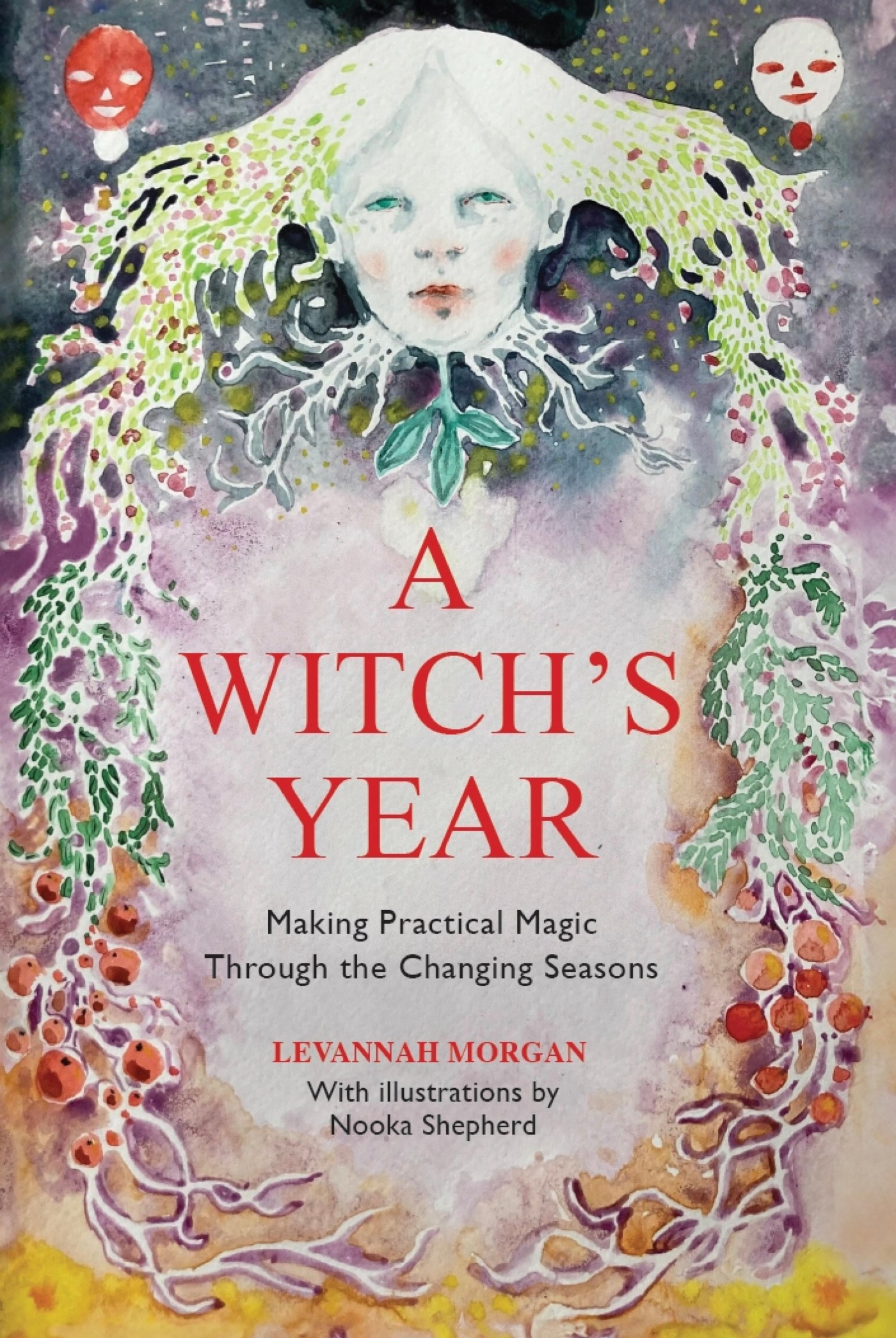
And now for something completely different. Reading the history of witchcraft, and Wicca, is fascinating, but now we get to grips with the actual casting of spells, doing of rituals, and so forth. Not all the books we’ll be reading are designed for a Wiccan path, but that’s okay. Magic comes in different forms, after all.
Here again is Levanah Morgan, whom you may remember from A Sea Witch’s Companion. This book, A Witch’s Year, is described as “a compendium of magic, lore, rituals, observances, spells, crafts, meditations, visualisations and all manner of practices that will bring you into a deeper relationship with all the beings who share this world with us, with the spirit world and with the gods.” In other words, it’s more like A Sea Witch’s Companion, but with a stronger focus on the year and the passing of time.
Each chapter begins with a story presented in italics, meant to set the scene, followed by a short list of monthly correspondences. Then there are passages discussing what the month means, both spiritually and in the greater context of the year itself, followed by seasonal rituals of various complexities.
Interestingly, Morgan lists nine sabbats on the Wheel of the Year rather than the usual eight. The reason for this comes in the January chapter, when she adds Twelfth Night (January sixth) to proceedings: “At Twelfth Night, the young god of the witches, the Unconquered Sun who was born anew at Yule, is honoured and welcomed. He is presented with his magical tools and weapons and dances the circle of the zodiac, signifying his journey around the Witch’s Year.”
I actually quite like this idea, not least because nine is a sacred number among Morrígan devotees like myself. On my calendar, Twelfth Night is labeled as “Triple Goddess Day,” making it an excellent day to worship the goddess of the moon, and the Horned God – in my practice, those roles are filled by Danu and Cernunnos. It’s a bit late for me to do this ritual now, but I’ll definitely try to do it in 2026.
If you want to try it, here’s what it looks like:
Lore
At Twelfth Night, the young god of the witches, the Unconquered Sun who was born anew at Yule, is honoured and welcomed. He is presented with his magical tools and weapons and dances the circle of the zodiac, signifying his journey around the Witch’s Year.
Preparation
The young sun god has many names and guises: in ancient Egypt he was Horus, in Greece and Rome Apollo, for the Britons of Roman times Belinus, in Wales Lleu, and in Ireland Lugh. We will learn more of his story as we journey through the year. His mother, the witches’ goddess, can be honoured at Twelfth Night as Holda or Holle, Arianrhod or Ceridwen, but is often just called the Mother. Read the myths for yourself, find names and stories that resonate with you and use them in your ritual.
This ritual can be performed at your altar. You will need your witch’s tools. If you do not yet have these, find one special object such as a stone or feather to present to the god. You will need your incense burner, incense of your choice, your salt and water vessels, a single altar candle, and a little dried mugwort. If you do not have mugwort, use dried rose petals.
The ritual is a small one that does not call for a ritual feast. Instead, cakes and wine are presented to the gods. If you wish, make some simple biscuits and include some oats and a little honey in the recipe, or use oatcakes and red wine or apple juice.
The Ritual
The circle is cast (see Practice on pages 22–25). Light the incense and the altar candle. Then call upon the mother goddess in her winter guise and ask her to be present. Call upon the young sun god and ask him to be present.
Next purify and bless the ritual tools. Each tool is first passed three times through incense smoke, and the element of air is asked to give its blessing. Then it is passed through a candle flame and fire is asked to give its blessing. Each tool is sprinkled three times with salt water and water is asked to give its blessing. Lastly each tool is rubbed three times with mugwort, and earth is asked to give its blessing.
The tools are then presented to the god at the altar.
There follows a meditation in which the god is visualised dancing across the night sky, on a circular path through all the constellations of the zodiac.
The rite concludes with a dance around the circle, in honour of the god. Ask the goddess and god to bless the cakes and wine, then eat and drink in their honour. Thank the goddess and god and bid them farewell. Put out the altar candle and close your circle.
Go outside after the ritual and look up at the constellations (if the sky is clear) as your witchcraft is both a real world and a spiritual practice. After all rituals, a little of your food and drink should be left outdoors as an offering to the Faeries or land spirits and any leftover salted water should be poured onto the ground.
Witch’s Year is definitely a more varied book than Sea Witch’s Companion. I wouldn’t quite call it a sequel, since the frame is entirely different, but there are certain lines she uses and tips she suggests that echo the latter book. It builds on the theme of witchcraft as a thing that arises from the very land itself – for Morgan, making a wand from a tree imbues it with more power than does buying one from a store.
That said, there are limitations to this approach. Not everyone lives in an area where there are hawthorn trees, for example, just like not everyone lives near a beach. That doesn’t mean her specific practice is invalid, it just means it won’t necessarily work for everyone. For this reason I tend to skip over the meditations and other sorts of spirit-world related portions of the book – I can’t visualize for anything, so those aspects of magic don’t do much for me.
What I didn’t like about this book is bits of commentary like this: “Working with a familiar spirit is a central part of witchcraft; active engagement with the world of spirit is what distinguishes the witch from those who simply follow the Pagan spiritual path.” This feels a bit dismissive to me. The implication here seems to be that if you can’t visualize very well, and lots of people can’t, then you’re not a Real Witch. Which, again, sounds a bit exclusionary.
The book isn’t all bad though. Cerridwen shows up numerous times, as one would expect for a book written by a Welsh woman, and certainly Morgan’s knowledge of Welsh mythology in general forms a prominent part of the book. But she doesn’t just focus on Wales – England, Scotland, and Ireland each get discussed as well, the same with Egypt, Rome, and Greece.
What did surprise me was the appearance of the Morrígan in the chapter on November. Morgan gives a very basic overview of who She is and her role in the Irish pantheon, and then provides an admittedly very cool dedication ritual:
This rite should be conducted at your altar at the dark of the moon during the hours of darkness, preferably late at night. Use it together with the meditation for November to learn the ways of the lady of darkness and winter.
You will need
-
- One black candle
- One red candle
- Your witch’s mirror
- Corvid feathers
- A black pebble
- A red pebble (please find the pebbles for yourself; searching for them is part of the magic)
- A charcoal block and incense burner
- Morrigan incense
Ritual
Decorate your altar with the corvid feathers and black and red pebbles. If the Morrigan inspires you, add other items of your own choosing. Place the candles on either side of your altar. Stand your mirror upright on the altar so that it will reflect the light of the candles. The room should be dimly lit; use only what you need to see by.
Light the charcoal and when it is glowing place a good pinch of your Morrigan incense on it. Light the candles. Let the everyday world fade away and concentrate your magical will on the candlelight.
Call silently on the Morrigan, saying inwardly whatever words come into your mind. Dedicate yourself to the Morrigan, again using whatever words come to mind. Offer your incense to the Morrigan. Allow images of the Morrigan to grow in your mind, experiencing whatever comes without trying to analyse it.
When you sense that enough time has passed, thank the Morrigan and snuff out the candles.
When the charcoal has cooled, bury it and any remains of the incense in earth. Leave the feathers and pebbles on the altar until the new moon. After that, you may use them in spells if you wish.
I can’t say I’ve ever seen anyone conceive of the Great Queen as a goddess of winter before, but I have to admit it makes a certain amount of sense: winter is a time where most things in nature are hibernating or dead, and the long dark nights can (and often do) give the feeling of being in a cave somewhere, like Oweynagat. And, well, half of Samhain takes place in November anyway – a holiday I will always associate with Her.
But anyway. The Morrigan material is cool and all, but that’s only one small part of the book. The rest might be useful for some witches out there, but I don’t think I’d get much use out of it. It’s a book that seems to be targeted toward people who live in the British Isles – those of us who don’t might have a harder time connecting with the material presented.
Better luck next time.


Leave a Reply