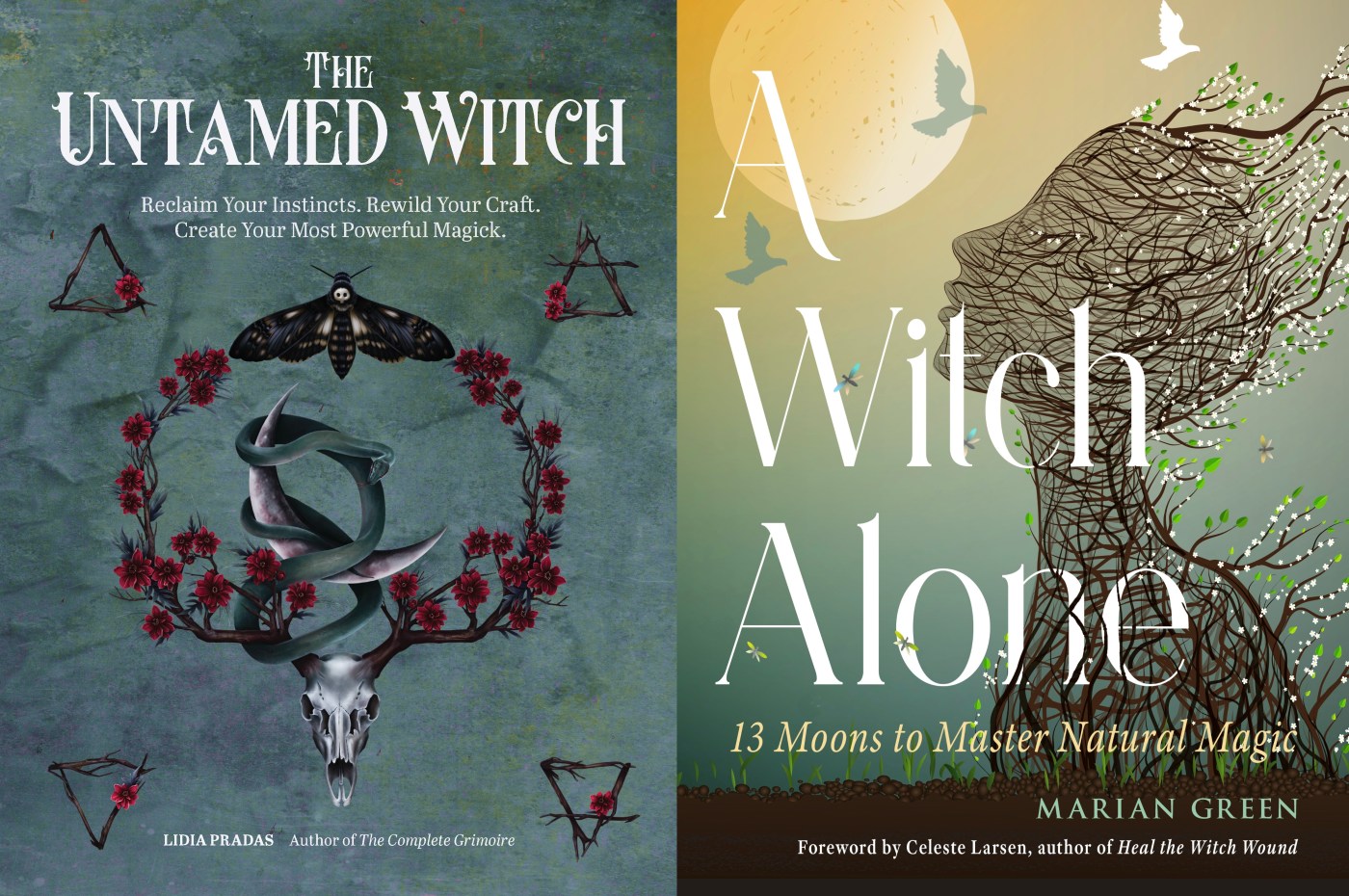
This week, a two-for-one special! I was worried I wouldn’t have enough to say about just the one book, so I’ve decided to cover two instead. Our first selection for this week is another witchy how-to book, but one that feels like my scene way more than last week’s did. It helps that Lidia Pradas is herself Wiccan, but she takes an interesting approach to writing about magic that I don’t think we’ve come across yet.
She writes in the introduction: “Most of the occult books that I’ve read are written from a personal point of view involving the writer’s experiences. I have nothing against this style; in fact, some of my favorite books are written this way. But my scientific background permeates my writing style and makes me express myself in a more impersonal way. I always try to lay out information in a simple, structured way that makes it easy to comprehend, and then I add exercises that allow you to put your new knowledge into practice.”
I really like this approach. Even just after a couple chapters, it feels like this particular style of Craft book suits me better than did, say, A Witch’s Year, which felt geared toward witches who were similar to Levannah Morgan. Pradas’s approach is to try and be as inclusive as possible, and her background means that includes writing, and formatting, the book as… well, like a textbook!
Let me explain what I mean. The 9 chapters making up this book are split into sections, with tables for specific exercises thrown in where appropriate, along with illustrations. It gives me the vibe of something like a high school biology textbook, only from the outside, it looks like any number of modern ‘pop culture’ witchcraft books. The post-Silver Ravenwolf aesthetic, you might say.
What I like about this book is that it takes a scientific view on how exactly it is magic works. It’s not supernatural at all – rather, we, as witches, are using normal biological processes in order to achieve a specific effect. It’s really fascinating stuff, and it’s truly unlike anything I’ve ever seen in a witchcraft book before.
Overall, I would recommend Untamed Witch for anyone who’s interested in the science behind witchcraft as much as the metaphysical side of things. It may be targeted to beginners, but sometimes brushing up on the basics is just what we need to re-light the flame and start working magic again.
Let’s move along, then, to A Witch Alone by Marian Green. She’s one of the other big names in British witchcraft, but unlike some of the other ones we’ve looked at, is decidedly post-Gardnerian in how she conceives of witchcraft. Her book A Witch Alone, written in 1991 with a second edition in 2002, came at a time when solitary witchcraft was really starting to take off, but rather than attempt to present a solitary form of Wicca, Green opts to go in a completely different direction.
The best way I can think of to describe A Witch Alone is that it is pure poetry. That’s not to say it’s a book composed entirely of poems – rather, it’s a book that trades in lyrical prose, where Untamed Witch was more clinical. Green’s writing style is vivid and colorful, making it easy to imagine her descriptions of the Goddess and God, or the celebrations of the people of Britain in the time before the Christians came.
As an example, check out this passage from chapter three about Easter:
“The decorated eggs, found all over Europe, stand in for the rebirth of Nature; the chocolate rabbit is the Goddess’s sacred hare in disguise. The Easter bonnets worn at the Easter Parades represent the new sets of clothes worn for the first time as spring unfurls her golden daffodils, and the tufts of pussy willow fur the branches in the hedges. It is a great time of renewal and new beginnings, when life rises refreshed from its sleep through winter’s dark. As day and night are seen to be equal, at the Equinox, the whole energy of the sun helps the Earth to dress in her new green gown.”
Though the book isn’t written from a Wiccan perspective, Marian Green does pay due respect to Gerald Gardner and Doreen Valiente, since it’s pretty much impossible to talk about modern witchcraft without acknowledging their influence. Even now, some 70 years after Witchcraft Today was published, the myths and methods of spellcasting those early Wiccans developed are still in regular use by witches of all types.
Chapter 3 is devoted entirely to the Wheel of the Year, with the addition of Twelfth Night as a hidden ninth Sabbat. Another chapter focuses on the merits of circle casting, and while some people might think this method of creating a sacred space is childish and simplistic, (as Morpheus Ravenna implies in The Book of the Great Queen) but there’s no doubt in my mind that it works!
Green’s process for circle casting is far more involved than what I usually do: I just trace a line out in the air with my wand or athame, say a short blessing to tie the magic together, and go to work. Green has you call the quarters, mark them out using various appropriate objects, and so on. That’s not really my style (I don’t think I’ve ever called the quarters once, though I have occasionally placed appropriate candles or crystals on my altar when needed) but if it works for you, go for it!
In the end, while both of these books take vastly different routes toward explaining witchcraft and magic, I find the extreme contrast between them makes for an interesting pairing. Neither book is “better” than the other – it all depends on the person, and which approach they might gravitate toward. Some people might prefer Lidia Pradas’ contemporary take, and others might vibe more strongly with Marian Green – she is, after all, a true Craft elder.
I suppose what I would suggest, if there any seekers out there who have happened to be reading this post, is to read them both and see which one you prefer. There’s a whole galaxy of witchcraft books out there now, all of them waiting to be discovered and read by the curious. Who knows? Maybe one of these books will be for you what Drawing Down the Moon was for me – the first step on the path that led me home, into the arms of the Goddess and God.


Leave a Reply