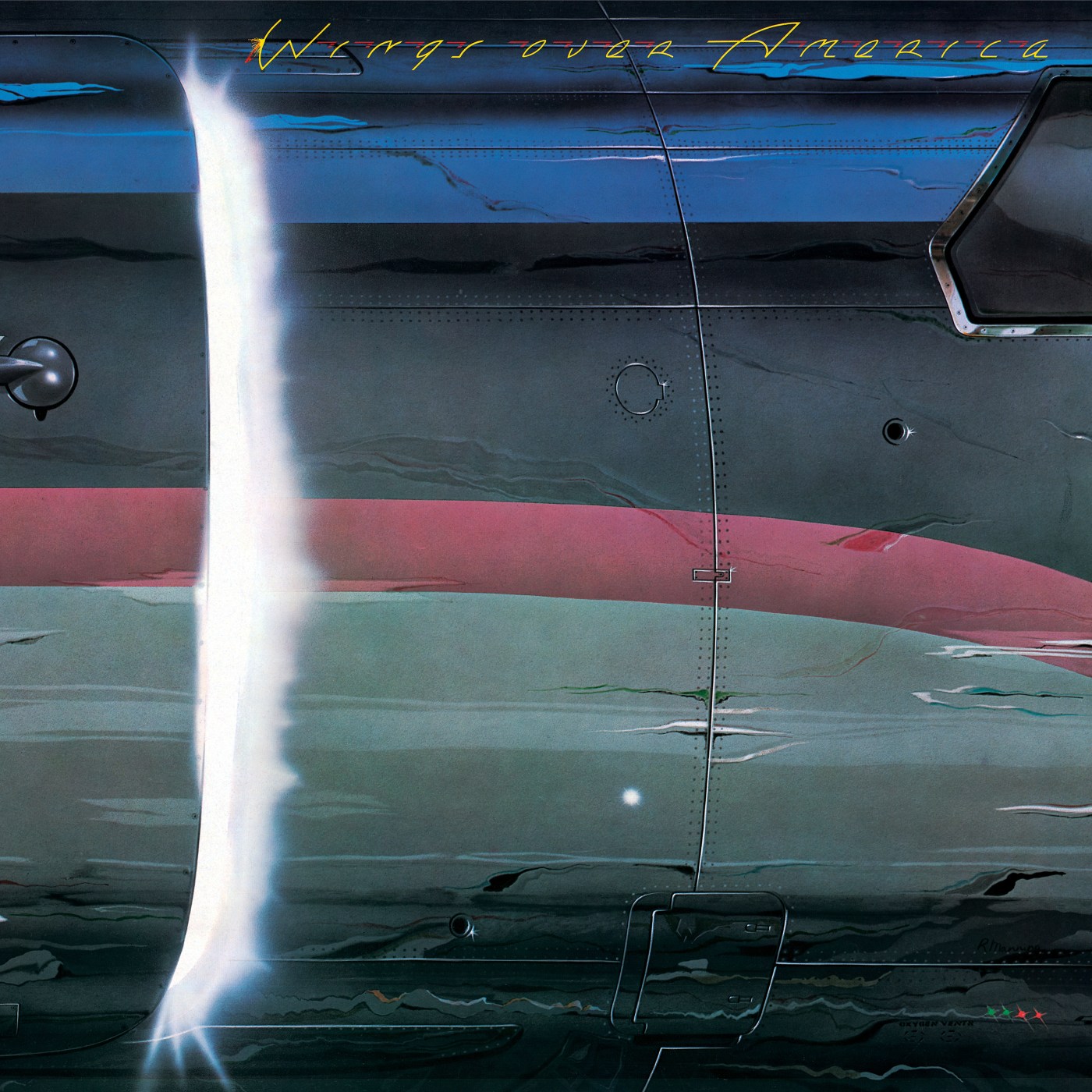
This week, a snapshot of Wings’ absolutely massive world tour in 1976, specifically the American leg. The US concerts Paul performed were not only his first shows there as a solo artist, but his first shows there period since the final Beatles tour of 1966 – that would be the one where they played Busch Stadium, and the rain was so bad that Paul was finally convinced to give up touring altogether. (Fortunately, the weather was gorgeous when I saw him at Busch exactly 50 years later.)
Since the last time we looked at at a live album featuring Paul McCartney, (the Beatles album Live at the Hollywood Bowl) a lot has changed in the intervening decade or so from when those Hollywood Bowl tapes were recorded. Recording technology has gotten better, the screams aren’t nearly so omnipresent, and of course, the whole Wings tour was played in arenas and stadiums – just like what Paul does now, in fact.
Some further differences between now and then: As we know from history, the Beatles’ entourage was notoriously small, – just John, Paul, George, Ringo, Brian Epstein, Mal Evans, and Neil Aspinall. There’s famous footage of Mal and Neil hurriedly setting up, and later tearing down again, the Beatles’ gear during the Shea Stadium concerts of 1965.
Just 10 years later, Paul’s entourage for these Wings concerts was way bigger. As Wikipedia puts it, “in the American stages of this tour the band’s entourage and equipment were transported to each successive venue in five 32-ton trucks.” Kind of a big change from the Beatles days!
Another big change? The set list. Beatles concerts in the 1960s were just under half an hour long, with the band playing only 11 songs at their STL show in ’66. Even the main collection of songs from the Hollywood Bowl album tops out at 33 minutes, with 13 tracks! They’d run on stage, zip through the tracks as fast as they could, then run back off again to head to the next show.
But with Wings, the band played TWENTY EIGHT songs, just ten fewer than when I saw him in 2016! That’s a long concert, but again, that’s very in keeping with who Paul has always been. Ever the showman, he just can’t help but go on for a long time, even into his eighties.
So, with all that in mind, let’s dive into some classic ‘70s arena rock:
‘Venus And Mars’/‘Rock Show’/‘Jet’: A medley, featuring the first two tracks from Venus and Mars, leading into the classic hit single from Band on the Run. The first two tracks work far better on stage than they did on the album, and pairing them up with “Jet” only enhances the epicness of all three!
Let Me Roll It: There are love songs, and then there are love songs by Sir James Paul freaking McCartney. No one, and I mean no one, can write them like he can. This is one of his best by far, and it’s been a staple of mine and Sophie’s joint playlist since we got together. And best of all? If you squint you can take it as Paul expressing his love for John, years after their musical argument in 1971. (I like to think of this song as paving the way to their brief reunion during the Walls and Bridges sessions of 1974.)
‘Spirits Of Ancient Egypt’: If John was reading Yoko’s books on astrology and possibly exploring the contemporaneous American witchcraft scene, (judging by his lyrics in “Cleanup Time” from Double Fantasy) Paul spent a chunk of the 1970s reading about ancient Egypt, specifically the book Secrets of the Great Pyramid by Peter Tompkins. The book influenced the song, at least as far as its title is concerned – the rest of the lyrics are entirely unrelated, but who cares? That title is wonderful.
‘Medicine Jar’: Wings member Jimmy McCulloch takes lead vocals on this song, an anti-drug song written by his friend Colin Allen. Ironically, McCulloch’s own problems with alcoholism would lead to such incidents as getting arrested for reckless driving in Nashville, and getting kicked out of Wings in 1977. Talk about a tough break.
Maybe I’m Amazed: Released on the first McCartney album, “Maybe I’m Amazed” is one of Paul’s most powerful love songs, which is no small feat considering how many of them he’s written over the years. In one of the darkest periods of his life, he had a shining light in the form of Linda, and his love for her shines through every note. He even brings back his “Oh! Darling” vocal stylings back!
‘Call Me Back Again’: A bluesy New Orleans soul number, Paul turns in a vocal performance like we haven’t heard since “Oh! Darling” in 1969, which this song more than slightly resembles. Lyrically, it feels like the thematic inverse of “You Won’t See Me,” with Paul wailing desperately for a phone call that will never happen. It is incredible.
‘Lady Madonna’: The hit Beatles single from 1968, now performed for a live audience for the very first time. It’s a piano-driven story track about a single mom trying to raise three children. Inspired by Fats Domino and Humphrey Lyttleton, the blues-inspired feel fits in nicely as a follow-up to “Call Me Back Again.” Though it is a Beatles song, Wings make it definitively their own here.
‘The Long And Winding Road’: Written by Paul in 1968 and recorded during the Get Back album sessions, this became the Beatles’ final single, issued in May 1970 alongside Let It Be. It’s a yearning piano ballad by Paul, in the style of Ray Charles.
‘Live And Let Die’: Paul’s first and only Bond theme, though I read somewhere they wanted to get him for Diamonds Are Forever but it went to Shirley Bassey again. Inaugurating the Roger Moore years of the Bond movie series, the lyrics have very little to do with 007, but who cares?! It’s a great fucking song. Allegedly, the producers originally wanted to have someone other than Paul sing, but George Martin convinced them to stick with Paul’s recording.
‘Picasso’s Last Words (Drink To Me)’: This track was inspired by a magazine article that recorded Picasso’s actual last words to some dinner guests. It was written at the request of Dustin Hoffman, who hit the ceiling when he saw Paul come up with this song essentially on the spot. It’s a pretty great song, and even includes snatches of “Jet” and “Mrs. Vanderbilt” in the middle and toward the end, respectively.
‘Richard Cory’: A Denny Laine number, but written by (of all people) Paul Simon in 1965 for the Simon & Garfunkel album Sounds of Silence, adapted from a poem by Edwin Arlington Robinson. I don’t entirely understand what it’s doing here, since it doesn’t fit with the entire rest of the set list, but… okay!
Bluebird: Paul’s third-ever bird related song, this is absolutely a spiritual successor to “Blackbird” from 1968, since it deals with similar themes – true freedom, and flight as a way to accomplish it. The main difference is context: “Blackbird” was about the civil rights movement and the plight of Black America, whereas in “Bluebird,” freedom comes from love and sharing in it with others.
I’ve Just Seen A Face: Now here’s a song that all young lovers can relate to! The throes of the early stage of a relationship, where everything is great and you can’t help but shout aloud how happy you are! I’m happy to say that even just two months of marriage, I still feel like this with Sophie. Hugs and kisses, my darling! ❤
Blackbird: Hearing Paul’s deeper vocal here, and then his higher vocal where he still largely sounds like he did in 1964, really brings home just how good his range was, and for a really long time.
Yesterday: For the final Beatles song of the album, what else could it have been but “Yesterday,” the most covered song in the history of popular music. I adore this song, and goodness knows I’ve had cause to think of it quite a bit over the years, when applying it to my own relationships.
‘You Gave Me The Answer’: Paul returns to the music hall era, previously explored in such numbers like “When I’m Sixty Four” and “Honey Pie.” It’s cute, and definitely fits the same vibe as similar 1940s musicians like Freddy Nagel, but I wouldn’t call it one of my favorites – these days, it’s most remembered as the title for Paul’s online newsletter.
‘Magneto And Titanium Man’: In which Paul McCartney outs himself as a Marvel fan fifty years before the MCU happened, and writes a story that’s more interesting than any of that franchise’s actual recent output. (Except Agatha All Along, by dint of being about witches.) Not being a comics girl myself, I don’t understand half of what’s being described here, but the tune is good.
Go Now: Another cover, this one of a Bessie Banks song that was later covered by (and became a hit for) the Moody Blues, Denny Laine’s old band. Fittingly, Laine is on lead for this song, and it soon became a staple of Wings’ live set in the mid-1970s.
My Love: A love song from Paul to Linda, in the style of “The Long and Winding Road,” down to Paul trying to do a Ray Charles voice. (But with electric piano, because this is the 1970s.) For me it sounds like an attempt to write “Something,” and not entirely succeeding. But it’s a Linda tribute song now, so I can’t really complain.
‘Listen To What The Man Said’: A classic optimistic McCartney love song, The Paul McCartney Project describes the lyrics thusly: “Even though love may be blind or may cause separated lovers to suffer, the singer believes that love will prevail,” accentuated with a tenor sax solo by Tom Scott, and kiss sound effects by Linda. It was released as a single in 1975, and became a hit.
‘Let ’Em In’: While the lyrics are nothing to get too excited about, the melody they are sung to is absolutely fantastic, and the snare drum gives the track an almost military vibe. When it was released as a single later in 1976, it did a lot to boost Speed of Sound’s flagging sales.
‘Time To Hide’: Another Moody Blues-esque song for Denny Laine, the only member of the band (other than Paul himself) to have more than one vocal spot on this album. This song grooves along very nicely, anchored by Paul’s bass (which is mixed quite loudly on this song) and a harmonica solo from Denny.
‘Silly Love Songs’: Paul returns with a rebuttal to music critics who didn’t like that he mainly wrote happy, poppy love songs. Given this was the 1970s and Paul was widely viewed as the villain in the story of the Beatles’ breakup, I kind of feel like that might’ve had something to do with how he was critically received. After all, no one complained about a profusion of love songs when John, George, and Ringo were there.
‘Beware My Love’: This sounds to me like a 1970s role-swapped version of “You’re Gonna Lose That Girl” – rather than warning the guy not to mistreat the girl, Paul instead warns the girl not to go out with the guy, whom he thinks is going to mistreat her. It’s a great song, and I’ll take any excuse to listen to Paul’s “rock and roll” voice again.
‘Letting Go’: A long rocker all about Paul realizing he needs to let Linda have some hobbies and interests of his own, “Letting Go” became a staple of Wings concerts throughout the mid-1970s, and it’s also Paul’s favorite track on Venus and Mars.
Band on the Run: Recorded with just himself, Linda, and Denny Laine, the song is a triptych, with three sections that sound completely different from each other… not unlike the medley that goes through half of Abbey Road, actually. A lot of the song has to do with freedom and escape, and “If we ever get out of here” was a nod to something George had said during an Apple meeting in 1969.
Hi, Hi, Hi: Wings’ fifth single, in which Paul entirely abandons the concept of metaphor and just does a rock song that is blatantly about sex and drugs. It was a huge hit when played live during a Wings European tour in 1972, but it led to the band getting arrested for possessing marijuana in Sweden. And if that wasn’t all, the single was yet another of Paul’s to get banned by the BBC. Still a great rock song though.
Soily: One of Paul’s more nonsensical/surrealist songs, appearing here as an encore track. What I find interesting about this song is that in certain places, when Paul hits his lower register, he actually sounds a bit like he does starting in the 1990s by default.
When released in December 1976, Wings Over America was an absolute smash hit, capitalizing on the wave of Beatles nostalgia that swept the US that summer. With John retiring from music to raise Sean, George’s live tour of 1974 having been a complete disaster, and Ringo having slid into commercial irrelevance, only Paul seemed ready and able to carry the band’s legacy into the future, making his performance of five Beatles songs all the more important.
But that’s not all. Wings Over America is more than Paul paying tribute to his old band, but a showcase of his new one at their absolute peak – this album was the fifth of five consecutive chart-topping albums on the Billboard charts, going all the way back to, of all things, Red Rose Speedway.
But having reached the peak, the end must come next, and so it did for Wings, as we will discuss next week with London Town and Back to the Egg.


Leave a Reply