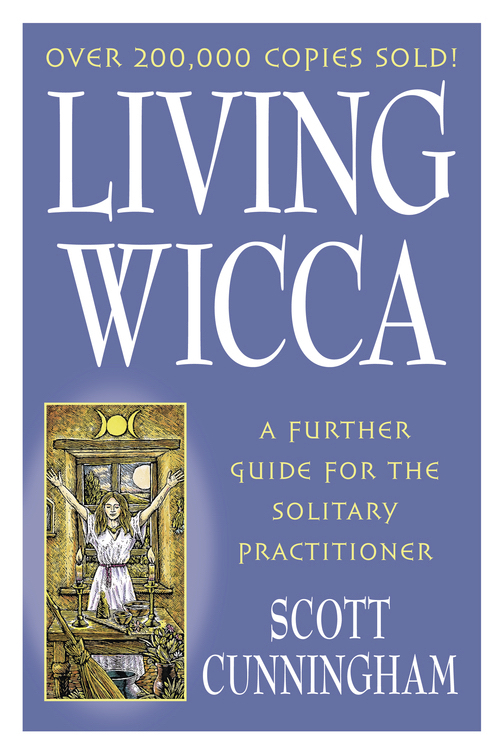
This week, we return to Scott Cunningham’s truly extensive library on all things Wicca with Living Wicca, the sequel to his bestseller, Wicca: A Guide for the Solitary Practitioner. Living Wicca continues in the same vein, and having established the basics last time around, in this book, Cunningham takes a deeper dive into some lesser-known aspects of Wicca, answering some questions that other writers may not have even thought to ask.
When we looked at Solitary Practitioner back in January, I noted that it was an absolute smash hit with readership, but that success did not come without controversy. Traditional Wiccans (that is, people who work in covens and generally adhere to the format as developed by Gardner and Valiente) were absolutely furious at Cunningham for daring to suggest that Wicca could be practiced alone and that coven-based practice wasn’t the only game in town.
As David Harrington wrote in Whispers of the Moon, the first biography of Cunningham, “Some witches found the idea that individuals could practice Wicca separate from a coven highly offensive, doubted that Scott had been initiated at all, and harshly derided the book. Most of the criticism came from actively teaching covens or groups with a strict hierarchy. What Scott proposed-and provided was a guide to what they perceived as spiritual anarchy.”
Cunningham himself alludes to this debacle in the opening pages of Living Wicca, noting that “Some will see this book as an insult to their form of Wicca, so I repeat: this is a guide for solitary practitioners who have no access to your form of Wicca. This in no way lessens it or any other Wiccan tradition. Read with an open mind and remember the time when you, too, were seeking.”
Translation: “Hey, guys, remember we all started somewhere and don’t get your robes in a twist, okay? We are all valid.” Harrington also discusses in Whispers that Cunningham was, understandably, more likely to speak out against aspects of coven Wicca that he felt were wrong, like the assumed infallibility of priests and priestesses and the BOS. So, with all that frustration bubbling away, no wonder he decided to strike out on his own and show others how to do the same!
But anyway, back to Living Wicca. Like Solitary Practitioner, it too is divided into three sections: Learning, Practice, and Your Own Tradition. Part 1 features discussions on how books can act as teachers for the solitary Wiccan, how the need for secrecy has changed as Wicca has grown and become more widely accepted within the mundane world, and even an essay on whether you can do a ritual while sick, in which he advises to use your best judgement, and listen to your body. (As for magic: he says no, unless it’s a self-healing spell.)
I particularly like the secrecy essay, not least because much of what Cunningham was writing about 32 years ago has now, by and large, come true. Witchcraft has now become so normalized that when I formally came out as a witch to a co-worker before I visited Salem, he didn’t even bat an eyelash! Neither did my family! They just rolled with it and moved on!
I also really like how Cunningham breaks down the common idea that we must keep silent about the magic we do. He writes, “True magic is limitless. Speaking of a ritual to others doesn’t disperse its energies. On the contrary, it gives you another opportunity to quickly send more power toward your magical goal.”
Exactly! Why would we think that magic is so fragile that it falls apart the instant a witch describes her spell to someone? Keeping silent might be useful for some people, but for me? I like to talk about the thing I just did with people, just because I think they might find it interesting.
One of my favorite essays may be the one about magical names. Read enough Wicca books, and sooner or later you’ll hit on the idea of a witch using a different name when doing Magic Shit than their legal name. Some people (like DJ Conway) insist that all witches must have a magical name, but Cunningham (blessedly) is not one of those people. He allows for both the decision to take one, and the decision not to.
For example: when I initiated myself a year or so ago, I chose not to use a magical name. Instead, I came before the Goddess and God as Lena, having already named myself for a powerful witch in the first place. Why use another when a perfectly good (and extremely magical) name was right there?
Where I disagree with Cunningham is on the chapter regarding initiations. He writes, “A self-initiation rite performed by a person after, say, a year of study and ritual will be a rich and spiritually significant event, simply because the rite was preceded by the experience that makes it genuine. In other words, one can’t become Wiccan (even a solitary one) overnight.”
Ah, but you can, sir! I know this because that’s almost literally what happened to me last year. (It was more of a week than overnight, but still.) Prior to the Claiming, I hemmed and hawed for absolutely ages over whether or not to dedicate myself ASAP, because I was so certain that Wicca was the path for me, or to wait a year as all the reputable sources out there told me to.
In that moment of doubt, Cerridwen came to me and said, “Where you came from does not matter. It’s who you are that’s important. Do you understand me, daughter?”
I have never forgotten that moment, and I don’t think I ever will. It was as clear an indicator as any that the gods blessed my path. My experiences since then, particularly during the Claiming, illustrate something that I’ve come to believe for myself: why on Earth would the Goddess care if a person has studied the Craft for a year and a day before initiating or dedicating themselves? Such artificial constraints are entirely mortal in design, they are not handed down to us on stone tablets.
In the circle on that magical May night, the gods did not tell me to wait a year. They simply came, and welcomed me home into their embrace and their love. And I have felt that love every day since. And that, more than anything else, should be what matters.
But getting back to Living Wicca. The Practice section is again the shortest part of the book, and it includes a decent selection of prayers for many occasions – I’m very bad at remembering to pray to the gods, but these short pieces may help with that, and get me over any residual strangeness I feel about the act of praying. Just because the Christians are loud about it doesn’t mean they alone can speak to the Divine.
By far the most interesting section of the book is the final one, Your Own Tradition. Cunningham himself created his own tradition sometime in the 1980s called American Traditionalism – the Book of Shadows included in Solitary Practitioner was derived from that, and in 2009, Llewellyn published the complete AT Book of Shadows for all to read.
The final 11 chapters of the book are entirely grouped around the idea of creating a new tradition just for solitaries, in order to provide us with a firm foundation as we build out our practice. While creating a new tradition isn’t required, Cunningham notes in the intro that “creating your own Wiccan tradition is exciting and challenging. It’s a process of defining not only your means of spiritual expression, but also the nature of your spirituality itself. Thus, it’s a journey of self-discovery.”
And that theme, the journey of self-discovery, is part of what makes Wicca (and in particular Scott Cunningham’s conception of it) so life-affirming. As Americans, we have all grown up in a world dominated by Christian attitudes and beliefs, including a certain tendency toward being stern and strict in matters of faith.
Cunningham’s books on Wicca blow all that apart, insisting over and over that we are not only allowed to question everything, we are encouraged to – even stuff he writes. He doesn’t claim to be the foremost authority on anything, his only job is to make this religion accessible to any seeker curious enough to learn about it, without all the internal politics of covens.
And for that, he has my everlasting gratitude.


Leave a Reply