As I noted toward the end of last week’s post, Wings Over America was pretty much the beginning of the end for Paul’s post-Beatles rock group. That album showed the band at their creative and critical peak, reaching highs not seen since the Beatles dominated the music world in the 1960s.
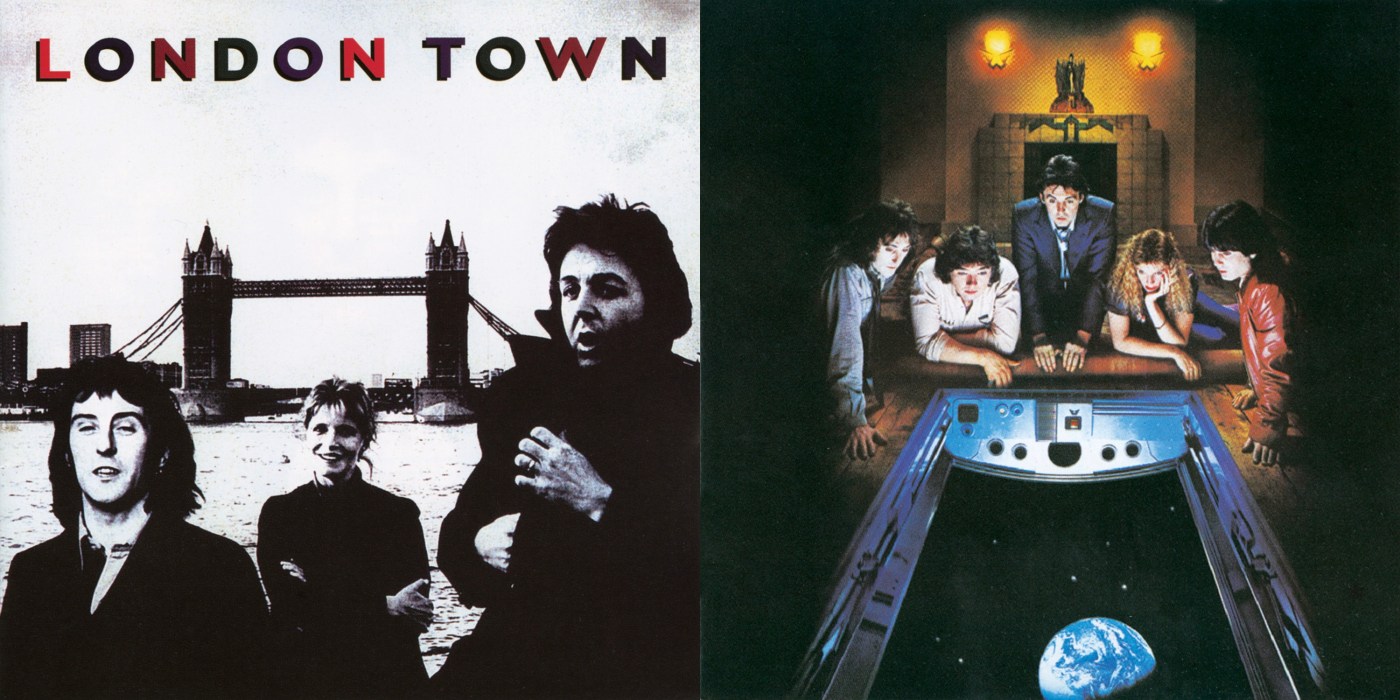
But for Wings, their end came even faster than the Beatles’ own did – just two more studio albums were recorded by the band prior to their break-up, so I thought it made sense to cover them both together. The first of these, 1978’s London Town, finds the band having taken most of 1977 off due to Linda’s pregnancy. So, rather than tour (which was the original plan) the band spent most of that year recording, reduced once more to the Band on the Run trio of Paul, Linda, and Denny.
Wings’ final album was 1979’s Back to the Egg, released in the US on Columbia Records. As Wikipedia notes, “The album reflects band leader Paul McCartney’s embracing of contemporary musical trends such as new wave and punk.”
And, like Let It Be before it, “Back to the Egg adopts a loose conceptual theme around the idea of a working band, and its creation coincided with a period of considerable activity for the group, which included making a return to touring and work on several television and film projects.” Because I guess Paul is just a glutton for punishment at this point. (Or something.)
Unfortunately, Back to the Egg proved to be as disastrous for Wings as Let It Be had been a decade before. A brief UK tour to start the 1980s that was meant to be worldwide led to Paul and the band being arrested for marijuana possession in Japan, bringing an immediate end to the tour. When Paul eventually returned to England, he decided the Wings era was over, and proceeded to do exactly as he had ten years earlier – make a solo album, and call it McCartney. (This time, McCartney II.)
But that’s next week. For now, let’s focus on the final bow of Wings:
‘London Town’: A surrealist look at life in London, with more than a few Beatles-related touches thrown in. According to the Paul McCartney Project, “including opening chords that sound like “Blackbird” and a chord progression similar to that in “The Fool on the Hill.” And they’re not wrong! It does feel a bit like a late ‘70s equivalent of “Penny Lane” with just a dash of “Strawberry Fields Forever”’s psychedelia.
‘Cafe On The Left Bank’: This song, I’ve discovered, was one of the last to include Jimmy McCulloch and Joe English as members of Wings, which explains something of why this song rocks as hard as it does. It was inspired by a trip to France that John and Paul took in 1961, where they went to… an actual cafe on the left bank!
‘I’m Carrying’: A quiet little ballad type number, featuring Paul on his own with acoustic guitar and strings. Also listen for the sound of a Gizmotron: “a device invented by 10cc’s Kevin Godley and Lol Creme, which attached to a guitar and bowed the strings to simulate the sound of orchestral string instruments,” per Beatles Bible. It sounds cool! (And as an aside, George really liked this song, as he admitted in 1979.)
‘Backwards Traveller’/‘Cuff Link’: Two songs that while they aren’t meant to be a medley, they work very well together as one – “Backwards Traveller” is a sci-fi thing that’s absolutely drenched in synthesizers, because this is 1978 and disco is starting to take off. “Cuff Link” is a cool little instrumental jam that I really like.
‘Children Children’: A happy little children song sung by Denny Laine, who co-wrote the song with Paul. It feels very like the successor to “Yellow Submarine,” but with vibes closer to “Octopus’s Garden.” I like Denny’s performance, but it needs more Ringo if you catch my drift.
‘Girlfriend’: If you’re wondering why Paul is doing a Michael Jackson impression, that would be because this song was originally written for Jackson when they met in 1975 and ’76. Jackson would end up recording it for his Off the Wall album in 1979, and of course, he and Paul would go on to collaborate quite a bit in the early 1980s. But this song, of course, is where it all started.
‘I’ve Had Enough’: A rollicking rock song that allows Paul to deploy his “Oh! Darling” voice again, along with a classic Little Richard scream lifted from songs like “I’m Down.” It’s not quite a breakup song (you’ll notice he doesn’t really write those anymore now that he has Linda) but it’s in a similar ballpark.
‘With A Little Luck’: Another Paul’s sunny optimistic songs, this track was a smash hit for Wings when it was released as a single in March 1978, reaching #1 in the US and Canada, and #5 in the UK. It’s a song that, like so much of the album, is soaked in synthesizers – neatly anticipating the synth-driven music of the ‘80s.
‘Famous Groupies’: A thoroughly ridiculous and very silly satire of the music business, with Paul delivering a theatrical vocal where, in places, you are reminded that he is indeed from the north of England. The record company liked it so much that they thought to release it as a single, but blessedly, they didn’t.
‘Deliver Your Children’: Another Denny Laine song, it’s ostensibly about children but it’s really more of a ramble, the child stuff only really shows up in the choruses. Interestingly, this song is actually in a Dorian mode, which makes for a really cool sonic effect when you listen to it – especially as the choruses are both in C major.
‘Name And Address’: A straightforward Elvis style rock number, written and recorded before the King died in 1977. It works pretty well as an Elvis tribute number though – you can tell Paul loved the guy, and made sure to replicate his sound as best he could.
‘Don’t Let It Bring You Down’: Written in Scotland in 1975, this is a pretty simple song in which Paul exhorts the listener not to let life’s troubles get them down – a very Paul message if there ever was one.
‘Morse Moose And The Grey Goose’: A song that originated from a jam, and it’s freaking cool! Wings were always a great jamming band, and this song is no exception.
You know, it’s funny: while this is just as much of a soft rock record as most of the Wings discography, this time it doesn’t bother me so much. The songs are solid, and the heavy use of the synthesizer sets the album apart from things like Red Rose Speedway. That most of the album was recorded by the same trio who did Band on the Run probably helps as well – Wings as a three-piece seems to be the ideal configuration. (At least for me.)
Onwards we go to, Back to the Egg:
‘Reception’: A funky instrumental piece with spoken word and radio broadcasts overlaid on top, (kind of like I Am the Walrus) it sounds really cool. Laurence Juber, Wings’ newest (and last) guitarist, explains: “We laid down a track with a Meters-like groove, Denny and I playing interlocking funky guitar parts. Then I overdubbed a lead guitar melody using an ARP Avatar guitar synthesizer.”
‘Getting Closer’: A solid slice of late ‘70s rock and roll, anchored by Paul’s nonsensical (but enjoyable) lyrics and Steve Holley’s drum part. The song was written sometime in 1973, which explains something of why it sounds like it could’ve been a lost Band on the Run track. Certainly, it’s just as epic!
‘We’re Open Tonight’: Another one of Paul’s “setting up for the show” songs, this was actually meant to be the title track for the album, until Linda suggested Back to the Egg. Like much of the album the song was recorded at Lympne Castle in Kent, which makes for some interesting sonic effects – Laurence Juber’s guitar part was recorded in a stairwell.
‘Spin It On’: A glorified guitar battle between Paul and Laurence Juber, with Paul playing an Epiphone Casino he bought in December 1964. That’s his favorite guitar ever, used on large chunks of mid-late period Beatles songs including “Taxman,” “Paperback Writer,” “Ticket to Ride,” and “Back in the USSR.”
‘Again And Again And Again’: A great performance from Denny Laine, who both wrote the song and sings it – it was put together from two unfinished songs that Paul thought would work well together, and he was right! They really do.
‘Old Siam Sir’: In which Wings dives deep into the hard rock pool with this song. It originated in 1976 called “Super Big Heatwave,” before being formally recorded by Wings during these sessions. The lyrics make little sense, but who cares? It feels a bit like a sequel to “Helter Skelter,” at least to me.
‘Arrow Through Me’: A funky little song that incorporates the idea of Cupid’s arrow, but inverts it, according to Paul: “The character in the song has been wounded. He’s been cheated on. And it could’ve been a great relationship, could’ve been fantastic. As things stand, you couldn’t ‘have found a more down hero’, because there was nobody more down than me at that moment.”
Notably, this song contains absolutely no guitar parts, it is instead dominated by synthesizer and keyboards.
‘Rockestra Theme’: Largely an instrumental piece, featuring a veritable Who’s Who of the late ‘70s British rock scene. According to Beatles Bible: “They included Pink Floyd’s David Gilmour, The Shadows’ Hank Marvin, The Who’s Pete Townshend, Led Zeppelin’s John Bonham and John Paul Jones, The Faces’ Ronnie Lane and Kenney Jones, and The Attractions’ Bruce Thomas.” Basically, an orchestra made entirely of rock musicians! It’s amazing, and also very impractical.
‘To You’: One of the coolest songs on an album that is probably my second-favorite Wings record,
‘After The Ball’/‘Million Miles’: A four song medley, just like on Red Rose Speedway only more successful. “After the Ball” is an anthemic number in the tradition of “Maybe I’m Amazed,” with Paul deploying a similar vocal style. “Million Miles” is just Paul singing and playing a concertina, in a beautiful intimate performance.
‘Winter Rose’/‘Love Awake’: “Winter Rose” is a minor key number that sounds almost funereal, but with a small element of hope and optimism in the lyrics that leads perfectly into “Love Awake,” where that optimism is paired with the coming of spring and summer, and given extra polish from the presence of an English brass band. It also features Laurence Juber on bass guitar for the first time ever, rather than Paul.
‘The Broadcast’: An experimental song, featuring a spoken word piece performed by Harold Margary, who owned the castle Wings were working in. The only Wings members on this song are Paul and Laurence – Paul’s piano part reminds me a little of Simon and Garfunkel’s “Silent Night/7 O’Clock News,” a similar sonic collage combining piano and spoken word.
‘So Glad To See You Here’: The Rockestra returns for the penultimate track, a high-energy rock song with Paul turning in one of his best vocal performances. He noted at the time, “It’s amazing how tightly they all played together. With people like Pete Townshend, Gary Brooker, Hank Marvin, Ronnie Lane, Ray Cooper and Dave Gilmour, you would have expected a rougher, less controlled sound. But it didn’t turn out that way. When you get 14 rock musicians together for the first time, they can be incredibly tight.”
‘Baby’s Request’: A jazz number to play us out, written by Paul for the Mills Brothers, an American jazz quartet he liked. Being a fan of mellow things, this song proved to be one of George Harrison’s favorites. The song was re-recorded in 2012 for Kisses on the Bottom, Paul’s album of jazz standards.
It’s kind of a shame that Wings ended up not recording any further music after this, because Back to the Egg is by far and away my second favorite of their albums. Steve Holley and Laurence Juber add some really tight performances to the album, and had they released another, I feel confident in saying it’d be a success.
What then, do we make of Wings, now that we’ve reached the end of their story in the wider McCartney saga? I think on the whole, it was a worthy experiment of Paul’s. He desperately missed playing in a band, and given the acrimonious breakup of his last one, a desire to rebuild makes complete sense. (Hell, I’ve been in that exact situation myself.) I’ll never be a soft rock girl, but even I am big enough to admit that they really were the defining post-Beatles musical project of the ‘70s. Certainly, I’ve added two more of their albums to my favorites playlist.
As I was writing this post, I learned that a two-disc celebration of Wings is due for release in November 2025. Simply titled after the band, the album includes tracks from all seven Wings studio albums, plus non-album singles and even “Soily,” from One Hand Clapping. With Wings itself getting attention in recent Paul McCartney books, I know I’ll be snagging myself a copy.


Leave a Reply