Hello witches, and welcome to a very special edition of Wiccan Reads! If you’re reading this on WordPress, it is now October, which here in New York means we have entered prime spooky season! The autumn leaves are falling, the nights are getting chilly, the sun is setting earlier and earlier every night… mid-autumn has always been my favorite time of year, but this year it’s even more special.
At the end of the month, of course, we have two holidays: Samhain, the Wiccan new year and a solemn night of remembrance for all those who have passed into the Otherworld. It is also a time of celebration, the making of plans for the year to come. And of course, it also Halloween, when witches and our particular aesthetic are at their most popular.
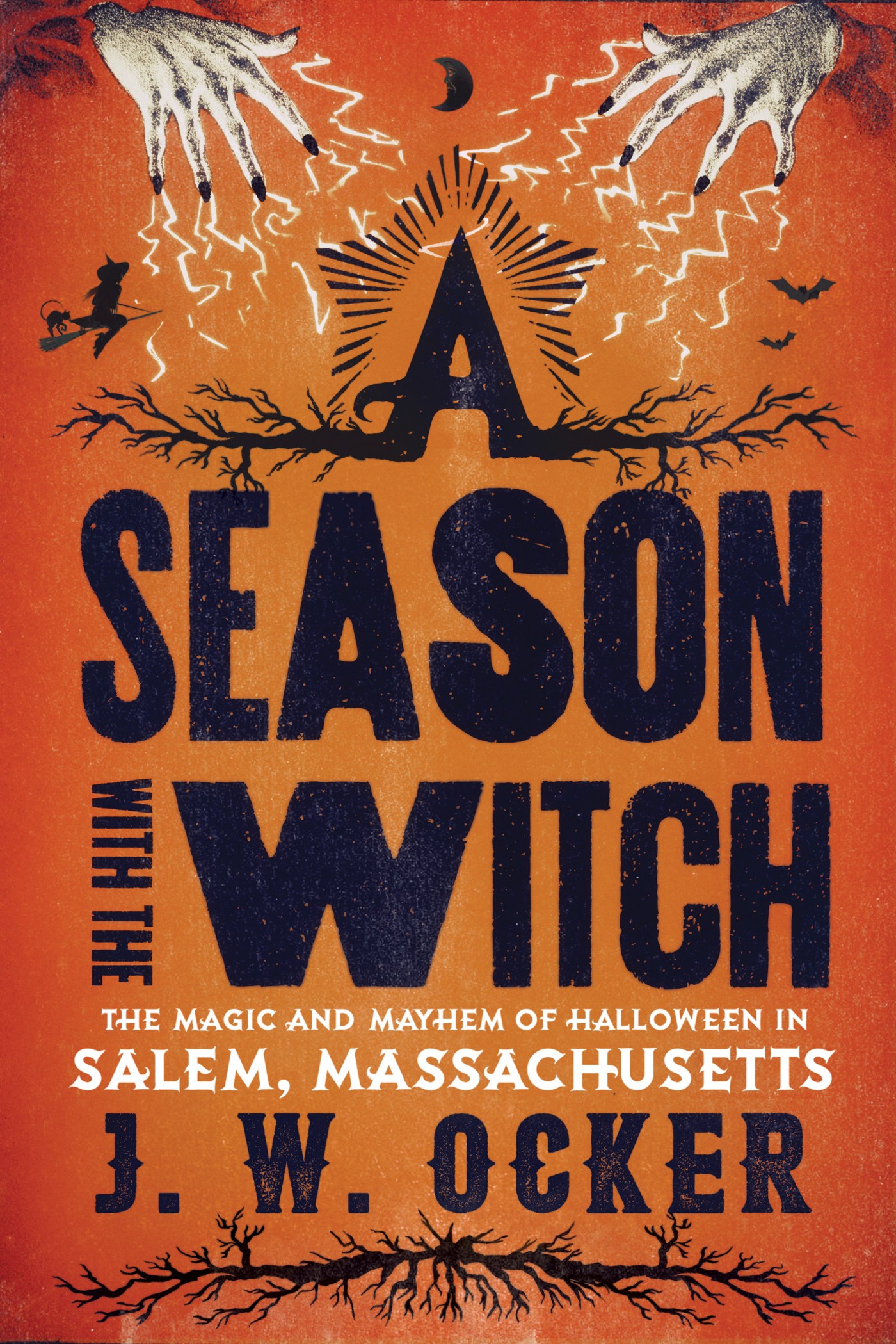
And where better to spend Halloween, or Samhain, than in the Witch City itself – Salem, Massachusetts. I’m not there in person, sadly, but the great thing about books is that they can take us anywhere, and I can’t think of a better book to read at this time of year than J.W. Ocker’s A Season with the Witch.
In 2015, he took his family from New Hampshire to Salem and spent the entire month of October there, in order to get a better understanding of what makes this wonderful city so special. Having now been married there, (and with the certificate to prove it) I like to think of myself these days as an honorary Salem witch, so why not honor that connection right here and now?
Salem is calling, witches! Let’s go!
Naturally, any book on Salem has to start with the Witch Trials. Ocker doesn’t disappoint, devoting the entirety of the second chapter (the first is caught up with his family’s arrival and their attendance at a Halloween parade) to how the trials began, with particular focus on Betty Parris, Abigail Williams, and one of the women they accused of witchcraft: Tituba, a Native American slave of the Parris family.
One key point he makes midway through chapter is how small moments, in small places, can have outsize impact in the wider lens of history. With his daughters standing in the excavated foundation of the house where the Parris family was living in early 1692, Ocker writes, “But in the end—or, I should say, in the beginning—it was two girls and a winter night. That’s how it started. All of it. The atrocity. The tragedy. The horror. All culminating centuries later in the modern phenomenon of Witch City. Right on the spot where my two girls were playing.” Kind of hits you like a brick, doesn’t it?
I regret that I didn’t get to do a lot of historical tourism in Salem – we were too busy with wedding prep and getting lost in the city’s extremely colonial geography. (Driving around that city requires satnav just to get anywhere.) Ocker’s book, thankfully, fills in the gaps in my visit. It’s not the same as seeing the city in person, of course, but it’ll give me an idea of what to expect next time I go.
While the Trials are of course known as the Salem Witch Trials (since that was where most of the people involved were executed) Ocker goes to great lengths to point out that in truth, the Trials were spread all over Essex County. Nearby Danvers, for example, is the OG Salem Village – they changed the name to Danvers around sixty years after the Trials – probably to avoid uncomfortable associations.
Ocker explains, “Salem was a bifurcated community at the time of the trials. The area known today as Danvers was called Salem Village back then, and it was the backwoods of Salem. […] The downtown area on the coast, Salem Town, is what grew into modern-day Salem.” There were, in essence, two Salems, and the poorer Village is where all the bad shit went down.
Danvers has a much different relationship to the Trials than Salem proper does – in Danvers, there are quiet memorials but little else, perhaps because the stain of history is too strong to remove. Even the one actual “tourist attraction” in town, the Rebecca Nurse Homestead, isn’t really in the business of doing much attraction. And that’s on purpose – Danvers views Salem Town as a tacky embarrassment.
For the city of Danvers, the Trials are a mark of shame, not something to build tourism around. Even today, they prefer to keep it quiet. As noted by local historian Richard Trask, “This was a small community, and there wasn’t a person there who wasn’t affected personally. When it was over, it was just a traumatic thing that they wanted to forget. Something like that passes through generations.”
The next chapter continues the history lesson, but this time we move to Salem Town. In the same neighborhood as the little collection of shops on Essex Street where real witches can buy books, cauldrons, hats, incense, and statuary, there is the Old Witch Gaol, or at least, the spot where it used to be. Ocker writes that the condemned would walk down Essex on their way to be hung – which, I must admit, gave me the extremely weird mental image of nearly two dozen people walking past shops like Moons and Coven’s Cottage in chains.
Marilynne K. Roach, a historian and writer from nearby Watertown, more or less launched the Witch Trials history world with her book, simply titled The Salem Witch Trials, aiming to provide as accurate an account of the tragedy as possible, in a time where the city’s role in history was still something of a black mark.
For an idea of just how much Salem has changed in the last fifty years, get a load of her quote about her second trip to the city in 1975: “Well, put it this way. The second trip I took that year was in October, the day before Halloween. I pretty much had the place to myself.”
If that doesn’t sum up the difference between Witch City Salem and the Salem of the Trials, I don’t know what does.
That’s not to say the book pours scorn on the more popular side of Salem, oh no. A large chunk of the book’s middle section is entirely devoted to how the Trials, and the myriad of methods used to tell the story, mix and mingle with the modern conception of Salem as a tribute to the witches of today, both in pop culture and real life. It’s a celebration of what Salem is, rather than what some people (like those in charge of PEM) would like it to be.
The Salem Witch Museum (that giant castle-looking place across the street from Salem Common) even includes an exhibit called Witches: Evolving Perceptions, dedicated to showing off all the other witches in the world, from the classic hat-and-broomstick sort with green skin to the Wiccans of now. Witches contain multitudes, why shouldn’t Salem celebrate all kinds?
In essence, the modern Salem has become far more than just the Trials: it’s home now to witches of every sort. Being the world’s Witch City is an act of both remembrance and celebration, and if that’s not a perfect encapsulation of October 31’s two holidays, I don’t know what is. Salem is a beautiful, wonderfully strange city, and it’s one that I will always, always love. Reading this book has only deepened it.
At the end of the book, Ocker deals directly with the question that every person who goes to Salem must deal with – is all the fun and buzz of Witch City worth the price paid in blood by 20 innocent people? Wouldn’t it be better to quietly memorialize the Trials, but otherwise be a normal New England town, as Danvers is? Isn’t it the height of cruelty to celebrate witches in a town we only know about because of the trials?
Ocker doesn’t think so. In his telling, the reason Salem can be the city of the Trials and the home of the best Halloween party on Earth and the Wiccan equivalent of Mecca, is all down to one single, magical word.
Witch.
Witches are creatures of transformation. And over the centuries, that word itself has gone from referring to Christians accused of cavorting with Satan to Margaret Hamilton in The Wizard of Oz to practitioners of Wicca and other forms of neopaganism. Hell, Wicca got started because Gerald Gardner thought he was reviving an actual ancient religion of witchcraft, dedicated not toward works of evil but works of good.
When it all comes down to it, the Salem witch “owes its existence to all three witches, but it has transcended them all, too, and become its own thing.”
And that, I think, is what people like historian Richard Trask or the people in charge of Peabody Essex Museum fail to understand about what Salem has become. The Trials may have been what put the city on the map, but it’s not all that Salem is, nor should it be. The definition of witch has grown and changed with the times, and Salem has adapted. That’s the magic of the city right there.
It’s the Witch City. It contains multitudes.
May that always be true.


Leave a Reply