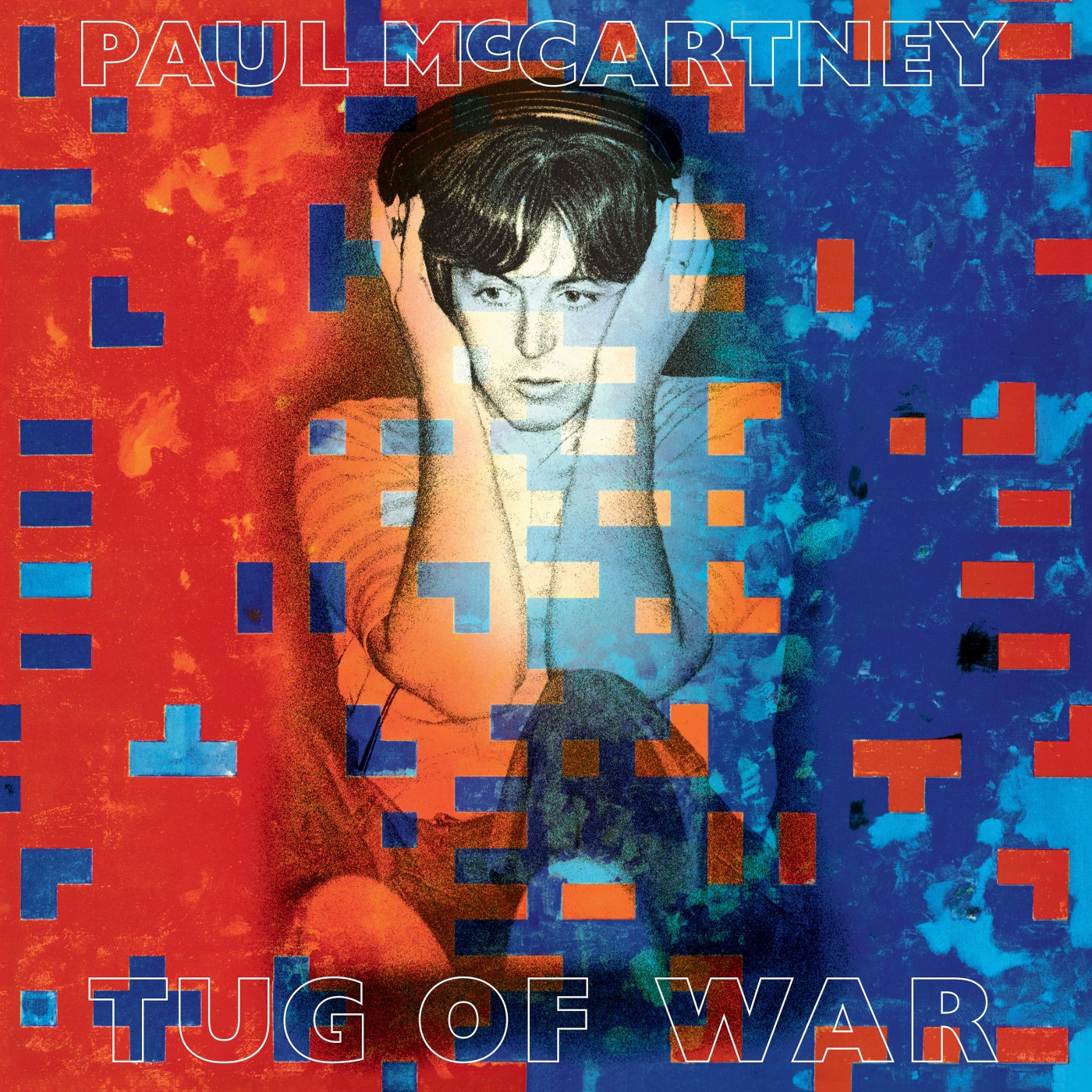
Recorded in 1981 and released in 1982, this was Paul’s first collaboration with George Martin since “Live and Let Die” around a decade earlier, and featured the return of Denny Laine of Wings and, of course, Paul’s fellow ex-Beatle Ringo Starr on drums, in their first work together since the final Beatles session in 1970. (John had left the group by then, so the Threetles of Paul, George, and Ringo recorded George’s “I, Me, Mine.”)
The album sessions were so productive that Paul saved some of the songs for Pipes of Peace, as mentioned above, but of course, John’s murder in December 1980 threw off everything. Album sessions were delayed until February 1981, during which time Paul joined up with Ringo and George to record George’s tribute song, “All Those Years Ago.” (Paul, of course, had one of his own, which we’ll talk about below.)
When Tug of War was released in 1982, it proved to be a big hit with record buyers and music critics, reaching the top of the album charts in Britain, America, and Japan. Rolling Stone described it as “the masterpiece everyone has always known Paul McCartney could make,” anchored no doubt by George Martin producing Paul in the way he used to with the Beatles – plenty of discipline and a high standard of quality.
Let’s see if some of that old Beatle magic is still around:
‘Tug Of War’: Beginning with the sounds of people grunting as part of a real tug of war, “Tug of War” does for this album what Sgt. Pepper did fifteen years earlier, introducing us to the main themes of the album. This is a record about “the struggle of opposites,” hence the title, and again like Pepper before it, the ending of this track fades into the next one.
Unlike Pepper though, there’s more substance to the lyrics here. Quoting Wikipedia, “The song has a clear division between the verses featuring sad lyrics about the struggle to survive, the necessity of conflict (pushing and pulling) and the hopeful refrain, in which McCartney looks for a future where these struggles are no longer necessary.” With John’s death, it feels as though Paul is taking up a similar mantle as his fallen friend, complete with a string section arranged by George Martin.
‘Take It Away’: On the subject of Pepper echoes, who should appear on this song but Billy Shears himself, Ringo Starr, on drums again? Of all things, the lyrics make this song sound a bit like a 1980s equivalent to “Listen to What the Man Said,” and I gotta say, I like it a lot.
‘Somebody Who Cares’: With this track, Paul enters new territory with a song that I can only describe as “music to brighten up your bad mental health days.” Given that Liverpudlian men of Paul’s generation were not taught to deal with their emotions, this is a wonderfully forward-looking statement that will recur, periodically, well into the 2010s.
‘What’s That You’re Doing?’: Clocking in at six minutes, this is the longest and the funkiest song in Paul’s entire catalog, and it all comes down to Stevie Wonder. The song originated with the two of them just jamming and having a great time. In places it sounds like an ‘80s remake of Wonder’s own hit from 1972, “Superstition.” They’re even in the same key! It sounds fucking great, and I’m happy to say there’s more from these two still to come.
‘Here Today’: This one is a heart-breaker. Paul’s gorgeous tribute to John, featuring just him, acoustic guitar, and strings – like a 1980s version of “Yesterday,” only instead of pining for a lost love, he’s pining for his best friend. When I heard him play it live in 2016, he choked up during the performance… apparently that happens a lot.
Paul’s sorrow at missing John has animated so much of his career over the past 40-some years, from “Here Today” to dusting off “Now and Then” and putting it out as the final-ever Beatles recording. Wherever John is now, I feel safe in saying that he misses Paul just as much.
‘Ballroom Dancing’: The first song on side 2 of the original vinyl release, “Ballroom Dancing” is a fabulous rock song in which Paul reminisces about his childhood. But there’s a certain amount of realism here, especially in the third verse where Paul’s lyrics take on a slight wistful quality. It sounds incredible, and that voice! He reaches new levels of depth on this track, even lower than “Get Back.”
‘The Pound Is Sinking’: Yes, this really is a song about the stock market and all the ridiculous phrasing you hear when you spend any amount of time of following the business news. It’s a hell of a thing for me to listen to now, given that the Trump administration is driving the American economy into self-destruction with tariffs, the end of the de minimus exemption, and all those fucking Medicaid cuts that might throw me off my health insurance next year.
And if that last paragraph is what gets me arrested by the feds, then so fucking be it. “And feeling quite appalling” is right. I hate what this man has done to my country, and we’re only 8 months into a four year term that he may not even see the end of, given his rapidly disintegrating body and mind.
May the gods have mercy on us all.
‘Wanderlust’: Remember “Warm and Beautiful” from Wings at the Speed of Sound? This song reminds me a bit of that, which is funny given that it actually originates from the London Town sessions. Apparently, this track was also supposed to include a guitar solo from George (which would’ve brought all three surviving Beatles back together for the first time) but Paul’s visit to George’s studio turned into a vocal tracking session instead.
‘Get It’: On an album saturated with impressive musical collaborations (Denny Laine, Ringo, Eric Stewart, Stevie Wonder) the only way that can possibly be topped is if you go with, say, Carl Perkins… and sure enough, here he is in a country-and-western flavored track. It’ll never be my favorite genre, but given Perkins’ legendary status in Beatle lore (he was George’s favorite guitarist, and the Beatles covered two of his songs on Beatles For Sale) I’ll let it slide.
‘Be What You See (Link)’: Nothing to say here, just one of Paul’s occasional linking tracks. It sounds very spacey.
‘Dress Me Up As A Robber’: Nothing much going on here lyrically, but the song they’re paired up with is really great! The synthesizer/acoustic guitar combo really shouldn’t work, but somehow it does. The surreal thing about this song in particular is how very Of A Piece it sounds with something like Duran Duran’s Rio album, which came out just a few weeks after Tug of War. The Eighties, people!
‘Ebony And Ivory’: One observation I didn’t get to make in the write-up on “What’s That You’re Doing?” is that Paul’s voice goes very well with Stevie Wonder’s. Certainly record buyers thought so too, considering this song, an ode to racial equality, hit the top of the charts in eleven countries. Critics thought it was cheesy in all the worst ways, but the critics are wrong, this song is a fucking classic.
Maybe it’s just me, but Paul sounds ever so slightly different on Tug of War than he did on any of the Wings albums. On those, he sounded pretty much exactly like he did in 1969, but here it sounds a bit like his voice has started to deepen, if only slightly. (The effect will become more pronounced when we get to his ‘90s releases.)
I suppose the effect is inevitable – George certainly evolved as a vocalist just within the Beatles era, nevermind how his voice lowered between his ‘70s albums and his last two. But with Paul, it’s just a bit surprising, since that choir-boy quality to his voice lasted for such a ridiculously long time.
Vocal changes aside, Tug of War is one of Paul’s best albums yet, and I say this as someone who thinks that of pretty much everything he’s come out with since 1997. Bringing back George Martin after so many years of Paul essentially producing himself was just what he needed to tighten things up, and prove that he didn’t need a band in order to create great music.


Leave a Reply