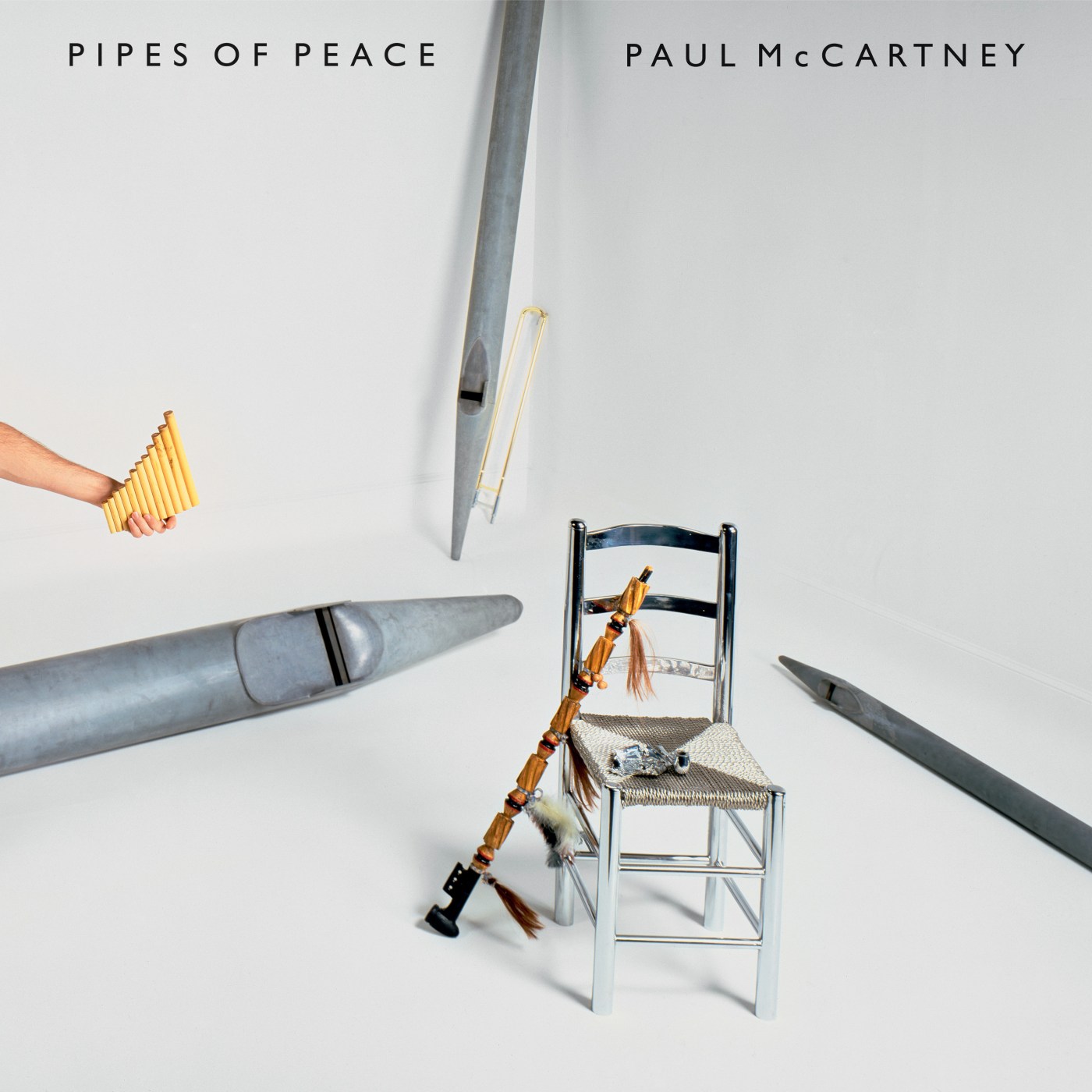
George Harrison, in the Anthology documentary, remarks in one episode that in his opinion, the Beatles albums Rubber Soul and Revolver were very much “Volume 1 and Volume 2.” I’ve never really agreed with that particular assertion (because the two albums have entirely different sonic palettes, as one is more folk-rock and the other is more acid-rock) but I do think it applies very well to Tug of War and Pipes of Peace.
To liberally quote from Wikipedia again, “Many of the songs released on Pipes of Peace were recorded during the 1981 sessions for Tug of War. […] Consequently, the album has many things in common with its predecessor: it was produced by George Martin; it featured two collaborations with the same artist; and it continued McCartney’s alliance in the studio with Ringo Starr and with 10cc guitarist Eric Stewart. It also contains his last session work with Wings guitarist Denny Laine.”
The Special Guest musician on this record is, of course, Michael Jackson. Jackson had become a global musical smash in his own right by 1983, off the massive success of 1982’s Thriller album. His work with Paul dates back to Paul’s own “Girlfriend” from London Town, which was later recorded by Jackson for his album Off the Wall. Thriller includes one collab with Paul: “The Girl Is Mine,” in which the two of them argue over an unnamed girl.
Pipes of Peace contains two more Jackson-McCartney collaborations: “Say Say Say” on the first side, and “The Man” on side two. These collaborations, though, would also turn out to be the last time the pair worked together – in 1985, Jackson purchased the copyrights to the Lennon/McCartney song catalog, and gloated about it to Paul not long afterwards. (Paul got his songs back in 2017 after filing a lawsuit.)
Obviously, Jackson’s legacy since his death is an extremely complicated one to say the least, but it’s not a subject I feel qualified to discuss. I’ve never been much of a Jackson fan – the only album of his I’ve ever heard was Thriller, and that was in an Audio Aesthetics class I took in college. His collaborations with Paul on Pipes of Peace are essentially where my interest begins and ends, so I can’t speak to the sexual abuse allegations at all.
And anyway, this is a Beatles blog. This is the one and only time we’ll have to deal with Jackson – he never intersects with Paul again after 1985. So, with all that said, let’s see what we’ve got:
‘Pipes Of Peace’: If there’s one thing Paul is known for, it’s a penchant for writing children’s songs. Obviously, “Yellow Submarine” is the biggest one, but his solo career features some as well – “Bogey Music” on McCartney II, or “We All Stand Together,” his Rupert Bear song from around this period.
“Pipes of Peace” combines the children’s song idea with a peace anthem, ala Lennon’s “Imagine,” but with a focus on climate change and the dangers thereof – and this is 1983, back when we had way more time to do something about it than we do now.
In The Lyrics, he mentions visiting Daunt Books in London – I went there close to a decade ago now, when studying abroad in the UK as a junior in college. I’ve kept the bookmark with me ever since, because I loved that place so much.
‘Say Say Say’: The first of the two Jackson collabs on this album, this one is easily the best – and insanely catchy. (I can’t listen to this song without getting it stuck in my head.) Paul’s vocals are panned to the left, while Jackson is on the right, while their trade-offs in the verses give the impression that this song is something of a spiritual successor to “The Girl is Mine.”
The single was a smash hit for both Paul and Michael when it was released in 1983. For Paul, it was his best-selling single of the entire 1980s, and his final stateside #1, according to the Beatles Bible. And if you want to hear a slightly different take on the track, check out the remix from the Pure McCartney compilation, where Paul’s and Jackson’s vocal parts are swapped.
‘The Other Me’: Of all things, this song feels like Paul’s version of “Jealous Guy” from Imagine, though it swaps that song’s confessional overtones for something more optimistic instead. (So far as I know though, this isn’t based in anything real, as John’s song was.)
As Paul observes in The Lyrics, “Maybe this yin and yang and trying to see both sides comes from being a Gemini. I never really bother with astrological signs, but I do know that the conventional Gemini has two halves, pushing and pulling, and it fits with my character.” Well duh, Paul! You wrote “Hello, Goodbye,” that’s a Gemini song if there ever was one!
(Said the proud Libra girl who writes a character named Gemini.)
‘Keep Under Cover’: This song is amazing, because it feels like a Wings track even though it isn’t – maybe it’s the presence of Denny Laine on acoustic guitar. Anchoring the track is a string section provided by George Martin, who employs the same Psycho-esque stylings he used with great success on “Eleanor Rigby.”
‘So Bad’: A simple love ballad from Paul now, featuring Ringo Starr on drums – it feels so good to hear him and Paul working together again. Paul does some neat stuff with his vocal on this sone, singing almost entirely on the upper end of his register. It’s the most femme vocal he’s ever done, and I am here for it.
‘The Man’: The second collab between Paul and Michael Jackson, it’s… okay, I guess? It centers around a nameless “Man” in the fashion of “Listen to What the Man Said,” where the identity of the figure is intentionally left to the listener’s imagination. This individual is capable of many amazing things that most people are not, lending credence to Paul’s belief that “The Man” is God. (Or in my theology, Cernunnos.)
‘Sweetest Little Show’: Another soft rock song that sounds like it could’ve been a Wings track, but it wasn’t. According to Paul, “That just came out of a jam, just a little chord sequence which was lying around for a while. It nearly got into a medley with two other pieces, and we suddenly didn’t like the two other pieces, but we liked “The Sweetest Little Show” bit.” It leads directly into the next song.
‘Average Person’: Ringo is back with a song that fits into the same “story song” genre as tracks like “Eleanor Rigby” and “Penny Lane,” but to me it feels like a 1980s version of “Another Day,” his debut single from 1971, what with its focus on the ordinary people of the world.
‘Hey Hey’: The only instrumental on the entire album, this is a collab between Paul and jazz bassist Stanley Clarke, well known in jazz circles for his work with Stan Getz and Chick Corea. The guitar lines that make up the bulk of the song are reminiscent of the ones from “Birthday,” down to the two songs being in the same key. The track also has a wonderful jazzy interlude that I really, really love, with Clarke playing bass rather than Paul.
‘Tug Of Peace’: In which Paul goes for broke and combines the title songs for this and Tug of War, like an early example of a mashup. I’m not entirely sure that it works, but it’s an interesting experiment, and it cements the fact that these two albums are each two sides of the same coin.
‘Through Our Love’: A lovely ballad from Paul to Linda to close us out, featuring George Martin playing a bicycle wheel. With the giant orchestral section taking up the back half of the song, it sounds like a suitably epic finale – just what you need for a track like this, if you ask me.
Pipes of Peace is made of Tug of War leftovers, and frankly it shows. It’s not a bad album by any stretch of the imagination, it’s just kind of meh. There are some good moments, but it doesn’t really cohere for me as well as Tug of War did. It feels, kind of, like Paul is trying to stay relevant in the era of Duran Duran, Pat Benatar, Joy Division, and the Smiths… and not entirely succeeding.
Still, at least he tries with this record… which is more than can be said for his next one.


Leave a Reply