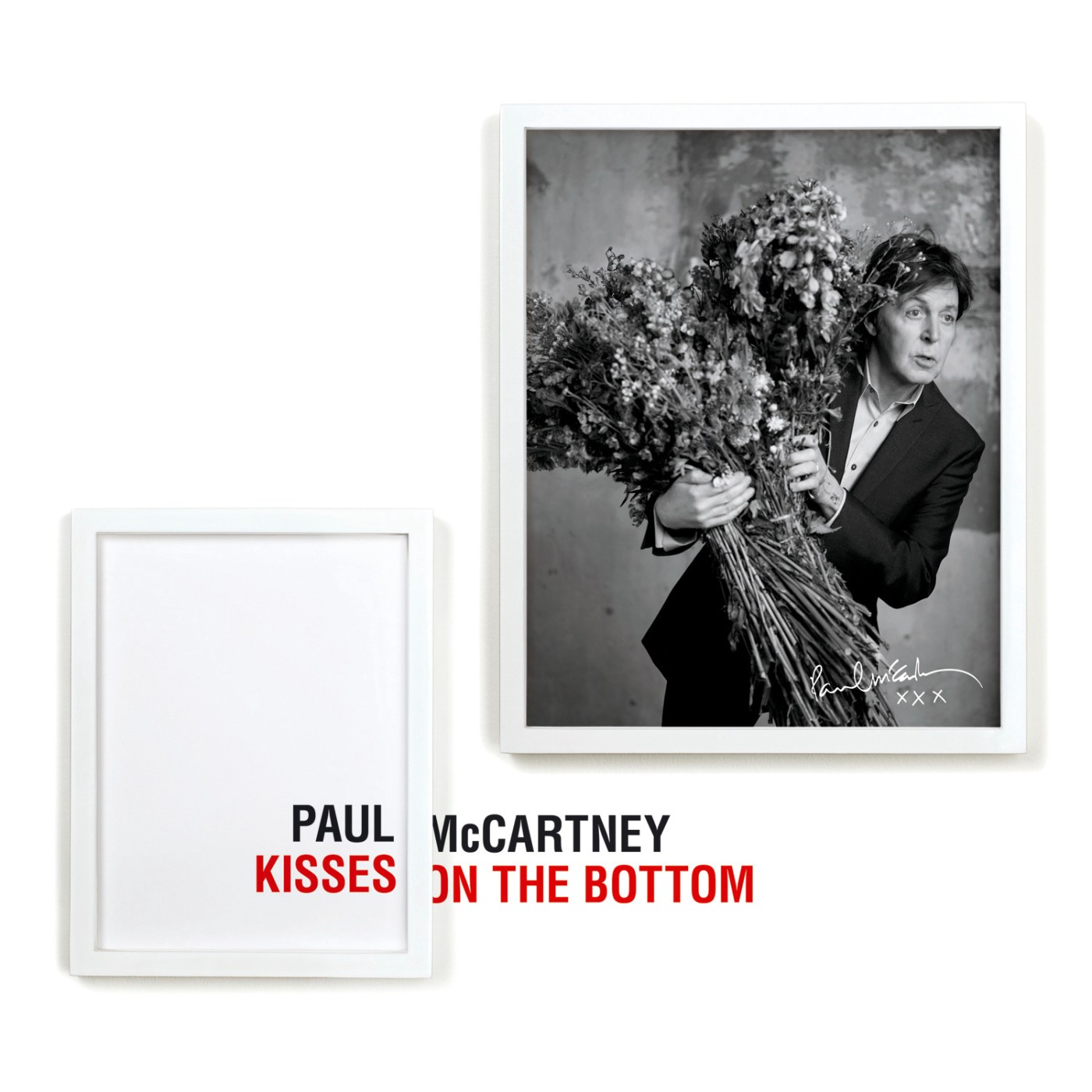
Recorded in 2010 but not released until 2012, Kisses on the Bottom finds Paul McCartney in the throes of new love once again – this time, he’s fallen for (and been married to) Nancy Shevell, his third wife, and the second one to be American. Paul met her in late 2007 while he was divorcing Heather Mills and she was divorcing her previous husband, a lawyer named Bruce Blakeman.
According to Philip Norman’s Paul McCartney: A Life, Nancy had been good friends with Linda, and even attended Linda’s alma mater – Arizona State University. (Though not at the same time.) Norman notes that “By a delicious irony, her second cousin was the television journalist Barbara Walters, whose 2002 interview with Heather produced one of the divorce claims against Paul which had been so mysteriously leaked to the press.”
They married on October 9th, 2011 – John Lennon’s 71st birthday. The ceremony was held at Old Marylebone Town Hall in London, the exact same place where Paul had married Linda. Paul’s daughter Stella designed Nancy’s wedding dress, while Beatrice (Paul’s youngest) was the flower girl. Ringo Starr was in attendance with his own new wife, Barbara Bach.
Performed at that wedding, naturally, was a new song from Paul: “My Valentine,” later released in December 2011 as a single. It’s one of only three McCartney originals on that album, with the other two being “Only Our Hearts” and “Baby’s Request,” a re-recording of the Wings track from 1979’s Back to the Egg.
The rest of the album is made up of standards, the kind of songs that Paul’s dad, Jim, used to play. In the tradition of jazz crooners like Frank Sinatra and Bing Crosby, much of the album was recorded at Capitol Studios in LA – Paul only sings on this album, the instruments are handled by everyone else.
Let’s see what he’s got for us:
‘I’m Gonna Sit Right Down And Write Myself A Letter’: This song is a 1935 popular song with music by Fred E. Ahlert and lyrics by Joe Young. It quickly became a part of the Great American Songbook, and was a hit for Fats Waller in the same year.
‘Home (When Shadows Fall)’: This is a song written by Harry Clarkson, Geoffrey Clarkson and Peter van Steeden in 1931. Since he liked the chords, Paul would sometimes play an instrumental version during the earliest writing sessions with John, but this is the first time he’s done a full studio recording.
Incidentally, the parenthetical and the lyrics both inspired the theme for a Werewolf game I ran about a couple years ago, about an old manor house that has been haunted by evil spirits. I made a suitably spooky-sounding remix of the track to accompany a trailer, but it creeped me out too much, so I ended up not using it.
‘It’s Only A Paper Moon’: “It’s Only a Paper Moon” is a 1932 song with music written by Harold Arlen and lyrics by Yip Harburg and Billy Rose. The song was written for an unsuccessful 1932 Broadway play called The Great Magoo. Hit recordings by Nat King Cole, Ella Fitzgerald and Benny Goodman transformed this song into a jazz and pop standard. Listen for Paul’s whistling during the solo!
‘More I Cannot Wish You’: “More I Cannot Wish You” is a 1950 song written by Frank Loesser for the theatre production of Guys And Dolls. Paul noted, “I thought it was such a poignant little song. And what totally did my head in is, it’s a guy, the grandfather, singing to a young girl. With me having a young daughter it’s very poignant.” (He means Beatrice.)
‘The Glory Of Love’: “The Glory Of Love” is a song written by Billy Hill, recorded by Benny Goodman in 1936, whose version was a number one pop hit. In 1951, R&B vocal group, The Five Keys, had their biggest R&B hit with their version of the song, hitting number one on the R&B chart for four non-consecutive weeks. I particularly like the way he sings “Standing there,” because of his exceptionally Liverpudlian pronunciation.
‘We Three (My Echo, My Shadow And Me)’: “We Three (My Echo, My Shadow and Me)” is a 1939 song written by Nelson Cogane, Sammy Mysels and Dick Robertson. It was a hit song in 1940 for both The Ink Spots and Frank Sinatra with the Tommy Dorsey Orchestra, both versions reaching No. 3 in Billboard in December.
‘Ac-Cent-Tchu-Ate The Positive’: “Ac-Cent-Tchu-Ate the Positive” is a 1944 song written by Harold Arlen and the lyrics by Johnny Mercer. The song was nominated for the “Academy Award for Best Original Song” at the 18th Academy Awards in 1945 after being used in the film Here Come the Waves. Paul dips into his lower register for this one, after using his higher register for the preceding several tracks.
‘My Valentine’: There are love songs, and then there are love songs by Paul McCartney. Of the trilogy of songs dedicated to his wives, “Maybe I’m Amazed” stands out as the best of them all, but this track is a very close second. Lyrically, it’s another of Paul’s weather songs, centered around rain, and it is absolutely gorgeous. Paul’s vocal is soft and tender, melding so perfectly with the acoustic guitar. (That’s Eric Clapton on the solo.)
‘Always’: This is an Irving Berlin song which he wrote in 1925 as a wedding gift for his own wife. It was later recorded by everyone from Frank Sinatra to Ella Fitzgerald, Harry Nilsson, Tony Bennet, Leonard Cohen, Phil Collins, and now Paul McCartney.
Paul’s recording (along with “My Valentine”) has come to be one of my favorite tracks on this album, and like “This Never Happened To Me Before,” would’ve been a song Sophie and I danced to at our wedding. To us, it exemplifies an important cornerstone of our relationship: that we are always there for each other, no matter what happens.
‘My Very Good Friend The Milkman’: “My Very Good Friend The Milkman” is a 1934 song written by Johnny Burke and Harold Spina, which was a hit for Fats Waller. Eric Clapton covered it in 2010.
‘Bye Bye Blackbird’: “Bye, Bye, Blackbird” is a 1926 song written by the American composer Ray Henderson and lyricist Mort Dixon. It is considered a popular standard and was first recorded by Gene Austin in 1926. Ringo Starr recorded it in 1970 for his album “Sentimental Journey,” another album of standards, and his solo debut to boot.
‘Get Yourself Another Fool’: “Get Yourself Another Fool” is a 1949 song written by Frank Haywood and Monroe Tucker. It was recorded by many artists including Sam Cookie on his 1963 album Night Beat. For Paul, I’m pretty sure this is the first break-up themed song that he’s recorded since his Beatles days. Eric Clapton returns on this track – that’s him doing the opening solo.
‘The Inch Worm’: “The Inch Worm” (also named “Inchworm“) is a song written by Frank Loesser and originally performed by Danny Kaye in the 1952 film Hans Christian Andersen. Mary Hopkins covered it on her 1969 album “Post Card“, and David Bowie has cited it as the inspiration behind his song “Ashes to Ashes.” When my dad heard Paul’s version of this song, he said recognized from his childhood in the 1970s.
‘Only Our Hearts’: The second of three McCartney originals, it serves as the closing song on the regular 14-track version of the album. It includes a harmonica solo by Stevie Wonder, his first collaboration with Paul since “Ebony and Ivory” and “What’s That You’re Doing” on Tug of War.
‘Baby’s Request’: As I noted in the post on Back to the Egg, this song was originally written in the late 1970s for the Mills Brothers, an American jazz quartet Paul liked. Being a fan of mellow things, the Wings version of this song proved to be one of George Harrison’s favorites. The remake was done at the request of Tommy LiPuma, the producer on Kisses.
‘My One And Only Love’: “My One And Only Love” is a 1952 song with music written by Guy Wood and lyrics by Robert Melling. It was recorded by Frank Sinatra in 1953, and by many other artists over the years including Doris Day, John Coltrane, Dean Martin, Ella Fitzgerald, Sarah Vaughan, Rickie Lee Jones, Sonny Rollins, and Oscar Peterson.
I have to admit, I don’t think I liked this album very much when it came out in 2012. I wasn’t yet the jazz aficionado that I am now, and the whole concept behind the album seemed a bit too adult for me – in the sense that, as Paul noted at the time, “This is an album you listen to at home after work, with a glass of wine or a cup of tea.” Not terribly interesting an 18 year old, even someone with my music taste. (Duran Duran’s 2011 album All You Need is Now was more my speed.)
Obviously, things look a lot different now that I’m in my early thirties. I still don’t drink wine, but I love me some jazz – it’s my favorite genre of music to listen to when I’m writing, reading, or just hanging out with my wife, and Kisses on the Bottom is a perfect fit into that milieu. Paul may have made his name as a rock musician, but he’s a spectacular jazz crooner here – whispery and delicate, perfectly suiting the mood of the songs.
Is it the kind of album I expected him to make? No, but that’s okay. In the last several years I’ve come to appreciate that Paul has reached a point in his career where he can just make whatever music he likes, without regard for what it means for his career. He’s truly freed himself as an artist, and this record proves it.


Leave a Reply