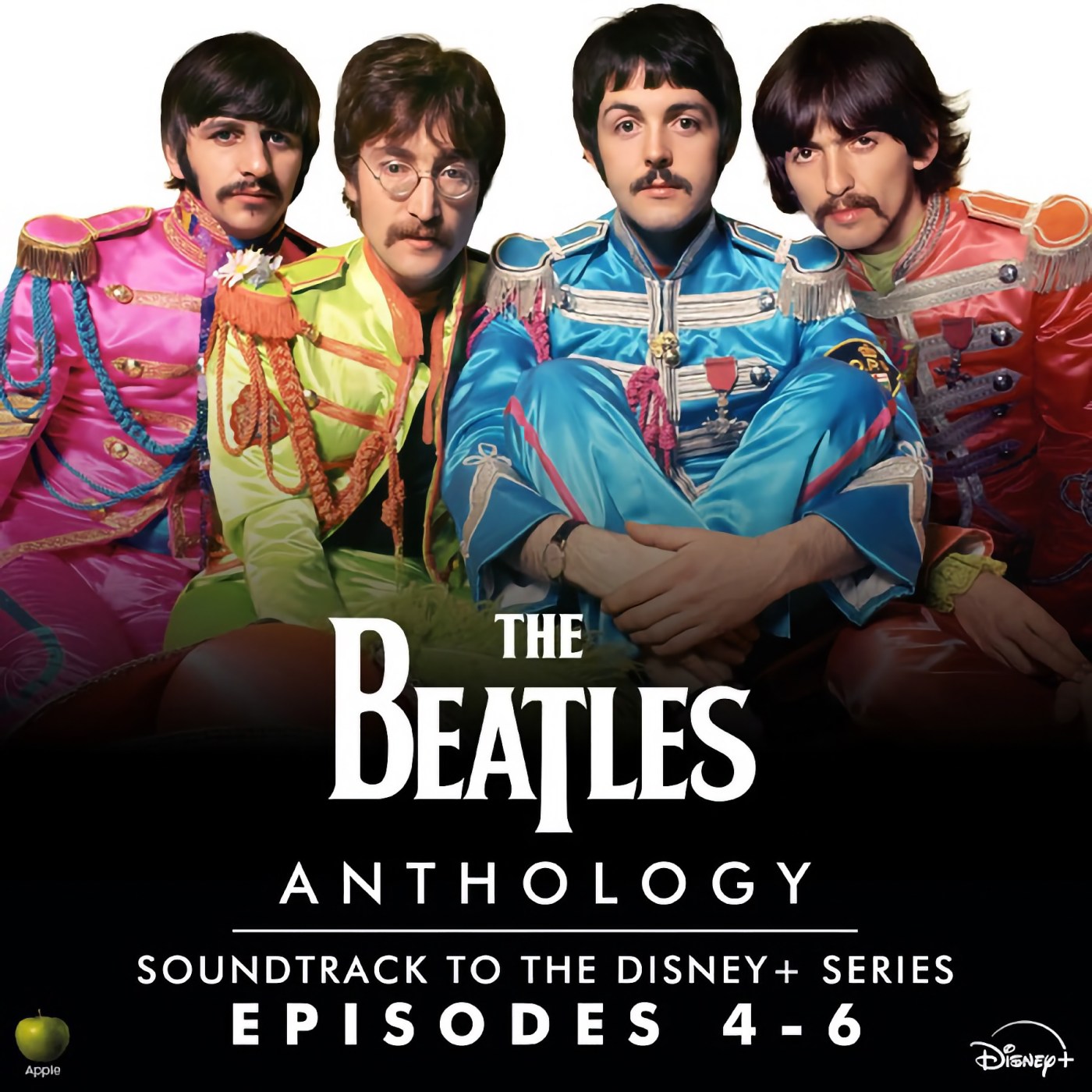
We’ve talked before about how my favorite period of the Beatle years is around 1965 to 1967, when the maturity of songwriting and musicianship, evidenced even on straight pop albums like A Hard Day’s Night and the non-cover songs from Beatles For Sale, suddenly skyrockets. Much of Help! is devoted to songs about love gone sour, and the title track is John pleading for assistance in the middle of the Beatle hurricane that he, Paul, George, and Ringo were still in the middle of.
As we know, it would take abandoning touring in 1966 and becoming a studio band for them to truly blossom into the world-changing artists we know them as today. Albums like Pepper, Magical Mystery Tour, and the White Album simply wouldn’t have existed in the alternate universe where the band kept playing live, and the original Anthology 2 captures that split perfectly – live songs with some outtakes on the first disc, and all outtakes on the second.
Compared to that, this album focuses more on the transition than an even split between that and the psychedelic. Most of the songs featured here are all from Beatles For Sale to Revolver, with one or two AHDN tracks tossed in for good measure. The psychedelia doesn’t come in until we get to “Strawberry Fields,” though when placed alongside “For No One,” the abrupt shift in the band’s sound is only slightly less jarring.
On we go!
Rock And Roll Music: John does a Chuck Berry cover, and he does a really great job with it! Kind of reminds me of “Twist and Shout,” though his vocal performance here is a bit more restrained here than in that earlier song. (For a given definition of “restrained” anyway.) Also note the way in which the piano drops out at 1:45.
I Feel Fine: Another song with a particularly notable beginning, the start of “I Feel Fine” happened when Paul McCartney plucked an A note on his bass while it was pointed in the vicinity of John’s guitar amp, causing feedback. Doing this technically violated EMI’s recording rules, but as so often happens in the story of this band, sometimes you have to break the rules to get the sound you want.
Baby’s In Black: This might sound weird considering the dark lyrics, but this is genuinely one of my favorite Beatles songs, entirely because of the vocals: John and Paul singing into the same microphone, harmonizing together in a way that only they were able to do, and it really comes alive in stereo. It’s fucking gorgeous.
You’re Going To Lose That Girl: I’ve always really liked this song, mainly because of how it’s used in the Help! movie: we join the Beatles pretending to record this song in a studio, in a haze of blue and purple light and cigarette smoke. (Because it’s the ‘60s.) It’s one of my favorite scenes in the whole film, and the song is pretty great as well.
Things We Said Today: Another Paul love ballad, featuring him harmonizing with himself. (It’s especially noticeable in stereo, you can hear him pushed off to the right.) They’d sometimes play this song during their concerts, including on the Hollywood Bowl album. God knows why, but it makes for an interesting effect, at least.
Help!: The title song from the 1965 film, written by John Lennon. He described it as essentially being him calling out for help amidst the hurricane that was Beatlemania in the early sixties, and that really does lend the track a more anxious vibe than “A Hard Day’s Night” had. Audio nerd note: the lead vocal heard on the stereo version is completely different to the lead vocal on the mono – listen to the verses and choruses, not the intro.
Yesterday: On the opposite end of the emotional scale entirely, we have “Yesterday,” the most covered song in the history of popular music. I adore this song, and goodness knows I’ve had cause to think of it quite a bit over the years, when applying it to my own relationships.
I Need You: George’s first composition in two years, it’s another uneasy song about love gone sour, as our protagonist (George himself) tries to get his girlfriend (Pattie Boyd) to cone back after a separation, explaining that he can’t make it through life without her. This is one of the last pure rock songs we’ll get from George before he starts getting really into Indian music – funnily enough, while the Help! film was being made.
Act Naturally: One of exactly two cover songs on this one, there’s really not a ton of stuff to say here – just Ringo doing a song by Buck Owens. That said, it is kind of funny that it’s Ringo singing this, since he was “acting naturally” in his famous ‘Ringo goes parading’ sequence in A Hard Day’s Night.
Eight Days A Week: The boys may not have thought much of this one, but it’s one of my favorite love songs of theirs, and intensely relatable now that I’m in a relationship. I really would love my wives eight days a week!
I’m Looking Through You: The best break-up song Paul McCartney ever wrote, I’ve listened to it a lot over the years, in a variety of contexts. Fun fact: my wife and I talked about this song quite a bit on the day we got together. In fact, it was part of our first conversation as a couple!
I’m Down: Out of all the songs where Paul did his Little Richard voice, “I’m Down” is probably the best one ever. It came out as the B-side of the “Help!” single, but it never got a proper album release until Rock ’n’ Roll Music came out. The studio version is great all by itself, but for a good time, watch the Shea Stadium performance from 1965, on the Anthology documentary, where John plays the keyboard with his elbows like a madman.
Drive My Car: This song was written around the time the Otis Redding track “Respect” came out, and you can hear the influence, particularly in the piano. That opening guitar hook, for my money, is as distinctive as the opening chord of “A Hard Day’s Night,” and it gets the album off to a strong start.
Norwegian Wood (This Bird Has Flown): John’s acoustic ballad about an affair he was having, it’s still a lovely song, with lots of acoustic guitar and some great vocal parts from John and Paul. But of course, what ties it all together is George’s sitar part, the first recorded instance of his growing interest in Indian music. Just try and imagine it without it. You can’t, can you?
Yellow Submarine: Maybe it’s cliche, but here I am at almost 30 years old, and I still love this song as much as I did when I was nine. It’s the perfect song for Ringo, always the favorite Beatle of young children everywhere, and I’m so glad it exists. The best part: “When the overdubs were finished, Evans led everybody in a line around the studio doing the conga dance while banging on the drum strapped to his chest,” and honest to goddess you can hear them doing it at the end of the song.
Taxman: Yes, I am aware that this is probably the most politically conservative Beatles song out there, since it’s two minutes of George Harrison bitching about paying taxes on his Beatles earnings… despite being unfathomably rich anyway. But I don’t care, because it’s a great fucking rock song to boot. This is the only time George gets the lead-off spot on a Beatles album, and I think it’s a sign of just how quickly he’s progressed as a songwriter that this is even the case.
Tomorrow Never Knows: John’s psychedelic masterpiece, a great big extended shoutout to Timothy Leary and the Tibetan Book of the Dead. Ringo gives one of his all-time legendary performances here, and of course, you’ve gotta love the combination of reversed guitar, tape loops, and John’s voice being fed through a Leslie speaker for the second half, after the solo. It’s one of the best closing tracks the Beatles ever did, and my favorite by far.
‘Day Tripper’: “Tripper” was, at once, a drug song (specifically LSD) and a reference to people who go on trips and then come home in the same day. Personally, I’ve always liked “Tripper” more, as it was the first Beatles song I learned to play on guitar.
‘We Can Work It Out’: Released as a double A-side with “Day Tripper” toward the end of 1965, “We Can Work It Out” proved to be the more popular of the two songs, as that was a Paul song, with John contributing the bridge. During recording sessions, George Harrison suggested performing the bridge sections in ¾ waltz time, to go with the minor chords used in those sections.
‘Paperback Writer’: Released as the first single of 1966, “Paperback Writer” all but defines the word distortion in its lead guitar part, though more attention is paid to Paul’s bass, which appears on a record for the first time as basically a lead instrument. Lyrically, this track is also one of the first Beatles songs, and the first single, not to have anything to do with love in any way whatsoever.
Got to Get You Into My Life: Don’t let the lyrics fool you, because this is not a traditional love song. This is Paul doing an ode to marijuana, disguised as a love song. (I bet it’ll go over really well in Colorado these days.) It’s also the first time we’ve heard a full horn section on a Beatles song, not including the solo on “For No One.” And, interestingly, Paul’s vocal is genuinely double-tracked here, not ADT’d. (The difference is subtle, but if you’ve heard this music as many times as I have, you learn to tell really quickly.)
She Said, She Said: Inspired by something John heard Peter Fonda say during their 1966 tour, the song is really more of a Lennon-Harrison collaboration than a Lennon-McCartney one. In fact, Paul (allegedly) doesn’t even appear on the song at all, because he walked out during the sessions. It’s the last song the Beatles recorded for the album, and indeed, recorded at all… at least, until November of that year, when they all grew mustaches and the next phase of their career began.
Think For Yourself: Another great break-up song on an album full of them, the fuzz bass on this song is kind of amazing. One of my favorite George songs, paws down – emotionally speaking, the exact opposite of “I Need You.” (George seems to have a thing for break-up songs, doesn’t he? They dominate most of his Beatles work, other than the Indian-inspired pieces of the mid-late sixties.)
The Word: The first Beatles anthem about love as a concept, this song is a forerunner of “All You Need is Love,” and as a theme, it stays with John throughout his life, all the way to “Mind Games” in 1974. It’s one of my favorites of his, and I particularly like the American stereo mix, where you have double-tracked vocals by him during the verses, something not heard on the regular UK version.
And Your Bird Can Sing: No matter how hard I try, I can’t listen to this song without thinking of the early take on Anthology 2, where John and Paul attempt to record vocal overdubs and fail because they can’t stop laughing. (Perhaps for that reason, John’s vocal is instead treated with ADT, or artificial double-tracking, another innovation from the recording sessions for this album.) It’s a great rock song anyway, I especially like the lead guitar part.
I’m Only Sleeping: One of my favorite John songs ever, this psychedelic ode to sleeping was recently the subject of a music video — said video went on to win “Best Music Video” at the 2024 Grammy awards! One of my favorite aspects of the song is the first use of reversed guitar on a Beatles record, including the solo, and it sounds really cool. And, like so many Beatles innovations, it was a complete accident, thanks to a tape op at EMI putting the tape into the machine wrong. (Having done exactly that myself, easy mistake to make.)
Run For Your Life: I absolutely fucking hate this song. I understand it’s John trying to do a sarcastic Elvis song, but I don’t care, because it just fucking sucks. While this doesn’t drag my opinion of Rubber Soul down in much the same way “You Can’t Do That” did, it’s still a bad note on an otherwise perfect album. Leave this off, and you have perfection. (Or put “Day Tripper” on instead. That would also work.)
For No One: Paul again with a song about love, except this time it’s a story about the aftermath of a nasty break-up. I love the melody, the horn solo, the lyrics… they were all really skilled at writing break-up songs, Paul especially. John really liked it too, so I’d say I have good taste.
Strawberry Fields Forever: My all-time favorite Beatles song ever, this. John wrote this in Spain after the band finished touring in 1966, and the actual recording of the song launched the band’s psychedelic period. It’s probably the most technically complicated song they ever did, not just with all the instrumentation going on, but the way it sounds – the first minute or so was performed in the key of B flat, while the rest of it (originally recorded in a higher key) had to be slowed down to match the first part.
The resulting edit is one of the most famous pieces of Beatles lore ever, and the song just wouldn’t feel the same without it. What starts as a nostalgic look back at a favorite hiding place of John’s as a kid becomes an LSD-infused wonderland, and it’s absolutely brilliant. I wish I could’ve heard this in 1967 – it probably blew everyone’s minds.
Penny Lane: Paul’s own nostalgia piece about his childhood in Liverpool, it’s far more conventional, musically, than “Strawberry Fields,” though there is a touch of surrealism in some of the lyrics. I like it, but it doesn’t hit the spot for me in quite the same way “Strawberry Fields” does.
Sgt. Pepper’s Lonely Hearts Club Band: The title song for the band’s 1967 masterpiece announces the “concept” of the album, by introducing the band named in the title… and that’s pretty much it, lyrically speaking. Musically there’s a lot going on, from crowd noises here and there to an absolutely blistering guitar part from George, to show they haven’t entirely forgotten their rock roots, a horn section, some nice harmonies in the choruses… it’s a pretty great song! And then it leads directly into…
With A Little Help From My Friends: A lovely ode on friendship, written by John and Paul for Ringo to sing. It’s one of his best, and he sings wonderfully on it. (There is also an amazing drum part, because of course there is – it’s freaking Ringo, people!) Small wonder that it’s become a mainstay of his live shows over the decades, right?
Being For The Benefit of Mr. Kite!: Another of my favorite John songs from the psychedelic era, Mr. Kite came from an old Victorian circus poster that John bought in an antique shop, and almost all the song’s lyrics were transcribed entirely from the poster.
It certainly sounds very circus-y, with all the organ and calliope music, albeit slightly unreal, almost eerie… and then the Love mix of the song takes it into nightmare territory by mixing it with “Helter Skelter” and “I Want You (She’s So Heavy)” after the last line. Mr. Kite’s circus from Hell, everyone!
A Day in the Life: Another song based on newspaper articles, it’s often hailed as one of the Beatles’ best songs, and honestly, I can’t argue with it. The echo on John’s voice gives it a somewhat dream-like quality, which then becomes nightmarish when the build-up starts, preceding Paul’s verse, and the other extremely well-known chord in Beatles music. (Fun fact: that chord was held for so long, with the gain turned up so high, that if you turn it up as it fades out, you can hear EMI’s air conditioning humming away.)
Lucy In The Sky With Diamonds: The somewhat controversial Lewis Carroll riff that John wrote based off a drawing by his son Julian, it’s one of my favorites of his songs from this period. The mono version (which is what Giles Martin based his 2017 remix on) is at a slightly different speed than the stereo mix more people are familiar with, which is always a little jarring, but you adapt quickly.
All You Need is Love: The quintessential Beatles song, right here. Like, if you had to distill everything that band was into one track, this would be the one you’d pick: an anthem about the power of love, and its singular power to heal divisions of all sorts. It’s a fusion of rock and classical music, it’s got a great hook, it’s thought-provoking without being too on-the-nose. It’s even got a brief snatch of “She Loves You,” a nod to the band’s roots. See what I mean? Quintessential!
In the long history of Beatles compilation albums, there aren’t many that hit the spot in quite the way this does. You’d get close if you listened to only the second disc of the Red Album with 2023’s additions mixed in, but even then you’re still missing out on some really great music that doesn’t usually end up on greatest hits records.
One thing that sticks out to me on this collection is just how enormously huge the band’s change in sound in the jump from 1964 to 1967 really was. In three years, they went from making radio-friendly pop like “Eight Days A Week” to five-minute epics like “A Day in the Life.” This is a completely insane sonic shift, it’s hard to believe that those two songs were performed by the same four men!
What brings it all together, and which this collection highlights so wonderfully, is that period of around Help! to Revolver where they are somehow able to defy all conventions what rock music is without actually leaving the genre for too long. You don’t get from “Things We Said Today” to “Strawberry Fields” without stuff like “Eleanor Rigby” or “Tomorrow Never Knows” in between.
Gods, I love this band. ❤


Leave a Reply