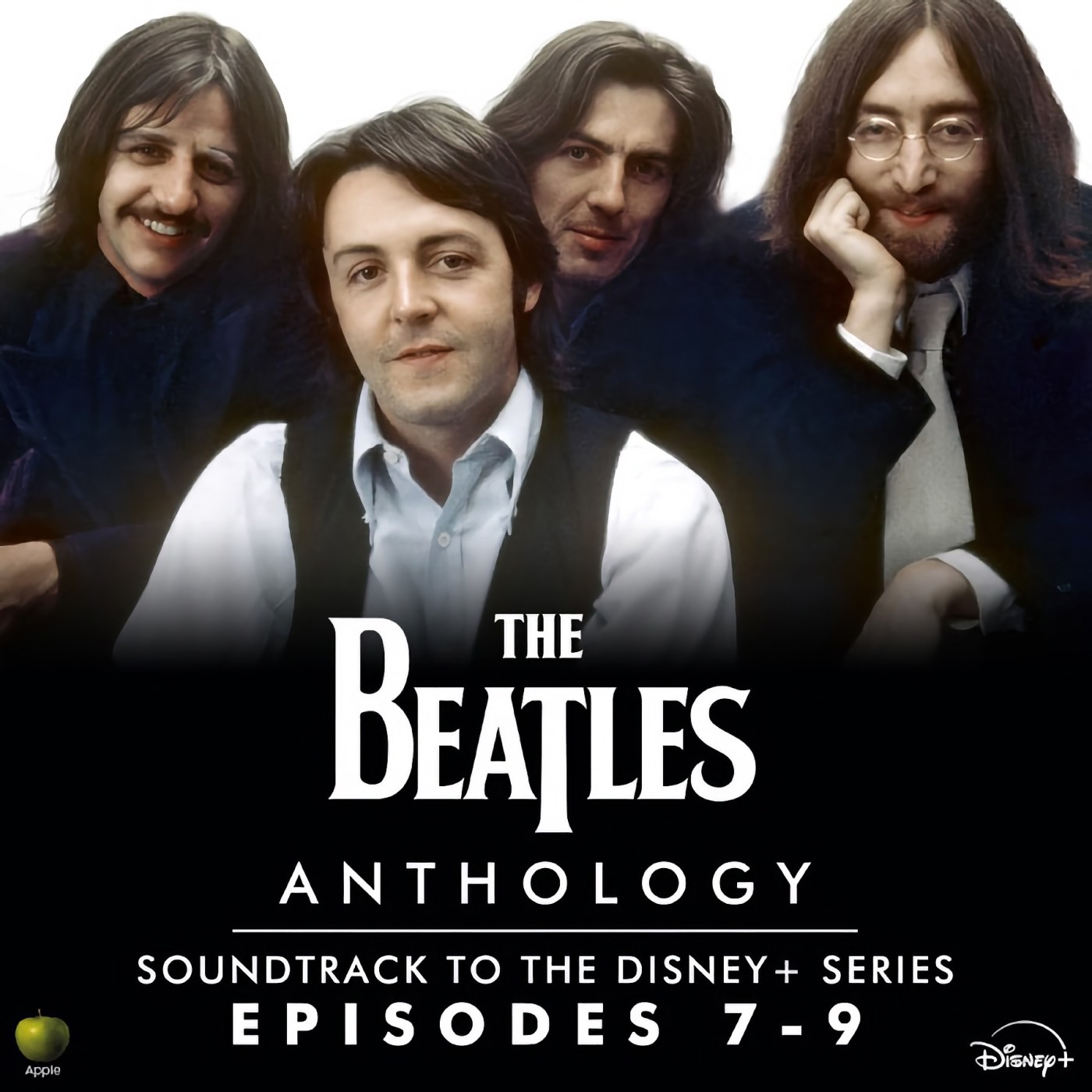
We wrap our deep dive into the Disney+ soundtracks with this, the album for the final three episodes the remastered Anthology docuseries. It’s been a wild time for Beatles fans in the past three years, between the unexpected release of A NEW SONG (the Grammy award winning “Now and Then”) and Anthology getting a suite of re-releases, but overall I’d say that anything which keeps the band in the popular consciousness is worth doing.
This batch of songs comes primarily from the band’s final three releases: The White Album, Let It Be, and Abbey Road. The psychedelia period is touched upon but only briefly – slightly unusually, there’s even a throwback to 1965 with the presence of “You’ve Got to Hide Your Love Away” from Help!, despite that song being lightyears in the past by this point in their development.
Similarly, quite why the album ends with the Pepper reprise, “Tomorrow Never Knows,” and that acoustic version of “While My Guitar Gently Weeps” will probably only be answered when I watch the episodes in question, so quite soon. (My immediate focus, naturally, has been the music.)
Still, let’s jump into it:
Baby, You’re A Rich Man: A couple years ago I read Al Brodax’s book about the making of the Yellow Submarine movie, and one of the stories he tells in the book has him at Abbey Road one day, tending to some issue regarding the Beatles cartoon show he was making at the time, and heard this song played by the band.
I’m not entirely sure I believe this anecdote, but who cares? It’s a great song all the same, the focus on the dangers of materialism, for all the world, remind me of “Imagine.” I love this song, and I swear it has to be one of the deepest cuts out there. (A lot of the Mystery Tour/Yellow Submarine songs feel like that to me, honestly.)
Within You Without You: Given the function of this project, I can’t possibly describe well enough the extent to which George’s exploration of Indian music and culture affected him. It became one of the biggest things in his life, and remained a part of him until he died in 2001. After the last Beatles tour in 1966, he almost left the group entirely, but ended up sticking it out for a few more years.
This song came about after he spent a few weeks in India being immersed in sitar lessons and Hindu spiritualism, and its lyrics may as well be foreshadowing for some of his best-known work as a solo artist in the ‘70s. We are a long, long way from “Roll Over Beethoven.”
You’ve Got To Hide Your Love Away: John doing another Dylan pastiche, only this time with flute rather than harmonica. No one is entirely sure what inspired the writing – John never spoke about it before he died, though some have claimed it may be about Brian Epstein, given that Brian was gay and that was illegal in 1965.
The Fool on the Hill: My second-favorite Paul song from 1967, this is yet another song of his that flirts with classical music rather than rock and roll, though this time the story is about a lonely man on the hill who is, and remains, misunderstood in his community. In other words, it’s an anthem for outcasts everywhere. Goodness knows I’ve vibed with it a lot of late.
Flying: The first ever, and only, instrumental Beatles song to appear on a regular album. I really dig it, honestly? It grooves along really nicely, it’d be a good song to listen to while watching scenery drift by car windows. Ringo carries this song really well, it’s a shame it’s only two minutes. I want an extended cut!
I Am the Walrus: If you want a song that perfectly encapsulates the psychedelic swirl of madness that was 1967, “Walrus” is easily the song to choose. John wrote it as a response to all those fans who tried to find hidden meanings in Beatles lyrics, so he composed a song where all the words are basically nonsensical, based on everything from Lewis Carroll to Liverpudlian skipping rhymes.
And then people argued over who the walrus was: John, or as he suggests in “Glass Onion,” Paul? John finally settled the issue in 1970 with the lyric, “I was the Walrus, but now I’m John,” from the song “God.”
Hello, Goodbye: A song about opposites, and another Paul song. Really not too much to say about it, but I like the melody, and the music videos are really great – the band play on a stage in their Sgt. Pepper suits, and periodically you see them dressed up in the grey collarless suits from the “I Want to Hold Your Hand” single cover. In other ones they play their instruments and goof around like total dorks, it’s kind of amazing. Easily one of my favorite Beatles videos, if I’m honest.
Across the Universe: Taken from 1968, this version of an otherwise gorgeous late-period Lennon song is slowed down, and then completely ruined with a fucking choir and strings. Honest to god, Spector. His “Wall of Sound” production style might work for John and George’s solo albums, but this is just a disaster. (At least the Giles Martin mix is listenable.)
Dear Prudence: John’s touching ballad to Prudence Farrow was lovely in its acoustic form, and it really shines now with its proper instrumentation. That’s not Ringo on the drums though – it’s Paul, because Ringo briefly left the band when these two songs were being recorded.
Everybody’s Got Something to Hide Except For Me and My Monkey: There’s a definite sense that the India trip completely re-energized John Lennon, the man is all over this album, and this is one of his best screaming rockers. Not done one of those for several albums now, and it’s really fucking great.
All Together Now: Another children’s song from Paul that’s almost exactly as innocent as you’d hope it would be, except for one line after the first chorus. It’s hard not to like this song anyway, even if Paul thought it was a throwaway – listen to the way the tempo gradually speeds up over the course of the track.
Happiness Is A Warm Gun: Derived from a gun magazine, this double entendre about guns and sex is honestly kind of difficult to listen to, given the circumstances under which John was murdered. It’s a good song, but a little depressing in hindsight.
Blackbird: Hearing Paul’s deeper vocal here, and then his higher vocal where he still largely sounds like he did in 1964, really brings home just how good his range was, and for a really long time. It’s not until you hit his Off The Ground album, from 1993, where he starts to sound middle aged.
Helter Skelter: Staying with the hard rock theme of the past few songs, here is Paul casually inventing heavy metal, entirely so he could outdo the Who. Paul’s sheer determination is one of my favorite things about him, this song is probably one of the hardest (if not the hardest) rock songs they ever did.. and it’s about a carnival attraction. Bless. (This is also the song that essentially invented Black Sabbath.)
I’m So Tired: The inverse of “I’m Only Sleeping,” as John is kept awake at night, pre-occupied with thoughts of Yoko. More audible in the mono mix is Paul’s backing vocals under the chorus. More of him experimenting with his deeper singing voice!
‘Revolution’: Like “Paperback Writer” before it, “Revolution” defines the word distortion, as the guitar sound came from the guitars being plugged into the mixing desk directly and played so loudly as to overload the meters.
It was one of Lennon’s earliest political songs, responding to the revolutionary fervor gripping the UK and the US by asking “What’s the plan for afterwards?” It was recorded twice: a slower version appeared on the White Album in 1968, and the single version is presented here. They also did it live (sorta) on TV later in 1968, with Paul and George contributing the “shoop-be-doo-wah” backing vocals from the album version.
While My Guitar Gently Weeps: If you want proof that George is increasingly outgrowing the Beatles, this should be argument enough. This is one of my all time favorite songs of his, serving as it does as a commentary on the band’s rapid disintegration.
I would also like to congratulate Hatsune Miku for finding a time machine and performing the solo on this track, because otherwise, I’d have to complain about George having terrible taste in friends. (Eric Clapton is a racist piece of shit now, he was racist in the Sixties, and I really question George glossing over this over the ensuing decades.)
‘Hey Jude’: The first song to be released on the Beatles’ own Apple label, “Hey Jude” began life as an attempt from Paul to comfort Julian Lennon, John’s son, as his parents were in the process of divorcing. The record-buying public certainly got the reassuring vibes, as it stayed at #1 for nine weeks, the longest run for any Beatles single, and remains their most successful song ever.
I’ve Got A Feeling: Alright, this is actually nicely done. It comes from the rooftop show, which explains the sheer energy of the song, particularly where Paul’s lead vocal is concerned. I can hear some slapback echo on the vocal, but I can’t tell if that was added in post, or is just the mic catching early reflections from the surrounding buildings. I question the decision to move John and Paul to separate parts of the stereo field during the last verse. (Martin’s mix does it too, but the panning isn’t as extreme.)
Two of Us: Credit where it’s due, Spector does a pretty good job with this take – it’s a better performance than the Get Back version, though it seems a bit too… well, harsh, for lack of a better term. Not enough low end. (Then again he was mixing for vinyl, so…) I personally favor the version off Let It Be Naked though, because it was the first one I heard.
For You Blue: A 12-bar blues song in the country rock style, this was a love song from George to Pattie. The album version from Let It Be is surprisingly decent – just a straight country rock number without as much reverb as on the Get Back version, though the piano and slide guitar swap channels. Personally, I liked them as they were.
The Long and Winding Road: AKA, the mix of the song that made Paul so angry, he used the song as one of the six reasons why the Beatles should be broken up in the 1971 lawsuit that led to the band’s formal dissolution. And just listening to it, with an overbearing orchestra and harp and choir, frankly, I’m on Paul’s side. This is why music critics hated the album so much, and they were right to.
‘Don’t Let Me Down’: One of John’s finest love songs, “Don’t Let Me Down” was inspired by his relationship with the artist Yoko Ono, whom he’d met in 1966. Released as the b-side of “Get Back,” both tracks feature the keyboard playing of Billy Preston, a friend of theirs from the Hamburg period, and who sat in as the “fifth Beatle” during the Get Back/Let It Be sessions.
Get Back: As revealed by Peter Jackson’s 2021 docuseries, this song sprung out of thin air seemingly during recording sessions for what would become Let It Be, as Paul found the chords for the introduction seemingly at random one morning in early January 1969. With cameras rolling and George and Ringo yawning, the song just appeared, though it took a move away from the film studio where they’d been rehearsing and into their new HQ in Savile Row for it to really take shape.
Let It Be: The final single released during the band’s lifetime, “Let It Be” had its origins in the 1969 recording sessions for the album of the same name. Feeling insecure and isolated as the band he’d given so much of himself to fell apart around him, McCartney has said repeatedly the track came to him in a dream, as with the elegiac “Yesterday”. This version was mixed by George Martin, and I much prefer it over the album version.
‘The Ballad Of John And Yoko’: This song was a hybrid of two approaches. Specifically, Paul’s preference for story-songs was wedded to John’s fondness for autobiographies to create this track, a written record of John’s marriage to Yoko Ono, and the honeymoon that followed.
It was John and Paul’s first true collaboration in some time, and they played all the instruments. “Ballad” was also the first Beatles song to be mixed only for stereo! No dedicated mono mix was ever prepared, as mono had fallen out fashion by 1969. (The last mono Beatles single was “Get Back,” backed with “Don’t Let Me Down”, and the last mono album was the White Album.)
Because: Inspired by Beethoven and driven by the electric harpsichord, this song is beautiful even in an instrumental take, but once you add the vocals? Pure sonic bliss. The last example we have of the Lennon-McCartney-Harrison 3-part harmony that goes back as far as “This Boy,” and it’s by far their best. There’s never been anything like those three voices before, and never will be again. Extracts from this track were even used on “Now and Then,” 2023’s final Beatle song.
Something: If there was ever any doubt that George Harrison had grown by leaps and bounds during his Beatles days, this should put those doubts to rest. Abbey Road was his happiest album, perhaps because he suspected that this part of his life was over. “Something,” as a love song, is one of the best ballads anyone ever did, and I appreciate it even more now that I’m married to Sophie.
Here Comes the Sun: Starting off side two is George again, with the happiest Beatles song he ever wrote. I only wish I knew why they decided to move his vocal to the right, rather than putting it in the middle. (Fortunately, we have the 2019 remix to fix that little issue.) The song has only gotten more popular in recent years, and in fact, it was the first Beatles track to reach a billion streams on Spotify. Given the anxious times in which we live, a little burst of Harrison’s sunny optimism is exactly what we all need.
Carry That Weight: In which all four of them sing together, with bits of “You Never Give Me Your Money” as well, heading into the last piece of the medley. I love how, out of all of them, Ringo is loudest when they sing. But they did, indeed, carry the weight of the Beatles a long time. They’ve never really stopped.
The End: This is it. Everyone gets a solo – for Ringo, it’s about the only one he ever did, and it’s fucking phenomenal. Then you get to the guitars, with John, Paul and George shredding like nobody’s business, and everything builds to a crescendo like A Day in the Life… and then it ends, with Paul contributing the last line of the last song on the last album: “And in the end… the love you take… is equal to the love you make.” He was echoing Shakespeare, I believe.
‘Free As A Bird’: Advertised as the first new Beatles track in 25 years, “Bird” is one of three Beatles songs that began as demo recordings by John Lennon from the late 1970s, during his hiatus from the music industry. Some of the lyrics were unfinished, which meant Paul got to do a little bit of collaborating with his old partner once again.
It’s a beautiful number, and while some people think it sounds a bit too much like ELO and less like the Beatles of the ‘60s, I personally feel like “Bird” is more like an evolution in their sound… the kind of thing they did in the 60s with every freaking album. If they kept making albums into the Seventies, Eighties, and early Nineties, it’s not hard to imagine them arriving at this sound organically.
This track has been remixed previously, back in 2015 for Giles Martin’s remix of 1, but the new one was done by none other than Jeff Lynne himself, doing his best impression of Martin’s mixing style. There’s more Ringo here, and John’s vocal has been cleaned up to be on par with “Now and Then,” since they can do that now. Personally I prefer the ethereal quality of the original mix, but I’m glad to have a version of the song that feels of a piece with “Now and Then.”
‘Real Love’: The second of three Beatles reunion songs, and the last one to be completed during the original ‘90s recording sessions. (“Now and Then” started here, but the technology to finish it wasn’t there yet.) While PG&R were not huge fans of this song, I’ve always really liked it – I feel like it’s an excellent summation of everything the band was about, even though it was written for Yoko. John almost recorded a version in 1980 for Double Fantasy, but changed his mind.
Now and Then: And now, the first, and last, Beatles recording of the 21st century. While it’s appeared both as a single and on the expanded Blue album from 2023, if you ask me the Anthology series is a far more natural home for it. This is where it belongs, right next to the two ‘90s reunion tracks.
This plaintive piano ballad by John becomes him and Paul harmonizing one last time, just like on “Baby’s In Black,” calling out to each other across the chasm of life and death. In a way, especially in light of Paul’s tweaks to the song’s structure, it’s almost like John’s long delayed answer to “Winding Road.” A miraculous recording made with love and determination, it’s a beautiful, fitting finale to a sixty year old story, and exactly the goodbye that these four men from Liverpool deserve.
Tomorrow Never Knows: John’s psychedelic masterpiece, a great big extended shoutout to Timothy Leary and the Tibetan Book of the Dead. Ringo gives one of his all-time legendary performances here, and of course, you’ve gotta love the combination of reversed guitar, tape loops, and John’s voice being fed through a Leslie speaker for the second half, after the solo. It’s one of the best closing tracks the Beatles ever did, by a mile.
Sgt. Pepper’s (Reprise): Again, not much to write about – the penultimate song on the album, suggesting that the surreal concert we’ve been listening to is about to end after the last song, about which there is far more to write. Nice drum part though, and more blistering Harrison guitar. No idea what it’s doing here though, considering its sister song was on the last album.
‘While My Guitar Gently Weeps’ [Anthology 3 Version]: A beautiful acoustic performance of probably my favorite White Album song of George’s, along with an organ part played by Paul. In 2006, this version of the song was the basis for its Love remix, which added a string section orchestrated by George Martin – the very last contribution he would make to a Beatles recording.
It says something about just how beloved the Beatles are that we are still here, in the year of the Goddess 2026, and every bit as obsessed with them as we were sixty plus years ago. And despite what the moaners on the Beatles subreddit would have you believe, we’ve actually been insanely spoiled, particularly since the original Anthology relaunched Beatlemania for the 1990s.
I mean, just look at what we’ve gotten in the last twenty-six years: a comprehensive collection of all their original hit singles that became the best-selling album of the decade, the Love soundtrack, brand new remasters of the original recordings in both stereo and mono, and starting in 2017, fresh remixes of, by now, a large percentage of the entire song catalog. And they’re still finding new things to share with us!
Why this band in particular, when so many of their contemporaries from the early Sixties have been left behind or, like the Rolling Stones, become a tribute act to themselves? I don’t really know, and I’ve been listening to this band practically since I came out of the womb. Maybe it’s the universality, the positivity, or even just the preternatural talent that existed between these four individuals – not even the deaths of John and George could keep that from manifesting.
Or maybe it’s like trying to understand why magic works. I don’t need to know how I am able to energize my morning coffee or how the light of the moon can transform an ordinary glass of water into a magic potion – all that matters is that the magic is there, doing its thing. And it’s the same with Beatles music – as long as the capacity exists for us to keep playing their stuff, I don’t think we’ll ever stop.
Honestly, I wouldn’t be the least bit surprised if the last sound the world hears is the final chord from “A Day in the Life.” That’d be a pretty badass way to go out, wouldn’t it?
Next time: the proper Anthology albums, including the newest one!


Leave a Reply