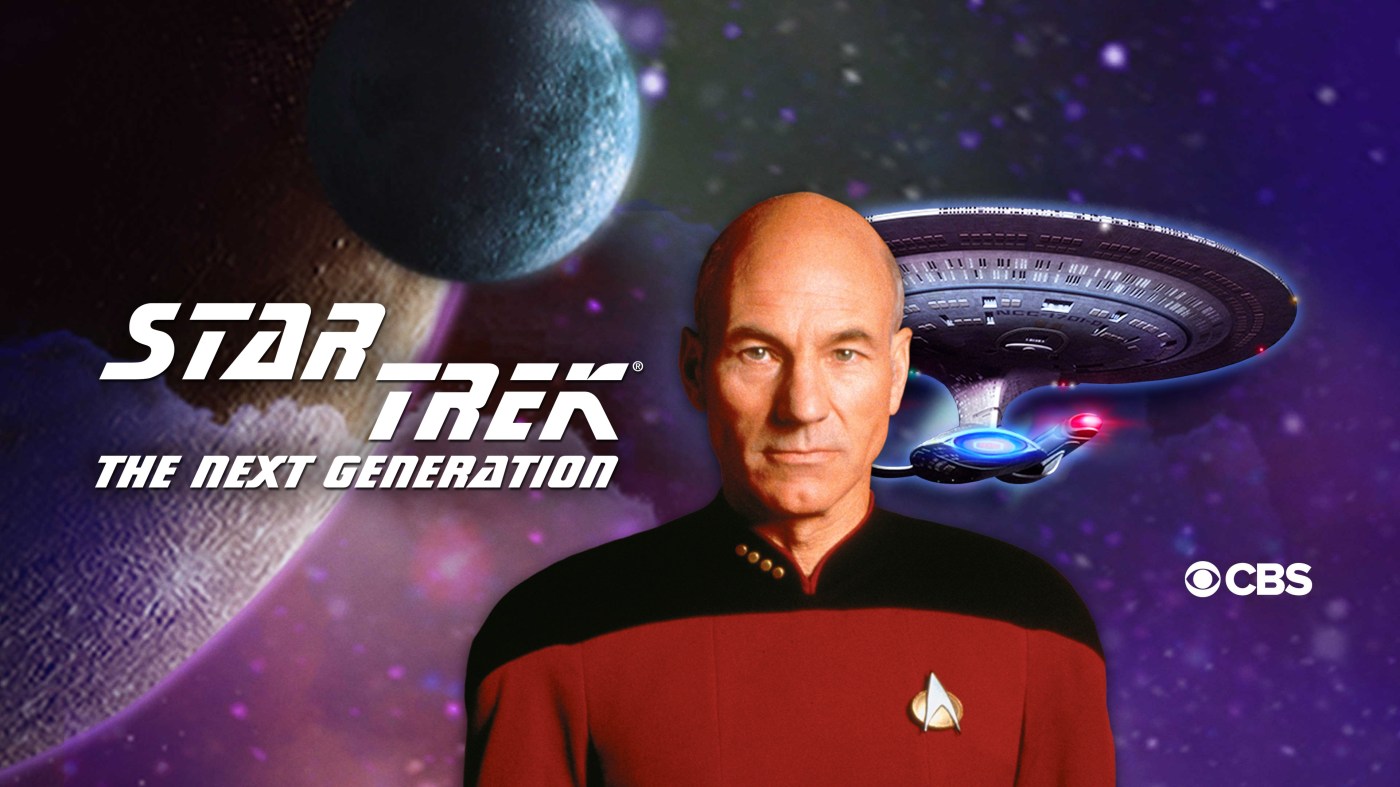
Captain’s log, stardate 81520.8: Vulcan Ambassador Sarek, father of Spock, beams aboard the Enterprise to be transported to his final diplomatic duty. But he is suffering the initial symptoms of a mind-deteriorating disease and his telepathic skills project violent, irrational impulses in the crew’s minds.
In which TNG has its first engagement with the Original Series era since the first two episodes of season one. Back then, you had DeForest Kelley make an appearance as a heavily aged Leonard McCoy in “Encounter at Farpoint,” then the very next week there was “The Naked Now,” an explicit sequel to the original “Naked Time” episode from TOS’s first season.
It was Gene Roddenberry’s policy to keep all references to the TOS era as minimal as possible, as he wanted TNG to claim its own identity without over-relying too much on continuity. Being set a hundred years after the events of the Original Series certainly helps with that – it’s much harder to do constant continuity nods when most of the characters of that era are dead.
Fortunately, Vulcans are a famously long-lived species, so bringing Sarek back is no trouble at all. (And Mark Lenard, it must be said, is looking pretty good considering he’s in his mid -sixties.) It turns out though that Spock’s father is not doing well at all – he’s come down with a case of what essentially amounts to the Vulcan equivalent of Alzheimer’s, and his emotional control is starting to slip.
The only way to fix it is to do a mind-meld with someone who, despite being human, has something of a Vulcan quality to him… Jean-Luc Picard.
I mean, who else would you pick? Save for some early kinks to his character as the writers were still figuring him out, as Picard’s characterization has settled over three seasons, we’ve seen him maintain an air of calm in the face of the wild and strange. Frenchman he may be, he has a Brit’s stiff upper lip…
Until now.
Late in the episode, Patrick Stewart turns in the performance of a lifetime, throwing absolutely everything into portraying Sarek’s pent up emotions – sadness at his advancing age, his love for his wives and children, and it’s honestly quite terrifying to behold. For a moment, we aren’t watching Picard, but Sarek in Picard’s body, with Beverly there to help him come back to himself.
And it was all done in one take.
It’s an effect not unlike that of what happens when a pagan, particularly if they are a devotee of the Morrígan, allows the goddess to briefly take them over as part of some trance possession ritual or oracular work. Trance possession isn’t too far off from a mind-meld, more or less.
As Morpheus Ravenna writes in The Book of the Great Queen, “In trance possession, the presence and voice of a deity or spirit is channeled through or embodied into the person of a priest, who may be said to “carry” the deity. It is understood by practitioners that in trance possession, the deity enters into and seizes control of the priest, so that for the duration of possession, the speech and actions on the part of the priest are essentially those of the deity.”
We do this work both because to hear directly from the gods, in terms we can understand, is invaluable – but also because to allow them to briefly inhabit our bodies and speak through us is to give them a gift of what Ravenna calls “the ultimate expression of trust and deep intimacy,” just as Picard’s mind-meld with Sarek was. And as someone who’s felt the Morrigan speak through her more than once, I can tell you it is a deeply surreal, but wonderful, experience.
Speaking of wonderful experiences, as fun as it is to see Mark Lenard return as Sarek one more time (he’ll do it again two seasons later in “Unification”) there is still an element of danger to it. The TNG writers’ room, particularly under executive producer Rick Berman, was deeply against mentioning TOS characters. Ira Steven Behr noted later that even getting Spock’s name dropped was a fight:
“I broke open the barrier and made it possible for The Next Generation to use names like Spock on-screen. That was a major taboo when I got there. No way could you mention the original Star Trek characters. It took days and days of arguing to slip in a single reference to Spock.”
There’s a lesson in that, I think, for modern Star Trek. Ever since Discovery launched in 2017, there’s been an endless desire in modern pop culture for reboots, sequels, prequels, and feck knows what else, all tied to Existing Intellectual Property. It’s gotten particularly bad with Star Trek. The last three theatrical films were rebooted TOS movies in a separate timeline from the main, but with OG Spock there as connective tissue.
When Trek returned to TV in 2017, the nostalgia fest just got worse. Discovery started out as a TOS prequel in the vein of Enterprise, before pivoting to the far future and spawning two spinoff series: Starfleet Academy and Strange New Worlds,which is, you guessed it, yet another TOS prequel. On top of that, you’ve got Picard, a sequel to The Next Generation, and Prodigy as a sequel of sorts to Voyager.
At some point in the last decade or so, Hollywood became addicted to nostalgia, reheating old ideas and living in fear of doing anything new. But the other side of that is that even as they mine the past for zombies to dig up, they aren’t allowing those new versions much room to breathe.
Streaming television means that what counts as a “season” has shrunk from, say, TNG’s regular order of 26 episodes to just 10. There’s less opportunity for us to spend time with these characters we once knew – they’re here for ten weeks, then gone again, not to be seen for a year or more. This can’t go on forever.
Even modern Star Trek seems to be rapidly reaching an endpoint, during its 60th anniversary year no less. Only two shows are still on, both of them canceled, and the man responsible for bringing them to life is probably going to be out of a job by the end of the year, if not sooner.
“Sarek,” in retrospect, isn’t quite the canary in the coal mine, but it’s definitely a step in that direction. Right now, Star Trek is still about boldly going. But before you can blink an eye, looking back will be all it knows how to do.


Leave a Reply