And we’re back! Having covered John and Paul’s respective solo careers, now seems like a good time to dig into George Harrison’s, since it’s his birthday on the day I write this. I’ve been wanting to dig into George’s music for a long time, since he was the spiritual Beatle and now, having found my own religious path, I feel like I can cover that aspect of his work with the respect it deserves, even if those paths are very different.
But back to the birthday boy. It’s no secret that by 1967, George was starting to get tired of the whole Beatle thing, and sought release wherever he could, whether it was studying Indian music and spirituality or kicking back in New York with Bob Dylan. So, of course he’d be the first Beatle to get a solo career going before any of the other three.
George’s solo career is best remembered these days for All Things Must Pass, his triple album masterpiece from 1970 where he discusses the Beatles’ breakup, religion, his friendship with the aforementioned Bob Dylan, and a wide variety of other subjects. But there’s so much more to his work than just that album, as fascinating as it is.
Thankfully, his son Dhani has been on top of things: In 2004 and 2014, both halves of George’s solo career each got their own box sets: The Dark Horse Years from ’04 handles everything on his own label sans 2001’s Brainwashed, (for some strange reason) while 2014 got us The Apple Years, and it’s primarily the contents of those two box sets that I’ll be covering in this series. (Along with lots of other stuff!)
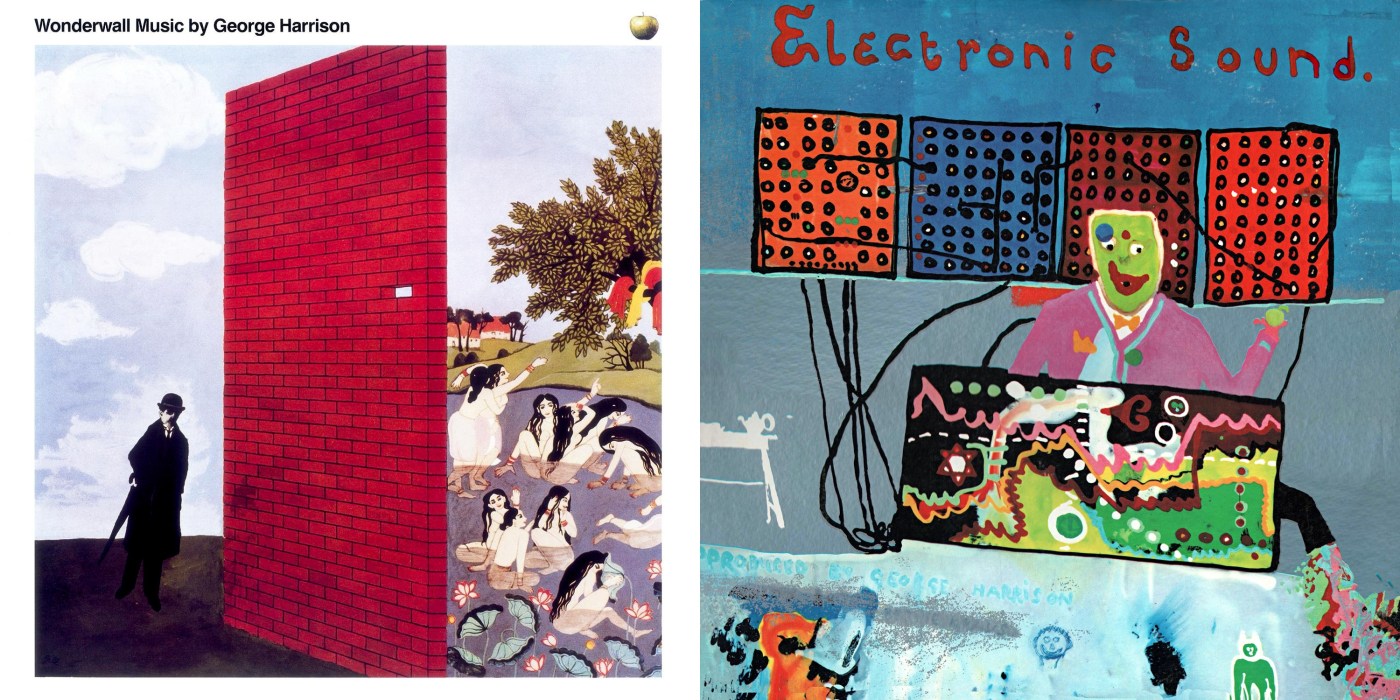
This week, a two-fer: Wonderwall Music and Electronic sounds, both released in the late Sixties as the Beatles were winding down. The former was released in November 1968, around four weeks before the Beatles’ eponymous double album.
As an album, Wonderwall Music represents several notable firsts. It is the first solo album to be released by any Beatle, it’s George’s debut solo album, it’s the first-ever Apple record, and it’s George’s first project related to a film, outside of acting in and recording music for Beatles movies.
Doing film scores seems to be something of a trend in the Harrison family – Dhani Harrison and his band, thenewno2, composed the soundtrack for the film version of Beautiful Creatures, which meant busting out some of George’s guitars. One wonders what the man himself would’ve made of his instruments turning up in the Caster world!
But getting back to Wonderwall. One of the recurring subplots in the Beatles’ story is George’s discovery of Indian classical music in 1965, when he was filming Help!, and throwing himself into the genre for much of the mid-Sixties: from the sitar part he added to John’s “Norwegian Wood” to the Indian-influenced “Love You To,” “Within You, Without You,” and “Blue Jay Way,” the man was absolutely obsessed.
Wonderwall Music is the culmination of his explorations into Indian music, though the film has nothing to do with India at all. He said in 1987, “I was getting so into Indian music by then that I decided to use the assignment as an excuse for a musical anthology to help spread the word.”
Much of the album was recorded in Bombay rather than England, as George wanted to surround himself with the best of the best. Eric Clapton and Ringo Starr both turn up on a couple tracks as well, and it was during the Bombay sessions that he recorded “The Inner Light,” his last Indian-themed Beatles recording. (And, as I’ve said, the source for an equally psychedelic episode of Star Trek: The Next Generation.)
Indeed, Wonderwall Music itself proved to be the end of George’s overtly Indian-inspired work. For the rest of his life, his music would be strictly Western in its presentation, though its lyrical themes (and his slide guitar playing) show that what he picked up in the Sixties never truly left him.
Anyway, here’s Wonderwall Music:
‘Microbes’: The opening track, it’s a bit lonely sounding, dominated by some kind of high-pitched instrument in the left channel, but I have no idea what it is. (And consulting the personnel list didn’t help.)
‘Red Lady Too’: This seems a bit more my speed. Tack piano, Mellotron, harmonium, and a bunch of other stuff, all played by the Remo Four, a Liverpool band.
‘Tabla And Pakavaj’: I’ve always liked the sound of tablas ever since I first heard them on “Within You Without You” as a kid, and this piece has plenty of them! I am told it doesn’t appear in the movie, and neither does the next track.
‘In The Park’: According to Beatles Bible: “The track was recorded in Bombay, India. Towards the end of the recording the sound of traffic from outside the studio can be heard.” It’s really pretty though, I can see why George liked Indian classical music so much. It really is like nothing else out there.
‘Drilling A Home’: Paul had “Fixing A Hole,” and now here comes George a year later with “Drilling A Home,” which really makes you wonder if that Simpsons joke about a Beatles carpentry book had more to it than you thought. It’s The Remo Four back again, featuring John Barham on flugelhorn and a thunderclap! It sounds very like 1920s jazz, like something I’d expect to hear being played by the Gaslight Squares, a band from St. Louis who specialize in that genre.
‘Guru Vandana’: Back to Indian music now with something that sounds surprisingly jazzy as well, given the vibe of the previous track! I kinda like it!
‘Greasy Legs’: This one is Tony Ashton of the Reno Four on Mellotron, and that’s it. I think I can hear the flute setting from “Strawberry Fields” in here somewhere, along with a variety of other interesting sound effects.
‘Ski-ing’: In which George goes big on acid rock! That’s Eric Clapton on guitar being panned all over the stereo field, and of course we have Ringo Starr on drums, keeping the beat down with some really swanky rolls and fills. I would also like to shout out George’s sitar playing, which has really improved since “Norwegian Wood.”
‘Gat Kirwani’: An exciting Indian piece now that really gets the blood pumping! Sounds like something you’d have in a really strange workout playlist.
‘Dream Scene’: This is actually three tracks in one, with the first part featuring Indian instruments and vocals with lots of reversed stuff as well, contributing to the dreamy atmosphere. The second contains mainly honky-tonk piano and Mellotron. The third and final part is a sound collage contains piano, harmonica, Mellotron, and tape loops that feels like a less apocalyptic “Revolution #9.”
‘Party Seacombe’: No, this isn’t the start of the Rutles song “Piggy in the Middle,” it’s just the Reno Four providing music for a party. And they’re all in the left channel, because this is the late Sixties and no one knows how to pan for stereo yet. (A mono version of this album was issued, but it was UK only.)
‘Love Scene’: A really quite sweet Indian-themed instrumental piece, used for a love scene. To me it sounds like it could be Part 2 of “Within You Without You.”
‘Crying’: To the surprise of no one given how many of his Beatles songs are about love gone sour, here that tendency is made piercingly literal by the use of a “thar-shanhai.” As George explained in 1981, “It’s like a one-string fiddle, a bowed instrument with the sympathetic strings resting over a stretched skin, so it has that hollow, echoey resonance, a wailing, crying sound.” He later sampled this track at the end of the song “Save the World” on Somewhere In England.
‘Cowboy Music’: No, your ears are not deceiving you, that is “Silent Night” arranged like a country and western number. I think this might just be the strangest version of it I’ve ever heard, but I dig it!
‘Fantasy Sequins’: “The instrumental was recorded in India under the working title ‘Fantasy Sequence’” It’s quite happy sounding!
‘On The Bed’: “The track was recorded under the working title ‘Waterworks Dream’,” and it’s too bad that it got changed because I like that title more! It sounds pleasantly strange, which I find quite compelling.
‘Glass Box’: If you like the sound of sitar, “Glass Box” has it for you. Works for me!
‘Wonderwall To Be Here’: Considering the pun on the phrase “it’s wonderful to be here,” this is a surprisingly melancholy track, but I dig the vibe.
‘Singing Om’: We end with some vocals this time – George singing Om, having apparently double and triple tracked himself. What else would do it, honestly?
“In the First Place”: More from the Reno Four, doing a minor-key psychedelic pop song in the tradition of “Blue Jay Way” with phasing over absolutely everything. George produced it, and it was thought lost until 1999, when he found it by accident when digging up the master tapes for the album. It was released as a single later that same year and was used in the opening credits for the movie.
“Almost Shankara”: According to Kevin Howlett’s liner notes, this song was “titled after an epithet for the Hindu deity Shiva and based on a traditional Indian raga.” George counts us in with that wonderful Liverpudlian drawl of his, with the main body of the piece being a gorgeous instrumental in the raga style.
“The Inner Light”: An instrumental version of George’s last Indian-themed Beatle track, featuring him instructing the musicians on what he wants them to play, and a count-in: “Abracadabra,” rather than 1, 2, 3, 4. Once the song gets started though, to my ears it sounds pretty much exactly like the released version minus vocals – which just means I can appreciate the beauty of the instrumental more!
After spending years being limited to just the occasional solo spot on Beatles albums, it’s a genuine treasure to hear George’s solo work take its first steps with music that clearly meant the world to him. Wonderwall Music is gorgeous in its strangeness, bouncing from traditional Indian music to unconventional spins on Western musical forms. In other words, it’s as eclectic as the man himself.
To me, this album feels like a self-portrait. This is who George was at that point in his life: 25 years old, having already become bigger than anyone else at that age by dint of his Beatleness, and all he wants to do is play the music he loves with friends who are as good at it as he is. That sounds like a good life to me.
A year later, George got even weirder with Electronic Sound, the last release on the Beatles’ Zapple label. (The other one was John and Yoko’s Life With the Lions.) It consists of exactly two pieces, “No Time or Space” and “Under the Mersey Wall.” The former was recorded “in California in November 1968 with the assistance of Bernie Krause,” according to the liner notes, while the latter was recorded after George had taken delivery of his own synth later that same year.
The Moog, of course, went on to play a significant role on Abbey Road, giving the Beatles’ sound a new dimension that anticipates the synth-driven pop and rock of the 1980s, from Duran Duran to Joy Division and Depeche Mode. But this, along with Switched On Bach by pioneering trans woman Wendy Carlos, was where it all began.
Let’s jump in:
“Under the Mersey Wall”: To quote George: “All I did was get that very first Moog synthesizer, with the big patch unit and the keyboards that you could never tune, and I put a microphone into a tape machine. I recorded whatever came out. The word avant-garde, as my friend Alvin Lee likes to say, really means, “’Aven’t-got a clue!” So whatever came out when I fiddled with the knobs went on tape—but some amazing sounds did happen.”
“No Time or Space”: The authorship of this track is mired in controversy, as it seems to be a recording of a Moog demonstration by Bernie Krause. To hear him tell it, not only did George record the demonstration without Krause’s knowledge or permission.
But we only have Krause’s word to go on, and Kevin Howlett (who knows a lot more about the Beatles than I do) flatly denied this in his liner notes for the 2014 reissue, stating simply that “There is no historical evidence that gives George’s view of that assertion.” I guess we’ll never know for sure, unless we want to take Krause’s word as fact.
In any event, I can kind of see why Allen Klein decided to shut Zapple down when he took over managing Apple in 1969. Electronic Sound is a deeply strange album, and not in the pleasantly quirky way of Wonderwall Music. As George’s self-deprecating line in the notes has it, “There are a lot of people around, making a lot of noise; here’s some more.”
Honestly, this sounds like something you’d expect to hear in a really trippy mid-late Sixties episode of Doctor Who. You could tell me that this was the score from a never-transmitted sequel to The Web Planet and I’d believe you. (Or it could be the soundtrack to a truly mind-bending Dalek episode!)
It’s an interesting historical artifact, but I don’t think it’s ever going to be a particular favorite of mine.
Next time, The Big One: the album no one expected George to make, but once he was out of the Beatles, he really began to flourish. It’s All Things Must Pass.


Leave a Reply