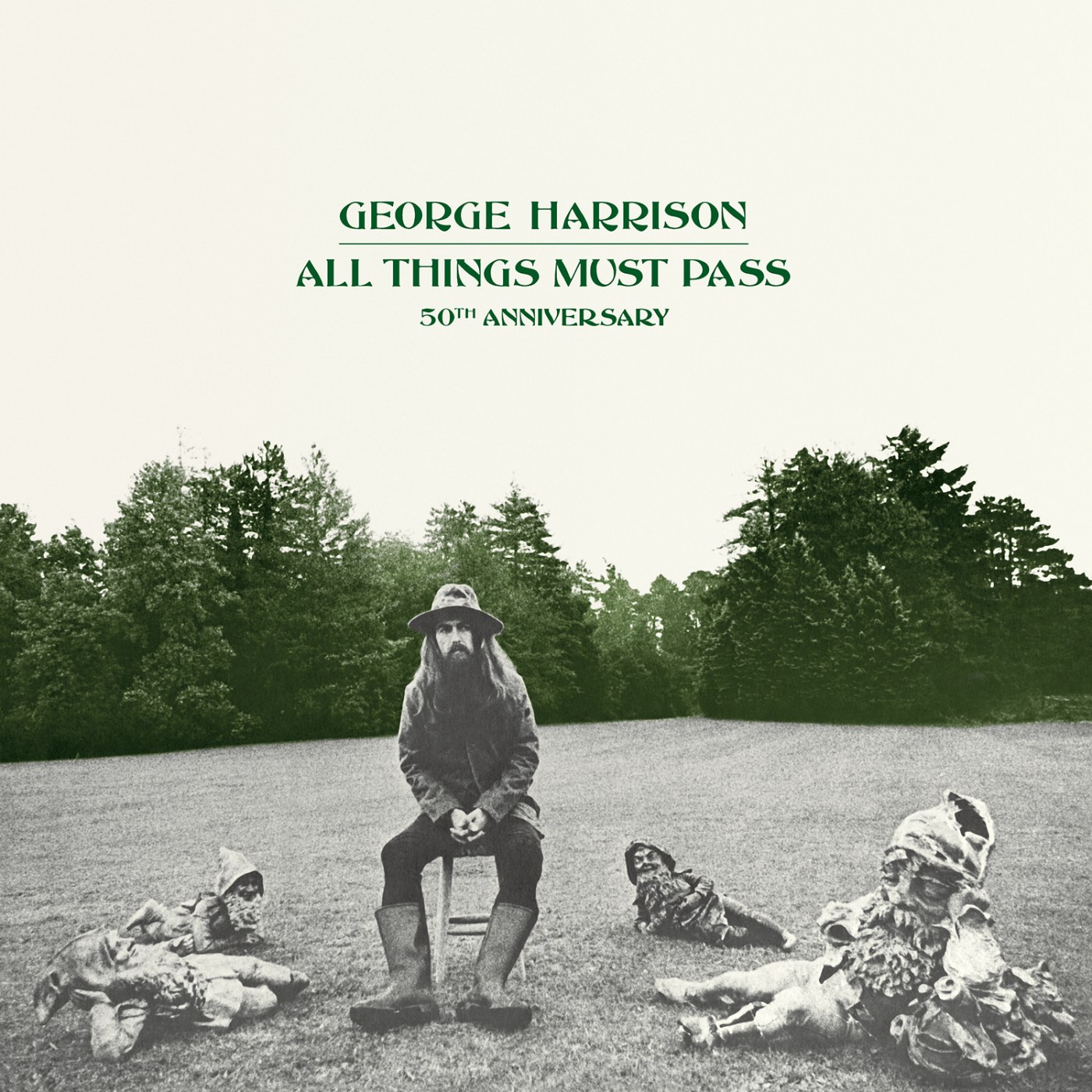
As I wrote back in the Off the Beatle Track post regarding Revolver, it is pretty much impossible to separate George’s music after 1965 from his religion. George’s Beatles songs from 1966 to 1968 all bore Indian influences, and his solo work, while in the form of traditional Western pop music, is still deeply spiritual in tone and vibe. And anyone who’s been reading this blog since somewhere around May of 2024 will be able to tell that my paganism, from Wicca to my relationship with the Morrígan, has wormed its way into pretty much everything I write.
All this is to say is that, for me, covering George’s music is actually going to be easier for me now than it would’ve been in the first half of 2024, when I was still an atheist. Back then I often felt I was being preached at on some of the more faith-related songs on ATMP, but the feeling has lessened now as I look at the world through a pagan lens.
My spirituality looks very different from George’s, but there are still points of commonality between us. We were both raised Christian, but drifted away into other faiths – him into the Hare Krishna tradition and Hinduism more generally, me into Wicca and Celtic paganism. And in those faiths, we found connections to the Divine that made sense to us in a way that the strict rules of Christianity didn’t.
Obviously we diverge – he was always a monotheist, while I am a polytheist even if the Great Queen is the goddess I pray to and work with more often. But there’s a quote of his that still rings true to me, despite the monotheist bent: “All religions are branches of one big tree. It doesn’t matter what you call Him just as long as you call.”
And he’s right! I get that now in a way that I couldn’t have in my atheist period. George had room in his life for all religions, not just his own, just as all the Beatles did. Ringo described himself in the Living in the Material World documentary as “a Christian Hindu with Buddhist tendencies,” while John was a deeply spiritual man but largely rejected most forms of organized religion, as we’ve discussed before.
But I digress. The point is, if I’m going to write about George’s solo career, the only way I can do that is to do it both as a fan and as a pagan. I have no doubt that I’ll have a lot to say about his more spiritual lyrics, and I look forward to finding out what they are.
In the meantime though, time to do some set up for the album proper.
It’s 1970. The Beatles have broken up, the Let It Be album and film have been released, and Ringo and Paul have already issued their first post-breakup albums: Sentimental Journey and McCartney respectively, with John’s Plastic Ono band rounding things off in early December.
What no one expected was for George to completely blow the doors off the barn and come out with an album that defied all expectations. In the Sixties, George had been seen as “The Quiet Beatle,” both for his tendency to keep to himself in public appearances and for his music, limited to no more than a couple of songs an album – save for Revolver, where he had 3, including the lead-off track.
All Things Must Pass is an explosion, as George finds himself free of his Beatle shackles, able to record pretty much anything he wanted, with songs that had been brewing since the late Sixties – if you watch Get Back, you can see him and John discuss the album’s title song together and work out lyrics for the verses.
Like John’s Plastic Ono Band, ATMP is a deeply personal record: George has a number of songs that are decidedly religious in nature, while others deal (at least vaguely) with not just the recent Beatle split, but George’s own feelings toward John and Paul. Still more songs are just George having fun and enjoying his new role as bandleader after so many years of being just the lead guitarist with an occasional vocal spot.
A note here: For this write-up, I’m listening to the 50th anniversary remix of the album, prepared in 2020 by Dhani Harrison and Paul Hicks, best known here on the blog for nearly a decade’s worth of remixed solo material by John Lennon. As with Giles Martin’s contemporaneous mix of Let It Be, the 2020 mix doesn’t quite strip away the Spectorian gloss, but it does clean things up, reducing the somewhat muddy sound of previous remasters. There’s more depth and clarity in the bass and overall increased clarity and prominence in the vocals, guitars and drums, just like in the Lennon mixes.
So! With all that in mind, let’s see what George has for us:
Disc 1
‘I’d Have You Anytime’: While the two didn’t collaborate on the finished track as I wrote a couple years ago, George and Bob Dylan did write this song together, around November 1968 in upstate New York. It’s a slow, almost jazzy number anchored by George’s lead guitar work, Klaus Voorman’s bass, and Ringo on drums, reminiscent of the lazy afternoons George spent in Dylan’s company.
‘My Sweet Lord’: If “Imagine” was John’s signature song, this is George’s equivalent, as spiritual as the former was decidedly agnostic in its outlook. Lyrically, this is his first big engagement with his faith since 1968, and the first time he’s invoked Captal-G God by name ever. The whole track is George expressing his desire to know and be near his god, complete with the backing vocals switching from “Alleluia” to the entire text of Vedic Sanskrit prayer.
And I gotta say, that hits real differently now that I am a practicing Wiccan. It was not until I read Drawing Down the Moon for the first time, back in 2024, that I realized I too felt the same yearning for spiritual connection that George writes about here. Compared to the Christian god, who too felt impersonal for my taste, Cernunnos, Danu, Cerridwen, and the Morrígan all felt (and still do) Present in my life. The night I Claimed myself was a powerful spiritual experience – I felt welcomed, warm, and safe in their embrace, and that’s still true even after all this time. My sweet lord, and ladies, indeed.
‘Wah-Wah’: All four members of the band processed the breakup in different ways: Paul tackled it indirectly by focusing on his terrible mental state in the aftermath and how Linda helped him cope, while John (as ever) went right for the jugular, savagely attacking all sorts of institutions and pop culture pillars including the Beatles.
George’s approach is somewhere between those two extremes. It’s just as angry as anything John came out with, but it’s not as vicious as something like “God” or “I Found Out,” because George’s anger is balanced out with his spiritual fulfillment and his joy at finding freedom away from the Beatles – his equivalent, in other words, of Paul’s verses in “Every Night” where he sings about Linda.
Opening with an electric guitar riff that can only be described as snarling, this song dates from January 10th, 1969 – the day George left the Beatles following an argument with Paul. He wrote this song that afternoon, expressing his frustrations with the rapidly-disintegrating rock band and his junior partner status within the band, culminating in the realization that he doesn’t need Beatle bullshit anymore.
‘Isn’t It A Pity (Version 1)’: Despite the tone of the lyrics, this isn’t actually about the breakup in any way whatsoever. The song dates to 1966, and George tried to include it on three separate albums: Revolver, Sgt. Pepper, and The Beatles, only to be rebuffed each time. In his 1980 autobiography, George wrote: “’Isn’t It a Pity’ is about whenever a relationship hits a down point … It was a chance to realise that if I felt somebody had let me down, then there’s a good chance I was letting someone else down.”
Given the subject matter, the song proves to be a perfect fit coming after “Wah-Wah” – it’s a plaintive song of reflection, mourning, and loss on the end of a relationship, and one can certainly read the opening verses as evoking the dramatic collapse of the Beatles. But again, this is a universal theme, tying into similar sentiments as “While My Guitar Gently Weeps.”
Still, the Beatles comparisons are inevitable. This take is one of two featured on the album, and of the two this one is far more Beatle-ish, what with lyrics that, in places, read like George responding to some of Paul’s late-period Beatles songs. The lines “How we take each other’s love/Without thinking anymore/Forgetting to give back” are George exploring the inverse of Paul’s famous couplet from Abbey Road – what happens when the love you take isn’t equal to the love you make.
But perhaps the strongest comparison (and the one this track most resembles) is with “Hey Jude.” Both songs are responses to failed relationships, but where Paul tries to make things better by pointing out, essentially, that every cloud has a silver lining, George’s approach is much gloomier, as has been his wont since “Don’t Bother Me.” His lyrics center the pain almost at the exclusion of all else – even the second verse manages to take a downbeat look at the bright side.
And of course, just like “Hey Jude” it ends with an extended coda in which the word “nah” is used a lot, though unlike the former song, these nahs are buried in the mix somewhat, and mixed in with repeated cries of “What a pity.” It even lasts for seven minutes and eleven seconds, just like Paul’s song.
Ironically for a track that started life three years before breaking up was even an idea in anyone’s mind, this song perhaps presents the best reflection on the emotional trauma of it all. Delivering it as an unintentional but fitting musical antithesis to Paul McCartney’s sunny optimism is just icing on the cake.
‘What Is Life’: Issued as a single in 1971, “What is Life” feels to me like George’s equivalent of “Maybe I’m Amazed” from McCartney. The song wears its Motown influence on its sleeve, as evidenced by the descending guitar riff that begins the track. While it is a love song, there is a matter of debate as to whether the object of his affections is a girl or a deity. (Personally, I think it’s a girl, but given the religious overtones of the album, I can see an argument for the other reading.)
‘If Not For You’: In which George Harrison covers Bob Dylan. Dylan and Harrison had a friendship that went all the way back to 1964, when he introduced the Beatles to marijuana during their first American tour. In 1968 and ’69, Bob and George started hanging out together, resulting in the two of them collaborating on the song “I’d Have You Any Time.”
This song was another collaboration, with Dylan’s version being released first. As with “I’d Have You Any Time,” it’s a wonderfully sunny, laidback song that is pretty firmly meant as a ballad.
‘Behind That Locked Door’: Staying with the Dylan theme, George wrote this country-styled number as an encouragement to Bob, who was about to make a return to live performance and was feeling very nervous about it. George, naturally, wants his friend to try anyway, and free himself of his own self-imposed loneliness. The track is anchored by a gorgeous slide guitar performance.
‘Let It Down’: Ironically for the man who sang “Isn’t It A Pity” literally four songs ago, this song is about George cheerfully taking Pattie’s love for him and causing her pain by having an affair with Charlotte Martin, who had recently ended a relationship with, of all people, Eric Clapton – who would go on to become Pattie’s second husband.
As Pattie herself noted, “George was fascinated by the god Krishna who was always surrounded by young maidens. He came back from India [in June 1968] wanting to be some kind of Krishna figure, a spiritual being with lots of concubines. He actually said so.”
As Beatles Bible phrases it, “‘Let It Down’ speaks of this interpersonal tension, Harrison’s lustful desires for earthly pleasures and his conflicting thoughts of more spiritual matters. Lyrically, it finds Harrison torn between wanting to be with his lover and feeling duty-bound towards God.”
He was living in sin and loving it. Not exactly the best at practicing what he preached, was he?
‘Run Of The Mill’: We end the first disc with this number, which feels very like a prelude to John’s “How Do You Sleep” in that it’s a response to a disintegrating relationship with Paul, but again, it doesn’t have the barbed qualities of John’s effort. Instead, George focuses on personal responsibility before moving into, essentially, the musical equivalent of vaguetweeting Paul, in a way that feels weirdly evocative of “Think For Yourself” from Rubber Soul, minus the acidity.
In a January 2001 interview with Guitar World magazine, George made this reading explicit: “At that point in time, Paul couldn’t see beyond himself. He was on a roll, but … in his mind, everything that was going on around him was just there to accompany him. He wasn’t sensitive to stepping on other people’s egos or feelings.”
Which, as we explored in the Wings phase of Paul’s solo career, was pretty much him all over, at all of that band’s ex-members not named Paul or Linda can attest.
Disc 2
‘Beware Of Darkness’: According to George: “‘Beware Of Darkness’ was written at home in England during a period when I had some of my friends from the Radha Krishna Temple staying: ‘Watch out for Māya’ – the cosmic illusion (that which is not). I like the melody – it’s sort of strange. The lyrics are self-explanatory.”
As well as warning of nonsensical things like “falling swingers” and “soft shoe shufflers,” I like how he advises looking out for sadness and greedy leaders. The line about Weeping Atlas Cedars is a reference to the trees that he, John, Paul, and Ringo were standing near during the last Beatles photo session in August 1969.
‘Apple Scruffs’: The only song on the album to feature George on his own, this is his loving tribute to the Apple Scruffs: The extremely dedicated Beatles fans who used to hang out outside various places where the boys were known to be. After recording the final master take, George went outside and played the song to the Scruffs themselves.
‘The Ballad Of Sir Frankie Crisp (Let It Roll)’: By far and away my favorite song on the album, partly because it’s one of the relatively few secular songs on the record and partly because of its lyrics: assorted signs hung around George’s big estate, Friar Park in Henley-on-Thames. It was built for Sir Frank Crisp, and George bought it at the start of 1970 – he’s sitting in the house’s garden on the album cover. Later in the 1970s, he added a recording studio, which he used extensively on future albums.
As to the song itself, what appeals to me most are the guitar parts that open it and recur throughout, the chord progression, and the low vocals intoning “Oh, Sir Frankie Crisp” between verses. George’s voice is treated with a bit of reverb, so it sounds like he’s singing in a cave. It’s a dark song, but not in terms of subject – it’s a comforting darkness, like your bedroom on a full moon night, or the Morrígan’s cave in Cruachan.
‘Awaiting On You All’: In which George writes a gospel number, albeit one from a distinctly Hindu perspective. As he explains in I Me Mine: “‘Awaiting On You All’ is about Japa Yoga meditation which is repetition on beads (mala) of mantras. […] Most mantras for Japa utilize the many names of God, and the maha-mantra has been prescribed as the easiest and surest way for attaining God-Realisation in this present age.”
Not content to merely evangelize, George also spends some time tearing down everything from John and Yoko’s Bed-In for Peace, visas and travel, the stock exchange, Pope Paul VI, and all the trappings of organized religion, from churches and temples to rosary beads and holy books. All of these, in George’s view, are completely unnecessary – worship can be done with chanting alone.
Production-wise, it’s one of those rare occasions where Spector’s “wall of sound” mixing style actually suits the track perfectly, it’s like standing in a cathedral. The 2020 remix in particular puts George’s voice front and center, allowing him to serve as a preacher… and boy, does he ever preach.
Now, I knew going in here that this and Living in the Material World were going to be collections of songs written by a monotheist for other monotheists. After all, between Christianity, Islam, and Judaism, monotheists make up the majority of religious people out there, pagans like myself are a minority. But the thing about “My Sweet Lord,” for example, was that there was still a measure of universality in there that allowed me to relate to the song through a polytheist lens.
But I can’t do that with this song. Out of all of the spiritual songs on this album, “Awaiting On You All” is probably the one I like the least. Quite apart from the invocation of Jesus by name, there’s a vibe to this song that positively reeks of what Ben Garson, in his review of the album for Rolling Stone, called “an air of sanctimoniousness and moral superiority,” the kind of thing I hear from some Christians when they learn I’m pagan.
As an example of what I mean: Around December 2024, my first Yule ever, I went with my wife to church, since she was still nominally Christian then. Sophie’s church was avowedly left-wing, and had no problem with occasional Sunday visits by a devout Wiccan – more than once, I’d end up having perfectly lovely conversations with some of the parishoners, and even Sophie’s former pastor, about my religion and the points of commonality I had with Christianity.
During the Yule visit, Sophie and I talked with a woman named Gabrielle. She was an older woman with whom she and I had gotten along with very well in the year or so I’d been living in Ithaca at that point, and like everyone else in the church, knew I was pagan. That day, I happened to be wearing an Ugly Yule Sweater with a picture of a deer, a wreath, and some runes and triquetras on it.
Gabrielle asked me about it, and so I explained to her the basics of Wiccan Yule lore, which holds that the Goddess gives birth to the baby boy who will become her consort, the Horned God, at Yule – the winter solstice. Over the course of the year that follows, the two deities meet, fall in love, and the Goddess soon becomes pregnant with the aforementioned baby boy, who is then born at Yule, starting the cycle all over again.
Somehow, learning that I worshipped two deities and not just one completely broke Gabrielle’s brain. In mid-stream, she interrupted me to demand “Why does it have to be many?! Why can’t it be one?!”
Less than six months later, it happened again. Sophie and I returned to church to attend the final service of the former pastor there, an elderly woman who we both loved very much, during which breakfast was served. At one point, Gabrielle came up to our table, slammed her hand down on it, and said firmly: “God bless you!” to me, and only me. All I could say was, as politely as possible, “Thank you!” when in truth I was seething – for a blessing, it sure felt like an insult, or at least a wordless condemnation of my religion.
Because again, this woman, and absolutely everyone else in the room, knew I was pagan. The pastor we were there to say goodbye to was thrilled Sophie and I were there, and even straight up told me something along the lines of “I know this isn’t your scene, but I’m glad you’re here.”
But the only person in that church whoever had a problem with my paganism was Gabrielle, and I never learned why. But I have been able to at least infer, probably correctly, that like so many Christians, she believed that her particular religious practice was the “correct” one, and all other forms were somehow invalid – particularly non-monotheist forms.
Which brings me back, at last, to “Awaiting On You All.” I know that George meant what he said in 1972 when he observed that all religions are branches of one big tree. I know he isn’t trying to paint polytheist religions as being inferior because we believe in many gods, not just one. But that’s the impression he gives in this song, with his Christian-inflected approach to religious devotion. While I don’t discount the use of chanting (I’ve been known to chant the names of the Morrigna on occasion) as a means of building up energy, it’s not all there is to devotion.
While it is true that we may not need the various trappings of organized religion, we still use them because we find some or all of them valuable – for example, I have a little deity altar on the windowsill above my desk, in direct line of sight with my computer, where four bronze statues of my gods sit on top of a blue and silver altar cloth. Any time I look out my window, I see Cernunnos, Danu, the Morrigan, and Cerridwen there as well, keeping me company and reminding me of their presence.
I find the fact that George denounces rosary beads in specific to be amusing, given that I have a set of Morrigan-themed prayer beads sitting on my desk at all times, and I will often hold them when I pray to her each day. I got them last Yule, and the instant I opened the box, I heard the Morrigan say: “Use them daily.” I have, and I am happy to say they’ve proven to be extremely useful in strengthening my relationship with Her.
So, I don’t know, George. All that chanting clearly worked for you, but just because it worked for you doesn’t mean it works for everyone. I don’t bang pots and pans each morning in order to get the Morrigan’s attention – just sitting at my altar and talking to her, like I would a friend, seems to be enough for both of us.
And frankly? I resent being proselytized, even if it comes from the former lead guitarist of my favorite band of all time. This song, as good as it is, reminds me of all the reasons why I left Christianity, and why I am glad to be a part of a religion, and a faith, that doesn’t try to force people into it. As John Beckett wrote, “For most people in most places throughout most of history, religion was and is about what you do, who you are, and whose you are.”
Exactly. I am a witch, and so I practice witchcraft. I am a pagan – Wiccan and Celtic polytheist specifically. While I belong to Danu, Cernunnos, and Cerridwen as well, it is my relationship with the Morrigan that is strongest, because She told me that was what She wanted, and I realized I wanted it too.
George’s Hinduism was and is valid. So is my paganism, so is my partner’s Judaism, so is my wife’s Islam, so is Christianity, so is atheism and agnosticism. There is no “right” religion, only different religions, each with their own practices and ways of relating to the divine, whether you worship one god, one goddess, or multiples of both.
And I really wish George had written a song about that instead.
‘All Things Must Pass’: At last, we reach this album’s title song. As everyone knows by now, George started writing this song in 1969 during the making of Get Back/Let It Be, hoping to find space for it on a Beatles album… and John and Paul said no. So, George used it here instead, and completely blew the other two away with it. Freed from the constraints of sharing album space with John and Paul, George finally able to soar, and that shows in how his guitar sounds here – like he’s flying away from the pain and strife of the Beatle years.
If “Awaiting On You All” felt like it was slamming the door on paganism, “All Things Must Pass” does the complete opposite, focusing its lyrics on one of the core tenets of pagan belief: that life happens in cycles, and that death is the end of only one lifetime. He uses aspects of nature to represent these ideas, starting with the opening lines: “Sunrise doesn’t last all morning. A cloudburst doesn’t last all day.” (Taken, incidentally, almost verbatim from a book by Timothy Leary, the same man who inspired John’s “Tomorrow Never Knows.”
George wasn’t pagan, of course, but it’s hard for me not to see it in at least some of his writing, particularly this song. After all, a big part of paganism is revering the natural world and seeing the gods in everything, from the morning sunrise to the glow of the full moon on a crisp autumn night. And after the sour taste the previous song left in my mouth, this feels like a much needed breath of fresh air.
‘I Dig Love’: The one where George writes a love song with lyrics that are about as complex as a Dr. Seuss book. (Green Eggs and Ham, probably.) Given the affair he was having with Pattie Boyd at around this time, I think it’d be safe to say he dug love so much that he was willing to ruin other people’s lives if it meant taking more love for himself. On the plus side, Ringo’s drum fills between the verses feel reminiscent of his big solo from “The End.” Which is something.
‘Art Of Dying’: Only George Harrison could possibly write what amounts to a hard rock song about death. The song dates to 1966, just after the Beatles nearing the end of their career as a live band. At that time, the opening lines read: “There’ll come a time when all of us must leave here/Then nothing Mr Epstein can do will keep me here with you,” a reference to Brian Epstein. This became Sister Mary in the final version.
The third verse centers on how Hindus conceive of reincarnation.In Hindu teaching, the self or soul (atman) is repeatedly reborn until reaching moksha – a state of self-realization, self-actualization and self-knowledge, and freedom from the cycle of death and rebirth.
To quote the man himself: “There will come a time when all of us must leave here (death) – and whatever anybody tries to do about it there is no way you will be able to avoid that eventuality. The last verse says: There will come a time when most of us return here (reincarnation) Brought back by our desire to be a perfect entity.”
Wiccans conceive of reincarnation slightly differently. We die and proceed to the Summerlands, a place of rest and reflection on the life just lived. Perhaps we might meet up with souls we loved particularly strongly, or commune with the gods on their own plane of existence. Then we move on into our next incarnation, and the cycle begins again… but even there, traces of our old selves still remain, watching over us.
When I think about how I might pass on, I don’t imagine a hooded figure holding a scythe coming to my bed. Instead, I picture the Morrigan entering my room, taking me by the paw, and leading her raven off into the Otherworld to rest before resuming my work for Her in a new life. The name and face will change, but my relationship with Her is eternal.
It’s a comforting thought, isn’t it? Way better than some kind of eternal damnation bit.
‘Isn’t It A Pity’ (Version 2): The penultimate song on the album is the same as on disc 1, but with a much sparser arrangement. Clocking in at 4:48, it’s much shorter than the first version, and frankly I prefer it over the other one.
‘Hear Me Lord’: We end with what is nothing less than George praying to his god, but set to music, with some lines recalling the chorus of the Beatle track “Help!”. Appropriate, given that this song is treading similar ground, but this time the person being asked of for assistance is made clear – the Lord, as Christianity and other Abrahamic faiths envision him.
As Wikipedia notes, in their pleas for forgiveness, acknowledgement of weakness and promise of self-improvement, Harrison’s words have been described by author Ian Inglis as offering a similar statement to the Christian Lord’s Prayer.
There’s nothing wrong with prayer. As Stephanie Woodfield writes in Prayers to the Morrigan, “Prayer is a way to commune with the Gods. It is a tool we can use in difficult times, in times of grief and when we need wisdom and direction. It is also a way to send our love and adoration to the divine, to offer our thanks and gratitude.” The only difference in my daily prayer to Macha versus George’s musical prayer is a question of focus and intent.
At times this feels almost too personal for our ears, but given how deeply this album is rooted in George’s faith, I can think of no better finale for it than this. I only hope my analysis has done this justice.
So, there we are. Two days, 10 pages, but at last it’s complete. I have discussed All Things Must Pass. In some ways this is the essay I’ve been longing to write, because I wanted to know what I would make of it, both as a fan of George’s work and as a pagan. And believe it or not, my assessment of the album hasn’t really changed from the first time I heard it in the Apple Years box set.
This is an immaculately crafted album, several lightyears away from what John, Paul, and Ringo were coming out with in 1970. Launching your solo career with the artistic statement that everyone will remember you for, particularly when you used to have only one or two songs per Beatle record, and then having THE ENTIRE MUSIC PRESS agree with you about how great it is… damn, George.
Bravo, sir. Bravo.


This is an outstanding article! I always knew that both his eastern influences and his spirituality were at the heart of Harrison‘s music, but you really took me down the rabbit hole on this one!
LikeLike
Thank you so much! ❤
LikeLiked by 1 person