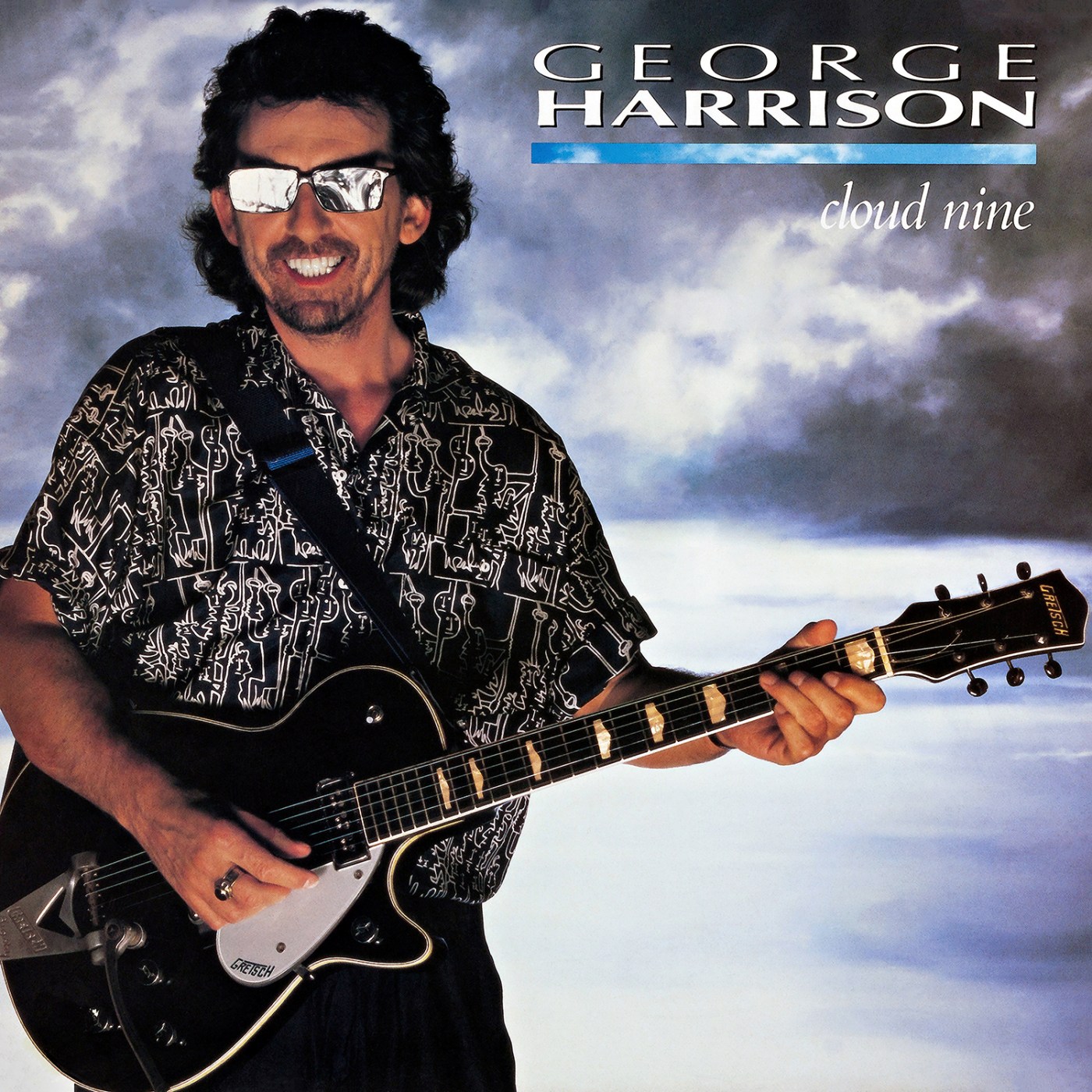
From the first note, you can tell that this is George like you’ve never heard him before. Cloud Nine finds our hero feeling relaxed and refreshed after five years away from the music business, and those five years really helped him, just as Double Fantasy had done for John back in 1980. Guest musicians on this album include Jeff Lynne, (also the producer) Eric Clapton, Ringo Starr, and Elton John, though you only hear him on piano.
Jeff Lynne tells this story about how he came to be involved: “I went to dinner one night with Dave Edmunds, in Marlow. At the end, as we walked down the street to our cars, he shouted back to me, ‘By the way, I forgot to mention, George Harrison asked me to ask you if you wanted to work on his next album.’ I said, ‘What do you mean, by the way!?’”
Lynne really is the central figure of George’s later career. From this album on, he would become part of the Traveling Wilburys supergroup, produce the 1990s Beatles songs “Free As a Bird” and “Real Love,” and he would (with Dhani Harrison) finish off Brainwashed, George’s final album. There’s no telling the story of the rest of George’s life without him, quite frankly.
Let’s hear the results:
‘Cloud 9’: The title song. George is joined on the studio recording by a veritable who’s-who of British rock royalty: Eric Clapton and Elton John both appear here, playing bass and piano respectively. George said: “There seems to be a running thread here about music and its powerful hold, eh? And it’s that way, too. We who love music, we love the people who make it, we love the sound of it, and we love what it does to us, how it makes us feel, how it helps us love.”
‘That’s What It Takes’: Written by George Harrison, Jeff Lynne, and Gary Wright, the song features two guitar solos – the first by George on slide guitar, and the second by Eric Clapton. George said in 1987: “Eric Clapton plays on four tracks; I’m sure you could hear him. Eric has the end solo on ‘That’s What It Takes’, he plays on ‘Devil’s Radio’, ‘Wreck Of The Hesperus’, and on the title track.”
‘Fish On The Sand’: If you’ve been with us for a while, ever since the post on A Hard Day’s Night back in March 2024, then you’ll recognise the guitar sound that opens the first twelve seconds of this song immediately: It’s George’s beloved 12-string Rickenbacker 360/12, which he used for the first time on that album. (He actually owned two.) He dug out his first one out of storage for this song, and when paired with Ringo’s drumming, you get an instant throwback to early-Sixties Beatles recordings.
‘Just For Today’: According to George, this song was inspired by an Alcoholics Anonymous pamphlet: “Gary Wright plays keyboard, the piano, on a song called ‘Just For Today’, which is a song I wrote from an Alcoholics Anonymous brochure. You know that little leaflet they give out to drunkards, to say to try to live through this day, for today only?”
This Is Love: A collaboration with Jeff Lynne of ELO, a man who basically defines the last couple decades of George’s life. His particular style as recording artist and producer shows up everywhere, from this song to Brainwashed and the two Anthology-era Beatles reunion tracks.
About the song, George explained: “That’s the great thing about Jeff. He wanted to help me make my record. But there’s so much in there Jeff contributed to. ‘Fab’ was a 50-50 contribution, but ‘This Is Love’ was a song where I said, ‘Why don’t you write me a tune?’ So he came down with lots of bits and pieces on cassette, and almost let me choose. I routined that song with him, and we wrote the words together. In fact, he had so many permutations of how that song is, he can still write another three songs out of the bits left.”
When We Was Fab: Released as a single in January 1988, George’s sudden desire to write a song that felt like something from his Beatles days was quite timely indeed, given the band’s back catalogue had recently been released on CD the year before, and Past Masters was due out in March.
The song is a nostalgic look back on Beatlemania with a sonic palette straight out of 1967, with Ringo on drums, backmasking, sitar, and cello parts. The single cover contained new art by Klaus Voorman incorporating his original drawing of George from the Revolver album, along with an updated sketch of George in the same style.
‘Devil’s Radio’: George said at the time: “I have to go past this little church to take my boy to school and they have a little billboard – just a little board outside the church – saying, ‘Gossip: The Devil’s Radio… Don’t Be A Broadcaster.’ That’s all. So I thought, that’s good, that’s a song, and I wrote it going to one of the Eurythmics concerts. […] The Revenge Tour was coming around England and I went to a couple of shows and I thought, ‘Yeah, I can do this. I can write these.’ So I wrote a couple of rockers.”
Big improvement over the endless “Hell is Real” billboards blanketing the Midwestern US!
‘Someplace Else’: Along with ‘Breath Away From Heaven’, it was one of two songs on the album written for the film Shanghai Surprise, which George co-produced. He later explained: “I never did a soundtrack album, because the film got slagged off so bad and we had such a rotten time with them while making it. I didn’t want to lose the songs, especially ‘Breath Away from Heaven’, which has nice words.”
The film starred Sean Penn, Madonna, and Richard Griffiths, and it has a 20% score on Rotten Tomatoes. Two more of the five songs George recorded for the movie appeared on later editions of this album as bonus tracks.
‘Wreck Of The Hesperus’: This song has everyone. George, Jeff Lynne, Eric Clapton, Elton John, and Ringo are all here. George indulges in some puns and joking around during the verses, then follows that up with attacks on the press during the choruses. He explained: “It’s just a really funny song. When I started to write the song, I just opened my mouth and it came out: ‘I’m not the wreck of the Hesperus, I feel more like the Wall of China,’ and I just continued along that theme. Except when it gets to the middle eight, and then suddenly I go into a vicious attack on the press!”
‘Breath Away From Heaven’: Another Shanghai song, with Bobby Kok on cello. It does indeed have nice words.
Got My Mind Set On You: This song finds George sounding like he’s never had before. His voice is much changed from where it was for much of the 1970s, with a new lower register that makes him sound warmer. His vocal is also pushed further forward in the mix, so he sounds present in a way he doesn’t usually. (“Give Me Love” follows this track, so listen to the two together to hear what I mean.)
The single was a huge hit for George, topping the singles charts in Australia, Belgium, Canada, Ireland, and the USA. It was George’s final US number one single, and the last by any of the former Beatles to top the Billboard Hot 100. It also hit the top the week prior to The Beatles’ induction into the Rock & Roll Hall of Fame.
And in 1988, the song received its highest honour: a parody version by Weird Al Yankovic, released on his album Even Worse. To date, it is one of exactly two Beatle-related parodies by Al, the other being “Pac-Man,” a parody of George’s song “Taxman.”
When the album was released later that year, it was an immediate critical success. The first single, ‘Got My Mind Set On You,’ topped the singles charts in Australia, Belgium, Canada, Ireland, and the USA. The album reached number eight on the Billboard 200 chart and number four on the Cash Box Top 200 in the USA. It was also number one on Cash Box’s Top 40 Compact Discs chart.
Writing in Rolling Stone, David Wild described Cloud Nine as “an expertly crafted, endlessly infectious record that constitutes Harrison’s best album since 1970s inspired All Things Must Pass”. Wild also acknowledged Lynne’s input as co-producer and praised “When We Was Fab”, “Cloud 9”, “That’s What It Takes”, and “Wreck of the Hesperus” as “sublime pop”.
In The New York Times, Stephen Holden called the release “crucial” to Harrison’s career, adding: “A pleasingly tuneful album, its sound is deliberately quaint, as it explicitly evokes the Beatles’ more romantic psychedelic music of the late 1960s.”
And then… that was it. Unlike Paul, whose Flowers in the Dirt from just a couple years later proved to be the first glimmers of a late-period renaissance that still hasn’t ended, George never released another studio album after that – at least, not under his own name.
Next week: Meet the Traveling Wilburys.


Leave a Reply