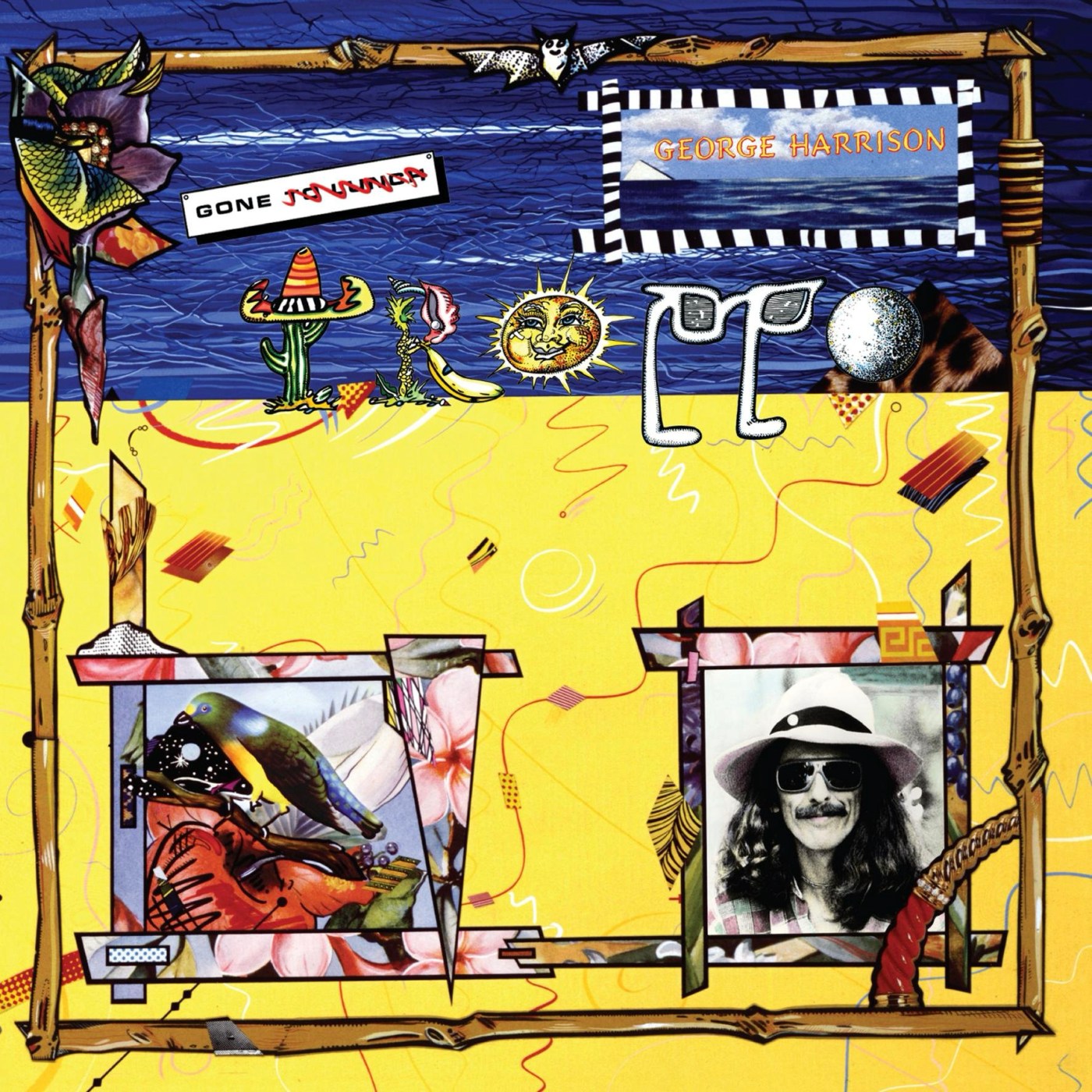
Released in 1982, Gone Troppo was George’s obligation album for Warners, recorded and released largely entirely to fulfil his contract. The title is an Australian slang expression meaning “gone mad or crazy due to tropical heat” or just “gone mad”, which weirdly fits George’s state of mind at this point in time. In the aftermath of John’s murder, Friar Park was turned into a fortress, and he would often hide away in various places as far flung as Hawaii and Australia, eager to get away from civilisation.
So disinterested was George in the state of the music industry by then that he refused to promote Gone Troppo, grant interviews, or make videos for its two singles. Warners were similarly unwilling to get behind the release, placing no press advertisements to inform record buyers about the album. Needless to say, it barely did anything anywhere except, unexpectedly, in Norway, where it peaked at #31 in their album chart.
Let’s hear how it went:
‘Wake Up My Love’: One of many George songs that sounds like it could’ve been about a girl, but then in the last third it turns out he’s actually begging and pleading for love from his Lord, like the 1980s equivalent of “My Sweet Lord.” Unlike that song though, ‘Wake Up My Love’ failed to chart in the UK and peaked at 53 on the US Billboard Hot 100.
‘That’s The Way It Goes’: The song is an attack on the capitalist politics and social order that dominated the 1980s. George variously bemoans people’s obsessions with the stock market, land speculators, and expensive property, before closing the song with a now-familiar plea to focus instead on spiritual matters. He’s in preacher mode again, with more than a little cynicism thrown in for good measure.
He said in 1989: “Dow Jones, and all that sort of money business, and Nikkei Dow, and the FTSE index. They’re the people that’s ruining the planet, you know – buying, buy, buy, buy, buy, buy. Sell, sell, sell, sell, sell. You know? Really. And this madness that like Reagan and Thatcher together created, where they say, ‘Everybody is much better off now.’”
“Everybody’s more in debt, everybody’s got two cars, there’s more concrete… You know, we’re having to sacrifice the planet for the motorcar. Madness. That’s why I can’t practice the guitar anymore. I’m so crazy with what they’ve done to our planet.”
So am I, George. And it’s only gotten worse since then.
‘I Really Love You’: Despite not being one of his originals, I’d still say this is my favourite track on the album. I really enjoy getting to hear George sing at the really low end of his register, like he’s an English Stephin Merritt or something. The original song was written by Leroy Swearingen, and originally recorded in 1961 by his group The Stereos. Released by Cub Records, it reached 29 on the US Billboard Hot 100.
George went on to explain: “If you remember that song then I’ll tell you that the Beatles wrote a song that I think was actually a nick, a bit of a pitch off that one. It was a song that John wrote and I sang on the very first Beatle album called ‘Do You Want To Know A Secret’. If you check that against the song you’re referring to on Troppo, that’s round two of where ‘Secret’ came from [laughter]. It’s a fun track.”
A promo single for this song contained both mono and stereo mixes, the last of George’s releases to do so.
‘Greece’: An absolutely delightful song in which George settles in to make a bunch of marvellous puns! My personal favourite is probably “Monty Pythagoras.”
‘Gone Troppo’: This song was written in Australia, one of many places where George went to get away from the world. Its opening lines summed up his contentment in being removed from civilisation: “There he, sitting in the moonlight/
Not found, living no city/
He smile, mucho in a sunshine
/Nightlife, counting de fruit bat.”
Olivia explained in 2007: “George was always on a quest to get as far away as he could. We found Hawaii and built a house there. But he wanted to keep going. We went to Tasmania, New Zealand, Australia. I had the feeling that he maxed the planet out, looking for solitude. It was about ‘How far away can I get?’”
‘Mystical One’: The song’s lyrics find Harrison “happier than a willow tree”, quietly contemplating life, and finding contentment in the “sweet serenity” of an unidentified other. It could be his God, his family, or an amalgamation of everything he held dear. Personally I vibe most with the god reading, if only because I feel the same way about how being pagan has enhanced my life.
‘Unknown Delight’: The song is a tribute to his second wife Olivia, whom he married in 1978, and their son Dhani. Towards the end of the 1970s George had found contentment in his family, after several turbulent years. In 1988 he said: “I’m quite happy, yeah. But you can’t say, you know. It’s all… this is our lives, you know? This is the only life I can remember, and I’m happy enough doing it, being up and down, and good and bad, and in the end, I think all of us have come out of it reasonably sane and… quite happy.”
‘Baby Don’t Run Away’: Very little is known about this song, but I can tell you that it has George on lead vocals with Billy Preston making an appearance on backing vocals as well. Jim Keltner appears here on the drums, as he so often does. George said in 1992: “There’s one good song I wrote called ‘Baby Don’t Run Away’. It’s not a good production, but it could be a good R&B song.”
‘Dream Away’: The song was written for the 1981 film Time Bandits, which was produced by Harrison’s company HandMade Films. It features over the end credits of the film. George explained in 1987: “The Pythons, as individuals, were all writing scripts. Terry Gilliam presented us with this brilliant idea, which turned into Time Bandits.”
George, of course, has a long association with Python, since the beloved British comedy troupe was to light entertainment what the Beatles had been to music: rightly famous and better than any of their contemporaries. He funded Life of Brian when EMI pulled out entirely because he “wanted to see the movie.” (The final Python film, The Meaning of Life, came out in 1983, a year after this album.)
‘Circles’: A haunting George tune featuring organ and lots of minor chords, George first wrote this song all the way back in 1968, where it appeared in the Esher demo recordings for the White Album. Fourteen years later, he’s dusted it off for a new version, featuring Billy Preston on organ and piano.
And yet, despite all this, it’s actually a surprisingly breezy sounding album – this is George on vacation, putting anything he wanted onto the record because he’s long past the point of caring. His contract with WB is complete, and from here on he records music because he wants to, rather than because he has to.
This freedom is why he only has two more studio albums after this, one of which came out after he died. Even so, it’s a fun album to listen to, even if it is easily the slimmest of George’s works. It’s beach music, really – summery, like Duran Duran’s Rio album.
Next time: George takes most of the 1980s off and comes back with his best album in years – would you believe it’s his penultimate record? It’s Cloud Nine.


Leave a Reply