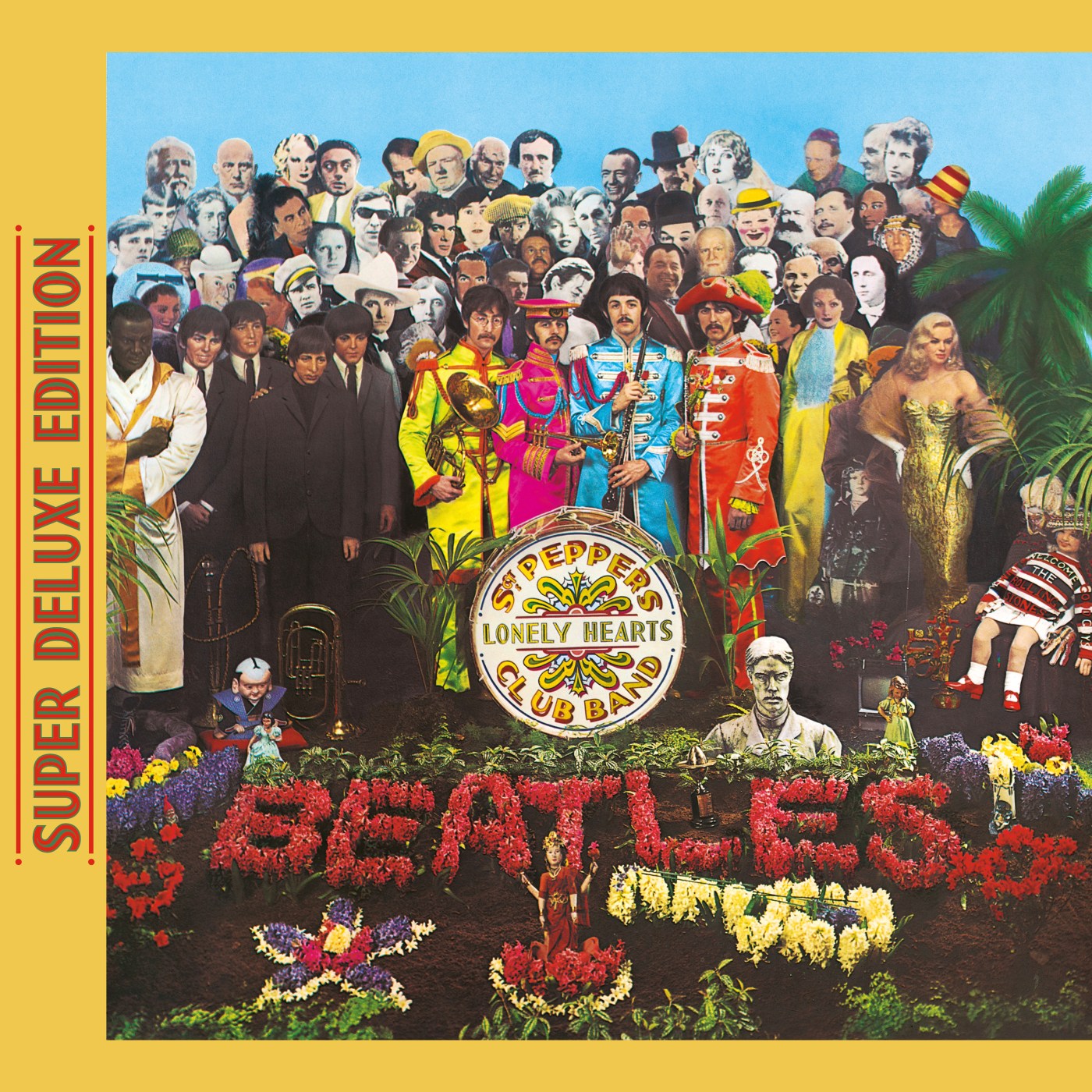
One of the things that bringing Off the Beatle Track back for 2026 allows me to do is cover aspects of the Beatles’ work that I, for whatever reason, chose not to focus on in the 2024 run. As a case in point, we’ve talked before about Giles Martin’s gradual sonic reinvention of the Beatles catalog, taking these sixty year old recordings and making them sound as modern as possible without detracting from the essence of the original performances, but only in a few specific contexts.
Remixing is a tough job by itself, but with a catalog as sacred as this one? Next to impossible… unless you have the right producer. And if you ask me, Giles most certainly is that. True, being the son of George Martin probably helps, but being a fantastic audio engineer counts for more than blood. Paul and Ringo clearly trust him, and since nothing gets released without buy-in from them, Sean Lennon, and Dhani Harrison, that matters.
The story of Giles Martin as re-producer begins in 2015, when he remixed the 1 collection from the ground up by going back to the original tapes and reworking them instead, completely erasing the overly digitized mixing job from 2000. Coming just six years after the much-vaunted 2009 remasters, and four years off from 1’s 2011 re-release, which used those 2009 masters, throwing out the rulebook and starting from scratch would’ve been completely insane.
And yet, it worked. People loved the new version of 1, so much so that in 2016, we were granted Live at the Hollywood Bowl, a new version of what was (at the time) the only Beatles live album, originally released in 1977. But due to all the screaming, that record was left to languish for 49 years until Giles came along and spruced them up and created a composite Beatles live show that allowed us to hear just how good they were as a live band. The screams are still there, but they serve to compliment the music rather than overwhelm it.
And of course, in 2023 we got the expanded and remixed versions of the Red and Blue albums, the definitive Beatles compilations. Suddenly, new frontiers of mixing were opened up, because the technology now existed to make it possible. We now have stereo versions of “She Loves You” and the original single version of “Love Me Do,” two songs for which no stereo mix was ever prepared. Two-track stereo songs from Please Please Me and With The Beatles now have modern stereo separation, with the vocals in the center rather than off to the left.
But the phase of the reinvention that has defined the last decade of Beatles releases has been, without question, his new mixes of the original studio albums. If anything, that’s an even more difficult task that the compilations, because these albums are so beloved and well-known. But if there’s anyone who can pull off the impossible, it’s Giles Martin.
Originally tied in with anniversaries before abandoning the calendar entirely starting with Revolver, the Giles Martin mixes of the catalog serve as celebrations of the albums and their places in the story of the band, featuring not just modern stereo mixes, but a wealth of session material as well, giving us a glimpse into how the final product was made. It’s like the spiritual successor to the Anthologies, only album-based.
The best place to begin, then, is with the mix that started it all: 2017’s remix of Sgt. Pepper’s Lonely Hearts Club Band. As with all of the Beatles’ pre-1969 releases, the mono mix was the one to listen to, since that was the version the boys themselves worked on, whereas the stereo versions were quickly thrown together. The mono Pepper, as I heard it in college, was a genuine work of sonic art, a triumph of 1960s audio production.
The stereo version… wasn’t.
And yet it was the one I knew best, whether the 1987 version from my childhood, or the 2009 version that came out when I was in high school. The stereo panning on that album, due to the limitations of the time, was a mess. With only four tracks to work with and none of the advantages of digital mixing, of course it was going to sound awful.
The 2017 remix completely changed the game. While he was still working from the same tapes as his father and Geoff Emerick, he also had access to Pro Tools, allowing him to completely reinvent the album for modern listeners and unveil new details that had previously gone unheard, and put the rhythm section (particularly Ringo) at center stage for the first time. What he created was a stereo mix that bore no resemblance to the old one whatsoever, because Martin used the mono mix as his starting point and based everything on that.
From then on, new Beatles album mixes came out like clockwork, centering mainly on the later portion of the Beatles’ career, when they abandoned touring and went entirely studio-bound. Some of that was a logistical thing: there’s just more room for him to maneuver with the later albums than the earlier ones, since the band progressed from four-track tape to eight-track tape while making them.
The second reason is because, initially, the technology did not yet exist to cleanly separate individual track elements beyond what had been recorded in the late Sixties. So, the mixes of Pepper, Abbey Road, Let It Be, and The White Album were all sourced from the original tapes, exactly as recorded by the band in the late 1960s.
So, to tell this story properly, that’s what we’ll do here, beginning with the super deluxe Pepper set. Clocking in at six discs, four of which are audio, the Pepper box contains the 2017 remix of the original album, two discs of session recordings, and the original 1967 mono mix, as released around the world that summer.
Let’s dive in, shall we?
2017 Remix
Sgt. Pepper’s Lonely Hearts Club Band (2017 Mix): The title song, now infused with new energy by Giles Martin. George’s lead guitar, by itself, becomes the star of the show. You can hear so much more of it now! I am also fond of Paul’s little howl just before the chorus. I also really like the way the chorus sounds following the brass solo, it’s got a rock vibe that I think is wonderful.
With A Little Help From My Friends (2017 Mix): Appropriately for a song that showcases Ringo with his three brothers, there is a lot of drum sound in here. The tom fill at around 40 seconds, in particular, sounds absolutely fucking huge. That’s one thing I really like about Giles’ mixes: he makes Ringo drum kit way more prominent without sacrificing the other three.
Lucy in the Sky With Diamonds (2017 Mix): For those of us used to the 1967 stereo mix, hearing “Lucy’ at its original speed is a little weird. But that’s how it was released back then in mono, and Martin’s goal in this new mix was to follow that version. I’d say he succeeded. (Also, again, Ringo’s drum hits between the verses sound really big.) One of my favourite aspects of this mix is the way the notes of the opening keyboard riff jump around the stereo field.
Getting Better (2017 Mix): What sticks out to me on this mix, aside from the panning on the guitars in the opening, is the prominence of Paul’s bass on the right channel. I also quite enjoy how low frequencies have been boosted throughout the song, it gives the track a bit more depth.
Fixing A Hole (2017 Mix): Maybe I’m hearing things, but it sounds to me like there’s a bit more reverb in Paul’s vocal than there used to be. I also like the use of ADT on George’s lead guitar part, it’s more balanced than keeping him shoved off to one side. (Strangely, the solo itself is over to the left a bit, and otherwise monaural.)
She’s Leaving Home (2017 Mix): In keeping with Martin’s desire to present a “3D mono” mix of the album, SLH is presented slightly sped up from the familiar 1967 stereo mix, just as it was on the mono. The string arrangement is mixed beautifully, it surrounds you in a warm cocoon of sound.
Being For The Benefit Of Mr. Kite! (2017 Mix): If I have one criticism of Giles’ mixes, it’s that the opening 5 seconds of this song sound like they’ve been brick-walled to death, and the waveform bears that out. The rest of the song sounds fantastic though – equal to the Love version of the track, minus all the extra embellishments of course.
Within You, Without You (2017 Mix): “Within” is a snapshot of where George’s interests lay in 1967. He’d gotten really into Indian music by now, and his compositions for most of ’67 and ’68 reflect that interest. While he won’t use Indian musical forms much past the late 1960s, Hindu spirituality will remain a key part of his music as a solo artist, all the way to the end.
When I’m Sixty-Four (2017 Mix): I love all the little details here, like the soft cymbal noises from Ringo’s drum kit. Everything sounds wonderful here, and I particularly enjoy the way the backing vocals are spread around. It’s just a cheerful little number!
Lovely Rita (2017 Mix): This song really benefits from having the backing vocals in stereo, kind of like at the start of “Help!” from the 2015 version of 1. There’s just really nothing like this song in the whole world, and I love it!
Good Morning Good Morning (2017 Mix): KABLAM! Has this song ever sounded so much like exactly the kind of thing you need to wake up in the morning? The drum and brass sounds here are absolutely unbelievable, especially the tom and snare. Ringo is absolutely on fire here, and that lead guitar sounds like musical fire.
Sgt. Pepper’s Lonely Hearts Club Band (Reprise) (2017 Mix): For those used to the 2009 stereo version, the transition between the end of the last song and the start of this one sounds completely different from the mono, and it’s always a bit jarring. Then the drum part from this song kicks in and suddenly you want to start drumming along beside Ringo. (Or is that just me?)
A Day in the Life (2017 Mix): John’s other psychedelic masterpiece, (after “Strawberry”) this new mix puts his vocal square in the middle where it belongs, rather than moving around between verses as on the original stereo version. Easily the best sounding mix of them all – though the Love version is close.
The Sgt. Pepper Sessions
Strawberry Fields Forever
Take 1: Take 1 of this wonderful song, and gradually, you can hear the track take shape. It’s not quite finished yet, but it’s getting there. This version is just John, his guitar, and a Mellotron – the take as released on Anthology 2 has the gorgeous backing vocals mixed out for some reason, it’s nice to hear them back on here. Take 1 will also serve as the basis for my favourite version of the song – the Love mix.
Take 4: Now the song starts to sound a bit more familiar, with an early version of the opening flute part. There’s no edit though, so the expected part of the song where the edit is in the final mix just continues on instead. It’s a bit dreamier than the first take, but not quite the psychedelic wonderland as the released version.
Take 7: Now we’re getting somewhere! A key change, and suddenly we have what sounds like, at least for the first minute, the final released version from February 1967. And then the expected edit (you know the one) never comes up, because this is the entire original Take 7, before John asked George Martin to combine it with take 26 – the orchestral version that had to be slowed down. This take is presented in full stereo for the first time on this box, as the Anthology 2 version was in mono.
Take 26: A genuine rarity: the other version of “Strawberry Fields,” in a higher key with an orchestral backing and much faster than the single release we all know. The point where Geoff Emerick makes his famous edit occurs at 0:24, the rest of the song is otherwise largely identical, just at a different speed.
2015 Stereo Mix: The first Beatles single of 1967, Giles Martin’s 2015 remix of this song first appeared as a bonus on the expanded 1+ blu-ray set, where it accompanied a remastered version of the music video. This is the first regular album release for this mix of the song, with no visual accompaniment. (Duh.) This new mix of the song is absolutely superb, and one of my favourites.
When I’m Sixty – Four (Take 2): In case you were wondering what this song would sound like at its original speed, this is it! An unadorned take of the one used for the final master, featuring even more of Paul’s bass and his vocal at its original pitch.
Penny Lane
Take 6: Not much to write about here, just a happy instrumental backing track – I guess for your next karaoke night?
Vocal Overdubs And Speech: Just Paul and the boys doing vocal overdubs – listen close and you can hear the backing track they’re performing to.
2017 Stereo Mix: Continuing the nostalgia theme, Paul’s song takes us through a famous Liverpudlian street he used to walk down a lot in his childhood. While slightly less poverty psychedelic than its sister song, there’s still some surrealism buried in the lyrics. This is actually the second time it’s been remixed by Giles – like “Strawberry Fields,” it received a new mix in 2015, but unlike “Strawberry” it got a second one two years later.
A Day in the Life
Takes 1 and 2: Despite what the opening dialogue would have you believe, this isn’t entirely an Anthology re-release – first up is the full, unedited take 1, never released before. Anthology 2’s release was a composite edit with music from take 2, which also appears on this disc. Note the humming that takes the place of the final piano chord.
Orchestra Overdub: The great big orchestral freakout.
Hummed Last Chord: Their first idea for ending this song, but despite the five tries presented here, it doesn’t work very well. It’s nice hearing them go at it though.
The Last Chord: Pianos now! Listening to this is really an exercise in waiting until they get to the one from the album, which turns out to be take nine: John’s favourite number.
Sgt. Pepper’s Lonely Hearts Club Band
Take 1: The first take of the opening song, where its rock-and-roll roots shine through. It’s worth a listen, particularly for Ringo’s wonderful drumming and the lead guitar squawks. No vocals here, just instruments.
Take 9: This one also opens the bonus disc on the 2-CD deluxe set, which makes good sense since it’s mostly the same as the master, with the vocals where they belong and mixed similarly. (Except in the choruses.) Still, some things are missing: no brass, no crowd noise, no lead guitar from George. Note also the lack of transition following Paul’s last line, instead the song just gradually comes to a halt.
Good Morning Good Morning – Takes 1 & 8: A brief take from further down the album, featuring way more snare from Ringo than he uses on the album version. Then it breaks down during the second verse section, leading us into take 8 – John’s vocal is here, single-tracked compared to the double tracked one on the master. There’s no brass here either, but everything else is pretty much the same.
Fixing A Hole – Takes 1 and 3: Don’t be alarmed, this is just the first take of the song, minus George’s guitar part – that was added later. The lead vocal was recorded at the same time as the rhythm track, a change from the Beatles’ post-1964 approach of overdubbing the vocal. The second track is take 3, but this isn’t the master – you can tell by the way Paul sings the words. Sounds like they got it right on the first try.
Being For The Benefit Of Mr. Kite! – Takes 4 and 7: Though the opening announcement with George Martin is familiar, the rest of this is brand new. Take 7 is also included here in stereo, having previously appeared in mono on Anthology 2.
Lovely Rita – Take 9): Not much dreaminess here, just the boys recording take 9 of this song from late on the album – which turned out to be the one used for the final master, judging by the way Paul sings the words. Notably, this recording is actually slightly faster than the album version, you can tell by how Paul’s vocal sounds.
Lucy In The Sky With Diamonds – Takes 1 and 5: This one should sound familiar, since it was released on Anthology 2 back in 1996. Not much dreaminess in this take, as John almost shouts the verses. There’s also no vocal during the chorus sections, as those hadn’t been added yet. Take 5, a new release, almost immediately breaks down when John laughs in the middle of the first few lines. Once it does get started though, it sounds closer to the final master.
Getting Better – Takes 1 and 12: Take 1 of Lucy’s follow-up, and with the electric piano going on in the left channel, to me it sounds like this could’ve been a Beach Boys number from around the same time period. It’s also entirely instrumental, save for occasional dialogue from the boys. Take 12 is a little more substantial, featuring lead guitar but no vocals.
Within You Without You – Take 1, George Coaching The Musicians: The first track you’ll recognise: this is the final master with just the Indian instruments, as originally released in 1996. The second track is George singing the melody for his vocal line in order to tell one of the players what he should perform.
She’s Leaving Home – Takes 1 and 6: Two instrumental takes of this song, with strings by Mike Leander – one of the rare times where they didn’t turn to George Martin for an arrangement. (He was very upset with Paul for that snub, and who can blame him?) Even so, it’s still a lovely arrangement. Listen for a brief cello phrase near the end of the bridges – that got mixed out in the final release.
With A Little Help From My Friends – Takes 1 and 2: Not much to write about here, just an instrumental take of Ringo’s song from the album. It’s two takes in one, as the first take breaks down quickly. Take 2 is pretty good, if a bit rough sounding in places.
Sgt. Pepper’s Lonely Hearts Club Band (Reprise) – Take 8: We end our glimpse into the band’s side of the recording studio with this early take of the Pepper reprise, featuring probably the worst vocal performance of Paul McCartney’s life… but it’s not like this was meant to be heard by anyone outside the studio anyway.
1967 Mono Mixes
I can remember exactly where I was when I first heard the mono version of Pepper. I was taking an audio aesthetics class in college, and one week our professor played three albums: Dark Side of the Moon, Thriller, and Sgt. Pepper in mono. Having grown up knowing only the stereo mix, to hear the mono version from 1967 was a genuine revelation. So many things were different! It was like hearing it for the very first time!
That class period directly contributed, I believe, to my decision to purchase the Beatles in Mono CD set a couple of years later, so I could hear the band’s music in exactly the format they intended. But of course, the CD versions were remasters of the original mono mixes – the mono Pepper presented here is not a remaster, but a direct transfer of the original master tapes from 1967. This is what record buyers would’ve heard that June, at the height of 1960s optimism.
When this collection was being prepared for release, archivists at Abbey Road found and added six bonus tracks to the running order – the original 1967 mono mixes of “Strawberry Fields” and “Penny Lane,” along with three previously unreleased early mixes of three songs and the thought-lost 1967 promo mix of “Penny Lane,” as prepared by Capitol Records.
Here they all are, for the very first time:
Sgt Pepper’s Lonely Hearts Club Band (Mono): The title song announces the “concept” of the album, by introducing the band named in the title… and that’s pretty much it, lyrically speaking. Musically there’s a lot going on, from crowd noises here and there to an absolutely blistering guitar part from George, to show they haven’t entirely forgotten their rock roots, a horn section, some nice harmonies in the choruses… it’s a pretty great song! And then it leads directly into…
With A Little Help From My Friends (Mono): A lovely ode on friendship, written by John and Paul for Ringo to sing. It’s one of his best, and he sings wonderfully on it. (There is also an amazing drum part, because of course there is – it’s freaking Ringo, people!) Small wonder that it’s become a mainstay of his live shows over the decades, right?
Lucy In The Sky With Diamonds (Mono): The somewhat controversial Lewis Carroll riff that John wrote based off a drawing by his son Julian, it’s one of my favorites of his songs from this period. The mono version (which I’m listening to while I write this) is at a slightly different speed than the stereo mix more people are familiar with, which is always a little jarring, but you adapt quickly.
Getting Better (Mono): Another of John’s confessional songs, but sung by Paul, which must’ve thrown people off. It’s still a great song though, the interplay of “it’s getting better all the time” and “it can’t get no worse” is very typical of John and Paul – ever the cynic and the optimist, those two.
Fixing A Hole (Mono): Easily my favourite song on this album, entirely became of the lead guitar line that runs through it. It’s absolutely delightful, and probably my all time favourite bit from any song. (Also on the list: the solo in “Nowhere Man,” and the harmonies in “Baby’s In Black.” Apparently, it came about as a result of a little blue dot Paul saw when he first took LSD, and isn’t actually an ode to home improvement.
She’s Leaving Home (Mono): Another song where the differences between mono and stereo stick out: this song is actually higher in mono than in stereo! Aside from that, this is another one of Paul’s classical music songs, and like “Eleanor Rigby” before it, tells the sad story of a woman… except the woman is real.
Melanie Coe ran away from home in February 1967, and being well-to-do, her story attracted Paul’s attention. (John’s lines in the choruses, meanwhile, were things his aunt Mimi used to say – this is the same woman who thought John would never make a living from guitar.) I had this song in my head when I moved to Ithaca in the autumn of 2023 – it’s intensely relatable.
Being For The Benefit Of Mr Kite! (Mono): Another of my favourite John songs from the psychedelic era, Mr. Kite came from an old Victorian circus poster that John bought in an antique shop, and almost all the song’s lyrics were transcribed entirely from the poster. It certainly sounds very circus-y, with all the organ and calliope music, albeit slightly unreal, almost eerie. Very in keeping with John’s burgeoning love of avant garde stuff, since he’d met Yoko by this time, though they wouldn’t start dating until 1968.
Within You Without You (Mono): Given the function of this project, I can’t possibly describe well enough the extent to which George’s exploration of Indian music and culture affected him. It became one of the biggest things in his life, and remained a part of him until he died in 2001. After the last Beatles tour in 1966, he almost left the group entirely, but ended up sticking it out for a few more years.
This song came about after he spent a few weeks in India being immersed in sitar lessons and Hindu spiritualism, and its lyrics may as well be foreshadowing for some of his best-known work as a solo artist in the ‘70s. We are a long, long way from “Roll Over Beethoven,” and it’s genuinely impressive at just how quickly he grew up.
When I’m Sixty Four (Mono): And now for something completely different. One of Paul’s earliest songs, it expresses a hope that the object of his affections will still care about him when he’s a senior citizen. Not too much to write about it honestly – I do like the clarinets, and the way they sped his voice up so he sounds younger. (Naturally, everyone made exactly the same joke when he did turn sixty four.)
Lovely Rita (Mono): When I was a little pup, I used to listen to this album on a Fisher-Price cassette player while taking a bath, and right around now was when I would decide I was ready to dry off. This has nothing to do with the song itself, but it’s a cute anecdote that illustrates just how long this music has been a part of my life. The song itself is something of a trip, but then, given all the LSD that was taken during recording, who’s surprised?
Good Morning Good Morning (Mono): Of all things, this song was inspired by a commercial for Kellogg’s corn flakes. I am not making this up. The lamest cereal in the world led to this! Who’d’ve thunk it? There’s not a lot to write about here either – John thought it was a throw-away, but I kind of like the lyrics, especially the parts about wandering around town when there’s no one else outside.
Sgt Pepper’s Lonely Hearts Club Band (Reprise) (Mono): Again, not much to write about – the penultimate song on the album, suggesting that the surreal concert we’ve been listening to is about to end after the last song, about which there is far more to write. Nice drum part though, and more blistering Harrison guitar.
A Day In The Life (Mono): Another song based on newspaper articles, it’s often hailed as one of the Beatles’ best songs, and honestly, I can’t argue with it. The echo on John’s voice gives it a somewhat dream-like quality, which then becomes nightmarish when the build-up starts, preceding Paul’s verse, and the other extremely well-known chord in Beatles music. (Fun fact: that chord was held for so long, with the gain turned up so high, that if you turn it up as it fades out, you can hear EMI’s air conditioning humming away.)
Strawberry Fields Forever (Original Mono Mix): My all-time favorite Beatles song ever, this. John wrote this in Spain after the band finished touring in 1966, and the actual recording of the song launched the band’s psychedelic period. It’s probably the most technically complicated song they ever did, not just with all the instrumentation going on, but the way it sounds.
The first minute or so is in the key of B flat, while the rest of it (originally recorded in a higher key) had to be slowed down to match the first part. The resulting edit is one of the most famous pieces of Beatles lore ever, and the song just wouldn’t feel the same without it.
What starts as a nostalgic look back at a favourite hiding place of John’s as a kid becomes an LSD-infused wonderland, and it’s absolutely brilliant. I wish I could’ve heard this in 1967 – it probably blew everyone’s minds.
Penny Lane (Original Mono Mix): Paul’s own nostalgia piece about his childhood in Liverpool, it’s far more conventional, musically, than “Strawberry Fields,” though there is a touch of surrealism in some of the lyrics. I like it, but it doesn’t hit the spot for me in quite the same way “Strawberry Fields” does.
A Day In The Life/Lucy In The Sky With Diamonds/She’s Leaving Home (Unreleased Mono Mixes): Never heard before, these are the unreleased first mono mixes of three album songs, where for once the recording studio itself (or at least the mixing console) becomes the instrument.
On “A Day in the Life,” listen for drastically different entrance points for bass and drums, as well as a different drum sound entirely, and even Mal Evans’ voice! No orchestra here either, just the boys themselves. When Paul’s vocal enters, it becomes eerily similar to the early take featured on Anthology 2. No final chord either!
“Lucy” appears in what is labeled on the track list as “Mono mix No. 11,” though unlike ADITL it largely sounds identical to the release version, save for some more flange on the vocals during the verse and chorus sections.
“She’s Leaving Home” contains some flange on the opening harp part, but is otherwise largely similar to the final mix, save for the presence of that cello phrase we heard from takes 1 and 6, and double-tracking on Paul’s vocal during the choruses.
Penny Lane (Capitol Records U.S. Promo Single – Mono Mix): A mix of the b-side from the February 1967 single, featuring some slightly different instrumentation from the single mix. It also sounds like it’s been run through a limiter, judging by a quick look at the waveform compared to the regular mono.
It’s always hard to know what to write about Pepper. It’s an album that has, over nearly sixty years, stood out as the Beatles’ greatest sonic achievement. Nothing sounds like it, not even Magical Mystery Tour. And while the album did leave me cold when I listened to it last time, I’m happy to say the remix does the opposite. When I first listened to it in June 2017, a week or so after it came out, I remember being blown away by how it sounded so incredibly contemporary.
And I’m not the only one who thinks that! Per Wikipedia, several critics praised Martin’s new stereo mix. Neil McCormick of The Daily Telegraph commented: “It is like seeing a favourite movie again in high definition. It doesn’t replace the original, it enhances it.”
Danny Eccleston of Mojo also approved of Martin’s work, especially the presence afforded Ringo Starr’s drums. He added: “The voices feel ‘properly’ balanced and positioned. And in general, where there was whimsy (the bête noire of most Pepper agnostics) the power of solid drums and central voices irons it out.”
It is simply the best fucking mix of this album that there has ever been, period.
Next time: we swap the psychedelia for the Beatles getting back to basics and doing another album that doesn’t sound like anything they’ve ever done before. It’s the glorious, chaotic mess that is the White Album.


Leave a Reply