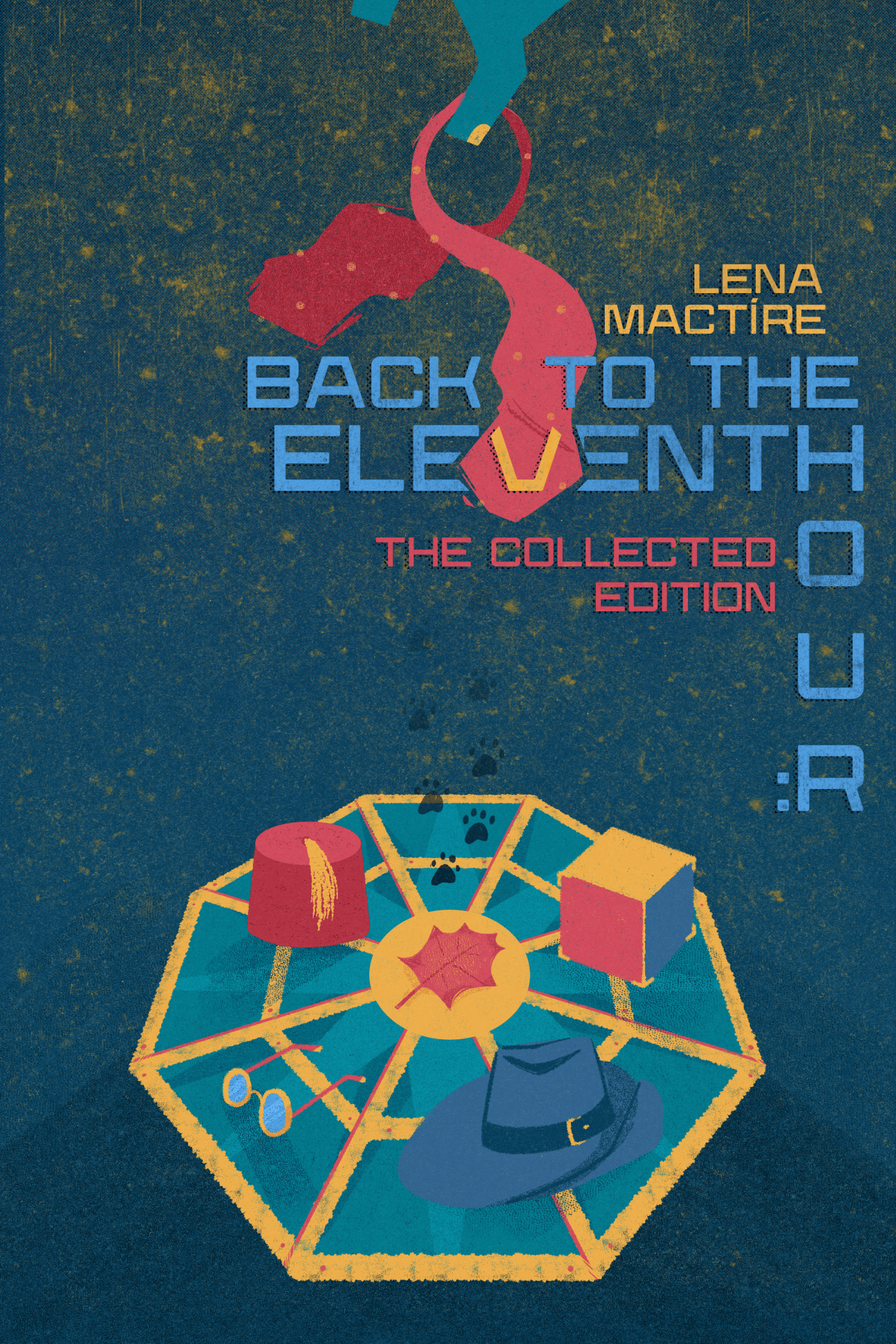
Today, a little over six years after the first book in the Back to the Eleventh Hour series was released, I am pleased to announce that all three books in the series are now available in a single volume for the first time. Back to the Eleventh Hour: The Collected Edition is out in print and digital from Arcbeatle Press.
To celebrate both the book release and the show’s 63rd anniversary, please enjoy my chapter on The Day of the Doctor. For more of this, kindly buy the book! It also makes a great holiday gift!
I can still remember where I was when I watched Day. Though the episode was simulcast on BBC America on November 23rd, 2013, I didn’t watch it then because my brother had a drum recital scheduled for the same time, so I went to that instead, albeit very reluctantly. (It was alright. He drummed along to “I Am the Walrus” by the Beatles.)
Before we got to the recital, we swung by the local Barnes & Noble to browse around. While I explored, I saw they had a copy of the Paul McGann movie on DVD, so I bought it with some leftover birthday money. I’ve always kind of liked the Eighth Doctor, and having seen his second ever TV story the week before, I decided getting his first would be a good idea.
So anyway, all this meant I didn’t get to watch Day until that night, when I downloaded a pirated copy from the internet (because I’d forgotten to set the DVR to record the show when it aired on TV). If you haven’t watched pirated Who downloaded from a sketchy fan site, have you really lived?
My opinion hasn’t changed even once in the ensuing eleven years since it came out: it is an absolute masterpiece of an anniversary spectacle, cramming in more fan service than we had in the entire preceding eight years of modern Who. Script extracts have floated around of the original Ninth Doctor draft (mainly the barn scene) and while I have to admit it would’ve been nice to have Eccleston back, given how things went the last time he was on the show, we have Big Finish now.
When I watch it now, I see it more as the War Doctor’s story rather than the penultimate Eleventh one, though it is that, what with him dangling out of the TARDIS at the beginning, the fez, and getting to say “Geronimo” one more time. It’s very much the “last time the Doctor gets to have fun” story as Planet of the Dead from the Tennant era, only way more interesting.
One gets the sense that when he sat down to write this story, Moffat looked at the previous two multi-Doctor stories and decided to pick the best parts out of each. Obviously, we have three Doctors, just like in The Three Doctors: the incumbents in the forms of Three and Eleven, the returning popular Doctors of Two and Ten, and the older, wiser Doctors of One and War. The Zygons are physically reminiscent of the anti-matter blob creatures from the same story, while of course, Kate Stewart stands in for the Brigadier during the UNIT plot.
The Five Doctors gives us Gallifrey lore out the wazoo, particularly in relation to the ancients of Gallifrey – granted, this is also true of Three, but Five’s lore actually takes place on Gallifrey. In 1983, we had the Death Zone and the various Objects of Rassilon, while 2013 gives us The Moment, the super powerful weapon of mass destruction said to have been created during the time of Rassilon and Omega, and of course, the surrounding Time War stuff, inherited from RTD. We also have a returning companion, sort of… Rose Tyler in her Bad Wolf form, rather than Sarah Jane Smith.
The story itself is really nicely structured: The Zygon storyline takes up most of acts 1 and 2, with the Time War material underpinning act 1, to introduce the War Doctor and get the rest of the plot going. The Zygon portion of proceedings, at first, appears to be an entirely unrelated adventure that could’ve been the subject of any other episode, not the 50th. If you watched only those scenes, you’d have a celebrity historical smashed together with a present-day Earth invasion story – a delightfully strange concept all by itself.
It’s only when you get to the sequences in the Black Archive, where the two Kates argue about destroying London to save the world, that you realize what’s really going on here: the Zygon invasion of Earth is meant to stand in for the end of the Time War, with Kate filling the Doctor’s role in the original timeline. Ten and Eleven make that explicit, and that leads them into forcing Kate to make a different choice, where everybody lives.
And what happens at the end of the episode? The exact same thing. Inspired by everything that just happened on Earth with Kate and the Zygons, the Doctors force themselves to make a different choice, where everybody lives. As above, so below.
And so, with a little help from their friend the Moment, Doctors Ten and Eleven find themselves in the old barn on Gallifrey, where once upon a time, the War Doctor pushed a big red button and destroyed Gallifrey.
It wasn’t supposed to be the War Doctor, of course – Moffat’s original idea had been to bring back Christopher Eccleston, so you’d have all three of the revival-era Doctors on screen together for the first time, just like in The Three Doctors forty years earlier. Early drafts of the script, which included Nine, were later released for charity, giving us a glimpse at what might have been.
Having read those extracts though, I honestly struggle to contemplate a version of that story that still works as well as our version does. There’s nothing in the first barn scene that really screams Nine to me. Contrary to Moffat’s assertion that the Doctors all tend to talk alike, Nine really did have a unique voice. He was the working-class Doctor, a man you expected to find at the pub, drinking a pint after work. The days of quasi-Victorian formalwear and a received pronunciation accent were far behind him. Just because you can write dialogue for the Doctor doesn’t necessarily mean you’ve written dialogue for Nine, Ten, Eleven, or anyone else.
Even Eccleston himself admitted that Nine didn’t fit the story as written, when he appeared at Rose City Comic Con in 2018. Per the Radio Times: “I didn’t feel that what they were asking me to do did justice to the Ninth Doctor. So I said no. The virtue of that is that we then get the War Doctor. Because if I’d have come back you wouldn’t have got the War Doctor – the War Doctor was there precisely because the Ninth Doctor wasn’t.”
The Ninth Doctor was a battle-scarred veteran of a war, and it’s genuinely difficult to imagine him without that background. He’d fit very well in a depiction of the original end of the Time War, but it would’ve made for a depressing anniversary special. The Day of the Doctor is a better story with War in it, and no less a figure than the Ninth Doctor himself agrees. Good for him.
The thing about the War Doctor is that, as I said last chapter, for all that he insists that he doesn’t deserve the name Doctor and can do things that “the Doctor” would never do, the episode itself says otherwise, repeatedly, in dialogue and in action. Like, sure, War uses a gun! A great big laser rifle even! And then he uses it to carve a message into a wall, rather than shoot anyone. Because he still cares about protecting innocents, even when he’s in emo warrior mode.
As I’ve noted previously, the War Doctor is also Moffat’s way of interrogating the concept of a “Dark Doctor,” though we’ll get more of this during the Capaldi years as well. In both cases, the conclusion he ultimately comes to is that having a dark, amoral Doctor is a basic impossibility, because the Doctor, in Moffat’s conception, is simply not set up to work like that. As Emma says in The Curse of Fatal Death, “You’re too nice, too brave, too kind and far, far too silly.” Take that away, and you don’t have the Doctor anymore.
What this episode is fundamentally about, and I think it’s part of why I love it so much, is the possibility of redemption. That theme has been a mainstay of my own writing for a long time, and it even informs the kind of media that I’m attracted to: My Little Pony: Friendship is Magic, for example, began with the villain of the piece being redeemed through the power of friendship, and it built on that theme for the next nine years, all the way to the end of the series.
When we first learn about the Time War, and the Doctor’s actions in particular in Dalek, it’s a legitimate shock. How in the world could this man be capable of double genocide? It simply doesn’t line up with the guy who, in Genesis of the Daleks, ultimately decided not to destroy the Daleks when they were being created because, as he says at the end of the story, “although the Daleks will create havoc and destruction for millions of years, I know also that out of their evil must come something good.”
He gets there because, after spending several hundred years being a warrior, he’s exhausted and wants it all to stop by any means necessary. And by the end of the Time War, any possible concept of “good side” and “bad side” have been so thoroughly eroded that even a civilian like Cass, in The Night of the Doctor, just assumes that the Doctor is as bad as all the rest of the Time Lords. So the Doctor pushes the button, and damns himself in the process.
Day is about allowing the Doctor to finally forgive himself for doing what he did… by making it so he doesn’t do it all. It’s a common hypothetical that we’ve all said at least once in our lives: “I wish I could go back in time and stop myself from doing…” And the Doctor, being a time traveler, finds himself in the unique position of being able to turn a hypothetical into an actual thing. And it only took him 400 years!
It’s the kind of Doctor Who story that can only be told once, and it’s something that I think needed to be told. At the time, the modern show was two years away from turning ten – that’s an eternity in TV years. Most shows in the mid-2010s don’t last that long. Hell, shows in the 2020s are lucky if they get past one season.
But Doctor Who has always played by its own rules – continuing the Time War angst past Smith would’ve been a bad move, and I’m very glad that it got resolved so neatly. Davies applies a similar idea to the Doctor himself in The Giggle – the bigeneration allows Fourteen to retire healthily, while also allowing Fifteen to continue adventuring, because for him, that extended mental health break has already happened.
And with eleven years of hindsight, I think I can say that Day is a perfect story for Eleven to have as his penultimate adventure. While Time War angst was never as much a core piece of his character as it was for Nine and Ten, it did still pop up in places, particularly in The Beast Below and The Doctor’s Wife. By being one of the three men to resolve the war on a brighter note, he is now free to travel without that guilt weighing him down, because now he knows what really happened.
So, of course, his next story puts him in a situation where he has to fight a completely different war in order to keep the first one from happening again. Go figure.


Leave a Reply