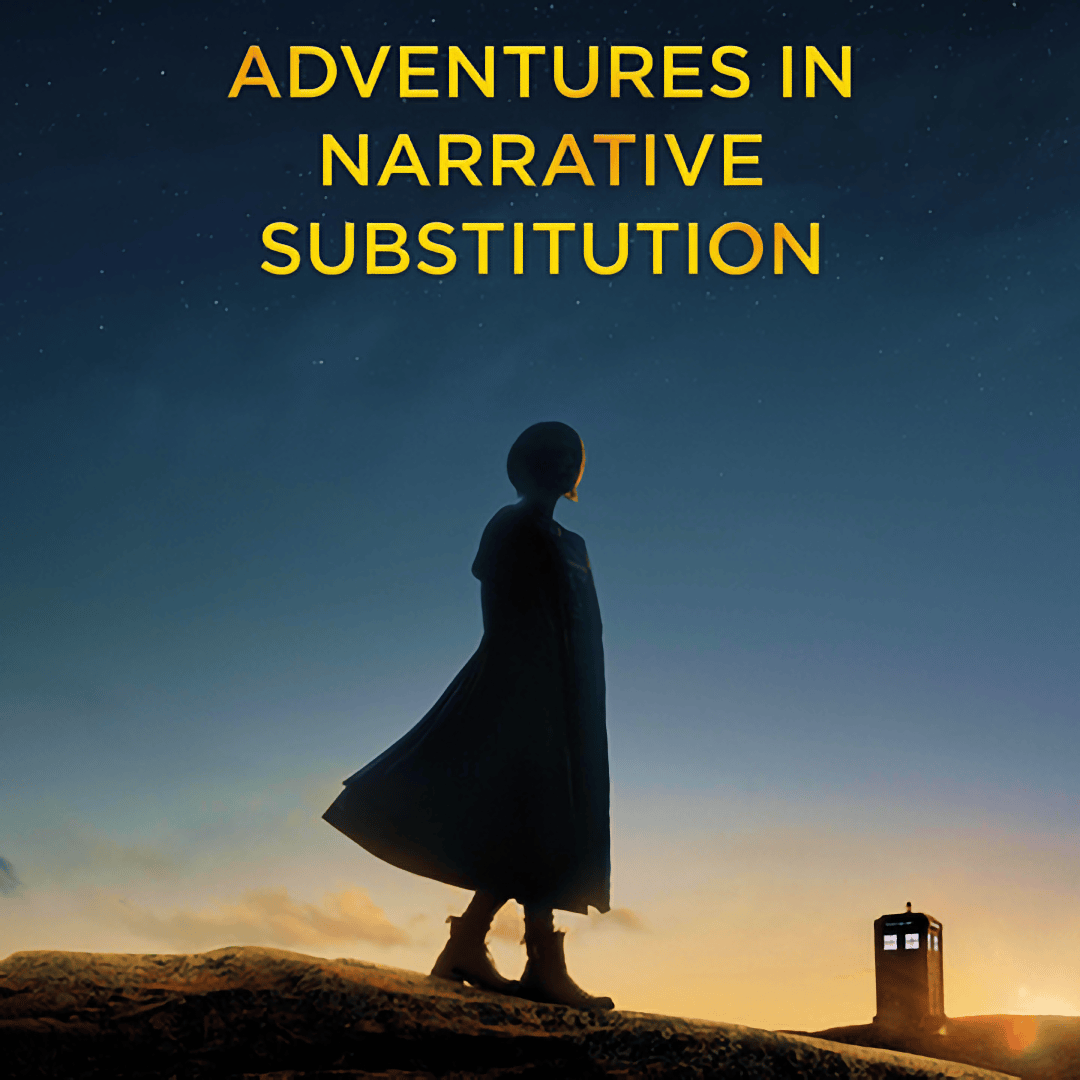
‘The Tsuranga Conundrum,’ as I’ve said, was the episode at which I realized the Chibnall era was never going to be my favorite. I’ll accept that the episode was a rush job due to the original writer dropping out at the last minute, forcing the showrunner to pick up the slack. Things like this happen all the time on Doctor Who. Russell T Davies, for example, wrote ‘Tooth and Claw’ himself because the writer originally assigned to it ignored the brief and turned in a script about aliens living in Queen Victoria’s eye. Watching the finished product though, you’d never guess it was a rush job!
But Chris Chibnall, simply put, isn’t half as good a writer as Davies. His problem isn’t entirely that his emotional and science fiction beats never cohere: Steven Moffat had that same issue in Series 6, but the end result was still watchable television because you had interesting set pieces and the ridiculously good acting of Smith, Gillan, Darvill, and Kingston.
Chibnall’s issue is that he never even tries to bring things together. The story itself even literalizes it! The Doctor and Yaz are in one part of the ship having a science fiction adventure while Graham and Ryan are busy in another doing a Call the Midwife episode with a pregnant alien man. The two plots never intersect; Chibnall just ticks those items off and moves on to the next thing.
The sad part is that he used to understand this. I know I gave him a hard time in my Series 5 book, and I stand by what I said there, but I will admit that from a construction standpoint, ‘The Hungry Earth’ / ‘Cold Blood’ is a better story than most of his Whittaker era scripts. The emotional beats not only cohere, they are the engine of the narrative. Elliot’s kidnapping and Alaya’s murder are the story, as they should be. So the question is: what happened between then and now? The true Tsuranga conundrum is, why did he actually get worse over time?
To try and arrive at an answer to that question, let’s look at a key moment from this story: the TARDIS crew and the folks aboard Resus One are in life-threatening danger due to the P’ting. Ryan and Yaz go and meet the aforementioned pregnant alien man, then grind what pacing the episode had to a complete halt so Ryan can give exposition about his absent father (which is a deeply problematic storytelling choice all by itself, but I digress).
It’s at least tangentially relevant to Yoss’ own concerns about fatherhood, but aside from that tenuous connection, the detail is dropped and ignored until ‘Resolution (of the Daleks).’ As with virtually everything else about the script, the conversation between Ryan and Yaz feels like it was only put there to fulfill the Emotional Moment requirement with no regard for how it might, or might not, affect the rest of the story. In other words, Chibnall’s approach to scriptwriting is the TV equivalent of building an IKEA bookshelf and then not bothering to put anything inside it.
So let’s look at two stories that can juggle emotional beats with science fiction ones, and quite well at that: first up, a story from the era that Chibnall had been said to steal from, the Hartnell era. Broadcast in early 1964 (while The Beatles were breaking into America, in fact), ‘The Edge of Destruction’ is a two-part story set entirely within the TARDIS, focusing on the Doctor, Ian Chesterton, Barbara Wright, and Susan as they all, in various ways, completely go to pieces while the ship appears to fall apart around them.
The first thing to note, for those of you have never seen a Hartnell story before, is that early Doctor Who is very different from the flashy HD series we know. It’s all in black and white and in a low resolution compared even to the rest of the classic series, so the picture looks a bit blurry relative to what we looked at last time.
Character-wise, the Doctor at this stage is very far removed from the character Jodie Whittaker plays; here, he’s suspicious and paranoid, quick to judge, and generally an insufferable asshole. Barbara even calls him out on it toward the end of the first episode, as part of a wider argument:
BARBARA: How dare you! Do you realize, you stupid old man, that you’d have died in the Cave of Skulls if Ian hadn’t made fire for you?
DOCTOR: Oh, I-
B: And what about what we went through against the Daleks? Not just for us, but for you and Susan too. And all because you tricked us into going down to the city.
D: But I, I-
B: Accuse us? You ought to go down on your hands and knees and thank us. But gratitude’s the last thing you’ll ever have, or any sort of common sense either.
‘The Edge of Destruction’ is a taut cabin fever thriller as the Doctor accuses Ian and Barbara of sabotaging the ship, Susan tries to kill people, and the TARDIS herself appears to be going haywire, and all this in a story that was supposed to be cheap to make due to the original episode order getting expanded from 4 to 13. The writer was David Whitaker, one of the best writers the show has ever had and a key ingredient in making the show what it is today.
What makes the story so compelling even after nearly sixty years are the characters themselves. Ian and Barbara never joined the Doctor on purpose; they were kidnapped and spirited away, first to pre-historic Earth and then to Skaro where they met the Daleks, with an irascible old man and his unearthly granddaughter for company. If you’re going to make a four-person TARDIS team work (and that’s very hard to do), you have to make them all very different characters and not be afraid to get them into conflict with each other. These four travelers are not friends; they’re just bound together by circumstance, though this story is where they begin to grow close.
Let’s look again at the TARDIS team Chibnall assembled when he took the reins of the show back in 2018. As in the ‘60s, we have a four-person TARDIS team split evenly between men (Ryan and Graham) and women (the Doctor and Yaz), who are brought together not by choice but by happenstance: ‘The Woman Who Fell to Earth’ has a final scene where the Doctor throws together a TARDIS detector and uses it to teleport where she thinks the ship is, accidentally taking the Sheffield trio with her. And as in the ‘60s, the episode ends on a cliffhanger leading into the next story; in this case, the four of them are stranded in the vacuum of space, clearly about to die. Not exactly a strong basis for a friendship there.
By all accounts, the Sheffield Trio should be pretty suspicious of the Doctor during ‘The Ghost Monument,’ right? Would you trust some alien woman who left you unprotected in space long enough that you should die of exposure pretty much immediately? I sure wouldn’t! Graham has a few noises to that effect later on as they’re wandering the vast, empty landscapes of Africa Desolation, but by story’s end, everyone is on the Doctor’s side, ready to vworp off on to the next adventure. Which isn’t really how character development works.
The recurring problem I’ve seen with Chibnall’s recent Who output is that he doesn’t seem to want to do the actual work involved in growing his characters organically. Just in Series 11 itself, we have the Sheffield trio all deciding to join the Doctor in her travels at the end of ‘Arachnids in the UK’ in spite of the fact that precisely none of the adventures they’ve had indicated that doing so is a good idea. At the end of the season, Graham suddenly announces he wants revenge on Tzim-Sha for Grace’s murder when there was zero indication of such in the previous nine episodes. But the plot of ‘Ranskoor,’ to the extent it has one, requires it, so there we are.
Things couldn’t be any more different in 1964. Over the course of two episodes, David Whitaker was able to turn his cast of regulars from four reluctant travelers into close friends through the crucible of a time machine that found itself rewinding back through history to the Big Bang. (And then, 20 years later, Christopher H. Bidmead did largely the same thing in the first episode of ‘Castrovalva,’ another story with a four-person TARDIS crew.) But the Fam of 2018 get no such development, not even a little.
All of this is a very long way of saying: is it any wonder Ryan’s chat with Yaz about his father rings hollow? Much like his dyspraxia or Yaz’s job as a police officer, it only comes up when the plot needs it to and is removed from play immediately afterwards. He feels flat and generic because no work was done to build him into an actual person.
Let’s jump ahead a bit to 2011 and visit a story that I already wrote about for Back to the Eleventh Hour: ‘The Girl Who Waited,’ written by Tom MacRae in his second and final script for the show. Much like ‘The Edge of Destruction,’ it’s a big character piece with only four characters – the Doctor, Rory, and the two incarnations of Amy – set primarily in a white void, a warehouse, and the TARDIS. It’s a magnificent piece of drama, taking Amy’s love for the Doctor and twisting it into hatred. Indeed, the Doctor is very much not a good guy in this story, what with not checking to make sure there wasn’t a plague going on before leaving the TARDIS in the first place then lying to Rory that both Amys would be able to travel together without causing a paradox.
This isn’t Back to the Eleventh Hour though, so I’ll keep my gushing brief: it’s a brilliant story and acted very well indeed by all the regulars, Karen Gillan in particular. In fact, this story is one that could only have happened with the Ponds (I can see an argument for Ian and Barbara, but only if they ever got character development on par with the Moffat Era, and good luck finding any of that in 1960s Who).
By this point in their timeline, we know them and their relationship with the Doctor very well: Amy is still haunted by the emotional abuse she suffered as a child, and the Doctor leaving her on Earth for 14 years was a huge part of that, so of course having it happen to her again would cause those old wounds to rip back open. And of course she’d react in the way she does, growing into a bitter and cynical older woman; you’d do that too if your abuser kept hurting you.
And that is what Amy’s story is about, as I’ve said before in other places: growing up with, and eventually healing from, that abuse. I don’t think it’s at all coincidental that she and Rory stop being regular companions in the episode immediately after this one. Karen Gillan and Arthur Darvill may have had more time left, but their characters were ready to bring their fairytale to an end, no doubt because of what they experienced here.
I vibe with Amy, I really do. I grew up as a victim of emotional abuse myself, and that abuse continues to this day, each time my mother chooses to respect the pronouns of a trans person she knows only in the abstract but never does for her own daughter. It’s not a happy life to live, and while I’m trying to break free from it, it won’t happen suddenly; it has to be done gradually. Unlike Amy Pond, I don’t have a fairytale hero in a magic box to rescue me.
It’s a credit to Steven Moffat’s writing ability and Karen Gillan’s ability as a performer that someone like me, an American transfemme enby wolf, can find loupself in a character like Amy. I could never do that with any of Chris Chibnall’s characters, because as I’ve said, he never does the work to make them feel real. They’re plot devices, not people.
‘The Edge of Destruction’ and ‘The Girl Who Waited’ both work because the writers made the effort to make these characters come to life and found the right actors to portray them. By contrast, ‘The Tsuranga Conundrum’ fails because nothing was done. For crying out loud, Yasmin Khan’s been on the show for three years now, and I still couldn’t tell you anything about her beyond basic biographical details.
I change my mind: the real Tsuranga conundrum isn’t why Chris Chibnall became a bad writer when he became showrunner. It’s why he was ever allowed near the job in the first place.


Leave a Reply