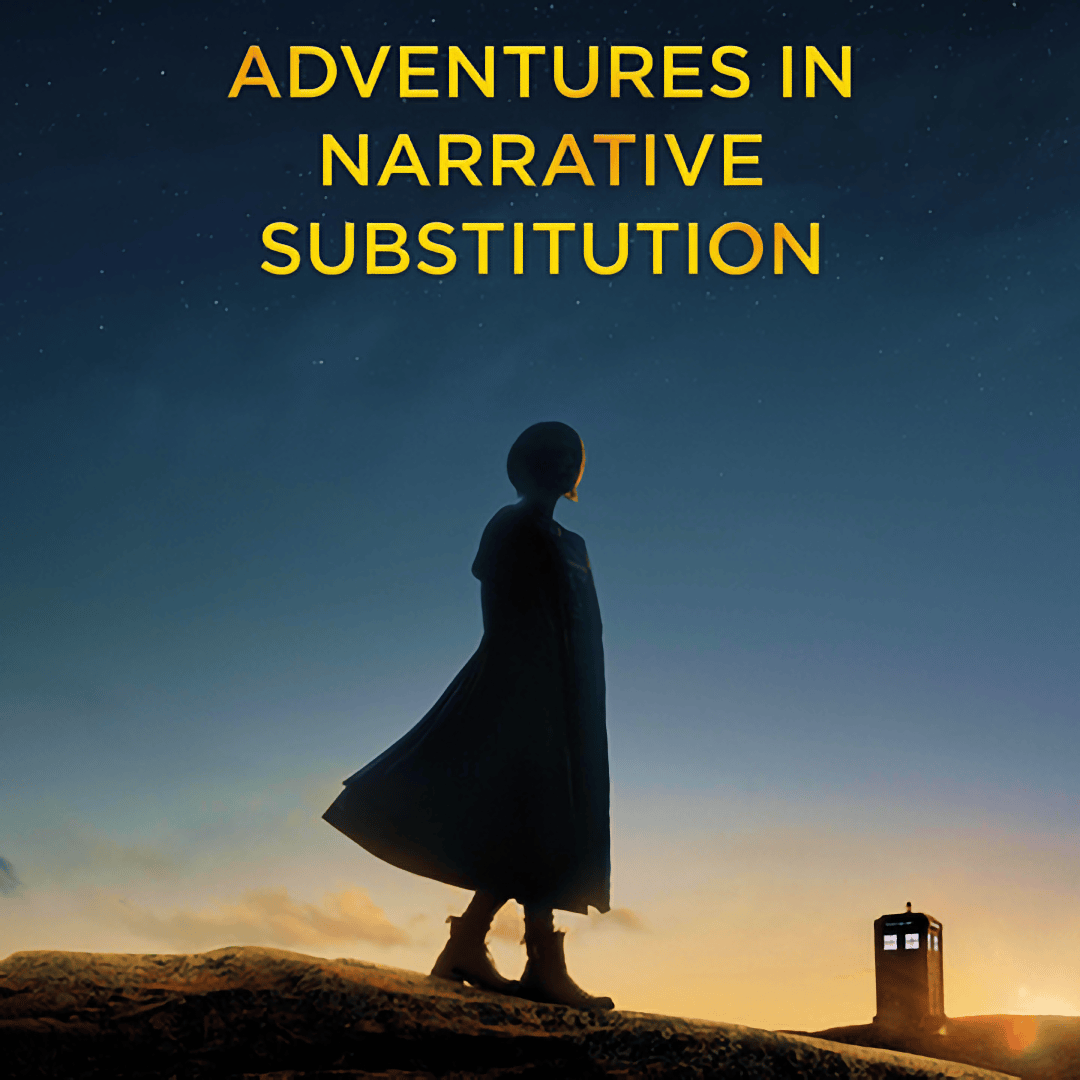
Demons of the Punjab has always presented me with something of a challenge. It is a rare example of what this particular era of the show looks like when all the pieces come together in the right way: The script is fantastic, the guest cast and the regulars are given plenty to do, the score is sublime (recording the show’s theme as an Indian chant was an inspired move). It received universal acclaim when it aired, and very well deserved at that.
Demons shows what this era can do when it really tries: it tells a beautiful, heartbreaking story about human problems and human concerns. If you took the Thijarians out, you’d have a convincing case for the revival of the pure historical, but focused on exploring social problems, like religious intolerance. (Rosa is another argument in favor of bringing back the pure historical. Honestly, I think it would work better as one.)
But it’s not really a Doctor Who story, or at least not in the way we’re accustomed to seeing one. Yes, it has the Doctor and the companions and the title sequence, but if you took out all those things, you’d end up with a 50-minute docu-drama about the partition of India and how it affected one family in particular. Which, I suppose, is the kind of fascinating thing that happens when an avowed non-fan is picked to write for the show.
The one thing that Demons fails at doing, however, isn’t even Vinay Patel’s fault. The episode was supposed to be Yaz’s moment in the spotlight, and to be fair, it is because of her that the episode even happens: she gets a broken watch from her grandmother as a present, and via the TARDIS telepathic circuits, the Doctor takes them back to India in 1947.
However, just because Yaz is the reason for the story doesn’t mean she’s an important part of it. Yes, it’s about her family, but you could remove her from the scenes in 1947, come up with a different reason for the Doctor and company to arrive there, and still have the same basic plot. Even in a story that is supposed to center around her, Yaz is surplus to requirements.
Yasmin Khan has to be the biggest waste of companion potential in the history of the revival, and perhaps the classic series as well. I mentioned this at the end of last week’s post but I’ll repeat it here: even after three years, with only nine episodes left of this era, I still know next to nothing about her beyond basic biographical information: she’s nominally a police officer, she has a family that allegedly drive her crazy, and she became a police officer because a cop brought her back to Sheffield when she ran away from home as a kid.
Outside of that, she’s a functional non-entity, existing only to ask the Doctor what something is or make empty comparisons of things she sees on her travels to what she’s familiar with back home. If Graham and Ryan are Comic Relief, she’s Exposition. She fulfills a requirement of the script and little else.
Is it any wonder that Mandip Gill, the poor woman who got saddled with playing her, was forced to admit this in a Radio Times interview?
“I’d had a conversation with Chris [Chibnall] about the first series, and he was very open to ideas. I only went with, “I’d love to know more about her.” And maybe she shouldn’t always agree with the Doctor, because I find in series 11 she did naturally always agree, she was always looking up to this person.”
Not exactly the kind of thing you want to hear from one of your lead actors, a polite request to the head writer to give her an actual character to work with instead of an exposition and agreement machine. But then again, that’s part and parcel with Doctor Who in the time of Chris Chibnall: no people, only plot functions.
On the other side of the companion coin, you have Rose Tyler, played so memorably by Billie Piper in the first two seasons of the revival and then sporadically in 2008. She is the companion of the Russell T Davies years, and while I don’t have the same nostalgia for that period of the show as I do for the Moffat/Smith years, even I can admit that Rose is very much deserving of her legendary status.
One of her best episodes is Father’s Day, a single-part story by Paul Cornell from Series 1. Like Demons, Father’s Day starts off with the companion asking the Doctor to visit a family member in their past: in Rose’s case, November 7th, 1987, the day her father was killed in a hit-and-run accident. (Incidentally, this happened in between two episodes of the Seventh Doctor adventure Delta and the Bannermen.) The Doctor agrees, and when they arrive, Rose witnesses his death but doesn’t move to comfort him like she planned to, she’s too paralyzed with fear. Immediately regretful, she and the Doctor give it another try. And on the spur of the moment, she pulls her father out of the path of the other car, saving his life and creating a time paradox.
A few minutes later, she and the Doctor have an argument in the living room of Pete’s apartment:
DOCTOR: When we met, I said travel with me in space. You said no. Then I said time machine.
ROSE: It wasn’t some big plan. I just saw it happening and I thought, I can stop it.
DOCTOR: I did it again. I picked another stupid ape. I should’ve known. It’s not about showing you the universe. It never is. It’s about the universe doing something for you.
ROSE: So it’s okay when you go to other times, and you save people’s lives, but not when it’s me saving my dad.
DOCTOR: I know what I’m doing, you don’t. Two sets of us being there made that a vulnerable point.
ROSE: But he’s alive!
DOCTOR: My entire planet died. My whole family. Do you think it never occurred to me to go back and save them?
ROSE: But it’s not like I’ve changed history. Not much. I mean he’s never going to be a world leader. He’s not going to start World War Three or anything.
DOCTOR: Rose, there’s a man alive in the world who wasn’t alive before. An ordinary man. That’s the most important thing in creation. The whole world’s different because he’s alive.
When we’re young, our parents and guardians tell us things like “The world does not revolve around you!” in an attempt to instill some humility in us. But in fiction, it’s different: the world really does revolve around the protagonist, and nowhere is that more true than in this story. Earth is under threat because of Rose’s rash decision, and the only way she can fix it is to come to terms with Pete’s death and allow history to play out as it must… more or less. She can still comfort Pete in his last moments and not attract the attention of the Reapers, so she does just that.
This story, to be blunt, simply would not exist without Rose. As with The Girl Who Waited last week, you couldn’t really do this with any other character except her. And it works because, even at this early stage, we know enough about her to make the concept sing. A version of Demons where Yaz tries to save Prem wouldn’t work because, as she herself points out, Prem isn’t her grandfather, there’s no drama there. But on the other hand, it would at least give her some sorely-needed character development. It’s shameful that Yaz still seems like an unknown quantity, where Rose doesn’t.
Demons is not, as I originally argued in 2019, the Chibnall-era version of Father’s Day. Yes, the stories start off similarly enough that I would still feel comfortable recommending it to anyone who wants to know what could have been with regard to Yaz versus Rose, but outside of that the two stories are complete opposites.
If anything, the story that Demons most resembles is The Massacre by John Lucarotti, which presents us with a bit of a problem: it’s completely missing.
While I’m sure 99% of the people reading this already know what I’m about to say, here it is for the 1% of you who might not: Until the late ‘70s, official BBC practice was that the tapes for a given episode of something would be wiped after the show had been transmitted. Television happened once back in those days, since the technology didn’t exist to record something for later. If you missed it, you were fucked.
And while quite a few stories have been recovered in video format in the decades since the junking practice was stopped, The Massacre wasn’t one of them. According to the TARDIS Data Core wiki:
This serial is one of the worst hit by the BBC’s now-abandoned junking policy, with not only all four of its episodes missing, but no footage or official telesnaps whatsoever existing to provide a visual reference point. Only promotional photographs are left to identify some of these lost moments. One of many lost moments was a landmark for Doctor Who, featuring one of the first times an actor playing the Doctor performed double roles as the main character and a look-alike: William Hartnell starred as both the First Doctor and the Abbot of Amboise, but unlike The Chase, in which Hartnell appears in some scenes as a robot duplicate, the Doctor and the Abbot never meet during the course of the story.
The best we’ve got is to listen to the soundtrack, available from BBC Audio with narration by Peter Purves. So, absent a visual incarnation of the story, the audio version is the one I’ll be referring to for the rest of the post.
The Massacre belongs to a genre of story I’ve mentioned twice already but have never defined: the pure historical. That is, a story taking place in Earth’s past that has no science fiction elements in it aside from the TARDIS. (Father’s Day is what’s called a pseudo-historical, where sci-fi bits are present, and usually cause problems.) In the story, the First Doctor and his companion Steven Taylor visit Paris in the 1570s, and as they explore, Steven discovers a terrible plot is being hatched.
In the early days of the Chibnall era, it was often said by various folks in fandom, myself included, that Chibnall appeared to be doing an updated take on the Hartnell seasons with his approach to the show, between setting up a four-person TARDIS team and having the historicals be of a more educational bent than what had gone previously: Rosa educated British kids on the civil rights movement and Parks’ role in the fight, and Demons taught me about a part of British history I was previously unaware of, being American and all. (Our involvement with UK history stops in 1783.)
And like Demons of the Punjab, The Massacre is a deeply unhappy story, as most stories covering historical atrocities tend to be. It even has similar subject matter: intolerance between religious sects, though in this case the assassination of various Huguenots in August 1592 instead of conflict between Muslims and Hindus. And as with the two Chibnall-era historicals we’ve looked at so far, the Doctor and Steven are unable to intervene, something that Steven angrily complains about in the fourth episode. He storms angrily out of the TARDIS, furious with the Doctor’s inaction.
But in the end, the Doctor is right not to intervene. What a pure historical does is it forces us to look at ourselves and our world as the monsters, rather than some fictional external force. It’s a hard pill to swallow, no doubt about it, no one likes to be confronted with their faults and wrong doings. Yes, Demons has aliens in it, but the Thijarians aren’t monsters, they just witness the deaths of the little people in the world, the ordinary people like Prem, and perhaps Pete Tyler. The real demons are humanity, and their constant need to kill and destroy anything different from them, no matter how minute those differences are.
Demons of the Punjab is a powerful, valuable story, and while I might find the era it’s a part of to be highly distasteful, I can’t bring myself to hate it. No other story in the show could take The Massacre’s focus on religious conflict and blend it with Father’s Day’s focus on the companion’s family, even if Yaz herself doesn’t have much of a role to play as I’d like. This is one story that ought not be substituted, but appreciated and loved for everything it is.


Leave a Reply