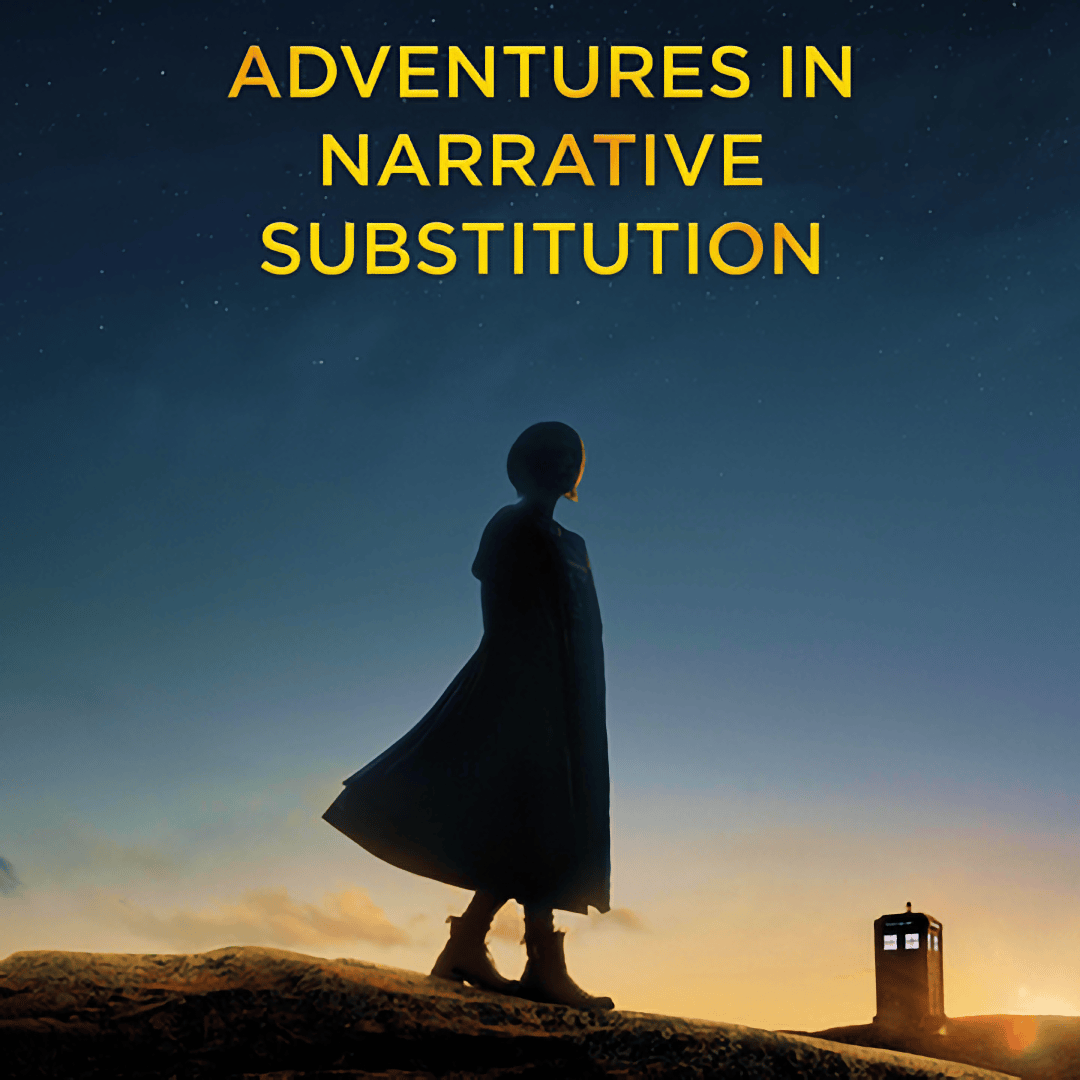
I said back in the ‘Arachnids’ post that the Thirteenth Doctor is someone who isn’t above turning a blind eye to systemic injustices if it means she can make use of them. Her entire beef with Tzim-Sha was that he did trophy hunting wrong. And she complained less about any of the evil things of consequence that Jack Robertson did and more about him using his gun to kill the spiders infesting his hotel, preventing her from going ahead with her pseudo-Ghostbusters-backpack spider-killing thingy. Which is Cleverer than guns, I guess.
In ‘Kerblam!’, we see her gush about how much she loves the humanoid delivery robots – despite the fact that one LITERALLY INFILTRATED THE TARDIS, WHICH IS SUPPOSED TO BE IMPOSSIBLE – react with disappointment when told she can’t ride the conveyor belts, and then she pulls that line: “The systems aren’t the problem.” I know that in the context of the scene, the Doctor was referring to the automated parts of Kerblam that aren’t controlled by humans, but that still doesn’t make the line any less morally repugnant. For crying out loud, Doctor, the system you love so much lured a girl to her death a few scenes ago, and you didn’t even care!
I admit I don’t know exactly who was responsible for the infamous twist, but I don’t know that it really matters either: yes, the story is well constructed and is clearly written by a longtime fan of the series who isn’t afraid to throw in a few in-jokes at us (mainly the fez), and yes, the first three-quarters of the story all seem to be trending in the Contemporary Cartmel Story direction… but all of that gets poisoned by the ending. It didn’t have to be like this.
Just a year earlier, in 2017, we had a story that hit a lot of the same beats as ‘Kerblam!’, but with a much better ending. I’m referring to ‘Oxygen,’ written once again by Jamie Mathieson. In that story, the Twelfth Doctor, Bill Potts, and Nardole land on the space mining station Chasm Forge. Here, people are dying, killed by their own spacesuits when they run out of oxygen. Air is a precious commodity in the depths of space, so if you can’t afford to pay, you’re out of luck… permanently.
Aside from being an excellent satire of the same ‘profit above all else’ mode of capitalism that animates the American health care system, it also works as a very effective preemptive critique of ‘Kerblam!’. The Doctor ends the story convincing Ganymede Systems, the company that owns Chasm Forge, that letting the employees die would be more expensive than letting them live, and in dialogue later, we find out that humanity was able to overthrow its capitalist space masters in the future. That, Doctor Thirteen, is how you deal with greedy corporations.
All that said, the Doctor isn’t the only abhorrent character in this story: the other one is Charlie, the curly-haired 20-something who is probably supposed to be a millennial or someone of Gen Z, depending on where the border between those two groups lies. He’s mad at Kerblam because they’re relying too heavily on automation for their business, and so he comes up with a plan: make some destructive bubble wrap, let the machines take the fall when it inevitably explodes, and erode people’s trust in automation so that more humans will have to work in Kerblam’s exploitative fulfillment centers… and at the end of the story, guess what happens? The people in charge at Kerblam announce they’ll start hiring more human workers, while the current ones get a month off and two weeks of paid leave.
Yeah. Charlie got exactly what he wanted, and he wasn’t even alive to see it.
Meanwhile, every single activist I know is arguing for the deconstruction of the capitalist state; subjecting more people to grueling work conditions for starvation wages would just compound the problem. I get that Charlie is meant to be a satire of people from my age group who are politically active, but what he’s trying to bring about is the literal opposite of what the millennial/Gen Z left actually believe. In other words, nothing about this character makes any amount of sense. Pete McTighe might be able to turn the women of Doctor Who into staunch capitalists, but he can’t seem to do decent political satire.
Fortunately, there is someone who can do good satire, and that would be Robert Holmes. In 1977, he wrote ‘The Sun Makers,’ a four-part story for the classic series’ fifteenth season. Here, the Fourth Doctor and Leela land on Pluto, where they quickly discover the workers who lived there are being kept in economic servitude by the sinister Company, forced to work all day and be taxed for everything, death included. The story came about because, according to Shannon Sullivan:
“[Holmes] was embroiled in a protracted disagreement with Inland Revenue — then the agency which handled the collection of taxes in the United Kingdom — over the levies applied to his income as a freelance writer. Holmes was becoming increasingly frustrated as he tried to navigate a series of seemingly arbitrary and byzantine regulations. With The Sun Makers, he saw an opportunity to lampoon Inland Revenue, and the sphere of finances and taxation in general.”
So, Holmes went and threw in as many snide Inland Revenue jokes as he could get away with, and the end result was a script that railed against taxation that targeted society’s poorest. Everything gets privatized all to hell and back, and the social safety net is ripped to shreds, so if people can’t afford to pay, the only way out for them is suicide. Bear in mind that Holmes was a member of Britain’s Conservative Party and supported Margaret Thatcher, and here he accidentally writes a story endorsing socialism.
Watching this story in 2021, I feel like I’m living in far-future Pluto. See, when I wrote the original version of this post two years ago, I didn’t know what it was like to work in retail. At the time, I was living at home with my parents, unemployed and looking for work after graduating college with a bachelor’s in audio production. Bored to death and in need of stimulation, I turned to writing media criticism so I could talk about one of my favorite shows in greater detail than would be possible in a tweet. That turned into writing at least four or five separate blog series, which then turned into writing two books with plans for several more.
Around the time I was starting to work on the edits for the Series 5 book, my job hunt paid off: I got a cashier gig at a major American pharmacy/retail store chain, making $10 an hour, 24 hours a week. Not exactly anything to write home about, and certainly nothing that would get me moved out into my own place, but it would be a useful step on the way there.
Even before you factor in the once-in-a-century pandemic that has completely uprooted everything, retail is hell. My company may not be as draconian as the titular Amazon clone in ‘Kerblam!’, but the exhaustion, inescapable sense of uselessness, and general depression about the path one’s life has taken is real. I spend most of my time at work standing up, aside from the 45 minutes I get for a break. On a good day, I’m there at 8 a.m. to 2:30 p.m., so I only lose the morning. On a bad daym I’m there for nearly 9 hours. But regardless of shift length, I’m still spending the vast majority of my time at work up front, ringing up customer after customer and asking if they’re a member of our rewards program (never, ever sign up for rewards programs). All being an essential worker means is that you’re expendable.
And if that wasn’t bad enough, consider this: rising house prices means that people of my generation are going to be a generation of renters, and even that isn’t going to be sustainable. The average renter in St. Louis pays $700 a month. In other cities, it’s even higher: at least $2000 a month in Boulder, Colorado, where I once lived for about a week. There’s still an eviction moratorium because the pandemic, but it only got extended because Cori Bush (a Congresswoman from Missouri, our version of Alexandria Ocasio-Cortez) made enough noise on the steps of the House of Representatives that President Biden finally decided to do something. Meanwhile, the majority of Bush’s Democratic colleagues packed up and went home for the August recess even though they knew the moratorium was due to expire.
And if that wasn’t enough, Missouri’s COVID-19 infection rates are continuing to climb, because our Republican governor refuses to do his job and institute a mask mandate, a vaccine mandate, or any other measure which might curb the spread of the delta variant.
This is what it’s like in America in 2021: not only can money not buy love, it can barely buy a place to live or food to eat. Our leaders in government at all levels don’t care, and if they do end up doing something decent, it’s only because someone twisted their arm. The best I can hope for is that I get a full-time job that pays enough to let me afford rent on one of those $700 apartments, along with food, utilities, and other necessities, to say nothing of the medical bills I’ll incur as I attempt to start my gender transition. Aftermarket womanhood ain’t cheap, and there are times where I genuinely envy the women I know who were born into it.
The Thirteenth Doctor is wrong. The systems are the problem. Capitalism is the problem. The best I can hope for in my life is to escape an unsupportive living situation into one where I barely have time to enjoy the place where I live because I’m working my tail off just to afford rent. That’s not the kind of life I want for myself; that’s not the kind of life anyoneshould want. We deserve to live life to the fullest, without worrying about bills and rent and goddess knows whatever else.
I have no doubt that if they were real people, Doctors Four and Twelve would do everything they could to bring down the government and build a collectivist society in its place. Hell, any Doctor would do that, because that’s what the Doctor is supposed to do. She’s supposed to tear the status quo apart because she knows it’s wrong, because she knows it’s hurting people she cares about.
But under the pen of Pete McTighe and Chris Chibnall, she doesn’t do any of those things. She doesn’t even try. She just takes Slade and Judy at their word, allows them to condemn more humans to minimum wage hell, and walks off back to the TARDIS.
At this point, we may as well just call her the Capitalist. It’s a better title than Doctor.


Leave a Reply