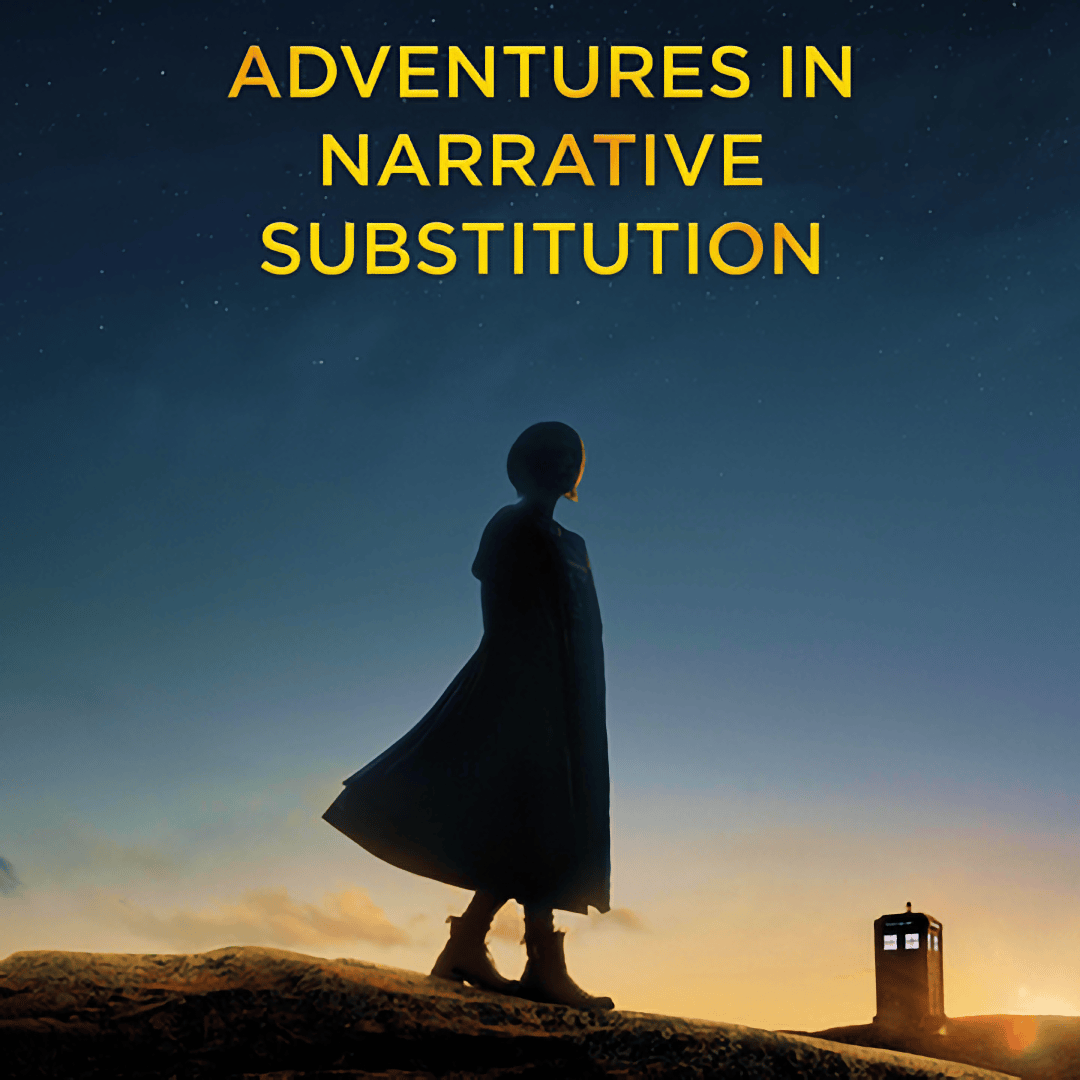
One of the things that has always bothered me about the Chibnall era is its complete and utter reluctance to acknowledge the eight years of television that immediately preceded it. That’s not to say it gets ignored entirely: a fez, the Eleventh Doctor’s signature hat, appears in the first few minutes of ‘Kerblam!’; the Doctor spends the bulk of ‘Woman’ wearing the raggedy remains of 12’s outfit; all three Moffat-era Doctors (War, 11, and 12) are glimpsed in the great big flashback scene in ‘The Timeless Children’ when the Doctor uses the power of continuity to break free of the Matrix; and a Weeping Angel and a Silent both pop up as the Doctor’s fellow prisoners in ‘Revolution.’
But all of that is surface level. The rest of the time, the show is more inclined to refer back to the Russell T Davies era, especially in Series 12, for reasons I’ll elaborate on when we get to ‘Spyfall.’ Series 11 was mandated by the BBC to be as continuity-free as possible, which partially explains things: contractual obligations do tend to limit what you can do with something. But on the other paw, you don’t need an avalanche of continuity references to show you’ve been paying attention; you can do that in how you tell your stories as well.
The best example of this actually comes from the Moffat era itself: his first season in charge, the revival’s fifth, was built along the same blueprint as the previous Russell T Davies seasons – an opening present/past/future triptych to introduce the new TARDIS team, a couple of two-part stories with returning monsters, a cheaper episode with minimal contributions from one or both of the regulars, and then a two-part finale, but all those parts had their own Moffatian touches to them that made them stand out from any of their Davies-era equivalents (for more on Series 5, please see Back to the Eleventh Hour: Volume 1 from Arcbeatle Press).
‘It Takes You Away,’ in my book, is the only story in Series 11 that feels like it’s part of the same show as anything from the Moffat years. This is even visible in the title: ‘It Takes You Away’ isn’t like a lot of Doctor Who episode titles, which are usually built out of nouns and adjectives. Steven Moffat’s titles, when they don’t follow those rules, are either puns or isolated lines of dialogue, as with Blink, Deep Breath, and Listen, and that’s the tradition It Takes You Away is following, as it describes what Hanne thinks the imaginary monster does when it goes out to hunt.
Even the episode’s construction echoes the Moffat era: going by the opening minutes, you expect the story to be about the Doctor and her friends rescuing a blind girl from a horrible monster, which would be very much in line with the current era’s focus on female pain and adversity. But the introduction of the mirror and the reveal that Erik’s been living there with a duplicate of his dead wife turns it into a completely different story entirely: parental abandonment.
If you’ve been reading Back to the Eleventh Hour, then you know how big a theme that was in the Smith years: Amy was raised by an aunt because her parents got eaten by the crack in her wall and so never existed, baby Melody was forcibly abducted from her parents as a newborn, and Clara’s mother Ellie died when Clara was a young girl, so she was raised by her widowed father.
And as with ‘It Takes You Away,’ those losses are made up for: Amy remembers her parents back into existence during ‘The Big Bang,’ while Melody spends the rest of her childhood in Leadworth with Amy and Rory after escaping from Kovarian and the Silents in America, and the days Ellie Oswald never got to live were instrumental in defeating the living sun in ‘The Rings of Akhaten.’
‘It Takes You Away,’ in so many ways, is a story that applies the preceding era’s storytelling methods to the current one and, in so doing, is a bit like when Robert Holmes wrote ‘The Caves of Androzani,’ a story that took everything Eric Saward had turned the show into (a macho military sci-fi festival of violence) and proceeded to do it better than the guy actually in charge. The difference, though, is that Holmes was a Who veteran coming back for a victory lap of sorts, while Ed Hime is completely new.
Where this story really shines isn’t just in its invocations of the show’s immediate past but in its emotional content too. Chris Chibnall’s decision to kill off Grace O’Brien to give Graham something to angst about remains one of his era’s original sins, (especially in light of Bill Potts turning into a lesbian water goddess), but the way Hime chooses to engage with that is beautiful:
GRAHAM: I’m lost, Grace. I miss you. All my life, I was looking for you. Then I found you and I was so happy.
GRACE: That makes two of us.
GRAHAM: And then I lost you.
GRACE: I’m here.
GRAHAM: Yeah. I miss you so much. I miss you so much, Grace.
Graham finally gets the closure he deserves, at long last. This by no means excuses the decision to kill Grace off (I would have much preferred a version of Series 11 and 12 with her instead of Graham, if I’m honest), but it does, at least, resolve that plot-line far more satisfactorily than what Chibnall himself does in the story immediately after this: having Graham suddenly announce a deep-seated desire to get revenge which he then chickens out on.
Successfully pulling off the conclusion to a character arc, in any other period of the show, would not be something to spend several paragraphs talking about in detail like this, but with the Chibnall era, we media critics have to set our standards low. I’ll talk about this more next week, but it’s worth stating here too: the Chibnall era, as I established in the ‘Tsuranga’ post, is terrible when it comes to emotions. ‘The Doctor’s Wife’ is a heartbreakingly beautiful story about the Doctor and her beautiful ghost monument finally getting a chance to talk to one another, face to face, and it ends with the Doctor visibly crying when he has to let Idris go, and that’s on top of a sequence in which we hear exactly what happened the day the Doctor left Gallifrey from the TARDIS’ perspective and, slightly later on, this conversation when they’re building the junkyard console room:
DOCTOR: You know, since we’re talking with mouths, not really an opportunity that comes along very often, I just want to say, you know, you have never been very reliable.
IDRIS: And you have?
DOCTOR: You didn’t always take me where I wanted to go.
IDRIS: No, but I always took you where you needed to go.
There is no sequence in the entire 58 year history of the series that describes the Doctor’s relationship with the TARDIS half as well as that one does. As I wrote in the Back to the Eleventh Hour post on Wife, this “is a love story between pilot and ship. Companions come and go, but the Doctor will always have the TARDIS to keep them company.”
Even ‘The Three Doctors’ gets in on this whole character arc resolution business, and it involves the TARDIS too! That story was the show’s tenth anniversary special, and saw Patrick Troughton join Jon Pertwee as the Doctor, with a few quick cameos by William Hartnell in his first, and last, return to the role since his own departure in 1966. Until this story, the Pertwee years had been entirely Earth-bound, with the Doctor unable to travel in space or time except on very rare occasions. ‘The Three Doctors’ concludes with the Time Lords thanking the Doctor for saving their collective asses by giving him back the TARDIS’ dematerialization circuit, allowing him to roam the time vortex again. That, Chibnall, is how you wrap up a character arc.
In the aftermath of Series 11, there were some rumblings (at least in the areas of fandom I’m involved in, best described as the Eruditorum Expanded Universe/Collective of Mad Sandifer Cultists) that ‘It Takes You Away’ should be considered the real finale of that run given how it engages with the Graham/Grace stuff, and I’m inclined to agree.
But I’ll also go one further: ‘It Takes You Away,’ in 50 minutes, gives us a version of this era that works, particularly in its handling of the Doctor. Ed Hime’s understanding of the character follows on from everything Moffat was doing in the past: her scribbling a message on the wall telling her companions to assume Erik was dead then lying about her doing so screams Series 6 and its repeated phrase, “The Doctor lies” (big shades of the sonic screwdriver trick in ‘Wife,’ actually). Additionally, the episode’s ending, where the Doctor successfully talks the Solitract into letting her go by promising to remember her, is rooted in the same theme of kindness that animated the entire Capaldi era.
This is notable. There is a difference between being kind and being nice: being kind, as the Twelfth Doctor described it, means returning the Brigadier’s grandfather to the World War I battlefield just late enough that he is prevented from having to kill or be killed or refusing to abandon the people of Floor 507 during the invasion of the Cybermen because it means they get to live a little longer.
What the Thirteenth Doctor has been, so far, is nice. For the bulk of the season you’d expect her to be one of those people who has ‘Live Laugh Love’ hung up somewhere on the wall or curtsy when voting against a bill to increase America’s living wage to $15 (which still isn’t enough for most people to live off of, but hey). Sure, she tortured Tzim-Sha with his own bombs, got Rosa Parks to re-stitch her coat and then didn’t pay her back, and stood by while a greedy mega-corp plotted to subject more humans to wage slavery, but at least she was polite about it all, right?!
The ITYA version of the Thirteenth Doctor, so far, is the only one that feels like a logical progression of the ones who came before, and it is very telling that a guest writer like Ed Hime has a stronger grasp on the character than the man in charge. Let’s hope that Chibnall’s replacement, whoever they are, doesn’t end up falling into the same trap.


Leave a Reply