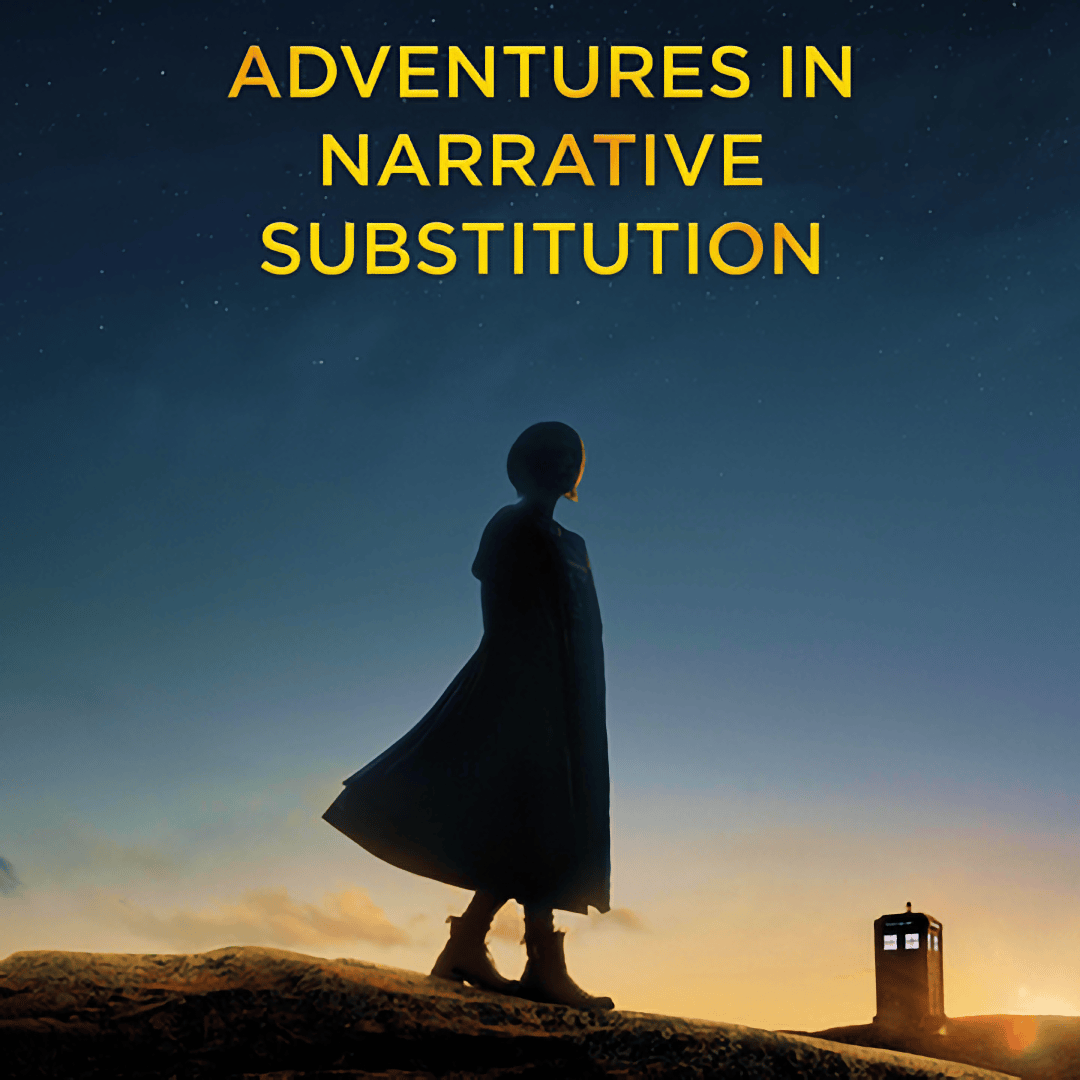
My usual format for this series has been to compare an aspect of a given Chibnall story with one from the Moffat/Davies phase of the revival and the classic series, but this week we’re breaking the rules: instead, a multi-Doctor story from each of the three modern showrunners.
Stick around the world of Doctor Who long enough and eventually you’ll find yourself writing a multi-Doctor story. Usually wheeled out for big 0 anniversaries, these very special stories are exactly what they sound like: the current Doctor joins forces with one or more of their predecessors, allowing everyone to joke around and determinedly ignore how old the previous faces have gotten since their eras ended. (For example: Patrick Troughton’s increasingly grey hair between 1973 and 1985.)
While the classic era generally stuck to the above template, with the blatant exception of Richard Hurndall filling in for a long-dead William Hartnell, the New Series has played with the formula a bit: RTD subverted it entirely with the 2008 Lenatmas special The Next Doctor, where the Other Doctor was just a human with info about our Doctor dumped into his head, while Moffat introduced a brand new incarnation added retroactively to the existing line up, albeit unnumbered. (Because yes, he is exactly the kind of person who cares about Doctor numbering, and I love that about him.)
As with Robert Holmes giving the Doctor two hearts so he’ll be sufficiently weird enough to meet the Brigadier in Spearhead From Space, the War Doctor exists to solve a plot issue introduced by Lena Eccleston refusing to come back for the 50th anniversary. Faced without everyone’s favorite leather jacket wearing Northern guy, Moffat asked himself, which Doctor fought in the Time War? Answer: someone whom the Doctor was so ashamed of once being that they refused to talk about it to anyone, even themself, until they couldn’t avoid it anymore.
Who do you get to play him? The greatest actor in the world, and because Great Britain has no shortage of them, they get John Hurt, who was absolutely delighted to play the Doctor. Soon as you see him in action in Day you immediately want more of him, he feels like he’s been in the role for years. Big Finish quickly obliged, writing and releasing a 4-part season of adventures with Hurt as the Doctor, though the last was released posthumously.
Here’s the thing about the War Doctor: for all that he is framed as being the incarnation that did things the Doctor would never do, the entirety of Day is about proving that really, in his hearts, he’s still the Doctor when it really matters. He uses a gun, but only to write a message in the wall. He helps save the Earth from the Zygon invasion and feels so bad about killing 2.47 billion Gallifreyan children that he goes along with 11’s plan to freeze Gallifrey in a pocket universe. The War Doctor is still the Doctor, no matter what.
On the other side of the coin, there is Jackson Lake. Yes, the cold open and even the title of the story want us to think he’s the next Doctor, but the facade doesn’t last: he has a screwdriver but it’s just a regular screwdriver, nothing sonic about it. And while he says he has a TARDIS, it’s not a police box but a great big hot air balloon. If anything, he’s closer to Peter Cushing’s Doctor than David Tennant’s. But in every way that matters (as 10 himself observes) he, too, is still a Doctor, in actions if not in name: “Infostamps are just facts and figures. All that bravery. Saving Rosita, defending London town, hmm? And the invention. Building a Tardis. That’s all you.”
The Jo Martin Doctor… well. Look, here’s the thing: I am entirely on board with Martin’s Doctor as a character. She more than looks the part, she got a Doctor Who Magazine cover with a “JO MARTIN IS THE DOCTOR” label on it and a “Introducing” credit in the closing titles, she’s got a police box TARDIS with a awesome console room that honestly looks better than the giant crystal penis one, (helps that it’s made from the same bits of neo-classic TARDIS that have been around since Hell Bent) and let’s face it, she exudes coolness. As soon as she introduces herself and goes into her TARDIS, it’s not Jodie Whittaker’s show anymore, Martin all but acts her off the screen.
This is kind of a problem, because once you’ve seen this, and how Thirteen responds to the Martin Doctor, you realize something uncomfortable: this is the show inadvertently admitting that the Thirteenth Doctor, as Chibnall wrote her, has been an abject failure. Martin’s Doctor kicks ass and takes names, she has agency, she’s an active part of the narrative in a way that Thirteen simply hasn’t been since The Woman Who Fell to Earth.
She really is the modern Fifth Doctor, constantly reacting to things rather than taking charge and owning the room. That kind of thing worked in the early days of the show when it was still primarily an ensemble cast led by an older man like William Hartnell, but it’s not 1964 anymore. It’s been a two-lead show for fifteen years now, and that means the person who gets top billing in the title sequence every week has to own that, and make it stick. Whittaker can do it when she’s given good material, but she can’t always, and only rarely do the scripts allow her to try.
In a way, this is the show attempting to perform a narrative substitution of its own, but it fails. There’s an alternate universe where we’ve had a season and a half of Jo Martin’s Thirteenth Doctor with Vinay Patel as head writer, and I honestly wish we lived there, because it’s a damn sight better than the one we’re stuck in. The show is aware of a better way to be itself, and then it chooses not to be that thing. Or rather, the better thing gets subsumed into the shittier thing. Martin’s Doctor is cool and all, but she doesn’t exist to solve a plot problem, as the War Doctor did. She exists to introduce… the Division.
I hate the Division, dear reader. I really, really hate the Division. Exactly why I hate it so much will have to wait until I start covering series 13, but I’ll give you a preview here. The premise of the Division is that once upon a time, the Doctor used to be an operative for what basically amounted to a Gallifreyan black-ops group, like their version of Section 31 in Star Trek.
Crucially, she had other faces during her time in the Division, at the very least a completely different set of thirteen to the ones we know, and Martin’s was one of them. In Series 13, Thirteen goes on a Quest for Information about her past life, and we even see what amounts to an extended flashback set during the Martin “era…” but it’s Jodie in her place, with a different coat. Martin gets in a few lines of dialogue and even appears in a mirror (echoing a similar shot of Hartnell appearing as Troughton’s reflection in The Power of the Daleks) but aside from that, she’s otherwise subsumed to provide development for Thirteen.
Oh yeah, and there’s this detail: Jo Martin is Black.
I’ve written previously about this era’s frustrating treatment with people who aren’t white: its original sin was the killing of Grace in The Woman Who Fell to Earth so Graham could have something to be sad about. Meanwhile, poor Ryan just gets “accept your white step-grandpa,” with barely a moment to mourn the woman who raised him. Oh yeah, and he has an absent father, because Chibnall can’t be bothered to think beyond the stereotypes.
Jo Martin plays the Doctor, but she’s never allowed to be the Doctor. She doesn’t get to help anyone, Thirteen just declares she can’t be the Doctor because the Doctor doesn’t use guns. Except that A) she does, and B) whether or not someone uses a gun is not actually indicative of their Doctorness. Martin’s Doctor is framed as a criminal on the run, which by itself is an appalling thing to write, doubly so for the first Black Doctor of any gender since Lenny Henry.
Representation matters. I’m not saying it doesn’t. When Whoopi Goldberg was very young, she watched Nichelle Nichols as Uhura in the original Star Trek and excitedly yelled, “Momma! There’s a black lady on television and she ain’t no maid!” That was huge for American TV in 1966! 22 years later, inspired by what she saw on TV in the ‘60s, Goldberg appeared on Star Trek: The Next Generation as Guinan, bartender on the USS Enterprise and a close friend of Jean-Luc Picard.
But what matters just as much as representation is context. And as I’ve made abundantly clear by now, there is no point in Fugitive of the Judoon where Jo Martin’s Doctor gets to be the hero. This is not her show, much as we truly wish it otherwise. Though she appears a couple more times after this episode, those appearances are much shorter and more in service to the Thirteenth Doctor’s journey. So, once again, a Black character is being sidelined so the story can focus on a white character.
Oh, and the Thirteenth Doctor’s journey? Here’s how series 13 ends: the Doctor drops the fob watch containing her missing memories into the heart of the TARDIS, where they will likely never be seen again. That doesn’t just include her memories of the Division, but also ones relating to another aspect of the Doctor’s past, which we’ll get to in a few posts from now.
Six episodes in series 13, plus three in this season, and four if you count the second half of Spyfall, all in service of Lena Chibnall’s deep dive into the Doctor’s past… all for nothing.
And this is where it starts. Jo Martin, the first Black woman to take on the role of the Doctor, gets dragged along to support an arc for Jodie Whittaker’s Doctor that goes nowhere.
Fuck. This. Era.
PS: If you like My Little Pony, cute artwork, Doctor Who opinions, and the Warrior Cats books, go give my friend Miranda Carousel a follow on Twitter. She’s fabulous, and it’s because of her that this post went in the direction it did. Love you, bestie!


Leave a Reply