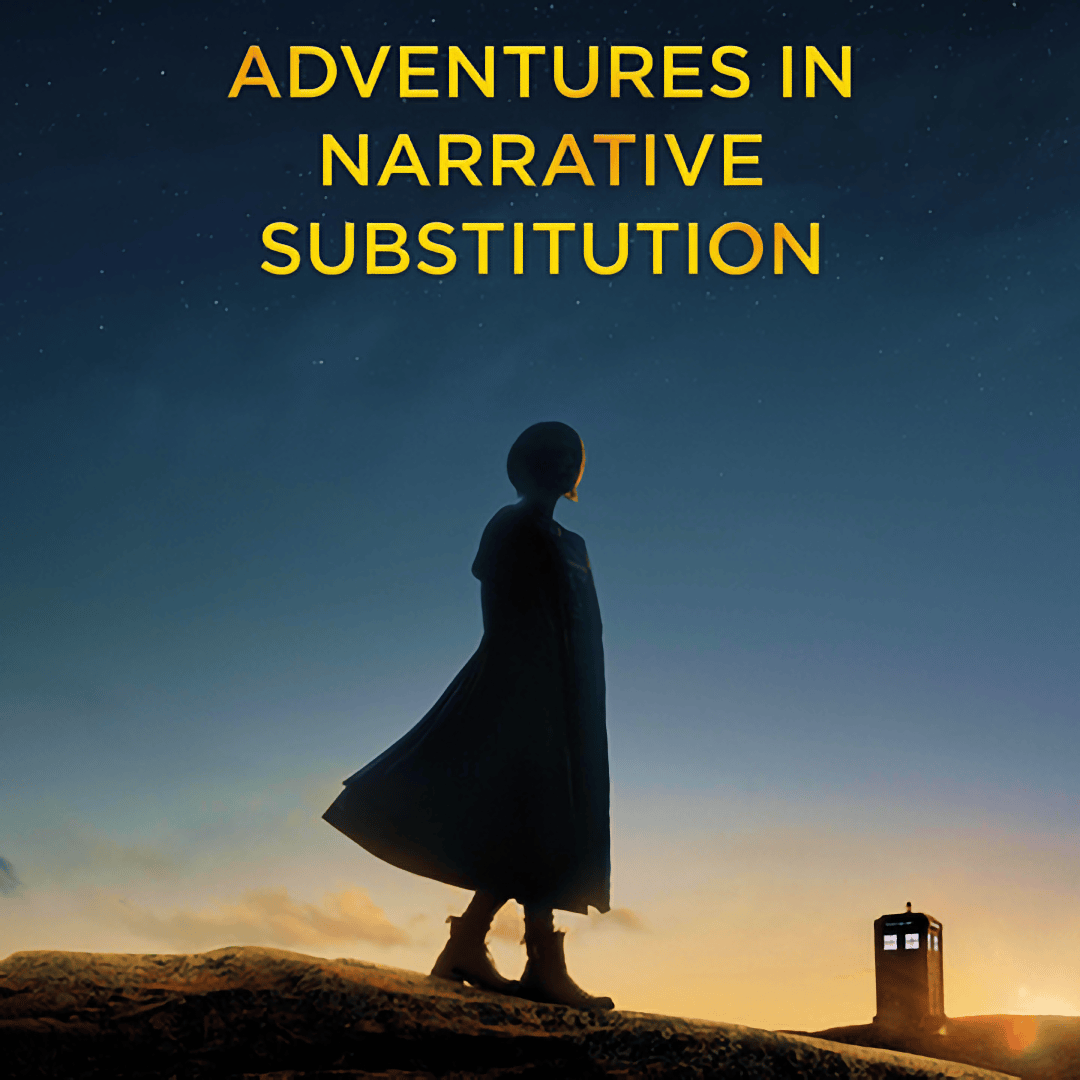
Ever since William Hartnell’s original Doctor first kidnapped a couple of schoolteachers from suburban London, companions have been essential to Doctor Who. Whether they’re humans like Sarah Jane, Ace, Amy, and Clara, or Time Lords like Missy and Romana, or lovers like River and Rose Tyler, they are the eyes through which we see the Doctor and the life they lead. Crucially, there’s a very small number of stories in which the Doctor doesn’t have a companion, and even then, they usually end up talking to someone. Sometimes even the viewer!
Which brings me to 2018 and the start of the Whittaker era. With that shift came a change in terminology: the other three leads were suddenly friends, not companions. This immediately implies a bit of distance: A companion is someone who spends large amounts of time in the TARDIS, perhaps even all their time, a friend is someone who largely has their own life separate from the Doctor, and into which the Doctor periodically intrudes. (See: the Ponds in series 7a, and Clara in series 7b and 8.)
This distance was immediately reflected in the show: Graham, Yaz, and Ryan don’t start out traveling with the Doctor willingly, they happen to be caught along for the ride at the end of The Woman Who Fell to Earth. They don’t officially become “companions” in the traditional sense until Arachnids in the UK, and even then, only at the very end of the episode, when each of them describe their reasons for coming along:
DOCTOR: Proper goodbye this time.
RYAN: About that.
GRAHAM: Do we have to? You see, Doc, the thing about grief is it needs time. I don’t want to sit around my house waiting for it to go away, cos that house is full of Grace and it makes it so much harder. But, er, being with you and seeing all these things out there, it really helps.
DOCTOR: What about you?
RYAN: Do you really think I want to go back to working in that warehouse? No way.
DOCTOR: Yaz, you wanted to come home.
YASMIN: I know. I love my family, but they also drive me completely insane. I want more. More of the universe. More time with you. You’re like the best person I’ve ever met.
RYAN: You’re pretty awesome.GRAHAM: You’re all right, I suppose.
In any other season, an exchange like this wouldn’t be worth remarking on. Literally every companion of the revival has said something like this, or at the very least agreed to the Doctor’s offer to travel. But crucially, Davies and Moffat also put in the work to make adventuring with the Doctor sound like a pleasant alternative to life on Earth.
But watch the first three episodes of series 11 in order, and it becomes clear that the end of Arachnids in the UK, as written, makes virtually no sense. I can at least understand why Graham says he wants to keep traveling: he can’t bear living in that house alone without Grace, and fair enough. Grace’s death was a horrible and tragic accident, and I’m not going to begrudge him wanting to escape.
But aside from that, what moment in the preceding three episodes is supposed to convince any of them that traveling with the Doctor is fun? Grace gets killed off, delivering a terrible blow to Graham and Ryan, then they all end up marooned on an alien planet, and when they finally do get back to Earth, it’s 1950s Alabama and all-American anti-Black racism. Quite frankly, if I met the Doctor and these were the first things I saw, I’d take my chances with the spiders.
But anyway: Arachnids ends with the Fam agreeing to continue their travels, because that’s what characters like them are Supposed To Do. As I wrote last season in the Tsuranga post, Chibnall doesn’t so much write characters as he writes plot functions: he starts from what he needs to do in order to achieve a particular goal in the script, then designs a character around that. His first question isn’t about who they are, but what they are. They are objects, not people.
Treating your characters as objects to be moved around like chess pieces on a game board, however, is not exactly a good way of writing a character-driven show like Doctor Who has been since 2005. Yaz spent most of series 11 being a background character aside from occasional outbreaks of being the Asking Questions One, and even then she shared that role with Ryan and Graham. This season, it gets even weirder: the Fam spend large chunks of almost every episode apart from the Doctor, caught up in their own side plots while the Doctor does other things with temporary one-off companions. Even this episode, devoted to fleshing out the companions a bit more, starts off with the Doctor on her own. It makes you wonder why they’re there in the first place, aside from tradition.
A very long time ago, back when I was optimistic about the Chibnall era and not the cynical old greymuzzle I am now, I said that if Chibnall wanted to make the show popular again, he could look to Series 1 or 5 as a model: look at the Doctor through the eyes of the companions, and make it about them as much as the Doctor. Womanstarts off promising enough, and Ghost Monument could have leaned further into whether or not the Doctor was trustworthy, but aside from a couple of one-liners from Graham at the outset, everyone ends the episode on board with the Doctor and ready to travel anyway.
Which brings me to Amy’s Choice. It’s been a favorite of mine pretty much from the day it aired in 2010, in a season that already had lots of strong points. Like Can You Hear Me, it centers on dreams becoming nightmares with a dark, mysterious figure orchestrating all of it, plus a focus on the companions and what makes them tick, but unlike CYMH, the character work that happens here goes on to affect not just the rest of the season, but Amy’s entire arc in general.
Rewatching The Eleventh Hour recently to celebrate Matt Smith’s birthday, what struck me about it on this viewing was Amy’s attitude in the last scene, when the Doctor comes to take her traveling. She never actually says yes! She does agree to travel with him: you don’t go in the box if you’re planning on turning around and going back to bed to get married. But the words “Sure, I’ll come,” or something similar, never leave her mouth. Instead she probes him with questions, not giving the Doctor an inch, proving beyond a doubt that wide-eyed Amelia Pond has grown into the (somewhat) more cynical Amy.
So why does Amy go with him anyway? Because there’s a wedding dress back home that she’s going to wear the next morning, and she’s not ready. She admits as much to Mandy Tanner the very next episode, and in Amy’s Choice, all of this comes to a head, because all of a sudden her fiancé is there and worried she’s going to back out at the last second, all because she ran away with a strange man the night before their wedding.
On one level, the Dream Lord’s choice is false: they’re both dreams, and Amy would’ve been perfectly safe had she chosen the frozen TARDIS over Upper Leadworth. But the dreams are just a way to get to which of the two men in her life she wants to spend time with, and to that end, she makes two choices: her first is that she loves Rory and wants to marry him (committing suicide in the village andchecking on him first in the frozen TARDIS over the Doctor makes that pretty obvious) and the second is that she doesn’t actually have to give up her TARDIS life for British suburbia. She chooses both, and in The Big Bang, that’s exactly what she gets: her husband and her best friend/son-in-law, traveling in time and space with both until time, circumstances, and a Weeping Angel split them up.
Yaz? Her equivalent to the Leadworth/Frozen TARDIS dreams is flashing back to the time when she was younger and ran away from home, only to be rescued by a friendly police officer. This, we’re told, inspired her to become a police officer herself… which would be great if Yaz being a police officer came up in any other episode except for Woman. In Series 13 she introduces herself as a “former” cop for the Sheffield PD, which implies any number of things: she got fired for not showing up to work, or her new life as a time traveler helped her see that maybe being a cop isn’t so great after all. But we have no way of knowing which it is because she has, in three seasons, still entirely failed to have a personality. The cop story never comes up again after this, and I doubt it’ll come up in the three episodes between now and the 2022 regeneration episode either.
At the time, I assumed Can You Hear Me was a last-ditch effort by Chibnall to give Yaz some personality and backstory perhaps as an effort to keep Gill from leaving, as Tosin Cole and Bradley Walsh were both about to do. But for some inexplicable reason, she stayed on for Series 13. There was hope that without the other two members of the Fam there, she might get some proper development with just the Doctor there to adventure with… and then they hired John Bishop as the Obligatory Bradley Walsh Understudy, then spent most of Series 13 keeping Yaz away from the Doctor due to, I don’t know, Chibnall’s apparent allergic reaction to companions who last longer than one episode.
At the end of the 1984 story Warriors of the Deep, the Fifth Doctor looks sadly at all the devastation and death surrounding him, then solemnly declares, “There should have been another way.” This is, largely, what’s been running through my mind ever since I gave up on the series in November, with Village of the Angels. Time and again I’ve sat here, recounting each and every bad decision made during this era of the show, discussing the old days when a similar story had a similar plot but went in a different direction.
There should have been another way. Jodie Whittaker should be going down alongside David Tennant or Tom Baker as one of the great Doctors, goodness knows she was in the part long enough. And Mandip Gill? She should’ve had much better. In the right hands, Yasmin Khan could have no end of fascinating things to add to the world of the series, we could be talking about her like we do Sarah Jane or Rose.
But no. We got stuck with Lena Chibnall, a man who, time and again, fails to provide anything for anyone who isn’t the same gender as him, the same color as him, or the same anything as him. We’re at the point now where the BBC had to bring back Russell T Davies, a workaholic in the extreme who still managed to damn near kill himself making the show in the late ‘00s, because there was apparently no one else on Earth who wanted the job. Godspeed to him, because he’ll need it.
There really should have been another way.


Leave a Reply