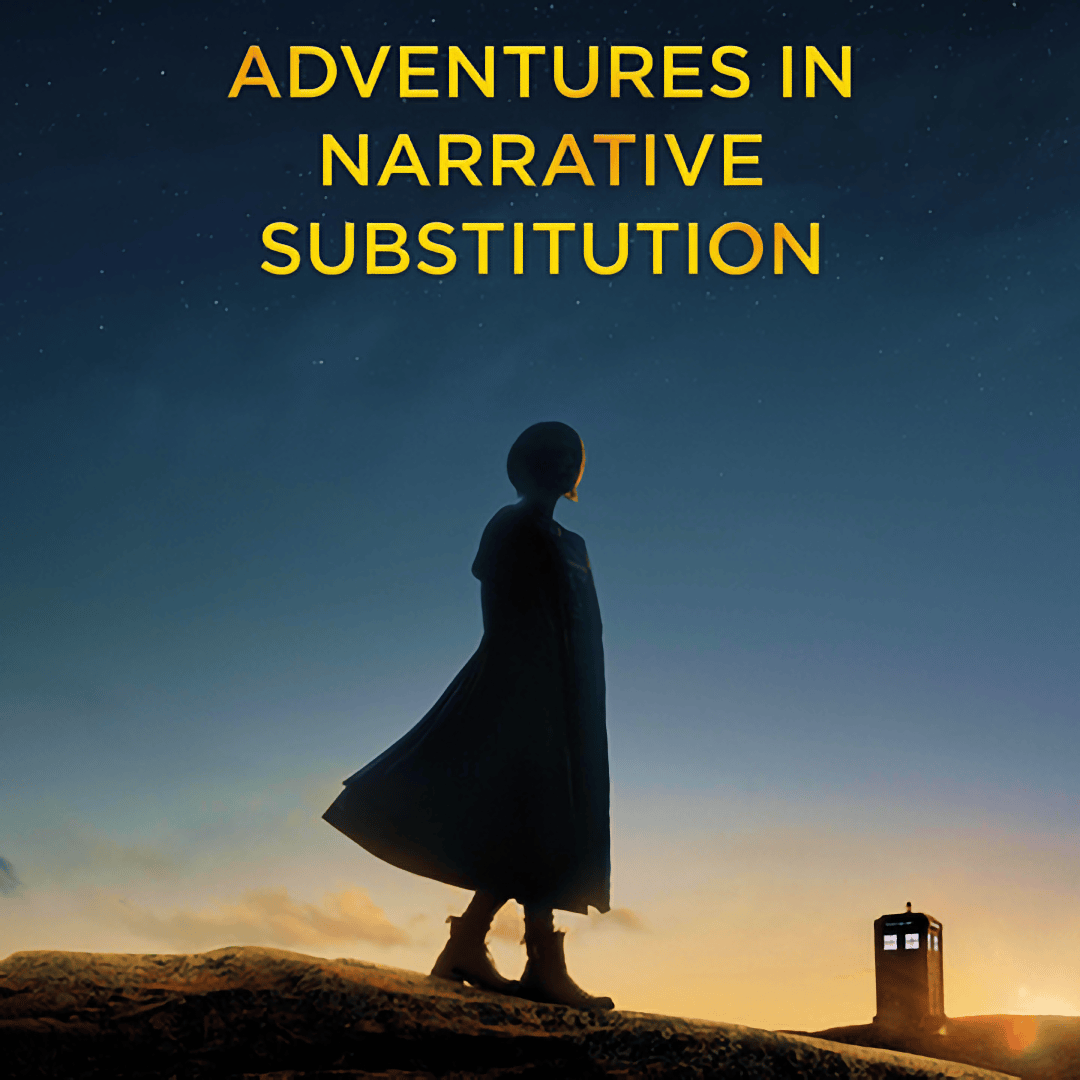
“The end of the universe. I always wondered what it would feel like,” says the Doctor, as onrushing universe-ending DOOM zips for the TARDIS doors. This is quite a choice of words, given that the Doctor has been present for the end of the universe in any number of stories, particularly our other subject for this week, the magnificent finale of Series 5, The Pandorica Opens/The Big Bang.
In The Halloween Apocalypse, the Flux is described and shown to be utterly destructive, turning magnificent views of outer space into blank voids of nothingness. Earth is only saved because of the shield around the planet put up by the Lupari, a race of canine aliens said to be “species-bonded” to humanity, a biological oath to protect their shaved ape charges.
The first two episodes of Series 13, in a way, map quite well on to Pandorica/Bang: the end of the universe isn’t just threatened, it’s allowed to occur, with Earth as the sole sanctuary. In part 2, we find that history itself has changed: War of the Sontarans reveals Russia is instead referred to as Sontar and become the home base for Robert Holmes’ angry potato-heads, while in The Big Bang, Richard Dawkins is said to belong to a “star cult,” and a museum documentary tells the story of the Lone Centurion, a Roman soldier who guarded the Pandorica through history, all the way up to the London blitz. But that’s where the similarities end.
In Once, Upon Time and later episodes, the Flux gets defanged: instead of creating empty no-places, it simply turns planets it hits into debris-strewn desolated landscapes, leaving a surprising number of living creatures alive. Daleks, Cybermen, and Sontarans are all described as taking over various sectors of the ruined universe, while Bel, Vinder’s love interest, wanders through the ruins searching for him.
And at the end of the season, the Doctor doesn’t actually prevent the Flux like she rebooted the universe as Matt Smith. She doesn’t do anything, The Vanquishers ends with a death toll that puts the Saward Dalek stories to shame. The Flux itself might be wrapped up, but the devastation it caused? Entirely ignored.
The end of the Flux illustrates the odd paradox of the Chibnall era: lots of things Happen to the various characters we meet, but absolutely no attempt whatsoever is made to illustrate how those various pieces of Plot Development affect the characters in question. Poor Karvanista, Dan Lewis’ Lupari guardian, gets rendered as the Last of His Kind when his entire species is murdered offscreen, and all he gets is a mournful “awoo.” (JUSTICE FOR THE DOGS!)
All of this was handled far, far better in Series 5. The total event collapse that occurs at the end of The Pandorica Openswas the result of an alliance of the Doctor’s enemies all deciding to lock him up in a box to “save” the universe, believing that because only the Doctor can pilot the TARDIS, locking him up will stop the explosion from occurring. It happens anyway, and the final shot of the story is the Earth floating in a blank void as silence falls. (Even the incidental music abruptly cuts off!)
The Big Bang simplifies the story after the continuity fest of part 1, focusing entirely on Amy, Rory, River, and the Doctor as they run around a museum, trying to figure out a way to prevent the TEC from happening. The Doctor eventually hits on the idea of flying the Pandorica into the heart of the exploding TARDIS, sacrificing himself in the process. In Series 13, the equivalent moment of heroism is given instead to Professor Jericho, because god forbid the Doctor be allowed to save the day for once.
Anchoring this two-parter, as always, are the characters. Rory returns as a Auton duplicate of himself and accidentally kills Amy, much to his immeasurable sadness, and so he atones for that by guarding the Pandorica for a couple thousand years, giving Amy enough time to be revived. Amy meanwhile is heartbroken at the loss of her imaginary friend, and remembers him back into existence at her wedding reception, deliberately invoking the old “something old, something new, something borrowed, something blue” rhyme so as to refer to the TARDIS.
And the Doctor himself? He doesn’t want to go, but accepts that he must: “I thought if you could hear me, I could hang on somehow. Silly me. Silly old Doctor. When you wake up, you’ll have a mum and dad, and you won’t even remember me. Well, you’ll remember me a little. I’ll be a story in your head. But that’s okay. We’re all stories in the end. Just make it a good one, eh? Because it was, you know. It was the best.”
Chibnall can’t. For all that the Thirteenth Doctor was promoted as a “Doctor of hope” in the lead-up to Series 11, her entire run has found her impotent in the face of catastrophe in nearly every case, and when she does get to be active, her solutions to the problem of the episode are utterly rancid, as we saw in Spyfall and Revolution. The subtext of this era appears to be “The world sucks, and even powerful figures like the Doctor can’t do anything to stop it.”
Which quite frankly is an appalling message to send in a series that is primarily, but not exclusively, marketed to children. Even A Series of Unfortunate Events, a book/TV series as gloomy as anything Chibnall’s ever written on the show, still finds time to point out that even in a world where it seems like the bad guys win and the good guys lose, there is always something the Baudelaires can do to make things better.
But Thirteen doesn’t even try. Other writers, mainly in the expanded universe, are able to wrench some traditional Doctorly heroism into the character, but never her creator. The Flux kills an unimaginably large number of people, and the Doctor does nothing to address it.
The end nears. I hope it comes swiftly.


Leave a Reply