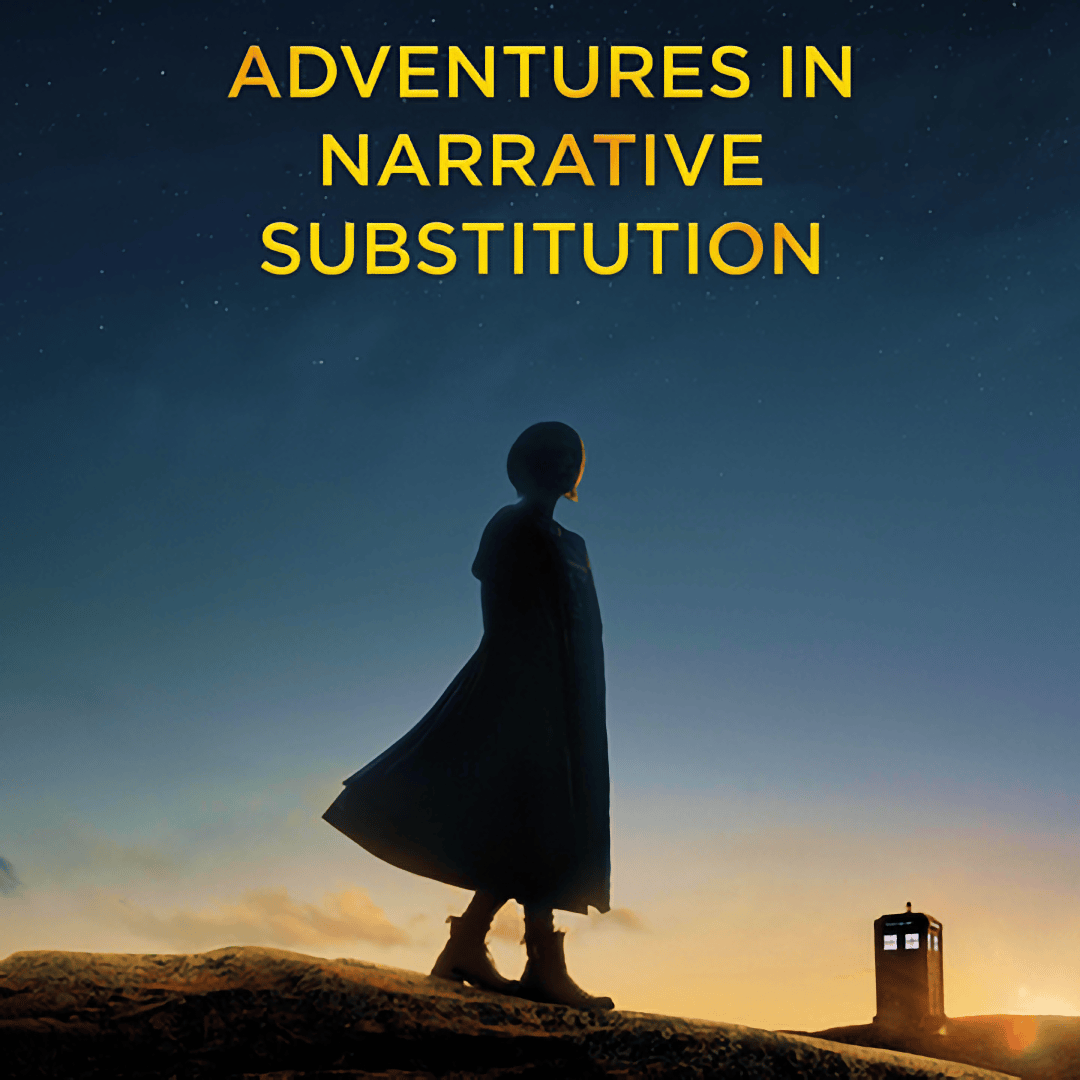
One of the things Chibnall decided was his job as showrunner of Doctor Who was to get the show to measure up alongside “prestige” Netflix dramas like Stranger Things or the various Kurtzman-era Star Treks. This led to changes in the show’s look, from a new aspect ratio (2:1, the same as the first season of Star Trek: Discovery) to anamorphic lenses in the cameras. Revolution of the Daleks even was the first episode of the series to be broadcast in 4K Ultra HD, a small but important jump forward since the show’s original move from standard definition to regular HD at the very end of the Davies years.
On the downside, the move to anamorphic cameras led to the arrival of modern color grading. Referred to by Kate Stebbins as the “intangible sludge,” it makes every scene look desaturated and filtered through browns or grays. It’s particularly noticeable for Series 11, just compare some of the marketing images to screenshots from an episode: far from being colorful, virtually everything in the Chibnall era is made dull and boring, either through color grading or location work and lighting choices on interior sets. He even instituted a “writer’s room,” (in line with American drama practices) or tried to, but it didn’t seem to work out very well.
There is plenty of merit to changing the show with the times in which it exists, of course. 1970 saw the switch from black and white to color, the late 1980s had the arrival of CGI, and there was the aforementioned HD switch in the early 2010s.
But all of that is just aesthetic, the problems come when Doctor Who tries to be like everything else on a story level: There’s a small but but crucial difference in doing, say, the Doctor Who version of a Marvel movie or a CW superhero crossover episode (The Stolen Earth/Journey’s End) and trying to make Doctor Who more like a Marvel movie: one of these things retains the show’s fundamental uniqueness, and the other one strips it away, making it look hopelessly generic and indistinguishable from every other Global IP not owned by Disney. (Yet.)
Series 13 (or Flux, as it’s officially known, but I refuse to call it that because I think it sucks) has Chibnall reach the apex of his prestige-ifying of the show. (Or, more accurately, he’s reached China in the hole he’s dug for himself.) He is now attempting to do Doctor Who via the Marvel Cinematic Universe, even ripping off the cliffhanger ending of the penultimate Avengers movie.
Our counterpoint this time is the one and only last try the show had at something like this: the sixteenth season of the classic era, more popularly referred to as the Key to Time season. Like series 13, it’s six parts and shows the Doctor on a quest for a hugely important MacGuffin, but unlike Series 13, it’s actually good… for the most part. (And yes, this means we’re doing Pirate Planet again. I promise I won’t rant about capitalism… this time.)
***
The Halloween Apocalypse isn’t really much of an episode, it relies very heavily on the idea-heavy “always have something to cut to” method of storytelling that really only works if you’re prepared to fire the gun you’ve left on the mantelpiece in act three. The story is, “A man from Liverpool is kidnapped by a dog, the Doctor and Yaz rescue him, the world ends. Again.” There’s not much there, but it’s hard to notice in the first viewing because of how much other stuff is going on. But there are still problems.
For starters, series 13 is transparently Doctor Who trying to be Marvel. The issue is, the show has never, ever done well when it has tried to change the kinds of stories it tells to be more like broader pop culture. That was true in 1978 with Star Wars, and it was true in the 1980s with Star Trek, and it is true now of Marvel movies.
Part of this is simply budget related: being funded by the British public through the license fee, the BBC has to keep within an increasingly limited pool of money. They can do period dramas and celebrity dance competitions easily, but something like Doctor Who, with its heavy effects budget, a constantly changing guest cast, expensive location filming, and so much more, puts that much more strain on cash flow.
By contrast, Star Trek: Discovery looks the way it does because it’s backed by corporate cash from ViacomCBS as much as Paramount Plus advertising and subscription dollars. It doesn’t quite have infinite money, but it definitely looks and feels more expensive than even the best-looking episode of Doctor Who. The only way our show can compete with Trek is if it got made by, say, a lupine-themed production company with ties to HBO. And what are the chances of that?
What Doctor Who is good at doing is being about people talking in rooms. The Day of the Doctor has occasional moments of visual grandeur, but the emotional core in that story is Clara in the barn with the Doctors trying to save their souls. The best parts of The Doctor’s Wife are Sexy and her thief talking to each other for the first time. The best parts of Hell Bent are the Doctor’s final conversations with Clara, on Gallifrey and in the diner TARDIS.
Robert Holmes understood this too. Writing in 1978, he knew that Doctor Who was never going to be able to compete with Star Wars at pretty much every level: one is a splashy American blockbuster movie and the other one is a ropey BBC science fiction series made with silly string, cardboard, and about twelve quid scavenged from the couch cushions. So Holmes doesn’t try to make it compete. Instead, he does something different.
The story opens with the White Guardian sending the Doctor on a quest against his will to find the Key to Time, an unimaginably powerful cube-shaped MacGuffin that is about to fall into The Wrong Hands. The Doctor’s task is to retrieve the key’s six segments and returned to the White Guardian before “the Universe is plunged into eternal chaos.” (Isn’t that basically The Return of Harmony?) It sounds like an epic quest, but Doctor Who can’t really do those, so Holmes distills the whole idea down to two conmen on Planet Space Russia fighting each other, then has the Doctor con the conmen and make off with the jethrik, actually the first segment of the key.
The Doctor’s quest to find the key is framed in the story as the forces of order being victorious against the forces of chaos. But chaos is neither good nor bad: it can be used for both ends, but generally it’s neutral. The Doctor has been an agent of chaos since the Troughton years, and more often than not will default to that mode when problem-solving.
But by the time we get to the Chibnall era and series 13, the order of things has been switched around. The series’ subtitle, and the titular entity, is “Flux.” Flux is another word for change. The Doctor spends the last few minutes of The Halloween Apocalypse trying and failing to prevent the Flux from attacking her TARDIS: she tries and fails to fight change. Later in the season, Swarm and Azure are framed as agents of change, using the Flux to bring death and decay to the universe. The Doctor says, “There is a balance to the universe, it exists that way for a reason,” cementing her as an agent of order and stasis. In trying to stop the Flux, she’s fighting against the idea of change itself.
Last week we talked about the Pertwee era and its inherent conservatism, turning the Doctor into a part of the British state. The Chibnall era echoes that conservatism, because what does conservatism mean, at the end of the day, than the preservation of the status quo above all else?
Read as much TARDIS Eruditorum as I have, and you can start to see that the show reflects the times in which it was made: psychedelia and the rise of the hippies fueled the Troughton era, and both came to a spectacular end as, with the rise of Richard Nixon in the US and the Pertwee era on Doctor Who, conservatism won. In the late 70s the show struggled to define itself amidst the arrival of Margaret Thatcher in 1979, and Ronald Reagan in 1980. In 2018 you had Jodie Whittaker’s debut amidst the tumult of the first Trump administration, and in 2021, the show is again fighting to survive in a world dominated by COVID-19 and ever-dwindling viewership numbers as more and more people migrate to streaming services.
Life really does depend on change and renewal, as the Second Doctor once said. You can either adapt, as the show tried and ultimately failed to do in the 1980s until it was far too late, or you can die. When the show last grappled with this idea, back in 2009, the Tenth Doctor did everything possible to keep the status quo alive, he didn’t want to go, all the way to the bitter end.
But he did go. He became the Eleventh Doctor, my raggedy madman with a box. The Chibnall era is facing the same choice, a decade on.
Ironically, the face of change looks a lot like the face of the old status quo.


Leave a Reply